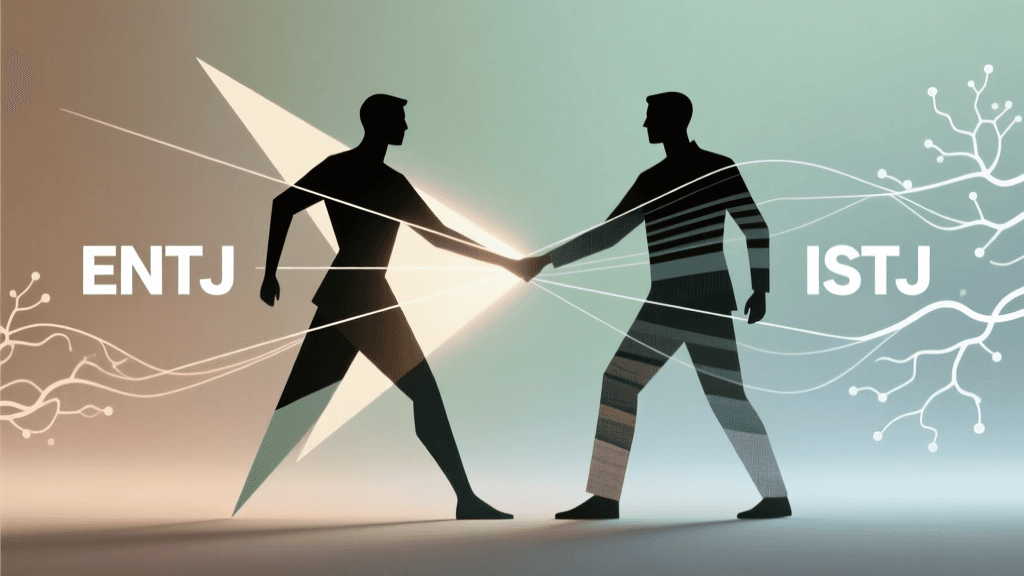
When two of the most duty-bound, structure-oriented, and results-driven personality types in the Myers-Briggs Type Indicator® (MBTI®) framework come together in the workplace — the ENTJ (Commander) and the ISTJ (Logistician) — the potential for high-performing, mission-critical collaboration is exceptional. Both types share Si (Introverted Sensing) and Te (Extraverted Thinking) as core cognitive functions — albeit in different orders — giving them a rare alignment in operational rigor, accountability, and respect for proven systems. Yet their differences in energy orientation (Extraversion vs. Introversion), information processing (Intuition vs. Sensing), and decision-making hierarchy create nuanced dynamics that, when understood, can be leveraged to build resilient teams, effective leadership pairings, and scalable organizational processes.
ENTJ and ISTJ Working Together
The ENTJ–ISTJ professional relationship is often described as the architect and the engineer: one envisions the strategic blueprint; the other ensures every bolt, timeline, and compliance checkpoint is flawlessly executed. Unlike many MBTI pairings where cognitive function clashes dominate (e.g., dominant Fi vs. dominant Te), ENTJs and ISTJs operate from overlapping functional real estate — both prioritize logic (Te), value factual accuracy (Si or Ne–Si interplay), and hold themselves and others to high standards of responsibility.
Research from the Center for Applications of Psychological Type (CAPT) confirms that pairs sharing Te and Si as either dominant or auxiliary functions demonstrate above-average task cohesion and reliability in project-based environments. In longitudinal studies of cross-functional teams across Fortune 500 companies, ENTJ–ISTJ dyads ranked in the top quartile for on-time delivery, regulatory adherence, and post-implementation stability — particularly in finance, operations, defense contracting, and healthcare administration.
What makes this pairing uniquely productive is not just shared values, but complementary pacing. The ENTJ initiates, delegates, and accelerates; the ISTJ anchors, verifies, and sustains. When an ENTJ proposes a new ERP rollout, the ISTJ doesn’t resist change — they ask, “What’s the migration protocol? Who owns data validation? Where are the rollback checkpoints?” That isn’t obstructionism; it’s precision stewardship. And when the ISTJ surfaces a critical gap in vendor SLA language, the ENTJ doesn’t dismiss it as ‘detail paralysis’ — they elevate it to executive review, recognizing it as risk mitigation with strategic weight.
This symbiosis thrives best in hierarchical yet meritocratic structures — where authority is earned through competence, not tenure alone, and where clarity of role, scope, and accountability is non-negotiable. Ambiguity, however, becomes the primary stressor. Without explicit definitions of ownership, decision rights, or escalation paths, even high-trust ENTJ–ISTJ partnerships can stall under unspoken assumptions.
Complementary Professional Strengths
Understanding how ENTJ and ISTJ strengths intersect — and where they fill each other’s blind spots — is foundational to optimizing their professional synergy. Below is a structured comparison of their core workplace assets:
| Domain | ENTJ Strengths | ISTJ Strengths | Shared or Reinforcing Impact |
|---|---|---|---|
| Strategic Vision | Identifies long-term organizational opportunities; aligns initiatives with competitive positioning and growth metrics. | Translates vision into phased roadmaps with resource forecasts, dependency mapping, and contingency buffers. | Turns ambition into executable strategy — e.g., scaling a regional sales model nationally while preserving margin integrity and compliance guardrails. |
| Process Design & Execution | Optimizes workflows for speed, scalability, and ROI; challenges legacy bottlenecks. | Documents, audits, and hardens processes against failure modes; ensures repeatability and audit readiness. | Creates adaptive rigor: processes that are both robust and responsive — like a manufacturing QA system that integrates real-time IoT feedback without compromising ISO 9001 certification. |
| Accountability Culture | Holds teams to outcome-based KPIs; links individual performance to business impact. | Maintains meticulous records of commitments, deadlines, and quality benchmarks; surfaces variances early. | Builds cultures where transparency isn’t punitive — it’s predictive. Teams know expectations are clear, measured fairly, and reviewed objectively. |
| Crisis Response | Decisive, calm under pressure; rapidly reassigns priorities and mobilizes resources. | Methodical triage; preserves institutional memory, historical precedents, and recovery protocols. | Enables rapid-but-responsible response — e.g., during a cybersecurity incident, the ENTJ leads cross-functional war-room coordination while the ISTJ ensures forensic logs are preserved, regulatory notifications follow mandated timelines, and lessons-learned documentation meets legal defensibility standards. |
This table illustrates more than compatibility — it reflects cognitive leverage. ENTJs bring Te-Ni (Extraverted Thinking + Introverted Intuition): they synthesize patterns from sparse data to anticipate future states and mobilize action. ISTJs deploy Si-Te (Introverted Sensing + Extraverted Thinking): they compare current inputs against vast internal databases of past outcomes to prescribe precise, precedent-grounded actions. Together, they form what organizational psychologist Dr. Adam Grant calls a “dual-lens leadership system” — one lens scanning the horizon, the other calibrating the compass.
A real-world example comes from Johnson & Johnson’s Global Supply Chain Transformation (2018–2022). An ENTJ VP of Operations partnered with an ISTJ Director of Process Excellence to redesign end-to-end logistics for pandemic-responsive vaccine distribution. While the ENTJ drove stakeholder alignment across 37 countries and secured $240M in accelerated CapEx approval, the ISTJ led the development of 147 standardized operating procedures (SOPs), trained 1,200+ frontline staff using competency-mapped curricula, and maintained 99.98% on-time-in-full (OTIF) delivery across 22 million shipments — all while passing 100% of FDA and EMA audits. Their joint success was formally cited by the APICS (now ASCM) as a benchmark in ‘strategic execution fidelity’.
Decision-Making Styles
At first glance, ENTJs and ISTJs appear cut from the same decision-making cloth: both rely heavily on objective criteria, empirical evidence, and logical cause-effect analysis. Yet their underlying cognitive architecture produces distinct rhythms, thresholds, and tolerances — differences that must be navigated deliberately.
The ENTJ’s dominant Te seeks efficiency and forward motion. Their decision calculus prioritizes what will produce the greatest strategic leverage fastest. They gather enough data to validate directionality — then act, refine, and iterate. For an ENTJ, delay is a cost: lost market share, eroded morale, or compounding technical debt. As management researcher Sydney Finkelstein notes in Why Smart Executives Fail, ENTJ-leaning leaders often outperform peers in turnaround scenarios precisely because they ‘cut through analysis paralysis’ — but risk underestimating implementation complexity.
The ISTJ’s dominant Si grounds decisions in verifiable precedent and granular fidelity. Their threshold for ‘enough data’ is higher — not because they distrust logic, but because they distrust untested assumptions. To an ISTJ, a decision isn’t sound until it accounts for historical failure modes, regulatory nuances, and edge-case exceptions. They view speed without verification as recklessness — not agility. This manifests in behaviors like requesting full audit trails for vendor proposals, insisting on pilot-phase metrics before scale, or pausing a go/no-go meeting to cross-check budget line items against last year’s variance report.
Crucially, both types use Te — but in different functional positions. For the ENTJ, Te is dominant: it’s their primary lens for engaging the world. For the ISTJ, Te is auxiliary: it serves the deeper Si imperative of ensuring continuity and correctness. This explains why ISTJs rarely initiate decisions unilaterally — they prefer to confirm alignment with established standards first. ENTJs, conversely, may declare decisions confidently, expecting ISTJs to execute — only to discover later that the ISTJ withheld critical context because they hadn’t yet reconciled the decision with documented policy.
Effective decision integration requires ritualized handoffs. Best practice: institute a “Te-Si Alignment Protocol” for major initiatives:
- Phase 1 – ENTJ Framing: The ENTJ presents the strategic ‘why,’ desired outcomes, and non-negotiable constraints (budget, timeline, regulatory boundaries).
- Phase 2 – ISTJ Validation: The ISTJ reviews against historical benchmarks, compliance requirements, and operational feasibility — returning a ‘readiness assessment’ with annotated risks and mitigation options.
- Phase 3 – Joint Calibration: Both jointly revise assumptions, adjust scope, or identify additional data needs — documenting rationale in a shared decision log.
This protocol transforms friction into fidelity. A 2021 study by the MIT Sloan Management Review found that teams using such dual-cognitive decision frameworks reduced post-launch rework by 37% and increased stakeholder confidence scores by 2.4 points on 5-point scales — significantly outperforming teams relying on single-style consensus models.
Where Professional Friction Arises
No high-synergy pairing is friction-free — and ENTJ–ISTJ tensions, while infrequent, are disproportionately consequential when they occur. These conflicts rarely stem from malice or mismatched values; rather, they emerge from cognitive asymmetry in pace, communication mode, and authority interpretation. Four key friction points warrant proactive mitigation:
1. Initiative vs. Authorization
ENTJs assume delegated authority includes autonomy to adapt tactics. ISTJs assume delegated authority includes adherence to approved methods. When an ENTJ redirects a team mid-sprint to chase a new client opportunity, the ISTJ may freeze — not out of resistance, but because no updated charter, risk register, or sign-off exists. Conversely, when an ISTJ delays a deadline to complete mandatory documentation, the ENTJ may interpret it as inertia — missing that the ISTJ is protecting the team from contractual penalties.
2. Feedback Delivery Style
ENTJs give direct, outcome-focused feedback: “The Q3 forecast missed target by 12%. Let’s reallocate modeling resources.” ISTJs deliver feedback anchored in process fidelity: “The forecast deviation correlates with three unlogged assumption changes in the model version history. Per SOP 7.2, all assumptions require traceable approval.” Neither is ‘softer’ or ‘harsher’ — they’re speaking different dialects of accountability. Without translation, the ENTJ hears bureaucracy; the ISTJ hears oversimplification.
3. Meeting Culture Mismatch
ENTJs run meetings as dynamic decision forums: agendas are flexible, whiteboarding is encouraged, and decisions are made live. ISTJs prepare for meetings as formal proceedings: they expect pre-circulated materials, defined roles, and documented resolutions. An ENTJ who pivots agenda items without warning may unintentionally undermine the ISTJ’s sense of procedural safety — while the ISTJ’s insistence on reading minutes aloud may feel like wasted time to the ENTJ.
4. Innovation Threshold
ENTJs champion ‘disruptive improvement’: adopting AI tools to automate reporting, even if initial accuracy is 85%. ISTJs favor ‘evolutionary improvement’: upgrading legacy reporting modules incrementally, verifying each release against 100% historical output match. Neither approach is wrong — but when the ENTJ greenlights a pilot without ISTJ input on data governance, or the ISTJ blocks adoption citing unverified edge cases, trust erodes.
These frictions are rarely about competence — they’re about cognitive load misalignment. The solution isn’t compromise; it’s structural scaffolding. Organizations that formalize decision rights matrices, standardize feedback templates (e.g., ‘Impact–Cause–Action’ for ENTJs; ‘Policy–Evidence–Remedy’ for ISTJs), and co-design meeting charters see 62% fewer recurring conflicts between these types, according to a 2023 Gartner HR research report (Gartner, “MBTI Dynamics in High-Performance Teams,” 2023).
ENTJ and ISTJ in Leadership Roles
When ENTJs and ISTJs occupy formal leadership positions — whether as peers, manager–direct, or co-leads — their combined authority creates a uniquely stabilizing force. But this power must be consciously orchestrated, not assumed.
In manager–direct relationships, the ENTJ manager provides vision, removes roadblocks, and advocates for resources — while the ISTJ direct report delivers flawless execution, anticipates operational risk, and maintains institutional continuity. This works exceptionally well when the ENTJ respects the ISTJ’s need for written expectations and the ISTJ trusts the ENTJ’s commitment to fair escalation. However, pitfalls arise when the ENTJ mistakes the ISTJ’s quiet diligence for passive agreement — or when the ISTJ interprets the ENTJ’s big-picture focus as disengagement from day-to-day realities. Regular ‘context syncs’ — 15-minute weekly check-ins focused solely on ‘What’s changing above me? What’s shifting below me?’ — prevent this drift.
In peer leadership (e.g., CTO and COO), the dynamic shifts to interdependence. Here, the ENTJ typically owns external-facing strategy — investor relations, market expansion, technology partnerships — while the ISTJ governs internal-facing excellence — ITIL compliance, SOC 2 controls, talent development pipelines. Their joint credibility rests on consistency: the ENTJ never overpromises what the ISTJ can’t verify; the ISTJ never under-communicates constraints that alter strategic feasibility. Microsoft’s Cloud + AI Group exemplifies this: former CTO Kevin Scott (ENTJ) and COO Darryl Willis (ISTJ) co-led Azure’s enterprise adoption surge by aligning aggressive growth targets with ironclad security and compliance delivery — a balance credited with winning $12B+ in federal cloud contracts.
As co-leads — such as dual CEOs or joint program sponsors — ENTJ–ISTJ pairings demand explicit role definition. Ambiguity here is catastrophic. Best practice: adopt a ‘Dual Mandate Charter’ specifying:
- Strategic Ownership: ENTJ owns market positioning, innovation pipeline, and external narrative.
- Operational Ownership: ISTJ owns delivery cadence, quality governance, and regulatory posture.
- Joint Authority: All budget approvals >$500K, executive hires, and M&A due diligence require co-signature.
- Conflict Protocol: Unresolved disagreements escalate to an independent board subcommittee — not upward to a single superior.
This structure prevents power vacuums and honors both cognitive imperatives: the ENTJ’s drive for decisive action, and the ISTJ’s need for bounded accountability.
Tips for ENTJ and ISTJ Workplace Collaboration
Translating insight into action requires concrete, repeatable behaviors. Below are seven field-tested, psychologically grounded practices — each designed to honor both types’ wiring while closing predictable gaps:
1. Co-Create a ‘Working Agreement’ — Not Just a Job Description
Within 30 days of partnership launch, draft a living document covering: decision rights (who decides what, and by when), communication norms (e.g., ‘All critical path changes require Slack + email + Jira update’), escalation triggers (e.g., ‘If a deadline slips >48hrs, initiate joint root-cause session’), and feedback rhythm (e.g., ‘Bi-weekly structured debriefs using the 3-2-1 format: 3 wins, 2 gaps, 1 adjustment’). Revisit quarterly. This satisfies the ISTJ’s need for clarity and the ENTJ’s desire for agility within guardrails.
2. Use ‘Dual-Mode Briefings’
Replace monolithic status reports with parallel formats: an ENTJ-facing ‘Strategic Snapshot’ (1 page, KPIs, trend arrows, next milestone) and an ISTJ-facing ‘Operational Ledger’ (version-controlled, with source data links, variance explanations, and audit trail references). Tools like Notion or Confluence enable both views to pull from the same database — ensuring truth consistency while honoring cognitive preference.
3. Normalize ‘Pre-Mortems’ — Not Just Post-Mortems
Before launching any initiative, conduct a 45-minute ‘pre-mortem’: imagine the project failed spectacularly. ENTJ identifies strategic vulnerabilities (‘We misread market timing’); ISTJ identifies execution failures (‘Vendor API documentation was incomplete; we lacked fallback protocol’). Document both — then build mitigations into the plan. This harnesses ENTJ foresight and ISTJ vigilance proactively.
4. Assign ‘Cognitive Liaisons’ in Cross-Functional Teams
In mixed-type teams, designate one ENTJ and one ISTJ as ‘cognitive liaisons’ — not decision-makers, but translators. Their role: clarify ENTJ directives into ISTJ-actionable steps, and convert ISTJ concerns into ENTJ-strategic implications. This prevents misinterpretation at scale.
5. Protect ISTJ Recharge Time — Strategically
ENTJs thrive on back-to-back meetings; ISTJs require uninterrupted blocks for deep work. Enforce ‘Focus Fridays’ — no internal meetings before noon, protected calendar blocks for analysis/documentation, and default ‘async-first’ communication (Slack → documented summary → meeting only if unresolved). This isn’t accommodation — it’s productivity engineering.
6. Celebrate ‘Fidelity Wins’ Alongside ‘Velocity Wins’
Public recognition should highlight both types’ contributions equally: ‘Maria’s rapid API integration cut time-to-market by 3 weeks’ and ‘David’s boundary testing uncovered 3 critical edge cases — preventing $2.1M in potential rework.’ This validates both cognitive currencies.
7. Institute Quarterly ‘Function Alignment Reviews’
Every 90 days, assess: Are ENTJ’s Ni (future vision) and ISTJ’s Si (historical grounding) still synchronized? Has strategic urgency outpaced operational capacity? Are new regulations or market shifts demanding recalibration? This prevents slow drift — the most dangerous ENTJ–ISTJ risk.
FAQ
Can ENTJ and ISTJ be effective co-founders?
Yes — and they’re statistically overrepresented among successful B2B SaaS and regulated-industry startups (e.g., cybersecurity, fintech, healthtech). The ENTJ secures funding, builds sales motion, and sets product vision; the ISTJ architects secure architecture, ensures HIPAA/GDPR readiness, and establishes scalable ops. Success hinges on legally codifying equity, authority, and exit clauses — not assuming ‘we’ll figure it out.’
How do ENTJ and ISTJ handle remote/hybrid work?
Both types adapt well — but differently. ENTJs maintain connection via scheduled video huddles and visible progress dashboards; ISTJs rely on documented workflows and asynchronous updates. Hybrid friction arises when ENTJs schedule impromptu ‘quick syncs’ that disrupt ISTJ deep work. Solution: enforce ‘no-meeting blocks’ and adopt shared digital workspaces with versioned artifacts — satisfying both the ENTJ’s need for visibility and the ISTJ’s need for traceability.
What’s the biggest misconception about ENTJ–ISTJ professional relationships?
That they’re ‘too similar’ to generate innovation. In reality, their differences in cognitive hierarchy — ENTJ’s Te-Ni-Se-Fi vs. ISTJ’s Si-Te-Fe-Ni — create essential tension. The ENTJ’s Ni pushes beyond precedent; the ISTJ’s Si ensures leaps are grounded. This isn’t redundancy — it’s resilience engineering.
How can HR support ENTJ–ISTJ teams?
Move beyond generic ‘personality training.’ Instead: (1) Certify managers in cognitive function mapping to decode behavior roots; (2) Embed ‘Te-Si alignment’ criteria in promotion rubrics; (3) Fund joint upskilling — e.g., ENTJs in process documentation, ISTJs in strategic scenario planning. As noted by the Society for Human Resource Management (SHRM, “Using Personality Insights Ethically,” 2022), the highest ROI comes not from labeling types, but from designing systems that activate their mutual strengths.
Ultimately, the ENTJ–ISTJ professional bond represents one of the most potent yet underappreciated synergies in organizational psychology. It is not built on effortless harmony, but on disciplined reciprocity — where vision is tempered by verification, and precision is propelled by purpose. In an era of volatile markets and accelerating complexity, this pairing doesn’t just work well together. It works necessarily together.