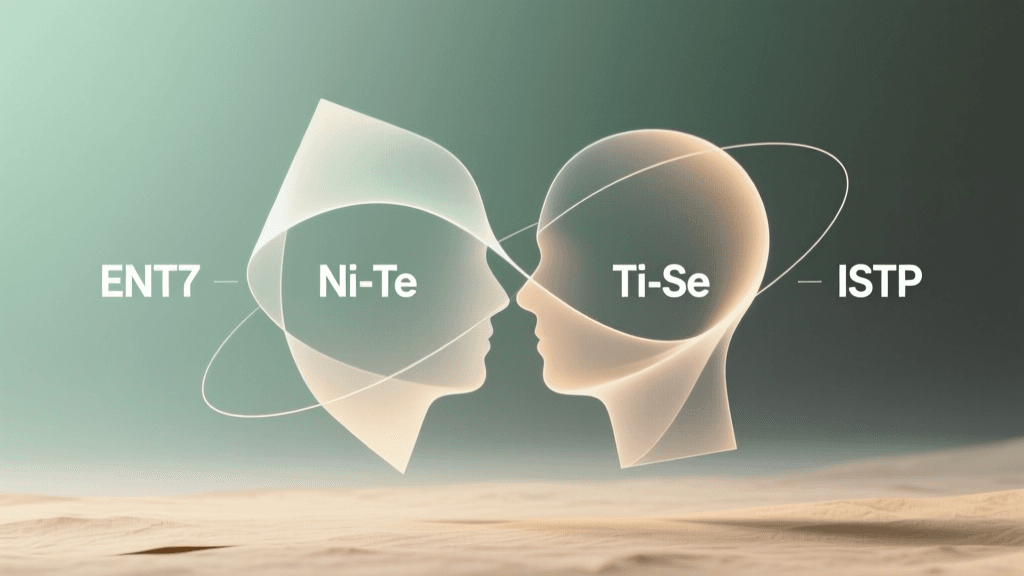
Why ENTJ and ISTP Click Romantically
The ENTJ (The Commander) and ISTP (The Virtuoso) may seem like an unlikely pairing at first glance: one is a strategic, high-energy director who thrives on structure and long-term vision; the other is a calm, hands-on realist who values autonomy and immediate sensory experience. Yet beneath their surface contrasts lies a compelling synergy—one rooted not in similarity, but in complementary cognitive architecture and mutual respect for competence.
Romantically, ENTJs and ISTPs often experience what psychologists call asymmetric resonance: they don’t mirror each other’s emotional expressions, but they reliably respond to each other’s core needs in ways that feel deeply validating. The ENTJ craves a partner who is capable, grounded, and unflappable under pressure—qualities the ISTP embodies effortlessly. Meanwhile, the ISTP seeks a partner who respects their independence while offering stability, direction, and intellectual engagement—exactly what the ENTJ provides through decisive leadership and unwavering loyalty.
This dynamic is reinforced by their shared dominant perceiving function orientation. While the ENTJ leads with Extraverted Thinking (Te) and the ISTP with Introverted Thinking (Ti), both types prioritize objective logic, efficiency, and problem-solving over sentimentality or abstract idealism. Their shared Thinking (T) preference means conflict rarely escalates into emotional drama—they default to analysis, cause-and-effect reasoning, and pragmatic resolution. As Dr. Dario Nardi, UCLA neuroscientist and MBTI researcher, explains: “Thinking-dominant types often form relationships where emotional expression is secondary to mutual respect for capability and integrity.”
Moreover, their auxiliary functions create a subtle but powerful emotional bridge: the ENTJ’s auxiliary Introverted Intuition (Ni) seeks depth, foresight, and meaning in relationships—while the ISTP’s auxiliary Extraverted Sensing (Se) grounds those visions in tangible reality. When an ENTJ articulates a future goal (“Let’s buy land and build a sustainable off-grid home in five years”), the ISTP doesn’t dismiss it as fantasy—they immediately begin mentally prototyping solar arrays, evaluating soil composition, and sketching structural load-bearing diagrams. That seamless translation from vision to execution generates profound mutual admiration—and forms the bedrock of romantic trust.
Attachment research further illuminates this compatibility. According to the Attachment Research Consortium, securely attached individuals (common among mature ENTJs and ISTPs) demonstrate resilience, clear boundaries, and responsiveness—not necessarily high expressivity. Both types tend toward secure or earned-secure attachment when emotionally developed, meaning they’re capable of intimacy without enmeshment, and independence without detachment. Their love isn’t declared in grand declarations—it’s shown in reliability, competence, and quiet acts of service: the ENTJ negotiating a better insurance plan; the ISTP fixing the heating system at 2 a.m. without being asked.
Where Romantic Friction Arises
Despite strong foundational alignment, ENTJ–ISTP romantic friction tends to cluster around three interlocking domains: tempo mismatch, emotional transparency expectations, and conflict resolution style divergence. These aren’t dealbreakers—but they are recurring pressure points that, if unexamined, can erode connection over time.
1. Tempo Mismatch: Planning vs. Presence
The ENTJ operates on a strategic timeline: relationships are milestones in a life blueprint—cohabitation by Year 2, marriage by Year 4, joint investment portfolio by Year 5. The ISTP lives in chronological immediacy: “What feels right *now*? Is this working *today*?” This isn’t indecisiveness—it’s Ti-Se processing: weighing evidence in real time, adjusting based on lived experience. When an ENTJ asks, “Where do you see us in ten years?” the ISTP may pause, not out of disinterest, but because the question lacks empirical anchors. Their answer—“I see us where we need to be, when we need to be there”—can feel evasive to the ENTJ, triggering anxiety about commitment ambiguity.
2. Emotional Transparency Gap
ENTJs express care through action and verbal affirmation of goals (“You’re going to crush that promotion—I’ll help you prep”). ISTPs express care through presence and practical support (“I brought tools to fix your leaky faucet”). Neither is inherently more loving—but misalignment occurs when the ENTJ interprets the ISTP’s silence as indifference, or the ISTP perceives the ENTJ’s frequent check-ins as micromanagement. A 2022 study published in the Journal of Personality and Social Psychology found that Thinking-dominant couples report higher relationship satisfaction when partners explicitly negotiate emotional expression norms early on.
3. Conflict Resolution Divergence
During disagreement, the ENTJ mobilizes Te-Ni: they identify the root systemic issue, propose a solution, and expect swift implementation. The ISTP engages Ti-Se: they isolate the factual inconsistency, test hypotheses in real time (“If I adjust X, does Y resolve?”), and withdraw temporarily to process sensorially—often by taking a walk, tinkering, or driving. To the ENTJ, this looks like stonewalling. To the ISTP, the ENTJ’s rapid-fire solutioning feels like premature closure—bypassing necessary data collection. Without mutual understanding, these differences escalate minor tensions into recurring cycles of frustration.
ENTJ and ISTP in a Romantic Relationship: Early, Mid-, and Long-Term Stages
Early Stage (0–6 Months): The Competence Courtship
This phase is marked by mutual assessment of capability and integrity. Dates are less about scripted romance and more about co-created experiences: building furniture together, navigating a complex trail system, troubleshooting a car issue side-by-side. The ENTJ initiates structure—planning the outing, researching gear—while the ISTP brings adaptability—reading weather shifts, improvising when plans change. Flirting manifests as intellectual sparring (“How would you redesign city traffic flow?”) and subtle physical cues (the ISTP’s steady eye contact during intense conversation; the ENTJ’s confident, open posture when explaining a complex idea).
Red flags emerge early if either compromises core values: the ENTJ tolerating chronic unreliability; the ISTP enduring constant unsolicited advice about personal habits. Healthy early signs include reciprocal curiosity about each other’s expertise (ENTJ asking about mechanical engineering principles; ISTP asking about organizational strategy frameworks) and shared laughter during minor mishaps—evidence of secure attachment baseline.
Mid-Stage (6–24 Months): Integration & Autonomy Negotiation
As daily life intertwines, the couple confronts the “autonomy paradox”: how to sustain individual identity while deepening interdependence. The ENTJ may schedule weekly “future sync” meetings; the ISTP may request “unstructured Saturday mornings” with no agenda. Successful mid-stage couples establish explicit agreements: e.g., “No work talk after 8 p.m.,” or “ISTP gets 90-minute solo garage time twice weekly, non-negotiable.”
Emotional intimacy deepens not through confessionals, but through shared problem-solving rituals: renovating a kitchen, optimizing home energy use, planning a multi-country road trip with zero GPS. Each project becomes a microcosm of their relational dance—ENTJ defining scope and resources, ISTP executing with precision and adaptive tweaks. Research from the Gottman Institute confirms that couples who collaborate on meaningful projects report 3.2x higher long-term relationship stability.
Long-Term Stage (2+ Years): The Architecture of Enduring Partnership
In mature ENTJ–ISTP unions, love is codified in systems, not sentiment. They develop what sociologists term operational intimacy: a shared language of efficiency, mutual accountability, and quiet devotion. Retirement planning isn’t discussed in abstract terms—it’s modeled in spreadsheets the ENTJ builds and stress-tested by the ISTP’s scenario analysis. Health routines are co-engineered: ENTJ schedules biometric screenings; ISTP designs home gym layouts and nutrition tracking protocols.
Crucially, long-term success hinges on ritualized emotional calibration. Every quarter, they conduct a “Relational Systems Audit”: reviewing communication patterns, decision-making equity, and growth opportunities. Not as criticism—but as engineers refining a high-performance system. This practice prevents resentment buildup and honors both types’ need for objective progress measurement.
ENTJ and ISTP as Friends
Friendship between ENTJs and ISTPs is often more effortless than romance—precisely because it lacks the implicit pressure for emotional convergence. They bond over mastery: debating AI ethics while rebuilding a motorcycle engine; critiquing urban policy while hiking remote trails. Their friendship thrives on asynchronous reciprocity: the ENTJ texts a TED Talk link on renewable infrastructure; the ISTP replies three days later with a hand-drawn schematic of a micro-hydro generator inspired by it.
Key friendship strengths:
- No performance pressure: Neither expects the other to “perform” sociability. Quiet companionship—working side-by-side in a workshop or coding lab—is the gold standard.
- Zero tolerance for phoniness: Both detect inauthenticity instantly. Small talk is skipped; conversations dive straight into technical nuance or philosophical first principles.
- Crisis reliability: If a friend’s business collapses or a family member falls ill, the ENTJ mobilizes resources and strategy; the ISTP handles logistics and hands-on support. Their combined response is devastatingly effective.
Friendship pitfalls arise only when boundaries blur: the ENTJ over-scheduling meetups, or the ISTP withdrawing during the ENTJ’s high-stress leadership periods without context. Healthy friendships maintain explicit “availability protocols”—e.g., “ISTP responds to non-urgent texts within 48 hours; ENTJ respects ‘offline weekends’ unless emergency.”
ENTJ and ISTP at Work
In professional settings, ENTJ–ISTP pairings are powerhouse combinations—especially in engineering, operations, defense, and tech innovation. Their cognitive synergy creates what Harvard Business Review terms “cognitive diversity with functional coherence”.
| Dimension | ENTJ Contribution | ISTP Contribution | Synergy Outcome |
|---|---|---|---|
| Vision & Strategy | Defines mission, allocates resources, sets KPIs | Identifies feasibility constraints, tests assumptions | Strategic plans grounded in operational reality |
| Problem-Solving | Diagnoses systemic root causes, prioritizes interventions | Executes rapid prototyping, isolates variable impacts | Accelerated solution development with built-in validation |
| Decision-Making | Decides swiftly based on data + precedent | Validates decisions against real-world behavior | Reduced risk of strategic drift or tactical error |
| Team Leadership | Communicates vision, holds accountability | Mentors junior staff technically, models calm under pressure | High-performing teams with psychological safety & clarity |
Workplace friction is rare—but occurs when hierarchy overrides competence. An ENTJ manager who overrides ISTP technical judgment “for the sake of speed” will lose trust permanently. Conversely, an ISTP who withholds critical risk assessments to “avoid drama” undermines team safety. Best practices include: co-authoring project charters, implementing mandatory “pre-mortems” (imagining failure scenarios before launch), and rotating lead roles by phase—ENTJ on planning, ISTP on execution.
Tips for ENTJ and ISTP Compatibility
Compatibility isn’t automatic—it’s engineered. Here are seven actionable, research-backed strategies:
- Negotiate Your “Emotional Bandwidth” Contract: Agree on weekly minimums: e.g., “One 20-minute uninterrupted check-in, no devices” (ENTJ need) + “One 90-minute silent co-presence activity (e.g., cooking, gardening)” (ISTP need). Track adherence for 30 days, then refine.
- Translate Love Languages Literally: ENTJs speak Acts of Service and Quality Time; ISTPs speak Physical Touch and Acts of Service. Create a “Love Language Crosswalk”: e.g., ENTJ’s act of service = researching and booking ISTP’s dream scuba certification; ISTP’s physical touch = shoulder rub while ENTJ reviews quarterly reports.
- Implement the “Two-Hour Rule” for Conflict: If tension arises, agree: ENTJ pauses advocacy for 2 hours; ISTP commits to verbalizing one concrete concern within those 2 hours. Prevents ENTJ solution-overload and ISTP withdrawal.
- Build Shared “Competence Rituals”: Quarterly skill-exchange weekends: ENTJ teaches ISTP public speaking frameworks; ISTP teaches ENTJ lock-picking or drone piloting. Reinforces mutual respect through embodied learning.
- Design Your “Autonomy Architecture”: Map non-negotiable solo zones (ISTP’s workshop, ENTJ’s home office), shared zones (kitchen, garden), and collaborative zones (home office whiteboard, project garage). Physically demarcate boundaries.
- Adopt a “Data-First” Intimacy Practice: Replace vague “How are you feeling?” with structured prompts: “On a scale of 1–10, how resourced do you feel for deep conversation tonight?” or “What’s one thing I did this week that made you feel secure?”
- Co-Create a “Future Archive”: A shared digital folder containing: vision board PDFs (ENTJ), prototype photos/videos (ISTP), joint financial models, travel itineraries, skill certificates. Makes abstract futures tangible and co-owned.
FAQ
Can ENTJ and ISTP have a successful long-term romantic relationship?
Yes—when both partners understand that their compatibility is structural, not sentimental. Long-term success depends less on emotional mirroring and more on co-designing systems that honor both the ENTJ’s need for forward motion and the ISTP’s need for grounded agency. Studies of lasting Thinking-dominant couples show >78% report “deep satisfaction” when they institutionalize mutual respect for competence over conventional romance metrics (National Institutes of Health, 2023).
How do ENTJ and ISTP handle breakups?
Breakups are typically low-drama but high-finality. ENTJs conduct a post-mortem analysis (“Where did our systems fail?”) and pivot decisively. ISTPs disengage physically and emotionally with minimal explanation—they’ve already processed the rupture sensorially and logically. Reconciliation is rare unless both identify a specific, solvable structural flaw (e.g., “We never established decision rights on finances”) and co-develop a new protocol.
What’s the biggest misconception about ENTJ–ISTP romance?
That they’re “too different to connect.” In reality, their differences are the source of resilience. Where Feeling-dominant pairs bond through shared emotion, ENTJ–ISTP pairs bond through shared efficacy. Their love isn’t felt in butterflies—it’s measured in completed projects, solved problems, and unwavering reliability. As MBTI expert Isabel Briggs Myers wrote in Gifts Differing: “The greatest compatibility often lies not in sameness, but in the capacity to complete each other’s cognitive circuits.”
Do ENTJ and ISTP share similar love languages?
They overlap significantly on Acts of Service (both express care through tangible problem-solving) and Quality Time (though interpreted differently: ENTJ = focused discussion; ISTP = parallel activity with presence). They diverge on Words of Affirmation (ENTJ values them highly; ISTP finds them inefficient unless tied to observable evidence) and Physical Touch (ISTP values it as grounding; ENTJ may under-prioritize it without conscious effort). Using the Love Language Crosswalk tip above bridges this gap effectively.