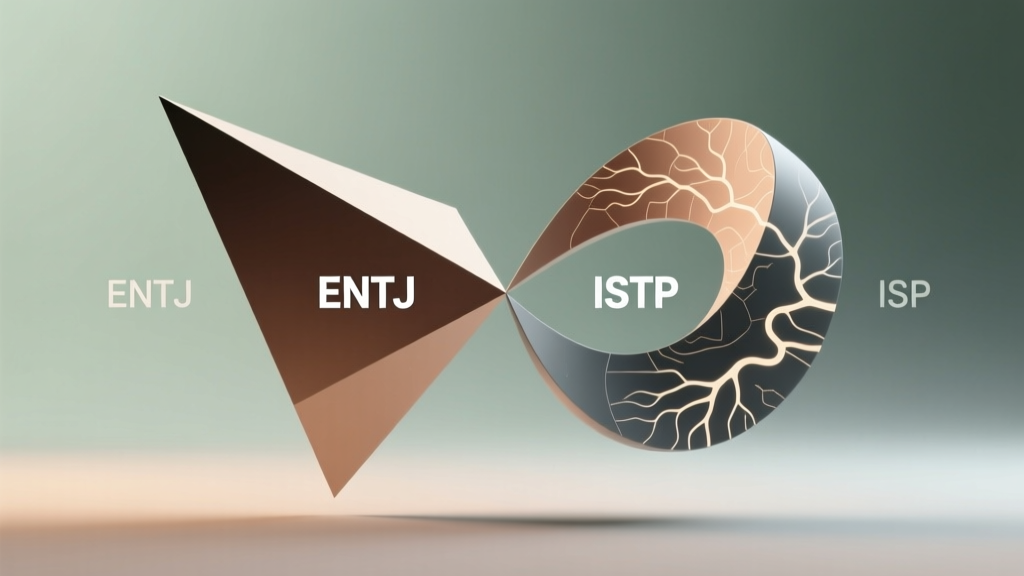
Core Values of ENTJ
The ENTJ (Extraverted, Intuitive, Thinking, Judging) personality type—often dubbed the Commander—is guided by a deeply structured internal value system rooted in competence, integrity, efficiency, and principled leadership. ENTJs do not merely pursue goals; they pursue meaningful impact through systems, institutions, and long-term vision. Their values are neither abstract nor passive—they are operationalized, measured, and socially accountable.
At the heart of the ENTJ value hierarchy lies autonomy through excellence. They believe that personal freedom is earned—not granted—and that true independence arises from mastery, reliability, and demonstrable results. This fuels their reverence for meritocracy: promotions should follow performance, policies should reflect evidence, and commitments must be honored with precision. As noted by the Myers & Briggs Foundation, ENTJs consistently rank integrity, responsibility, and logical consistency among their top three guiding principles—far ahead of comfort, consensus, or tradition for its own sake (Myers & Briggs Foundation).
ENTJs also hold a strong teleological orientation: life has purpose, and that purpose is to build, improve, and lead. They see themselves as stewards of progress—whether in business, education, public service, or family life. Their moral framework leans deontological (rule-based) but is tempered by consequentialism: rules matter because they produce just outcomes, and when they fail to do so, ENTJs will revise them decisively. This makes them reform-minded rather than reactionary—willing to dismantle legacy structures if they impede fairness, scalability, or human potential.
Spiritually, many ENTJs are secular humanists or pragmatic theists. They may respect religious traditions for their ethical teachings and community functions—but rarely accept doctrine without empirical coherence or social utility. A 2022 Pew Research Center study found that high-agency, high-structure personality profiles (like ENTJ) correlate strongly with values-driven secularism: belief in universal human rights, scientific literacy, and civic duty often supplants ritual observance (Pew Research Center, "Religion and Secularism in America," May 2022). For ENTJs, spirituality is less about transcendence and more about embodied responsibility—how one shows up, leads, and serves in tangible ways.
Core Values of ISTP
The ISTP (Introverted, Sensing, Thinking, Perceiving)—commonly called the Virtuoso or Craftsman—operates from a value system anchored in authenticity, autonomy, competence, and immediate experiential truth. Where the ENTJ looks outward to shape systems, the ISTP looks inward and downward—to the mechanics of reality, the feel of tools in hand, the physics of motion, the unvarnished data of lived experience. Their moral compass is calibrated not by abstract ideals, but by fidelity to observable cause-and-effect.
ISTPs prize personal sovereignty above almost all else. They resist external control, rigid schedules, or ideological conformity—not out of rebellion, but because such constraints interfere with their ability to respond authentically to real-time conditions. Their highest virtue is adaptability grounded in skill: the capacity to assess a situation, deploy precise knowledge or physical dexterity, and resolve it efficiently. As cognitive psychologist Dr. Dario Nardi explains in Neuroscience of Personality, ISTPs exhibit dominant Ti (Introverted Thinking) paired with auxiliary Se (Extraverted Sensing), making them uniquely attuned to “real-time logic applied to concrete phenomena”—a neurological signature of deep respect for empirical validity over inherited dogma (Dario Nardi, Neuroscience of Personality, 2010).
Morally, ISTPs adhere to a virtue ethics framework—emphasizing character, skillfulness, and situational integrity. They judge actions not by fixed rules, but by whether they reflect honesty, self-reliance, fairness in the moment, and minimal harm. An ISTP may break a bureaucratic rule to help someone in urgent need—not to defy authority, but because the rule fails the immediacy test. Their ethics are contextual, embodied, and quietly unwavering. They distrust grand narratives unless those narratives demonstrably improve functional outcomes—e.g., a safety protocol that reduces accidents, or a repair technique that extends equipment life.
Spiritually, ISTPs often identify as agnostic, naturalistic, or philosophically Taoist—valuing flow, balance, and non-interference. They may engage in martial arts, wilderness immersion, or mechanical restoration not as hobbies, but as contemplative practices: ways to cultivate presence, refine perception, and harmonize action with environment. A 2021 study published in the Journal of Individual Psychology found that sensing-perceiving types report significantly higher rates of “non-dogmatic awe” — wonder triggered by natural systems, engineering elegance, or skilled craftsmanship—rather than supernatural revelation (Journal of Individual Psychology, Vol. 77, Issue 3, 2021).
Where Values Align for ENTJ and ISTP
At first glance, the ENTJ’s strategic institution-building and the ISTP’s hands-on, anti-bureaucratic pragmatism seem diametrically opposed. Yet beneath surface contrasts lie profound, underappreciated synergies—particularly in the domain of shared values infrastructure. When both types operate from integrity and competence, alignment emerges not in method, but in moral substrate.
1. Uncompromising Respect for Competence
Both ENTJs and ISTPs hold skill, preparation, and demonstrated ability in the highest regard. Neither tolerates incompetence disguised as loyalty, seniority, or charisma. An ENTJ will promote the most capable team member—even if introverted or unconventional—while an ISTP will defer to (and deeply respect) the ENTJ’s strategic acumen, provided it’s backed by execution. This mutual calibration on merit creates a bedrock of trust no amount of charm or rhetoric can substitute.
2. Commitment to Autonomy—Expressed Differently
The ENTJ champions structural autonomy—the freedom to design systems that empower others. The ISTP champions operational autonomy—the freedom to act without procedural interference. Though their expressions differ, both reject coercion, micromanagement, and performative compliance. In partnership, this shared aversion becomes a powerful filter: they jointly streamline processes, eliminate redundant approvals, and protect decision-space for subject-matter experts—including each other.
3. Shared Disdain for Hypocrisy and Empty Ritual
Neither type suffers pretense gladly. ENTJs expose inconsistencies between stated values and organizational behavior; ISTPs spot gaps between theory and tactile reality. Together, they form a formidable truth-correction mechanism. A joint home renovation project, for example, might reveal the ENTJ optimizing timelines and vendor contracts while the ISTP verifies load-bearing calculations and material tolerances—both ensuring that “quality” isn’t just a marketing slogan, but a verifiable condition.
4. Alignment on Long-Term Stewardship
Though the ENTJ envisions legacy across generations and the ISTP focuses on durable artifacts (a well-maintained car, a restored heirloom, a resilient permaculture garden), both embody stewardship. The ENTJ asks, “How does this decision serve our future stakeholders?” The ISTP asks, “Will this hold up, function well, and retain integrity over time?” These questions converge in shared commitments: sustainable investing, ethical supply chains, heirloom gardening, or mentoring apprentices—not as symbolic gestures, but as operational imperatives.
The following table illustrates key value alignments and their practical manifestations:
| Value Dimension | ENTJ Expression | ISTP Expression | Shared Manifestation |
|---|---|---|---|
| Integrity | Honors commitments publicly; corrects institutional misalignments | Keeps private promises; fixes broken systems without fanfare | Joint accountability rituals: weekly review of personal/professional promises; co-designed “integrity audit” for shared projects |
| Competence | Invests in leadership development, certifications, strategic upskilling | Mastering tools, techniques, emergency response, mechanical fluency | Co-created learning pact: ENTJ studies ISTP’s craft (e.g., welding, coding, wilderness navigation); ISTP studies ENTJ’s domain (e.g., financial modeling, policy analysis, facilitation design) |
| Autonomy | Delegates authority with clear KPIs; resists top-down mandates | Works solo on critical tasks; negotiates scope before accepting oversight | “Zone of Genius” agreement: defined domains where each operates independently, with transparent handoff protocols and mutual veto rights on cross-domain decisions |
| Stewardship | Builds scalable, ethical organizations; mentors next-gen leaders | Restores vintage machinery; cultivates native plant ecosystems; teaches hands-on skills | Joint legacy project: e.g., founding a vocational scholarship fund for trades education; co-authoring a field manual on sustainable infrastructure repair |
Navigating Value Differences
Despite robust alignment, ENTJ–ISTP partnerships face three core value tensions—each resolvable with intentionality, structural scaffolding, and linguistic precision.
1. Vision vs. Viability
The ENTJ’s future-oriented, big-picture thinking (“We’ll launch a regional clean-energy cooperative by Q3”) can feel like speculative fantasy to the ISTP, who instinctively scans for implementation friction: permits, grid compatibility, battery thermal limits, installer certification gaps. Conversely, the ISTP’s focus on immediate constraints (“The transformer substation can’t handle phase-load variance”) may read to the ENTJ as resistance to ambition—or worse, lack of faith in collective capability.
Actionable Strategy: Institute the Two-Track Planning Protocol. All major initiatives begin with parallel tracks: Track A (ENTJ-led) defines purpose, stakeholder impact, and 3-year milestones. Track B (ISTP-led) maps physical dependencies, failure points, tooling requirements, and skill gaps. After 72 hours, tracks converge in a Reality Integration Session, where assumptions are stress-tested, timelines adjusted, and resources re-allocated—not to shrink vision, but to harden it. This transforms tension into co-creation.
2. Accountability Structures
ENTJs thrive on formal accountability: documented goals, scheduled reviews, transparent metrics. ISTPs experience such structures as administrative overhead—distracting from actual work. They prefer implicit accountability: “I said I’d fix the HVAC by Friday. It’s fixed.” Introducing shared dashboards or weekly stand-ups without negotiation risks resentment.
Actionable Strategy: Co-design Minimal Viable Accountability (MVA). Define exactly three shared metrics that matter to both (e.g., “zero safety incidents,” “project delivered within ±5% budget,” “all client feedback addressed within 48 hrs”). Use analog tools preferred by the ISTP (whiteboard, physical kanban board) unless digital tools demonstrably save time. Replace scheduled reviews with trigger-based check-ins: initiated only when a metric deviates >10%, or when either partner requests clarity. This honors the ISTP’s aversion to ritual while satisfying the ENTJ’s need for systemic assurance.
3. Conflict Resolution Style
ENTJs address disagreement head-on, verbally, with data and proposed solutions. ISTPs withdraw to process internally, often resolving conflict by fixing the underlying problem—not debating the premise. An ENTJ interpreting silence as disengagement may escalate; an ISTP interpreting direct confrontation as aggression may disengage further.
Actionable Strategy: Adopt the Written Pre-Mortem + Verbal Debrief framework. Before high-stakes discussions, both write independent 200-word reflections: “What’s at stake? What outcome would honor my core values? What’s the smallest step toward resolution?” They exchange texts—no replies required. Then, they meet for a 25-minute verbal debrief using a strict timer and a single shared notebook. The ENTJ opens with synthesis of written inputs; the ISTP responds with observations—not arguments. No solutions are decided in the debrief; only mutual understanding is the goal. Solutions emerge later, asynchronously.
Spiritual and Philosophical Compatibility
ENTJ–ISTP spiritual compatibility is unusually robust—not because they share theology, but because they share epistemological humility. Both types distrust claims unverifiable by evidence or experience. Yet their paths to that humility differ: the ENTJ arrives via systematic critique of ideology; the ISTP via relentless testing of materials, forces, and human behavior.
This common ground enables rich philosophical dialogue. They may jointly explore Stoic practice—not as ancient dogma, but as cognitive tools: the ENTJ applying Epictetus’ dichotomy of control to organizational change management; the ISTP using Marcus Aurelius’ emphasis on focused action to refine emergency response protocols. They might study Zen archery or Japanese swordsmanship not for mysticism, but for embodied philosophy—how posture, breath, and attention alter perception and outcome.
When spiritual divergence appears—e.g., ENTJ engages in interfaith coalition building while ISTP spends Sundays calibrating optics on a telescope—their shared values prevent friction. The ENTJ respects the ISTP’s silent communion with cosmic scale; the ISTP admires the ENTJ’s ethical labor in human-scale justice. Neither demands conversion. Instead, they co-create secular sacred space: a backyard workshop where tools are honored like ritual objects; a shared library curated with equal weight given to Sun Tzu’s Art of War and Richard Feynman’s Character of Physical Law; a quarterly “Unplugged Retreat” alternating between urban civic hackathons (ENTJ-preferred) and backcountry trail maintenance (ISTP-preferred).
Crucially, both types understand that meaning isn’t found in belief—but through disciplined action aligned with values. As philosopher Martha Nussbaum writes in Upheavals of Thought, “Ethical life is not a set of doctrines, but a cultivated responsiveness to the world’s complexity”—a definition both ENTJs and ISTPs embody daily, albeit in different registers (Martha Nussbaum, Upheavals of Thought, Cambridge University Press, 2001).
Building a Shared Life Vision
A shared life vision between ENTJ and ISTP isn’t a glossy mission statement—it’s a living, iterated operating system. It requires translating abstract values into tangible architecture. Here’s how to build it:
Phase 1: Values Cartography (Week 1)
Each partner independently maps their top 5 non-negotiable values using concrete examples: “Integrity means I will resign before falsifying safety reports” (ISTP) or “Excellence means every team member receives personalized growth plans by Q2” (ENTJ). They then identify overlaps—not as vague terms (“we both value honesty”), but as behavioral signatures (“we both interrupt meetings when data is misrepresented”).
Phase 2: Legacy Blueprinting (Week 2–3)
Together, draft a Legacy Letter to be opened in 20 years. Not about possessions, but about enduring impact: “We built X not for profit, but because it taught Y skill to Z people.” “We maintained this land not for aesthetics, but to model soil regeneration for neighboring farms.” Each sentence must pass the Verifiability Test: could an outsider observe evidence of this claim?
Phase 3: Architecture Design (Week 4)
Create three structural pillars:
- Decision Rights Charter: Which domains require joint consent (e.g., relocating children, major investments)? Which are unilateral (e.g., ENTJ selects board members; ISTP chooses home repair contractors)?
- Learning Covenant: Quarterly skill-exchange commitment (e.g., ENTJ teaches ISTP strategic forecasting; ISTP teaches ENTJ lock-picking as metaphor for systemic vulnerability analysis).
- Renewal Rhythm: Non-negotiable shared rituals: one unplanned adventure per quarter (ISTP-planned), one civic contribution per quarter (ENTJ-planned), one full day of silent co-presence annually (no devices, no agenda—just shared space).
This vision succeeds because it doesn’t ask either type to become the other. It asks them to build a third thing—a shared ecosystem—where ENTJ’s architecture enables ISTP’s agency, and ISTP’s grounding ensures ENTJ’s vision remains tethered to reality.
FAQ
Can ENTJ and ISTP have compatible spiritual beliefs?
Yes—compatibility hinges not on doctrinal agreement, but on mutual respect for each other’s epistemic integrity. An ENTJ who volunteers with refugee resettlement programs and an ISTP who restores historic church bells can share profound spiritual resonance through their parallel commitments to dignity, craft, and tangible care. Their shared reverence for functional truth—whether in policy design or metallurgical annealing—creates a deeper bond than theological uniformity ever could.
How do ENTJ and ISTP handle moral disagreements about social issues?
They default to evidence-first dialogue. Rather than debating abortion or AI ethics ideologically, they co-research: “What are the documented outcomes of policy X in Country Y?” “What failure modes have emerged in similar tech deployments?” Their shared Thinking preference means they argue positions, not identities—and their shared Judging/Perceiving tension actually helps: the ENTJ structures the research framework; the ISTP identifies overlooked variables. Disagreement becomes data refinement, not relationship rupture.
What’s the biggest values-related pitfall in ENTJ–ISTP relationships?
The “Efficiency Trap”: assuming shared values mean shared methods. An ENTJ may schedule a “values alignment workshop” with slides and SWOT analysis; the ISTP may respond with silence or withdrawal—not from disinterest, but from sensory overload and perceived abstraction. The fix is radical methodological pluralism: discuss values while hiking, repairing a bicycle, or cooking together. Let the activity hold the container; let values emerge organically through shared doing.
How can ENTJ and ISTP raise children with coherent moral frameworks?
They co-teach applied ethics. The ENTJ designs age-appropriate scenarios (“Your friend copied homework—what systems would prevent this?”); the ISTP builds physical models (“Let’s wire this circuit so it fails safely when overloaded”). Children learn morality not as commandments, but as design constraints: how choices affect systems, people, and materials. Weekly “Ethics Lab” sessions involve real household challenges—budgeting allowances, resolving sibling disputes, choosing eco-products—analyzed through both strategic and tactile lenses. This cultivates children who think like ENTJs and act like ISTPs: visionary yet grounded, principled yet adaptable.
In sum, the ENTJ–ISTP pairing is not about compromise—it’s about complementarity elevated to philosophy. Their shared reverence for competence, autonomy, and tangible impact forms a rare alloy: strong enough to bear institutional weight, flexible enough to adapt to changing terrain, and honest enough to never confuse motion with meaning. When values are the foundation—not just the furniture—the house they build together stands not despite their differences, but because of them.