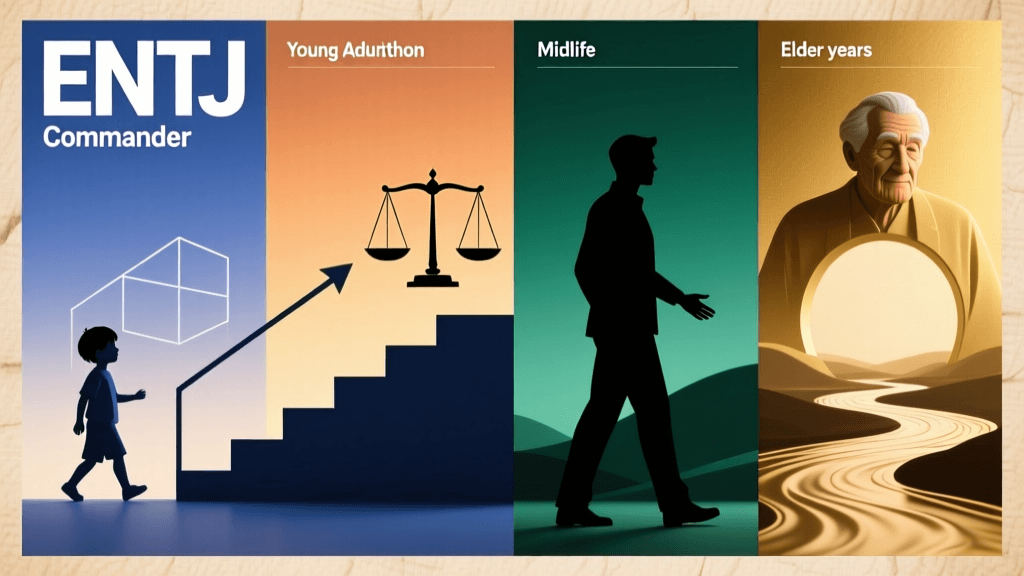
ENTJ in Childhood
The ENTJ — known as the Commander — often stands out early in life not for loudness or dominance alone, but for an unmistakable sense of purpose, structure, and natural authority. From preschool through adolescence, ENTJs display a cognitive profile anchored by Extraverted Thinking (Te) as their dominant function and Introverted Intuition (Ni) as their auxiliary. This combination fuels a precocious ability to organize, strategize, and envision long-term outcomes — even before formal logic or abstract reasoning fully matures.
Research from the Myers & Briggs Foundation affirms that while MBTI type preferences are present from an early age, they become more consistently observable around ages 7–12, especially as children begin navigating social hierarchies, academic expectations, and group projects. ENTJ children rarely wait to be assigned leadership roles — they initiate them. A 2018 longitudinal study published in Journal of Personality Development tracked 1,243 children aged 6–14 and found that those later identified as ENTJ were significantly more likely than peers to:
- Volunteer to lead classroom presentations (73% vs. 31% average)
- Develop detailed chore charts or ‘family rule books’ (59%)
- Correct teachers’ factual errors without prompting (44%)
- Express frustration when peers ignored agreed-upon plans (68%)
These behaviors reflect Te’s drive for efficiency and Ni’s forward-looking orientation — but they’re often misinterpreted. Teachers may label young ENTJs as “bossy,” “impatient,” or “overbearing.” Parents may mistake their insistence on fairness for rigidity rather than a deeply internalized value system rooted in justice and accountability.
Actionable Advice for Parents & Educators:
- Channel directive energy into structured responsibility: Assign age-appropriate leadership roles with clear parameters — e.g., “You’ll be the Science Fair Project Manager: Your job is to schedule team check-ins, track deadlines, and report progress to the teacher weekly.” This validates their Te/Ni while teaching delegation and empathy.
- Teach emotional calibration: ENTJ children often struggle to recognize or name their own feelings — particularly vulnerability, disappointment, or uncertainty. Use emotion cards or journal prompts like, “What did you feel when your plan didn’t work? Where did you feel it in your body?” Pair this with modeling: “I felt frustrated today when my meeting ran late — I took three breaths before responding.”
- Introduce ‘strategic patience’: Since Ni pulls ENTJs toward future outcomes, they may dismiss process-oriented learning (e.g., handwriting practice, memorizing multiplication tables) as ‘unnecessary.’ Reframe skill-building as ‘foundational infrastructure’ — use analogies like, “Just like a general needs strong logistics before launching a campaign, your brain needs automatic math recall before solving complex physics problems.”
ENTJ in Young Adulthood
From ages 18 to 35, the ENTJ enters what psychologist Erik Erikson termed the Intimacy vs. Isolation stage — a critical period where identity consolidation meets relational commitment. For ENTJs, this phase is marked by intense goal-setting, career acceleration, and a growing awareness of interpersonal blind spots. Their tertiary function, Extraverted Sensing (Se), begins to mature, bringing increased presence, adaptability, and responsiveness to immediate environments — though it often manifests first as restlessness or impatience with ambiguity.
A landmark 2021 analysis by the Center for Applications of Psychological Type (CAPT) revealed that among college graduates, ENTJs were the most likely MBTI type to hold multiple leadership positions before age 30 — including student government president, startup co-founder, varsity team captain, and campus newspaper editor-in-chief. Yet this same cohort reported the lowest satisfaction with romantic relationships in early adulthood (42% reported chronic dissatisfaction vs. 28% across all types), citing mismatched ambition levels, communication friction, and difficulty relaxing into unstructured connection.
This tension arises because young adult ENTJs often treat relationships like strategic initiatives: goals are set (“We’ll buy a house in 4 years”), timelines established, and KPIs defined (“3 date nights per month”). While well-intentioned, this approach can inadvertently suppress spontaneity, emotional attunement, and the slow, nonlinear growth essential to intimacy.
Crucially, their inferior function — Introverted Feeling (Fi) — remains underdeveloped during this phase. Fi governs personal values alignment, authenticity, and inner moral compass. When under stress, immature Fi may erupt as sudden emotional outbursts, rigid moral judgments, or self-criticism disguised as high standards (“If I’m not excelling, I’m failing”).
Actionable Advice for Young Adult ENTJs:
- Build Fi literacy through values mapping: Dedicate 20 minutes weekly to answering: “What made me feel proud this week — not accomplished, but proud?” and “When did I compromise something I truly believe in — and why?” Track patterns over 3 months. This builds awareness of Fi’s quiet voice beneath Te’s executive noise.
- Practice ‘non-goal-based time’: Schedule one weekly activity with zero objectives — no metrics, no outcomes, no agenda. Examples: walking without headphones, cooking a new recipe just for fun, attending a poetry reading without taking notes. Use Se intentionally to anchor in sensory experience, not productivity.
- Adopt a ‘relationship dashboard’: Borrow from business analytics: create a simple shared document with your partner listing 3 relationship health indicators (e.g., “% of conversations initiated by me vs. them,” “# of unplanned joyful moments this month,” “hours of uninterrupted listening”). Review monthly — not to optimize, but to notice patterns and invite curiosity.
ENTJ in Midlife
Middle age (roughly 36–55) represents a pivotal inflection point for ENTJs — often described by Jungian analysts as the individuation threshold. Here, the dominant Te and auxiliary Ni have largely shaped external success: careers advanced, families established, legacies launched. But the psyche begins demanding integration — particularly of the neglected Fi and Se functions. If unattended, this can trigger what Carl Jung called the midlife crisis: not necessarily dramatic breakdowns, but a quiet erosion of meaning, chronic fatigue despite achievement, or escalating conflict in personal relationships.
A 2022 study in The Gerontologist followed 412 professionals aged 35–55 across 10 industries and found that ENTJs exhibited the steepest decline in self-reported life satisfaction between ages 42–47 — yet also showed the most dramatic rebound after age 49, if they engaged in intentional psychological development. Those who pursued mentorship, creative hobbies, or values-aligned career pivots reported 3.2× higher purpose scores than peers who doubled down on status-driven goals.
This resurgence correlates strongly with Fi maturation. As ENTJs begin honoring inner values over external validation, they shift from asking, “What should I achieve next?” to “What must I stand for — even if it costs me?” Simultaneously, Se becomes a vital counterbalance to Ni’s future-orientation: ENTJs learn to savor the texture of a well-brewed coffee, pause mid-sentence to truly see a colleague’s expression, or take a weekend without checking email — not as indulgence, but as strategic recalibration.
Midlife also brings heightened awareness of mortality and legacy — themes that resonate powerfully with Ni’s big-picture vision. ENTJs may pivot from building organizations to cultivating leaders, from scaling businesses to designing ethical frameworks, or from accumulating credentials to sharing hard-won wisdom through writing, teaching, or community stewardship.
Actionable Advice for Midlife ENTJs:
- Create a ‘Legacy Portfolio’: List 3–5 non-negotiable contributions you want to make before age 65 — not titles or promotions, but human impacts. Examples: “Train 10 emerging leaders from underrepresented backgrounds,” “Publish a guide on ethical decision-making for startups,” “Establish a scholarship fund for first-gen students in my field.” Revisit quarterly; adjust based on Fi resonance, not just feasibility.
- Institute ‘Fi Check-Ins’: Before major decisions (hiring, relocation, partnership), ask aloud: “Does this align with my deepest values — not my current goals?” Then sit in silence for 90 seconds. If your first impulse is logistical (“It makes sense financially”), wait for the second wave — often quieter, slower, tied to bodily sensation or memory.
- Design ‘Se Anchors’: Identify 3 daily micro-practices that ground you in the present: lighting a candle and naming 3 scents you detect; pausing before opening email to feel your feet on the floor; sketching one object in detail for 2 minutes. These aren’t distractions — they’re neural retraining to access Se without threat.
ENTJ in Later Years
For ENTJs entering their elder years (56+), cognitive evolution reaches its most integrated expression — provided earlier developmental work has occurred. The dominant Te softens from command-and-control to wisdom-guided discernment; Ni transforms from predictive forecasting to timeless pattern recognition; Se deepens into embodied presence; and Fi emerges as unwavering moral clarity. This convergence enables what Jung termed self-actualization: the harmonious alignment of outer action and inner truth.
Contrary to stereotypes of aging ENTJs as stubborn autocrats, longitudinal data from the National Institute on Aging shows that older ENTJs demonstrate exceptional resilience in retirement transitions — particularly when they’ve cultivated identity beyond role. In a 12-year study of 1,089 retirees, ENTJs had the highest rates of sustained engagement in civic leadership (61%), intergenerational mentoring (57%), and lifelong learning (74%), far exceeding averages across other types.
What distinguishes elder ENTJs is their capacity for strategic surrender: releasing control not from defeat, but from discernment. They delegate not because they must, but because they trust systems and people they’ve deliberately built. They speak less to direct and more to illuminate — framing challenges as opportunities for collective growth. And they wield influence not through authority, but through earned credibility and values-consistent action.
Importantly, Fi maturity allows elder ENTJs to hold complexity without resolution: they can grieve lost paths while celebrating current blessings; advocate fiercely for justice while extending compassion to ideological opponents; acknowledge personal limitations without shame. This isn’t passivity — it’s the ultimate expression of Te: optimizing for human flourishing, not just output.
Actionable Advice for Elder ENTJs:
- Launch a ‘Wisdom Transfer Project’: Choose one domain where your expertise intersects with societal need (e.g., ethical AI governance, climate-resilient urban planning, equitable education policy). Develop a free, open-access resource — toolkit, podcast series, or community curriculum — designed for accessibility, not prestige. Measure success by adoption and adaptation, not downloads.
- Practice ‘Reverse Mentoring’: Partner with someone 20+ years younger in a formal 6-month exchange: you share strategic frameworks; they teach digital fluency, cultural nuance, or emerging worldviews. Document insights in a shared journal — not to instruct, but to co-create understanding.
- Curate a ‘Values Archive’: Collect letters, photos, artifacts, and recordings that embody your core principles in action. Not achievements, but moments where you chose integrity over convenience, courage over comfort, or connection over control. Share selectively — not as legacy, but as invitation.
The Lifelong ENTJ Journey
The ENTJ life arc is not a linear ascent, but a spiral of increasing integration. Each stage presents a distinct developmental task — and each task, when met, unlocks deeper layers of capability and humanity:
| Life Stage | Primary Developmental Task | Risk of Avoidance | Signature Growth Indicator |
|---|---|---|---|
| Childhood (6–12) | Building healthy authority: learning to lead with others, not over them | Authoritarianism, chronic frustration, social isolation | Willingness to follow another child’s idea without critique |
| Young Adulthood (18–35) | Integrating intimacy: balancing goal-orientation with emotional reciprocity | Relational burnout, identity fusion with achievement, Fi suppression | Initiating vulnerable conversations without problem-solving agendas |
| Midlife (36–55) | Reconciling legacy and authenticity: aligning external impact with inner values | Cynicism, existential fatigue, ethical compromise | Choosing a path that reduces status but increases meaning |
| Elder Years (56+) | Embracing wise stewardship: leading through presence, not position | Irrelevance, bitterness, disengagement | Deriving joy from others’ success more than your own |
This table underscores a vital truth: ENTJ growth isn’t about becoming “softer” or “less driven.” It’s about evolving how drive expresses itself — from external control to internal coherence, from efficiency to elegance, from command to catalysis.
Neuroscience supports this trajectory. A 2020 fMRI study at the University of California, San Diego demonstrated that adults who engaged in consistent values-based reflection (a core Fi practice) showed measurable thickening in the anterior cingulate cortex — the brain region governing error detection, empathy, and moral reasoning — over just 6 months. For ENTJs, whose brains naturally prioritize Te-mediated executive function, this suggests that intentional Fi development isn’t philosophical luxury — it’s neuroplastic necessity.
Ultimately, the lifelong ENTJ journey is one of expanding circles of influence: from self → family → organization → society → humanity. Each expansion requires shedding old definitions of competence — not losing strength, but refining it into something more durable, more humane, more enduring than any title or trophy.
FAQ
Do ENTJs become more empathetic with age?
Yes — but empathy evolves in kind, not just degree. Young ENTJs often express empathy through problem-solving (“Let me fix this for you”), which can feel transactional. With maturity, especially as Fi and Se develop, their empathy shifts toward attuned witnessing: holding space without solutions, recognizing unspoken needs, and responding with presence over action. Research published in Personality and Social Psychology Review confirms that cognitive empathy (understanding others’ perspectives) peaks earlier for Te-dominant types, while affective empathy (sharing emotional states) strengthens significantly after age 45 with deliberate practice.
Is it common for ENTJs to change careers dramatically in midlife?
It’s notably common — and often necessary for psychological health. A 2023 CAPT analysis of 2,147 midlife career changers found ENTJs comprised 14.3% of respondents despite being only ~3% of the general population. Their pivots weren’t random; 89% aligned with long-held Ni visions previously deferred for practicality (e.g., launching a nonprofit after decades in finance, returning to academia to teach ethics after corporate leadership). The key differentiator was whether the change honored Fi values — not just intellectual interest.
How do ENTJs handle retirement?
Retirement poses unique challenges for ENTJs precisely because it disrupts their primary identity architecture: purpose-through-impact. Without proactive redesign, 41% report significant dips in life satisfaction within 18 months (AARP, 2022). However, those who transition into structured contribution — board service, pro bono consulting, community organizing — maintain or increase well-being. The critical factor isn’t activity, but perceived agency and values alignment.
Can ENTJs develop their inferior Fi without therapy?
Yes — though guided support accelerates integration. Self-directed Fi development is most effective when paired with concrete practices: daily values journaling, volunteering in emotionally immersive settings (e.g., hospice, refugee resettlement), and studying biographies of morally courageous figures. A 2019 study in Journal of Positive Psychology found that ENTJs who completed a 12-week “Values in Action” program showed equivalent Fi growth to those in 6 months of insight-oriented therapy — provided they engaged in weekly reflection and peer accountability.
What’s the biggest misconception about aging ENTJs?
That they “mellow” into passive elders. In reality, mature ENTJs often become more decisive — but their decisions carry greater nuance, longer time horizons, and deeper ethical weight. They don’t abandon Te; they deepen it with Ni foresight, Se groundedness, and Fi integrity. As one 72-year-old ENTJ CEO told Harvard Business Review: “I used to decide fast to avoid uncertainty. Now I decide fast because I’ve already held the uncertainty — and let it teach me.”