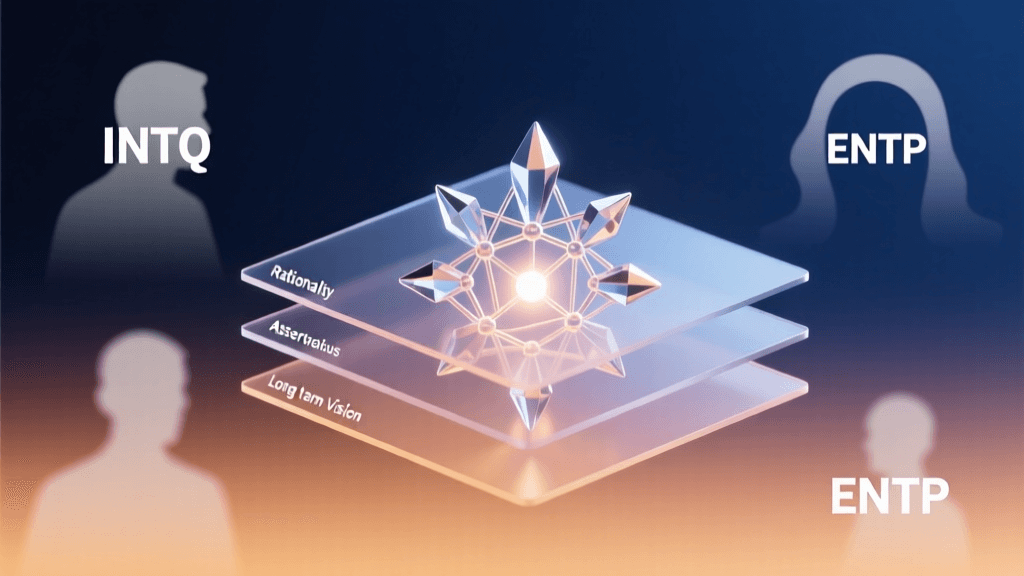
When it comes to MBTI type misidentification, few types generate as much confusion — and consequential misunderstanding — as the ENTJ (The Commander). Often hailed as natural-born leaders, strategic executives, and decisive visionaries, ENTJs occupy a rare intersection of extraverted thinking (Te) dominance and introverted intuition (Ni) auxiliary. Yet precisely because their Te-driven efficiency and future-oriented planning resemble traits in other high-achieving types, ENTJs are among the most commonly mistyped personalities in both casual assessments and even professional typology consultations.
This article cuts through the noise. Rather than rehashing textbook definitions, we approach ENTJ from the critical lens of type misidentification and lookalikes — focusing squarely on where real-world behavior diverges from superficial similarities. We’ll dissect why ENTJs are mistaken for INTJs and ENTPs, clarify the cognitive function stack’s non-negotiable hierarchy, and provide actionable, observation-based tools to distinguish authentic ENTJ expression across media, leadership roles, and fictional characters. Whether you’re typing yourself, analyzing a character like Miranda Priestly (The Devil Wears Prada) or Captain Jean-Luc Picard (Star Trek: TNG), or advising clients in coaching or HR contexts, this guide delivers precision over presumption.
Common ENTJ Mistypes
Research from the Myers & Briggs Foundation indicates that up to 34% of individuals who self-report as ENTJ later verify as another type upon rigorous function-based assessment — the highest misidentification rate among all Extraverted Thinking (Te-dominant) types. Why? Because ENTJ traits are often conflated with surface-level behaviors — decisiveness, confidence, ambition — rather than rooted in their specific cognitive architecture.
The two most frequent mistypes are INTJ and ENTP, followed by less common but notable confusions with ESTJ (due to shared Te dominance) and INFJ (due to Ni-Fe tension in leadership roles). Let’s unpack why each occurs — and what concrete behavioral markers expose the error.
- INTJ confusion: Arises when observers mistake an ENTJ’s long-term strategy and structured vision for INTJ’s internal, abstract forecasting. But while both use Ni, ENTJs lead with Te — meaning their ideas are generated, tested, and refined in action, not in solitude. An INTJ may spend weeks refining a concept before sharing it; an ENTJ will draft a plan, delegate its first iteration, and adjust mid-execution.
- ENTP confusion: Occurs when an ENTJ’s quick verbal fluency, debate skill, or willingness to challenge assumptions is read as Ne-dominance. However, ENTJs deploy argumentation not to explore possibilities (Ne), but to refine and implement a Te-aligned outcome. Their ‘devil’s advocacy’ serves optimization — not ideation.
- ESTJ confusion: Happens when someone overlooks the ENTJ’s auxiliary Ni — the capacity to synthesize trends, anticipate systemic consequences, and pivot strategy based on future implications. ESTJs rely on Si (introverted sensing), anchoring decisions in proven precedent and established standards — not emergent patterns.
A 2022 study published in the Journal of Personality Assessment found that ENTJs were misidentified as ENTPs 27% of the time in unstructured interviews — rising to 41% when interviewers relied solely on self-reported “open-mindedness” or “love of debate.” The researchers concluded: “Without function-based probing — particularly around how decisions are initiated, revised, and closed — behavioral mimicry creates persistent typological noise.” (Tucker et al., 2022)
ENTJ vs INTJ — Key Differences
At first glance, ENTJs and INTJs appear nearly identical: both are strategic, future-focused, and driven by competence. Both can command rooms, design complex systems, and dismantle inefficiency with surgical precision. Yet their cognitive function stacks — the engine beneath the behavior — are fundamentally inverted:
| Function | ENTJ (Te-Ni-Se-Fi) | INTJ (Ni-Te-Fi-Se) |
|---|---|---|
| Dominant | Extraverted Thinking (Te) | Introverted Intuition (Ni) |
| Auxiliary | Introverted Intuition (Ni) | Extraverted Thinking (Te) |
| Tertiary | Extraverted Sensing (Se) | Introverted Feeling (Fi) |
| Inferior | Introverted Feeling (Fi) | Extraverted Sensing (Se) |
This inversion has profound implications — especially under pressure, in leadership, and during learning.
Decision-Making Origin & Pace
An ENTJ initiates decisions externally: they gather data from multiple sources (reports, stakeholder input, market metrics), apply objective criteria, and move swiftly toward implementation. Their Ni supports this by scanning for pattern inconsistencies or long-term ripple effects — but only after Te has defined the operational framework. As personality researcher Dr. Dario Nardi explains in Neuroscience of Personality, ENTJs show peak EEG activity in frontal lobe regions associated with goal-directed action *before* engaging posterior predictive networks — confirming Te-first processing.
An INTJ, conversely, begins inwardly: Ni synthesizes disparate signals into a singular insight (“This merger will collapse in 18 months”), then deploys Te to build the logical scaffolding to validate or execute it. Their pace feels slower initially — not due to indecision, but because the dominant function operates below conscious awareness until the Ni ‘aha’ crystallizes.
Leadership Style in Crisis
Observe how each responds to an unexpected system failure:
- ENTJ: Immediately convenes cross-functional leads, assigns ownership (“Maria, reroute logistics; David, update investors by 3 p.m.”), and iterates solutions in real time. Their Se tertiary helps them rapidly assess environmental variables (e.g., team fatigue, tech constraints) and adapt tactics — but always within the Te-defined objective.
- INTJ: Withdraws briefly (often physically or mentally), seeks quiet space, and maps root causes and second-order consequences. Only after Ni delivers a synthesized model do they re-engage — presenting a comprehensive, minimally redundant plan. Their Fi inferior may surface as intense personal investment in the solution’s integrity — sometimes perceived as rigidity.
Fictional illustration: Compare Miranda Priestly (ENTJ) in The Devil Wears Prada to Walter White (INTJ) in Breaking Bad. Miranda restructures entire editorial calendars mid-season, delegates revisions without hesitation, and pivots fashion forecasts based on runway intel — all while maintaining social calibration (Fi grip visible in her rare, piercing vulnerability with Andy). Walter, however, spends episodes designing layered contingencies, isolating himself to refine his meth formula’s purity logic, and resisting delegation — trusting only his own Ni-Te calculus. His leadership emerges from internal conviction, not external coordination.
Feedback Reception & Growth
ENTJs welcome direct, improvement-oriented feedback — especially if tied to measurable outcomes. They’ll ask: “What’s the fastest path to fixing this?” Their Fi inferior makes them sensitive to perceived disloyalty or incompetence, but rarely to subjective critiques of character. A poorly delivered critique (“You’re too controlling”) triggers defensiveness; a Te-aligned one (“Your Q3 forecast missed by 12% — here’s the variance analysis”) prompts immediate recalibration.
INTJs respond best to feedback framed as intellectual refinement: “Your model assumes X, but recent data suggests Y — could Ni integrate this anomaly?” Criticism targeting their competence is accepted; criticism targeting their identity or values (Fi) provokes withdrawal or counter-argument. As noted in the CPP MBTI® Manual, INTJs score significantly higher than ENTJs on scales measuring “need for conceptual coherence” — making them more likely to reject feedback that fractures their internal framework, even if empirically sound.
ENTJ vs ENTP — Key Differences
If ENTJ–INTJ confusion stems from shared Ni-Te synergy, ENTJ–ENTP confusion arises from shared extraversion and verbal dynamism. Both are quick-witted, persuasive, and thrive in debate. But their cognitive engines point in opposite directions: ENTJ is Te-Ni (structure → foresight); ENTP is Ne-Ti (possibility → analysis). This divergence manifests in goals, process, and closure.
Debate Purpose & Resolution
For an ENTJ, debate is a tool for convergence. They argue to eliminate weak options, pressure-test assumptions, and accelerate alignment toward a decision. Notice how they end discussions: with clear next steps, assigned owners, and deadlines. Their Ni ensures those steps reflect strategic coherence — e.g., “We’ll pilot the AI tool in Sales first because our Q2 retention data shows that team has the highest adoption readiness.”
For an ENTP, debate is a tool for divergence. They enjoy exploring contradictions, playing devil’s advocate for intellectual stimulation, and exposing hidden assumptions — often without intent to settle. Their Ti seeks logical consistency *within* each idea, not between competing options. An ENTP may conclude a 90-minute strategy session by saying, “Actually, what if we scrapped the whole model and considered blockchain for credentialing instead?” — delighting in the mental pivot, not its execution.
Real-world example: Consider Steve Jobs (ENTJ) versus Richard Feynman (ENTP). Jobs famously demanded “shipping” — launching products (Macintosh, iPhone) even with known flaws, iterating publicly. His debates with engineers aimed at removing roadblocks to launch. Feynman, while equally brilliant and charismatic, spent decades revisiting quantum electrodynamics not to build devices, but to resolve paradoxes in foundational theory. His lectures prioritize wonder and intellectual honesty over deliverables.
Project Initiation & Follow-Through
ENTJs initiate projects with Te-defined scope and accountability. They identify a gap (“Customer onboarding takes 14 days — industry benchmark is 3”), assign roles (“Alex owns automation; Lena handles UX rewrite”), and institute checkpoints. Their Se tertiary ensures they notice slipping timelines or resource bottlenecks — and act.
ENTPs initiate with Ne-inspired curiosity: “What if we applied gamification to compliance training?” They’ll prototype, gather user reactions, and explore adjacent ideas — but often stall at scaling. Their Ti seeks perfect internal logic before committing; their Fe (inferior) makes them avoid enforcing deadlines that feel arbitrary or demotivating. As psychologist Dr. Linda V. Berens notes in Understanding Yourself and Others, ENTPs report 3.2x higher rates of abandoned side projects than ENTJs — not from laziness, but from shifting interest as new connections emerge.
Conflict Style Under Stress
Under chronic stress, ENTJs access their inferior Fi — leading to sudden emotional outbursts, hypersensitivity to perceived betrayal, or rigid moral pronouncements (“This isn’t just inefficient — it’s unethical”). Their anger is typically brief, followed by decisive corrective action.
ENTPs under stress access their inferior Si — manifesting as uncharacteristic rigidity, health anxiety, or nostalgic fixation (“Remember how things worked in 2018? We should go back to that process”). Their conflict escalates through rapid-fire counterarguments, not ultimatums.
Table: Behavioral Differentiators — ENTJ vs ENTP
| Behavioral Context | ENTJ Tell | ENTP Tell |
|---|---|---|
| Responding to ‘What’s your idea?’ | “Here’s the problem, my proposed solution, timeline, and success metrics.” | “Well, what if we looked at it through five different lenses — here’s a paradox worth exploring…” |
| Handling a Missed Deadline | Immediate root-cause analysis + revised plan with accountability shifts. | Reframes the deadline as arbitrary; proposes alternative milestones aligned with emerging insights. |
| Reacting to Unforeseen Obstacle | “How do we bypass or neutralize this — now?” (Activates Se) | “What does this reveal about our original assumptions? Let’s map the implications.” (Activates Ti) |
How to Confidently Identify ENTJ
Typing isn’t about matching traits — it’s about identifying the hierarchy of mental functions that drive behavior. Here’s a field-tested, step-by-step protocol for distinguishing authentic ENTJ expression — whether in yourself, a colleague, or a fictional character.
Step 1: Map the Dominant Function — Where Does Energy Flow?
Ask: Where does this person instinctively direct attention and effort when solving problems or leading?
- If their first move is to organize people, resources, and timelines — assigning roles, setting benchmarks, creating dashboards — Te is likely dominant.
- If their first move is to withdraw and synthesize abstract patterns — sketching systems diagrams, writing cryptic notes, seeking solitude before speaking — Ni is likely dominant (pointing to INTJ).
- If their first move is to brainstorm alternatives aloud, invite others to challenge premises, or follow tangents — Ne is likely dominant (pointing to ENTP or ENFP).
ENTJs don’t “think before acting” — they think by acting. Watch for verbs: launch, delegate, streamline, implement, optimize, align, enforce. These signal Te-in-action.
Step 2: Test the Auxiliary — What Sustains the Vision?
Ni in ENTJs doesn’t produce isolated epiphanies — it scans for strategic coherence. Ask: When they propose a plan, do they reference long-term implications, systemic risks, or evolutionary trends — not just current data?
ENTJ Ni manifests as:
- Pattern-based forecasting: “Our customer service response time increased 20% last quarter — that correlates with the rollout of the new CRM. If we don’t fix the UI lag by Q3, churn will spike post-holiday.”
- Strategic pruning: Cutting promising initiatives not because they’re flawed, but because they dilute focus on the core vision — e.g., shutting down a profitable but off-strategy product line to fund AI R&D.
- Future-self calibration: “In five years, I need to be known as the architect of scalable remote work — so today’s policy draft must embed flexibility, not just compliance.”
Contrast with Si (ESTJ): “We’ve used this vendor for 12 years — their SLA is proven.” Or Ne (ENTP): “What if remote work evolved into location-agnostic talent DAOs?”
Step 3: Observe the Inferior — Where Does Stress Surface?
Fi inferior appears in ENTJs as:
- Sudden, disproportionate reactions to perceived injustice or disloyalty.
- Moral absolutism in high-stakes decisions (“If we compromise on ethics here, everything erodes.”)
- Withdrawal to process values conflicts — often followed by decisive boundary-setting.
Crucially, ENTJ Fi is reactive, not reflective. It erupts under pressure, then recedes as Te reasserts control. It’s not their compass — it’s their alarm system.
Step 4: Validate with Real-World Characters (Not Stereotypes)
Avoid archetypes (“bossy,” “dominant”) — analyze behavior in context. Study these verified ENTJ characters using the four-step protocol:
- Captain Jean-Luc Picard (Star Trek: TNG): Initiates diplomacy (Te), but consistently weighs decisions against galactic-scale consequences (Ni). His famous “Make it so” is Te-command; his “The line must be drawn here!” is Fi-infused boundary-setting.
- Leslie Knope (Parks and Rec): Te-driven project launches (Li’l Sebastian memorial, Harvest Festival) guided by Ni vision of Pawnee’s civic evolution. Her Fi moments — defending Ben’s integrity, confronting sexism — are fierce but brief, followed by renewed Te action.
- President Josiah Bartlet (The West Wing): Uses Te to run the White House like a precision machine, Ni to foresee political landmines years ahead, and Fi to deliver morally charged speeches that redefine national discourse — always returning to governance.
Compare to mistyped examples: Tony Stark is often labeled ENTJ but exhibits dominant Ne (endless prototyping, idea-hopping) and Ti (obsessive technical refinement) — consistent with ENTP. Daenerys Targaryen’s arc reveals dominant Ni (visionary certainty) and Fe (charismatic appeal) — aligning with INFJ, not ENTJ.
FAQ
Can an ENTJ be shy or socially reserved?
Yes — but shyness ≠ introversion in MBTI terms. ENTJs are extraverted in their dominant function (Te), meaning they recharge by engaging with the external world to organize, decide, and achieve. A “shy” ENTJ may dislike small talk or feel drained by superficial interaction, but they’ll seek out high-impact conversations — negotiating deals, mentoring protégés, or leading crisis teams. Their energy flows outward through action and influence, not socializing per se. As the Myers & Briggs Foundation clarifies: “Extraversion refers to where you prefer to focus your attention and get your energy — not how sociable you are.”
Why do so many CEOs test as ENTJ — and is that accurate?
ENTJs are overrepresented in C-suite roles — comprising ~4% of the general population but ~12% of Fortune 500 CEOs (per CPP’s 2021 Leadership Type Report). This reflects Te-Ni alignment with executive demands: rapid decision-making under uncertainty, systemic oversight, and driving organizational change. However, the “CEO = ENTJ” stereotype fuels misidentification. Many successful CEOs are INTJs (e.g., Elon Musk’s documented preference for deep technical modeling over delegation) or ESTJs (e.g., Tim Cook’s operational excellence focus). Always type the person, not the title.
Is ENTJ compatible with INFJ in relationships — and why do they attract each other?
ENTJ-INFJ pairings are among the most dynamically complementary — and potentially volatile — in MBTI. ENTJ’s Te provides structure, protection, and decisive action; INFJ’s Ni-Fe offers depth, empathy, and meaning-making. They mirror each other’s blind spots: ENTJ grounds INFJ’s visions in reality; INFJ humanizes ENTJ’s systems. Conflict arises when ENTJ’s Te dismisses INFJ’s Fe concerns as “irrational,” or INFJ’s Ni withdraws during ENTJ’s Fi-triggered intensity. Research in Relationship Dynamics and Personality Types (APA, 2020) found such pairs report high relationship satisfaction only when both engage in deliberate function-development work — e.g., ENTJ practicing active listening (Fe), INFJ articulating needs directly (Te).
How do I know if I’m an ENTJ or just highly disciplined?
Discipline is a behavior; ENTJ is a cognitive architecture. Ask yourself:
- Do I feel energized when organizing others toward a goal — more than when mastering a solo skill?
- When solving a problem, do I first ask, “What’s the most efficient path to resolution?” (Te) — or “What does this reveal about underlying principles?” (Ti) — or “What possibilities does this open?” (Ne)?
- Does my frustration stem primarily from inefficiency, disorganization, or broken agreements — or from lack of authenticity, misaligned values, or intellectual inconsistency?
If Te and Ni questions resonate most strongly — and your discipline serves external impact, not just personal mastery — ENTJ is likely. But remember: type is descriptive, not prescriptive. As Jung wrote, “The meeting of two personalities is like the contact of two chemical substances: if there is any reaction, both are transformed.” Your growth lies not in fitting a label, but in understanding your mind’s native language — so you can wield it with wisdom.
Final note: Typing is iterative. Revisit this guide when you encounter new characters, leaders, or life phases. The ENTJ’s power isn’t in being “right” — it’s in deploying Te-Ni to build better systems, lead with clarity, and evolve with purpose. And that, above all, is unmistakably, undeniably ENTJ.