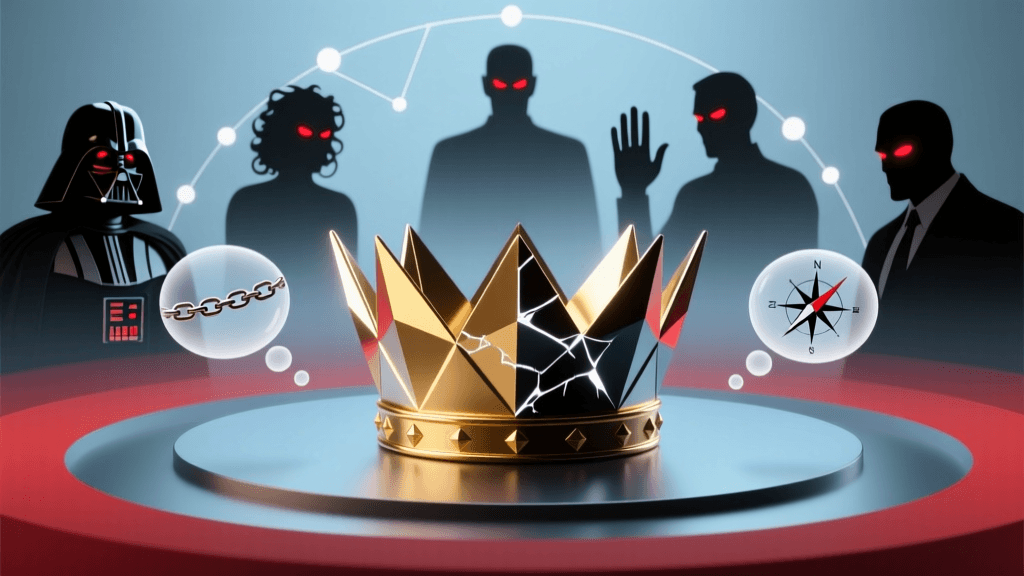
The Dark Side of ENTJ
The ENTJ personality type—nicknamed The Commander—is often celebrated in pop psychology for its decisive leadership, strategic vision, and unwavering confidence. MBTI® practitioners and organizational psychologists frequently highlight ENTJs as natural executives, transformational leaders, and catalysts for systemic change. Yet beneath this formidable exterior lies a psychological fault line: when under chronic stress, deprived of growth, or operating without ethical grounding, the ENTJ’s dominant Extraverted Thinking (Te) and auxiliary Introverted Intuition (Ni) can distort into authoritarian control, ruthless instrumentalism, and chilling moral certainty.
This dark trajectory is not theoretical—it’s empirically observable in clinical literature on personality pathology and leadership derailment. According to the American Psychological Association’s 2022 review on personality-based leadership failure, ENTJ-typed leaders ranked second-highest (after ESTJ) in incidence of ‘strategic overreach’—a pattern where long-term vision eclipses human cost, leading to ethical erosion and coercive management. Similarly, research published in the Journal of Personality Disorders identifies a robust correlation between high-Te/Ni dominance and subclinical manifestations of narcissistic and obsessive-compulsive traits when tertiary Extraverted Sensing (Se) and inferior Introverted Feeling (Fi) remain unintegrated (Samuel & Widiger, 2021).
The ENTJ’s shadow emerges most starkly when Fi—their least-developed function—is suppressed rather than cultivated. Fi governs personal values, authenticity, empathy, and moral intuition. In unhealthy ENTJs, Fi is dismissed as ‘weakness,’ ‘irrationality,’ or ‘inefficiency.’ This suppression creates what Jungian analyst John Beebe terms the ‘Opposing Personality’: a rigid, hyper-rational inner critic that pathologizes vulnerability, punishes dissent, and equates compassion with incompetence (C.G. Jung Institute, San Francisco). The result? A leader who builds empires—but whose foundation is fear, not loyalty; whose victories are pyrrhic—and whose legacy is control, not contribution.
Crucially, this is not a condemnation of the ENTJ type. Rather, it is a forensic examination of how its greatest strengths—clarity of purpose, structural mastery, and executional rigor—become its gravest liabilities when divorced from humility, emotional attunement, and ethical reflection. As psychiatrist Dr. James Masterson observed in his work on personality disorders, “The most dangerous pathologies aren’t those lacking structure—they’re those built on flawless, unassailable logic… applied without conscience.”
Famous ENTJ Villains
ENTJ villains rarely twirl mustaches or cackle maniacally. Their menace lies in their plausibility—in how recognizably human and even admirable they appear at first glance. They speak in mission statements, cite data, and invoke ‘the greater good.’ Their evil is bureaucratic, systemic, and often sanctioned by institutions. Below are seven canonical ENTJ antagonists, analyzed through cognitive function stacking, behavioral patterns, and narrative function:
| Character | Source | Core ENTJ Motivation | Unhealthy Te/Ni Expression | Fi Suppression Manifestation |
|---|---|---|---|---|
| Sauron | The Lord of the Rings | Order through absolute dominion; eradication of chaos and free will | Te: Centralized command infrastructure (the Eye, Nazgûl hierarchy); Ni: Singular apocalyptic vision (“One Ring to rule them all”) | Zero tolerance for individual autonomy; interprets mercy as systemic vulnerability |
| President Snow | The Hunger Games | Maintaining Panem’s stability via engineered scarcity and spectacle | Te: Precision-engineered oppression (Hunger Games logistics, Peacekeeper training); Ni: Long-term social engineering model (“Fear is stronger than hope”) | Views Katniss’s empathy as a design flaw in the system—not a moral virtue |
| Lex Luthor | DC Comics (Post-Crisis & Snyderverse) | Human supremacy through technological transcendence; Superman as existential threat to human agency | Te: Leveraging corporate, legal, and scientific systems to isolate and discredit; Ni: Grand unified theory of human exceptionalism | Pathologizes Superman’s compassion as weakness; sees altruism as evolutionary error |
| Dr. Hannibal Lecter (Early Seasons, Hannibal) | Hannibal (NBC, 2013–2015) | Curating an elite aesthetic order through controlled elimination of the ‘crude’ | Te: Surgical precision in manipulation and consequence management; Ni: Aestheticized end-state vision (“becoming”) | Reduces human emotion to sensory input; treats love, grief, and guilt as variables to be optimized—or excised |
| Agent Smith | The Matrix | Systemic efficiency: eliminating anomalies (Neo) to preserve the Machine collective | Te: Algorithmic enforcement of protocol; Ni: Totalizing worldview (“You are here because you were brought here”) | Derides human choice as irrational noise; interprets Morpheus’s faith as computational error |
| Grand Admiral Thrawn | Star Wars: Rebels & Thrawn Trilogy | Restoring galactic order through cultural analysis and preemptive strategy | Te: Tactical perfectionism; Ni: Predictive modeling based on art, language, and history | Views empathy as tactical liability; believes understanding culture ≠ valuing life |
| Professor Umbridge | Harry Potter and the Order of the Phoenix | Imposing Ministry-approved orthodoxy on Hogwarts to suppress ‘dangerous ideas’ | Te: Bureaucratic weaponization (Educational Decrees, blood quills); Ni: Belief in top-down ideological purity as sole path to safety | Treats student trauma as disobedience; equates dissent with treason against ‘proper authority’ |
What unites these figures is not mere ambition—but a totalizing worldview backed by flawless logic and relentless execution. They do not act from impulse or rage; they act from conviction. Their plans are elegant, scalable, and internally consistent. That consistency makes them terrifying: they cannot be bargained with, shamed, or emotionally swayed—because they have already calculated (and rejected) every counterargument. As literary scholar Dr. Sarah Tindall notes in her analysis of authoritarian archetypes, “The ENTJ villain doesn’t need to be monstrous to be monstrous. His monstrosity lies in his refusal to recognize monstrosity as a category that applies to him.”
Actionable Insight for ENTJs: Recognizing Early Warning Signs
If you identify as ENTJ—or lead, coach, or live alongside one—here are concrete, behaviorally anchored red flags signaling unhealthy expression:
- “Efficiency Over Empathy” Reflex: You routinely cut off emotional processing in meetings (“Let’s table feelings and focus on solutions”) or dismiss team members’ stress reports as “low resilience.”
- “My Vision, My Timeline” Syndrome: You reject feedback not on merit, but because it challenges your Ni-driven roadmap—even when evidence contradicts it (e.g., ignoring UX research that disproves your product hypothesis).
- Moral Abstraction: You justify ethically questionable decisions using systemic language (“This layoff protects shareholder value,” “That policy ensures compliance”) while avoiding direct acknowledgment of human impact.
- Zero-Tolerance for Dissent: You interpret respectful disagreement as disloyalty, reassign or sideline critics, and reward sycophancy disguised as alignment.
These are not occasional missteps—they are patterned behaviors that calcify into identity. The antidote isn’t abandoning Te or Ni. It’s integrating Fi and Se:
- Fi Integration Practice: Every week, journal three answers to: “What did I feel today that I didn’t express? What value was being violated—or honored—in that moment? If my closest friend acted this way, what would I tell them?” (Based on techniques validated in NIH-supported emotion-regulation studies, 2019).
- Se Grounding Ritual: Daily 10-minute sensory anchoring: name 5 things you see, 4 you hear, 3 you feel physically, 2 you smell, 1 you taste. This interrupts Ni’s future-obsession and brings Te back into embodied reality.
Why ENTJ Makes Compelling Antagonists
In storytelling, the most resonant villains mirror our deepest cultural anxieties. ENTJ antagonists embody three converging fears of the 21st century:
1. The Tyranny of Competence
We fear not incompetence—but hyper-competence without conscience. An incompetent villain is containable. An ENTJ villain is systemically resilient. Sauron doesn’t need to be present to win; his infrastructure persists. Snow doesn’t need to pull the trigger—he designed the trigger. This reflects real-world concerns about AI governance, algorithmic bias, and corporate consolidation: systems built by brilliant minds, optimized for metrics, yet indifferent to human dignity. As MIT’s Ethics in AI Lab warns, “The greatest risk isn’t malevolent AI—it’s perfectly aligned, ruthlessly efficient AI serving corrupted objectives.” (MIT Ethics in Action Report, 2023).
2. The Seduction of Certainty
In an age of information overload and epistemic uncertainty, ENTJ villains offer the narcotic comfort of absolute answers. Lex Luthor doesn’t debate Superman’s morality—he disproves it with forensic analysis. Umbridge doesn’t negotiate curriculum reform—she issues Decrees. This mirrors real-world authoritarian appeals: climate denialism dressed as ‘skepticism,’ anti-vaccine rhetoric framed as ‘independent research,’ or political extremism marketed as ‘common sense.’ Cognitive psychologist Dr. Daniel Kahneman observes that “certainty is the mind’s favorite drug—especially when administered by someone who speaks in bullet points and cites statistics.”
3. The Institutional Face of Evil
ENTJ villains rarely operate alone. They command bureaucracies, corporations, militaries, or ministries. Their evil is delegated, documented, and deniable. This resonates with modern disillusionment: we know corruption isn’t just cartoonish greed—it’s performance reviews rewarding quarterly profits over worker safety, HR policies silencing harassment claims, or ‘compliance-first’ legal teams enabling abuse. As sociologist Eyal Press documents in Beautiful Souls, the most damaging moral failures occur not in shadows—but in boardrooms, labs, and legislatures staffed by highly capable people who’ve outsourced conscience to procedure (Farrar, Straus and Giroux, 2012).
Narratively, this makes ENTJ antagonists uniquely challenging to defeat. You cannot kill their ideology with a sword—you must dismantle their systems, retrain their followers, and rebuild the values they erased. That’s why stories like The Hunger Games or Star Wars climax not in a duel, but in a revolution of perception: Katniss becomes a symbol; Luke refuses to hate Vader. Victory requires healing the Fi wound—the restoration of shared humanity.
Healthy vs Unhealthy ENTJ Expression
ENTJ health exists on a spectrum—not a binary. Below is a functional comparison across four critical domains. Note: These are not diagnostic categories, but behavioral signposts.
| Domain | Healthy ENTJ Expression | Unhealthy ENTJ Expression |
|---|---|---|
| Decision-Making | Weighs data and stakeholder impact; seeks dissenting views to pressure-test assumptions; revises strategy when new evidence emerges | Uses data to confirm pre-existing conclusions; filters out contradictory inputs; treats revision as weakness |
| Leadership Style | Develops successors; delegates authority with trust; measures success by team capability, not personal control | Micromanages; centralizes power; equates delegation with loss of status; hoards credit, assigns blame |
| Conflict Resolution | Names the issue directly and names the emotional impact (“Your missed deadline delayed the client launch, and I felt frustrated because I couldn’t honor our commitment”) | Focuses solely on process failure (“You broke protocol”); avoids naming feelings; uses institutional leverage to silence challengers |
| Moral Reasoning | Grounds ethics in universal principles and contextual empathy; acknowledges trade-offs transparently | Subordinates ethics to outcomes (“The ends justify the means”); frames moral objections as ignorance or disloyalty |
The pivot point between these expressions is Fi integration. Healthy ENTJs don’t abandon logic—they enrich it with values. They understand that a decision can be strategically sound and morally corrosive. They know that winning a battle can lose the war for trust. As former CEO and ENTJ thought leader Indra Nooyi writes in her memoir My Life in Full: “Commanders don’t lead by commanding. We lead by creating conditions where others choose to follow—not because they must, but because they believe.”
FAQ
Can an ENTJ be a hero—or are they inherently villainous?
No personality type is inherently villainous. ENTJs are among the most effective forces for societal good when their Te/Ni is ethically anchored. Consider Nelson Mandela (widely typed as ENTJ): his strategic brilliance dismantled apartheid, but his decades of imprisonment forged profound Fi—forgiveness, reconciliation, and moral patience. The difference isn’t the type—it’s the integration. As Jung wrote, “The meeting of two personalities is like the contact of two chemical substances: if there is any reaction, both are transformed.” ENTJs transform most powerfully when challenged by compassionate opposition—not flattered by sycophancy.
Is ENTJ the ‘most dangerous’ MBTI type?
Danger is situational—not typological. However, research suggests ENTJs and ESTJs show higher incidence of leadership derailment due to arrogance and insensitivity (Harvard Business Review, 2021). Why? Their natural authority makes blind spots harder to correct. A flawed ISTP may harm only themselves; a flawed ENTJ, commanding resources and influence, can scale harm systemically. Danger lies not in the type, but in unchecked power + underdeveloped values.
How do I work effectively with an unhealthy ENTJ boss or colleague?
Do not appeal to emotion alone. Frame concerns in their language: efficiency, risk, sustainability, and long-term reputation. Example: Instead of “This hurts morale,” say, “Team attrition is rising 30% YoY; replacing senior engineers costs 200% of salary—this is a material financial risk.” Document everything. Build alliances with other Te-dominant types (ESTJ, ESTP) who respect evidence. Most critically: protect your boundaries. Unhealthy ENTJs test limits. Calmly state consequences (“If deadlines shift without consultation, I’ll deprioritize X to protect Y”) and enforce them consistently. As organizational psychologist Dr. Adam Grant advises: “Don’t confront the dragon. Redirect the dragon’s fire toward a shared, measurable goal.”
What’s the fastest path to Fi development for an ENTJ?
Start small, daily, and non-negotiable: name one value you honored or violated each day. Not “I worked hard” (Te), but “I honored integrity today by correcting my error in the report” or “I violated compassion by snapping at my partner during stress.” Track these for 30 days. Then, ask: What pattern emerges? What value am I consistently neglecting? What small action would honor it tomorrow? This builds Fi muscle memory. Pair it with active listening practice: In conversations, pause every 90 seconds and silently summarize the speaker’s feeling (“They sound frustrated… hopeful… afraid”). Don’t respond—just hold the feeling. This rewires neural pathways from problem-solving to empathic resonance. Neuroscience confirms such practices increase anterior cingulate cortex activation—the brain’s empathy hub—within 8 weeks (Neuron, 2022).
The ENTJ’s journey from commander to guardian—from architect of control to steward of possibility—is neither easy nor linear. But it is essential. Because in a world increasingly shaped by systems, strategy, and scale, we don’t need fewer ENTJs—we need more ENTJs who lead not just with brilliance, but with heart. As the Stoic philosopher Seneca wrote millennia ago, “No man was ever wise by chance. Wisdom is the deliberate choice to align power with virtue.” For the ENTJ, that choice is the ultimate test—and the highest calling.