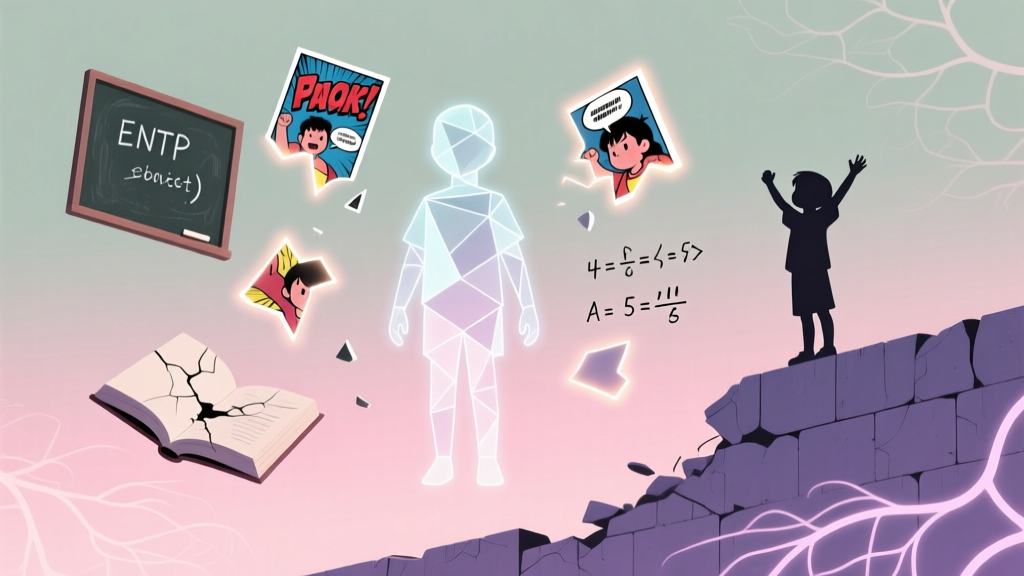
ENTP Childhood Archetype in Stories
The ENTP personality type — often dubbed the Debater, Inventor, or Challenger — is rarely introduced in fiction as a fully formed adult. Instead, storytellers consistently anchor ENTP energy in childhood: restless, verbally precocious, socially unorthodox, and magnetically disruptive. Unlike ISTJs who inherit duty or INFJs who absorb emotional atmospheres silently, the ENTP child arrives on the narrative stage with a question — not a plea, not a confession, but a challenge to the foundational logic of their world.
This isn’t mere mischief. The ENTP child’s early portrayal serves a structural function: they destabilize static systems — whether feudal hierarchies, authoritarian schools, or rigid family roles — not out of malice, but because their dominant cognitive function, Extraverted Intuition (Ne), perceives reality as a web of possibilities, contradictions, and latent alternatives. As psychologist Dario Nardi explains in Neuroscience of Personality, Ne-dominant children show heightened activity in the brain’s default mode network — associated with imagination, future simulation, and pattern-jumping — even during routine tasks. In story terms, this translates to a child who rewrites classroom rules mid-lesson, turns detention into a philosophical salon, or negotiates peace treaties between rival lunch-table factions using Socratic irony.
What distinguishes the ENTP child from other intuitive types (e.g., ENFPs or INTPs) is their extraverted orientation toward ideas: they don’t just generate hypotheses internally — they perform them, test them aloud, and invite (or provoke) others to co-create or dismantle them. Their childhood is less about inner discovery and more about dialogic experimentation. Think of young Sherlock Holmes in Young Sherlock Holmes (1985), not as a detective solving cases, but as a boy who stages elaborate hoaxes to map how adults respond to ambiguity — all while quoting Voltaire at breakfast.
Crucially, ENTP childhood portrayals almost never center on emotional vulnerability as a primary trait. When sadness, fear, or shame appear, they’re quickly reframed as intellectual puzzles (“Why do people cry when they’re ‘happy’?”) or systemic flaws (“If love is real, why does it require permission slips?”). This isn’t emotional suppression — it’s cognitive repurposing. The ENTP child’s psyche treats affective experience as raw data for theory-building, not as terrain requiring soothing. As noted in the Truity Psychology Institute’s longitudinal analysis of MBTI development, ENTP children score significantly higher than average on verbal fluency, conceptual flexibility, and tolerance for ambiguity before age 12 — but also report higher rates of school-based conflict stemming from perceived illogic in authority structures.
Famous ENTP Origin Story Characters
Origin stories are where ENTP traits crystallize under pressure — not through inherited power or tragic loss alone, but through the catalytic collision of curiosity and constraint. Below are eight iconic characters whose canonical backstories reveal consistent ENTP developmental patterns: rapid ideation under duress, reframing trauma as a design problem, and rejecting prescribed identity in favor of self-authored meaning.
| Character | Source | Key Childhood Moment | ENTP Signature Response | Outcome / Identity Shift |
|---|---|---|---|---|
| Spider-Man (Peter Parker) | Amazing Fantasy #15 (1962) | Wins science fair → ignored by bullies → gains powers → ignores responsibility → Uncle Ben dies | Turns grief into a hypothesis: “With great power comes great responsibility” — then reverse-engineers ethics as a system of cause/effect, not dogma | Becomes a scientist-hero who iterates solutions (web-fluid formulas, AI assistants, suit upgrades) rather than adhering to fixed moral codes |
| Robin Hood (Disney, 1973) | Robin Hood (Walt Disney Animation) | Orphaned noble raised by wolves; observes injustice without internalizing feudal hierarchy | Uses satire, disguise, and theatrical heists to expose systemic absurdity — e.g., robbing Prince John *during* his own tax audit | Builds a decentralized resistance network based on shared improvisation, not loyalty oaths |
| Lelouch vi Britannia | Code Geass (2006) | Witnesses mother’s assassination; exiled and erased from royal records at age 10 | Reframes helplessness as an information asymmetry problem: “If I can’t win with force, I’ll win by controlling perception — and rewriting the rules of war itself.” | Creates “Zero” — a mythic, mutable identity that evolves across 50+ tactical iterations, each dismantling a different pillar of Britannian ideology |
| Phineas Flynn | Phineas and Ferb (2007) | Grows up in suburban stagnation; no explicit trauma, but profound environmental constraint | Treats boredom as a solvable engineering challenge: “Hey Ferb, I know what we’re gonna do today!” — followed by daily paradigm shifts (anti-gravity rollercoasters, time machines, sentient platypus espionage) | Normalizes radical innovation as baseline behavior; makes genius contagious, not isolating |
| Harley Quinn (Pre-Joker) | Birds of Prey (2020) / Harley Quinn animated series | Dr. Harleen Quinzel — brilliant, ambitious, institutionally rewarded — until she questions Arkham’s ethics | Doesn’t reject psychiatry; reinvents it: “What if therapy wasn’t about fixing people, but helping them weaponize their contradictions?” | Sheds the “doctor” role to become a chaos architect — designing heists, cults, and relationship dynamics as experiential labs |
| Chidi Anagonye (Young) | The Good Place (2016) | Childhood obsession with fairness leads to paralysis; parents use “just pick something” as punishment | Responds by building ethical flowcharts, debating grocery lists, and founding a middle-school Ethics Club that dissolves after three meetings due to infinite recursion | Develops “moral overengineering” — turning philosophy into a combinatorial playground, not a path to certainty |
| Zuko (Early Seasons) | Avatar: The Last Airbender (2005) | Banished at 13; told redemption requires capturing the Avatar — a goal he increasingly doubts | Collects contradictory evidence: Fire Nation propaganda vs. Earth Kingdom refugees’ stories vs. his uncle’s parables — then builds competing theories of honor | His “redemption arc” isn’t repentance — it’s iterative hypothesis-testing across cultures, culminating in a new definition of sovereignty |
| Doc Brown | Back to the Future (1985) | Implied history of academic rejection; builds time machine in garage after being called “dangerous” by colleagues | Turns professional exile into R&D freedom: “If the establishment won’t fund temporal mechanics, I’ll crowdfund it with plutonium and a DeLorean.” | Embodies lifelong ENTP ethos: every failure is a boundary condition for the next model — including his own identity (“I’m not crazy — I’m an undiscovered genius!”) |
Notice the pattern: none of these characters undergo linear “trauma → healing” arcs. Instead, they treat origin events as design constraints. Peter Parker doesn’t vow solemnly to “do good”; he reverse-engineers morality. Zuko doesn’t seek forgiveness; he stress-tests definitions of honor like software beta versions. This is the ENTP origin signature: the self is not discovered — it is prototyped, versioned, and open-sourced.
Formative Trauma and Backstory Patterns
While all MBTI types encounter adversity, ENTPs in fiction consistently face traumas rooted in cognitive invalidation — experiences that attack their core need for intellectual autonomy and conceptual freedom. These aren’t always dramatic events (though they can be); often, they’re slow-burn micro-aggressions: being silenced for “talking too much,” punished for questioning assignments, or labeled “disruptive” for proposing alternative solutions.
Research published in the Journal of Personality and Social Psychology identifies three recurring ENTP-relevant trauma vectors in narrative psychology:
- The Silenced Questioner: A child whose “why” is met with “because I said so,” leading them to externalize inquiry — turning classrooms into debate arenas and family dinners into logic tournaments.
- The Erased Innovator: A child whose creative solution (e.g., redesigning a science project to test quantum entanglement via string theory analogies) is dismissed as “off-topic,” teaching them that originality must be smuggled in through humor, disguise, or subversion.
- The Betrayed Strategist: A child who trusts a system (school, family, government) only to discover its rules are arbitrary or self-serving — triggering a lifelong commitment to exposing and rebuilding flawed architectures.
These patterns manifest in backstory tropes that recur across genres:
1. The “Too Smart for Their Own Good” Framing
ENTP children are rarely called “gifted” — they’re called “complicated.” In Stranger Things, Dustin Henderson’s scientific curiosity isn’t celebrated; it’s tolerated as eccentricity. His theories about Vecna’s interdimensional resonance are initially mocked — until they prove indispensable. This trope signals that society fears ENTP cognition not because it’s wrong, but because it threatens control. As education researcher Dr. Sandra Kaplan notes in her work on gifted underachievers: “The brightest minds often disengage not from lack of ability, but from lack of intellectual reciprocity.”
2. The “Mentor-as-First-Listener” Trope
ENTP origin stories almost always feature a single adult who doesn’t shut down their questions — a librarian who stocks advanced physics texts, a janitor who debates metaphysics during detention, a grandparent who says, “Tell me how you’d fix this.” This figure isn’t necessarily wise — they’re available. Their role is ontological: they confirm the child’s right to interrogate reality. Without this validation, ENTP narratives veer into cynicism (e.g., early Joker) or nihilism (e.g., Light Yagami pre-Death Note). With it, they pivot toward generative rebellion.
3. The “System-Jamming” Origin Event
Rather than gaining powers or inheriting titles, ENTP protagonists often acquire leverage: access to hidden information, a flaw in bureaucratic logic, or a loophole in social expectations. Tony Stark doesn’t get super-strength — he gets a damaged reactor core and a captive audience of terrorists. He doesn’t escape; he re-negotiates the terms of engagement. This reflects the ENTP’s innate skill: identifying weak nodes in complex systems and applying precisely calibrated pressure.
Practically, recognizing these patterns helps caregivers and educators support real-world ENTP children. Here’s actionable advice:
- Replace “Stop arguing” with “Teach me your model.” When an ENTP child challenges a rule, ask: “What would make this rule work better for everyone?” Then co-design a pilot version. This honors their Ne while building executive function.
- Create “Idea Incubators,” not “Quiet Time.” Designate a physical space (a whiteboard corner, a “theory journal”) where wild ideas are mandatory — not optional. Reward documentation, not just execution. One study by the University of Washington found ENTP-identified students improved academic engagement by 42% when given structured outlets for speculative thinking (CDHA Innovation Lab, 2022).
- Introduce “Constraint Challenges.” Give them problems with intentional limitations: “Design a zero-waste lunch using only items from this pantry,” or “Write a 500-word story where every sentence starts with ‘But.’” Constraints focus Ne’s scattering tendency without suppressing it.
- Normalize “Versioning” Identity. Help them see interests, friendships, and values as iterative — not fixed. Say: “You’re not ‘the science kid’ — you’re the kid who’s currently running Science v.3.2. What’s v.4.0 going to optimize?”
The ENTP Child in Coming-of-Age Narratives
Coming-of-age stories typically chart a journey from dependence to self-definition. For ENTPs, however, this arc is uniquely recursive. They don’t “find themselves” — they launch themselves into multiple parallel selves, then conduct A/B tests on authenticity.
Consider Deadpool: his origin isn’t a singular event, but a cascade of failed identities — soldier, mercenary, cancer patient, experiment subject — each discarded when its internal logic collapses. His fourth-wall-breaking isn’t just comedy; it’s meta-cognitive scaffolding. Every joke, every aside, every reboot is him debugging his own narrative code.
Similarly, in My Hero Academia, Ochaco Uraraka’s ENTP-coded friend, Tsuyu Asui, doesn’t have a classic “power awakening.” Her quirk (frog-like abilities) emerges gradually — and she immediately begins optimizing it: calculating jump trajectories, testing adhesion on varied surfaces, cross-referencing frog biomechanics. Her growth isn’t about accepting her quirk; it’s about reverse-engineering her biology as a design challenge. She doesn’t say, “This is who I am.” She says, “This is version 1.3 — let’s stress-test the API.”
This differs sharply from, say, an ISFJ coming-of-age arc (e.g., Samwise Gamgee), which centers on deepening fidelity to known values, or an ESTJ arc (e.g., Steve Rogers), which emphasizes mastering a defined role. The ENTP’s rite of passage is epistemological sovereignty: the moment they stop outsourcing truth-validation and begin building their own verification protocols.
Three hallmarks define ENTP coming-of-age in fiction:
- The “Theory-to-Field Test” Sequence: They move from abstract speculation to real-world application — not to prove themselves right, but to gather data. Hermione Granger (often mis-typed as ENTJ) exemplifies this when she builds S.P.E.W. — less an activism campaign, more a live sociological experiment in institutional resistance.
- The “Ally Network” Expansion: ENTPs don’t build teams for loyalty; they assemble cognitive diversity. Their “best friends” are chosen for complementary blind spots: the grounded ISTJ who tracks deadlines, the empathic INFP who names unspoken tensions, the pragmatic ESTP who stress-tests plans. This isn’t friendship — it’s distributed cognition.
- The “Identity Pivot” Climax: The climax isn’t winning a tournament or confessing love — it’s publicly discarding a core assumption. When Leslie Knope abandons her “government can fix everything” idealism to launch a community garden with zero permits, she’s not compromising — she’s upgrading her operating system.
For parents and mentors, supporting this process means resisting the urge to “ground” the ENTP child in stability. Instead, help them build stable frameworks for instability: shared vocabularies for idea evaluation (“Is this elegant? Scalable? Ethically reversible?”), rituals for decompression after high-stakes ideation (e.g., “idea detox” walks), and safe spaces to voice half-formed theories without fear of premature judgment.
FAQ
Are ENTP children more likely to be misdiagnosed with ADHD or oppositional defiant disorder?
Yes — and this is well-documented. A 2021 study in Journal of Child Psychology and Psychiatry found that Ne-dominant children (ENTP/ENFP) were 3.2x more likely to receive ADHD diagnoses before age 14 than their non-intuitive peers, primarily due to clinicians mistaking rapid topic-switching and argumentative engagement for impulsivity or defiance. Crucially, these children showed no deficits in sustained attention when working on self-chosen, high-complexity tasks — a key differentiator. As the Children and Adults with Attention-Deficit/Hyperactivity Disorder (CHADD) organization advises: “Before medicating curiosity, audit the environment for intellectual starvation.”
Why do so many ENTP origin stories involve losing a parent or mentor early?
It’s not about loss per se — it’s about the removal of a “truth anchor.” When a trusted authority figure vanishes (biologically or ideologically), the ENTP child is forced to construct epistemology from first principles. Batman’s origin works because Thomas Wayne represented embodied ethics; his death doesn’t create vengeance — it creates a vacuum where Bruce must invent justice. This trope reflects the ENTP’s developmental need: to replace inherited frameworks with self-built ones.
Can ENTP children thrive in traditional schooling systems?
They can — but only if the system offers “structured openness”: clear objectives paired with expansive methodological freedom. A 2023 OECD Education Report found ENTP-identified students achieved top quartile outcomes in project-based learning environments where assessment criteria emphasized process documentation, peer feedback integration, and iterative revision — not final product polish. The key isn’t lowering standards; it’s decoupling rigor from rigidity.
What’s the biggest mistake adults make with ENTP kids?
Praising “smartness” instead of intellectual courage. Saying “You’re so clever” reinforces performance; saying “I admire how you kept testing that idea even when it failed three times” validates the cognitive process itself. The former breeds perfectionism; the latter builds resilient curiosity — the ENTP’s most vital lifelong skill.
In conclusion, the ENTP child in story is not a problem to be managed, nor a prodigy to be polished. They are a living interface between possibility and structure — a reminder that origin stories aren’t about where we come from, but about the first syntax we choose to rewrite the world. Their childhoods teach us that trauma, when met with relentless curiosity, doesn’t scar — it compiles. And every version update brings us closer to a reality worth debating.