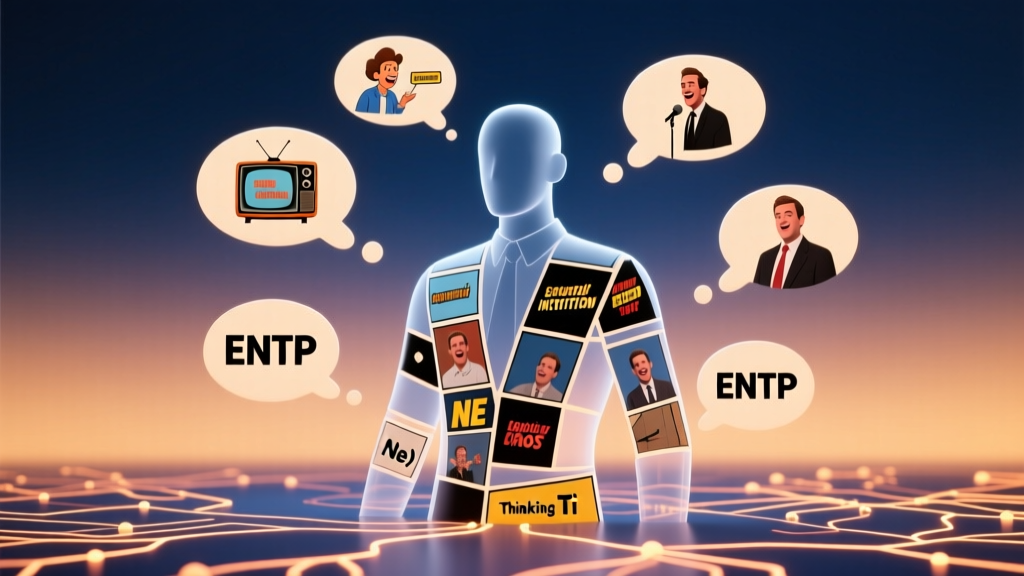
ENTP Humor Style and Comedic Voice
The ENTP — the Debater, the Champion of Chaos, the Intellectual Provocateur — doesn’t just tell jokes. They rewire the premise of the joke itself. Their humor isn’t rooted in self-deprecation or slapstick alone; it’s a high-speed collision of pattern recognition, linguistic dexterity, and irreverent curiosity. At its core, ENTP comedic voice is powered by their dominant function, Extraverted Intuition (Ne), which scans endlessly for connections, contradictions, absurdities, and alternative interpretations — all in real time. Paired with auxiliary Introverted Thinking (Ti), this creates a unique comedic engine: rapid-fire hypothesis testing (“What if gravity reversed for three seconds… *just* during a wedding toast?”), playful deconstruction of social norms (“Why do we say ‘bless you’ after sneezing but not ‘condolences’ after yawning?”), and an almost allergic reaction to unexamined dogma.
Unlike the structured punchline delivery of an ESTJ or the warm, empathetic irony of an ENFP, the ENTP’s humor is dialectical. It thrives on debate, not resolution. A classic ENTP quip isn’t designed to land a single laugh — it’s engineered to spark a cascade of follow-up thoughts, objections, and counter-jokes. Think of it as intellectual jiu-jitsu: they don’t punch down; they gently unspool your assumptions until you’re laughing at the sheer ridiculousness of your own logic. Their tertiary Extraverted Feeling (Fe) adds a layer of social calibration — they read the room with astonishing speed, knowing exactly when to pivot from absurdity to warmth, or when to weaponize sarcasm against hypocrisy. And their inferior Introverted Sensing (Si)? That’s where the nostalgia-bait callbacks, the hyper-specific pop-culture references, and the sudden, deadpan delivery of a forgotten 90s commercial jingle live — used not for sentimentality, but as ironic juxtaposition.
This manifests in several signature styles:
- The Hypothetical Hijacker: Takes any mundane situation and spins five wildly divergent, logically airtight (yet utterly preposterous) outcomes. (“If this coffee machine were sentient and unionized, what would its grievance about ‘unfair bean-to-water ratio exploitation’ sound like?”)
- The Linguistic Labyrinth Builder: Delights in puns, malapropisms, neologisms, and semantic traps. Their jokes often hinge on double meanings, etymological rabbit holes, or grammatical subversion.
- The Authority Antagonist: Uses wit as a scalpel to dissect bureaucracy, pretension, or rigid systems. Their humor isn’t angry; it’s gleefully diagnostic, exposing the inherent absurdity in rules that exist “because they’ve always existed.”
- The Improv Alchemist: Thrives in unscripted moments, riffing off audience reactions, environmental cues, or a fellow actor’s flub. Their best lines are often born in the moment, fueled by Ne’s constant scanning for new angles.
Research supports this cognitive link between intuition and comedic talent. A 2018 study published in Psychology of Aesthetics, Creativity, and the Arts found that individuals scoring high on measures of divergent thinking and conceptual flexibility — hallmarks of Extraverted Intuition — demonstrated significantly higher success rates in generating novel, humorous associations in controlled tasks. Similarly, neuroscientist Scott Weems, in his book Ha!: The Science of When We Laugh and Why, argues that humor arises from the brain’s “error detection” system resolving incongruity — a process perfectly aligned with the ENTP’s Ti-Ne loop constantly generating and evaluating unexpected connections. As Weems notes, “The ‘aha!’ of laughter is the same neural spark as the ‘aha!’ of insight” — a spark ENTPs ignite constantly.
Famous ENTP Comedic Characters (6-8)
ENTPs don’t just appear in comedies; they often *are* the comedic engine. Their presence guarantees friction, surprise, and a relentless questioning of the status quo — the essential ingredients for sustained, intelligent humor. Below are eight iconic characters whose dialogue, motivations, and narrative function scream ENTP, analyzed through the lens of their cognitive stack and comedic impact.
| Character | Source | ENTP Hallmark Behavior | Signature Humor Example | Cognitive Function in Action |
|---|---|---|---|---|
| Sheldon Cooper (Early Seasons) | The Big Bang Theory | Relentless questioning of social rituals, creation of elaborate, rule-based systems for trivial interactions, obsession with logical loopholes. | “I’m not insane; my mother had me tested.” | Ne (generating absurd hypotheticals about sanity tests) + Ti (rigorous internal logic framework). |
| Dr. Gregory House | House M.D. | Diagnosing patients by dismantling their lies and societal facades; using medical puzzles as metaphors for human absurdity. | “Everybody lies.” (Delivered with a smirk that implies he finds the lie itself more fascinating than the truth.) | Ne (spotting inconsistencies in narratives) + Ti (building complex diagnostic models from fragmented data). |
| Leslie Knope (Seasons 1–2) | Parks and Recreation | Over-engineering solutions to minor bureaucratic problems; turning city council meetings into improv stages; boundless, chaotic enthusiasm for civic engagement. | Her entire “Galentine’s Day” concept — a holiday she invented to celebrate female friendship, complete with waffles and heartfelt speeches, presented with absolute, unshakeable conviction. | Ne (inventing new social constructs) + Fe (using humor to build community, even if it’s slightly overwhelming). |
| Chandler Bing | Friends | Defensive sarcasm as a shield; using humor to deflect vulnerability while simultaneously analyzing group dynamics with surgical precision. | “Could I *be* any more...?” (A meta-commentary on his own performative identity, delivered with perfect timing.) | Ti (self-analysis) + Ne (rapidly generating self-deprecating, layered observations about his role in the group). |
| Pepper Potts (MCU Films) | Iron Man series | Masterfully managing Tony Stark’s chaos; translating his Ne-driven inventions into practical business plans; using dry wit to ground his flights of fancy. | “You’re not the guy who’s going to make me happy. You’re the guy who’s going to make me interesting.” | Fe (calibrating her response to Tony’s emotional state) + Ne (seeing the long-term, unconventional potential in their relationship). |
| Wesley Crusher | Star Trek: The Next Generation | Challenging Starfleet protocol with youthful, logic-based questions; proposing unorthodox scientific solutions that seem reckless but are grounded in sound theory. | His infamous “I’m not a doctor, but I play one on TV”-style confidence in solving crises no one else saw coming. | Ne (spotting hidden variables in stellar phenomena) + Ti (constructing novel solutions from first principles). |
| Robin Scherbatsky (Early Seasons) | How I Met Your Mother | Using Canadian cynicism and journalistic skepticism as comedic weapons; pivoting between deadpan delivery and manic energy; constantly reinventing her persona. | Her “Robin Sparkles” pop-star alter ego — a bizarre, self-aware performance art piece that satirizes fame, identity, and 90s pop culture. | Ne (creating and inhabiting multiple, contradictory identities) + Fe (performing for an audience, reading their expectations and subverting them). |
| Phil Dunphy | Modern Family | Endless, poorly conceived DIY projects; attempting to connect with his kids through elaborate, failed schemes; explaining complex concepts with charmingly flawed analogies. | His “Dunphy Dilemma” — a self-invented philosophical paradox about choosing between two equally terrible options, explained with increasing absurdity. | Ne (generating endless, impractical ideas) + Ti (trying, and failing, to impose a logical structure on family chaos). |
It’s crucial to note that many of these characters evolve. Sheldon softens into a more Fe-dominant figure; Leslie matures into a decisive leader (leaning ESTJ). But their foundational comedic power — the spark that made them unforgettable — is pure ENTP: the restless mind, the love of the argument for its own sake, and the unshakeable belief that reality is just a suggestion waiting for a better idea.
ENTP in Sitcoms and Comedy Films
Sitcoms and comedy films provide the perfect petri dish for ENTP traits. The constrained setting (a living room, a workplace, a spaceship bridge) acts as a pressure cooker for their Ne-driven need to explore every possible angle of a situation. Their role is rarely the stoic straight man (ISTJ) or the wide-eyed innocent (ISFP); they are the catalyst, the wildcard, the person who walks in, drops a non-sequitur, and instantly changes the trajectory of the scene.
In the traditional sitcom ensemble, the ENTP often occupies the “Smart-Aleck Friend” or “Chaotic Genius Colleague” archetype. They are the character who knows *exactly* how to push every button in the room, not out of malice, but out of an insatiable curiosity about human behavior. In Brooklyn Nine-Nine, Jake Peralta embodies this: his brilliant detective work is fueled by Ne’s ability to see connections others miss, while his immature pranks and rule-bending are textbook Ti-Ne seeking stimulation. His famous “Vindication!” dance isn’t just celebration; it’s the physical manifestation of his cognitive loop finally resolving a complex puzzle.
Comedy films leverage the ENTP’s love of high-stakes improvisation and systemic critique. Consider Office Space. While Peter Gibbons is often typed as INTP, his transformation is deeply ENTP-coded: his epiphany isn’t quiet contemplation, but a loud, public, Ne-fueled rejection of the entire corporate paradigm (“I’m gonna need you to go ahead and come in on Sunday.”). The film’s humor derives from the clash between the rigid Si-world of TPS reports and the liberating, chaotic Ne-energy of Peter’s newfound perspective.
For writers and performers seeking to channel authentic ENTP comedy, here’s actionable advice:
- Write the “What If?” First: Before crafting a joke, ask five wild “What if?” questions about the scene’s premise. The third or fourth one is often the funniest. (“What if this job interview was actually a courtroom drama? What if the HR rep is the judge? What if my resume is evidence?”)
- Embrace the “Unresolved Ending”: Don’t feel compelled to wrap up every gag with a neat punchline. An ENTP joke can end on a question, a bizarre tangent, or a sudden shift in topic. The humor lives in the audience’s mental scramble to catch up.
- Use Props as Thought Experiments: Give your ENTP character an object (a stapler, a coffee mug, a broken printer) and have them use it to illustrate a complex, unrelated philosophical point. This mirrors how Ne uses concrete stimuli to generate abstract ideas.
- Calibrate the Sarcasm: ENTP sarcasm is rarely cruel; it’s diagnostic. Have them mock a system, not a person. The target should be hypocrisy, inefficiency, or absurd tradition — never vulnerability.
This approach is validated by industry practice. Comedy writer and showrunner Dan Harmon (Rick and Morty, Community) has spoken extensively about using “story circles” and “idea collisions” — a direct parallel to Ne’s function. In a 2014 masterclass at SXSW, Harmon described his process as “taking two things that shouldn’t be together and forcing them to have a baby,” a description that could be the ENTP’s motto. His characters, particularly Rick Sanchez (a darker, more Ti-dominant variant), are masterclasses in ENTP-style intellectual chaos.
Why ENTP Makes Great Comic Relief
Comic relief is often misunderstood as mere filler — a brief pause in the action. For the ENTP, it is strategic narrative oxygen. Their function isn’t to distract, but to reframe. In high-tension scenes — a dramatic confrontation, a life-or-death decision, a moment of profound grief — the ENTP’s interjection doesn’t diminish the stakes; it provides a vital, cognitive pressure valve.
Consider the ENTP in a fantasy epic like The Lord of the Rings. While not a primary character, Samwise Gamgee’s loyal, grounded nature is the heart, but imagine an ENTP hobbit: they’d be the one asking, mid-march across Mordor, “So, Gandalf, if the One Ring corrupts absolutely, does that mean Sauron’s tax returns are also evil? Has anyone checked the audit trail?” This isn’t disrespect; it’s a way of asserting humanity in the face of overwhelming darkness. By introducing absurdity, the ENTP reminds the audience — and the other characters — that the world is still complex, malleable, and full of angles beyond despair.
Neurologically, this is profound. Laughter triggers the release of endorphins and reduces cortisol, the stress hormone. An ENTP’s well-timed, intelligent quip doesn’t just get a laugh; it literally lowers the physiological stress load for everyone in the scene — fictional or real. This is why ENTPs are so valued on set and in writers’ rooms: they are not just funny, they are functional.
Moreover, ENTP comic relief is uniquely sustainable. Unlike a one-note “dumb guy” or a static “sarcastic robot,” the ENTP’s humor evolves with the story. Their growth isn’t about becoming less funny; it’s about refining their wit. They learn when to deploy a devastating logical takedown versus a gentle, Fe-infused observation that heals a rift. Their journey is from chaotic instigator to wise, compassionate provocateur — a transformation seen in characters like Leslie Knope, who channels her Ne energy into building a better community rather than just tearing down the old one.
For aspiring comedic actors or writers, embodying this requires moving beyond mimicry. It requires cultivating genuine curiosity. Spend a day observing conversations, not for content, but for the underlying assumptions and unspoken rules. Practice rewriting mundane instructions (a microwave manual, a parking sign) as satirical manifestos. The ENTP’s power isn’t in being the loudest voice in the room; it’s in being the one voice that makes everyone else suddenly hear the room — and themselves — in a completely new, hilarious, and illuminating way.
FAQ
Is Chandler Bing really an ENTP, or is he just sarcastic?
Chandler’s sarcasm is his most visible trait, but it’s a symptom, not the diagnosis. His sarcasm is a highly developed Ti-Ne defense mechanism — a way to process the emotional chaos of his friends and his own insecurities through rapid, logical analysis and verbal deflection. His constant need to “figure things out,” his love of wordplay (“Could I *be* any more…?”), and his tendency to over-analyze simple social interactions (like dating) all point to a dominant Ne-Ti loop. His growth into a loving husband and father shows the maturation of his Fe, moving from defensive wit to protective, caring humor.
Can an ENTP be a successful stand-up comedian?
Absolutely — and many are. ENTPs thrive in stand-up because it is the purest form of their cognitive functions in action: Ne generates endless premises and angles; Ti crafts the tight, logical structure of the bit; Fe reads the crowd’s energy in real-time to adjust pacing and emphasis; and inferior Si allows for the precise recall of personal anecdotes and cultural touchstones used for relatable, ironic contrast. Comedians like John Mulaney (whose early work is deeply analytical and self-referential) and Hannah Gadsby (whose groundbreaking Nanette deconstructs comedy itself with Ti-Ne rigor) exhibit strong ENTP patterns. As the New York Times noted in its review of Nanette, Gadsby’s special is “a masterclass in using comedy not to escape pain, but to dissect it with surgical, intellectual precision” — a hallmark of the ENTP’s Ti-Ne dynamic.
Why do ENTPs sometimes seem to “ruin” serious moments?
They aren’t trying to ruin them; they’re trying to *save* them. For an ENTP, a moment of pure, unprocessed emotion feels like a cognitive vacuum — an unstable, unexamined state. Their instinct is to introduce a question, a comparison, or a piece of absurd context to anchor the feeling in something tangible and discussable. It’s not a lack of empathy; it’s a different pathway to connection. They believe that by naming the absurdity of grief, or the hypocrisy in a funeral eulogy, they are making the moment more real, not less. It’s a form of intellectual compassion.
How can I write a believable ENTP character without making them annoying?
The key is grounding their intellect in vulnerability. Give them a clear, relatable desire — to be understood, to fix a broken system, to protect their friends — that their Ne-Ti engine serves. Show the cost of their chaos: a failed relationship, a project that collapsed under its own complexity, a moment where their “brilliant idea” caused real harm. Let their Fe develop. The most beloved ENTP characters aren’t just clever; they learn that the most important connection they can make isn’t between two abstract ideas, but between two human hearts. Their greatest joke isn’t the one that gets the biggest laugh — it’s the one that makes someone feel truly seen.