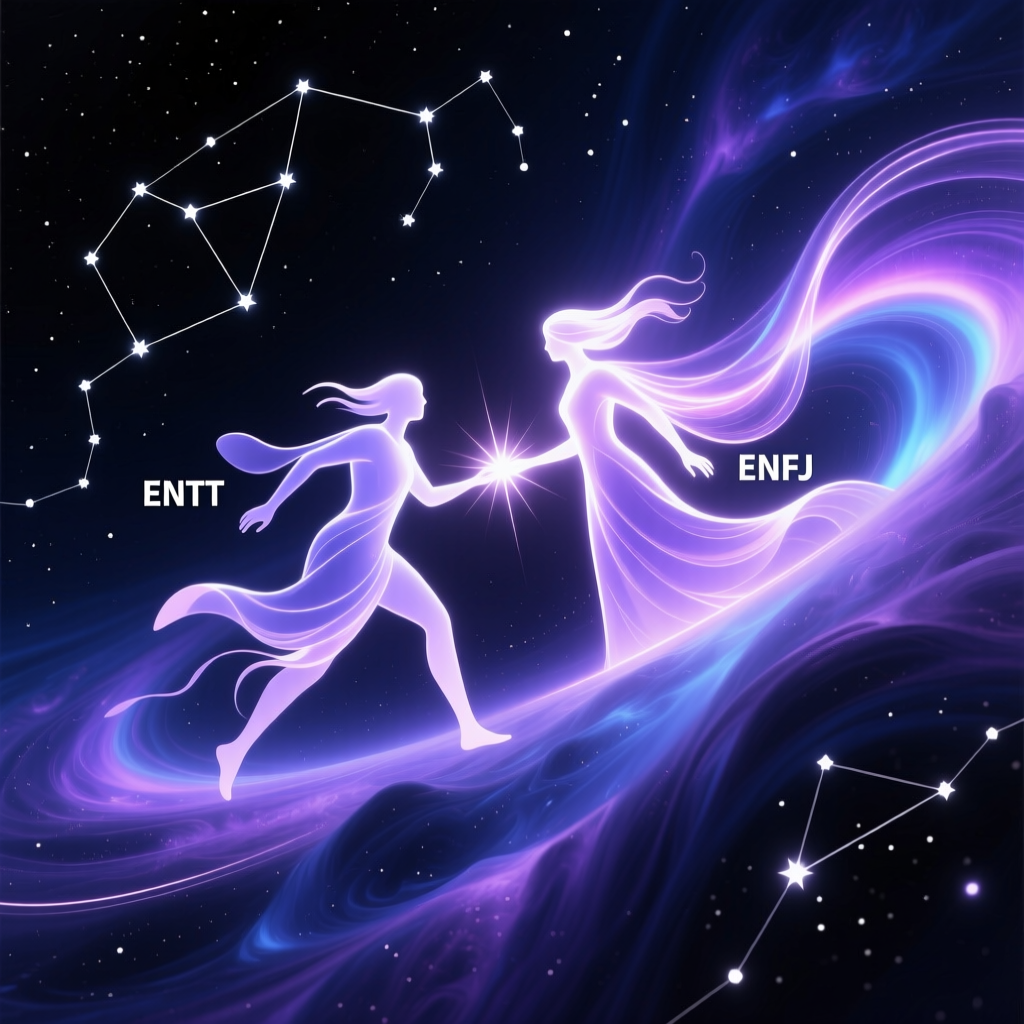
ENTP & ENFJ Relationship Dynamics: A Complete Compatibility Guide
When the inventive, debate-loving ENTP meets the charismatic, emotionally attuned ENFJ, the result is often a relationship crackling with intellectual energy and emotional depth. Both types share extroverted enthusiasm, intuitive big-picture thinking, and a genuine curiosity about the world and the people in it. Yet beneath these surface similarities lies a fascinating interplay of cognitive functions that can either forge an extraordinary bond or create unexpected friction.
Understanding the dynamics between an ENTP and an ENFJ requires more than surface-level personality descriptions. It demands a close look at how their cognitive functions interact, how they communicate, how they handle conflict, and how they support each other's growth across every area of life. Whether you are exploring a romantic partnership, a friendship, or a professional collaboration, this comprehensive guide will illuminate the strengths, challenges, and transformative potential of the ENTP-ENFJ connection.
Romantic Dynamics: Passion Meets Purpose
The romantic relationship between an ENTP and an ENFJ often begins with an electrifying spark. The ENTP's quick wit and unconventional ideas draw the ENFJ in, while the ENFJ's warmth, emotional intelligence, and genuine interest in people captivate the ENTP. This initial attraction is rooted in a shared love for exploration — the ENTP explores ideas and possibilities, while the ENFJ explores human potential and emotional landscapes.
The Honeymoon Phase and Beyond
In the early stages, this pairing thrives on stimulating conversation and shared adventures. The ENTP brings novelty and intellectual playfulness to the relationship, constantly proposing new experiences, debates, and hypothetical scenarios. The ENFJ contributes emotional richness, thoughtful gestures, and a deep desire to understand their partner on every level. Together, they create a relationship that feels both intellectually invigorating and emotionally fulfilling.
As the relationship matures, however, certain patterns begin to emerge. The ENTP's need for autonomy and spontaneous exploration may occasionally clash with the ENFJ's desire for emotional closeness and relational harmony. The ENFJ may sometimes feel that the ENTP treats emotional conversations like intellectual puzzles rather than opportunities for genuine vulnerability. Conversely, the ENTP may feel that the ENFJ's focus on feelings and interpersonal dynamics overanalyzes what they see as straightforward situations.
Emotional Intimacy and Growth
When both partners commit to understanding each other's emotional languages, the romantic bond deepens significantly. The ENFJ can teach the ENTP to slow down and sit with emotions rather than immediately intellectualizing them. In return, the ENTP helps the ENFJ develop a more objective perspective, reducing the tendency to absorb other people's emotional burdens. This mutual growth creates a partnership where both individuals become more well-rounded versions of themselves.
The ENFJ's natural inclination to nurture and support their partner aligns well with the ENTP's sometimes-hidden need for encouragement. While ENTPs project confidence and intellectual bravado, they often harbor insecurities about whether their ideas will materialize into meaningful outcomes. An emotionally attuned ENFJ partner can provide the validation and gentle accountability that helps the ENTP transform brilliant concepts into tangible achievements.
Friendship Patterns: The Dynamic Duo
As friends, ENTPs and ENFJs form a dynamic and highly visible pair. Their shared extroversion means they recharge through social interaction, and their intuitive nature ensures that their conversations never stay on the surface for long. A friendship between these two types often becomes the social hub of their wider circle, drawing others in with their infectious energy and engaging discussions.
Social Synergy
The ENTP-ENFJ friendship excels in social settings because each type brings complementary strengths. The ENFJ reads the room with remarkable accuracy, sensing who needs attention, who feels left out, and how to create an inclusive atmosphere. The ENTP, meanwhile, provides entertainment, stimulates group discussions with provocative ideas, and ensures that gatherings never become dull. Together, they create social experiences that are both meaningful and memorable.
Their friendship also benefits from a shared tolerance for complexity. While many people prefer simple, black-and-white answers, both the ENTP and the ENFJ are comfortable navigating ambiguity — albeit in different domains. The ENTP thrives in intellectual ambiguity, exploring multiple perspectives without rushing to conclusions. The ENFJ navigates emotional complexity, understanding that human feelings are rarely straightforward. This complementary comfort with nuance allows them to have rich, layered conversations that other personality types might find exhausting.
Loyalty and Longevity
One potential challenge in this friendship involves the ENTP's tendency to chase new interests and social circles while the ENFJ invests deeply in a smaller number of relationships. The ENFJ may sometimes feel that the ENTP's broad social net dilutes the friendship, while the ENTP may not realize that their ENFJ friend craves more dedicated one-on-one time. Open communication about expectations helps maintain the friendship's vitality over the long term.
When both friends prioritize the relationship, it becomes one of the most rewarding connections either type can experience. The ENFJ gains a friend who challenges their thinking and encourages intellectual risk-taking. The ENTP gains a friend who offers emotional honesty, unwavering support, and the kind of feedback that promotes genuine self-awareness. Explore more about ENTP relationship patterns to understand how this type builds lasting bonds.
Workplace Synergy: Innovation Guided by Vision
In professional settings, the ENTP-ENFJ pairing can be extraordinarily productive. The ENTP generates innovative solutions, identifies systemic inefficiencies, and challenges outdated practices with fearless intellectual honesty. The ENFJ motivates teams, aligns projects with meaningful purposes, and ensures that every team member feels valued and heard. When these strengths converge, the results are often transformative.
Leadership and Collaboration
The ENTP typically excels in roles that require creative problem-solving, strategic brainstorming, and conceptual development. They are the team member who sees possibilities where others see obstacles and who questions assumptions that everyone else takes for granted. The ENFJ shines in leadership, team coordination, mentoring, and any role that requires understanding and developing people. They create environments where talent flourishes and where team members feel personally invested in shared goals.
When an ENTP and an ENFJ collaborate on a project, the ENTP's ideation phase generates a wealth of possibilities, and the ENFJ's people-focused judgment helps determine which ideas will resonate most with stakeholders and team members. This combination of innovation and emotional intelligence creates proposals, products, and initiatives that are both creative and deeply human-centered.
Navigating Professional Tensions
Professional friction may arise when the ENTP's love of devil's advocacy conflicts with the ENFJ's preference for harmonious team dynamics. The ENTP may push back against ideas in meetings purely to stress-test them, not realizing that the ENFJ perceives this behavior as potentially demoralizing to the team. Conversely, the ENFJ's tendency to prioritize group cohesion over critical analysis may frustrate the ENTP, who values intellectual rigor above comfort.
Establishing clear norms around feedback and debate helps both types thrive professionally. When the ENTP understands that the ENFJ's concern for team morale is a strategic asset rather than a weakness, and when the ENFJ recognizes that the ENTP's challenging questions stem from a desire to improve outcomes rather than to undermine colleagues, a powerful professional synergy emerges. Discover more about ENFJ career strengths and how this type excels in collaborative environments.
Communication Styles: Bridging Head and Heart
Communication is both the greatest strength and the most significant growth area for the ENTP-ENFJ pairing. Both types are articulate, expressive, and eager to engage in meaningful dialogue. However, they approach communication from fundamentally different cognitive starting points, which can lead to misunderstandings if left unexamined.
The ENTP Communication Approach
The ENTP communicates primarily through extroverted intuition (Ne) supported by introverted thinking (Ti). This means they think out loud, generating ideas rapidly, making unexpected connections, and using debate as a tool for refining their understanding. Their communication style is often playful, provocative, and intellectually dense. They enjoy playing devil's advocate, not because they necessarily disagree, but because testing ideas from multiple angles is how they arrive at truth.
For the ENTP, a good conversation is one that expands possibilities and challenges assumptions. They may jump between topics, follow tangents, and revisit earlier points with new insights. This nonlinear communication style reflects their cognitive process but can sometimes overwhelm or confuse partners who prefer more structured, emotionally grounded dialogue.
The ENFJ Communication Approach
The ENFJ communicates through extroverted feeling (Fe) supported by introverted intuition (Ni). They are attuned to the emotional undertones of every conversation, reading body language, tone, and subtext with remarkable accuracy. Their communication style is warm, purposeful, and oriented toward mutual understanding and relational harmony. They seek conversations that deepen connections and align people around shared values.
For the ENFJ, a good conversation is one that builds trust, clarifies feelings, and moves the relationship forward. They may become frustrated when the ENTP treats emotionally significant topics with intellectual detachment or when debates feel like exercises in logic rather than genuine attempts at understanding.
Building a Shared Communication Language
The key to effective communication between these types lies in mutual adaptation. The ENTP can learn to preface debates with emotional check-ins, ensuring their partner feels heard before diving into intellectual sparring. Simple phrases like "I want to explore this idea with you" or "I'm thinking out loud, not arguing against you" can dramatically reduce misunderstandings.
The ENFJ can develop greater comfort with intellectual debate by recognizing that the ENTP's challenging questions are a form of engagement, not rejection. When the ENTP debates an idea, they are showing interest and investing mental energy — which is, in its own way, an expression of care. Understanding this fundamental difference in communication intent transforms potential conflicts into opportunities for deeper connection. For more insights, explore our guide on MBTI communication styles across all personality types.
Conflict Resolution: Turning Tension Into Growth
Conflict in an ENTP-ENFJ relationship tends to follow predictable patterns rooted in their cognitive function differences. Understanding these patterns is the first step toward transforming disagreements into catalysts for mutual growth and deeper understanding.
Common Conflict Triggers
The most frequent source of conflict involves emotional validation versus intellectual analysis. When the ENFJ expresses frustration or hurt, their instinct is to seek empathy and acknowledgment. The ENTP's instinct, however, is to analyze the problem, identify logical solutions, and offer practical advice. While the ENTP believes they are being helpful, the ENFJ may feel dismissed or unheard because their emotional experience was not validated before solutions were offered.
Another common trigger involves social energy allocation. The ENFJ may feel hurt when the ENTP pursues independent interests or socializes with other groups without including them. The ENTP, who naturally distributes their social energy across many relationships and activities, may not realize that the ENFJ interprets this behavior as a sign of declining interest or commitment.
Resolution Strategies That Work
Effective conflict resolution for this pairing begins with the ENTP learning to lead with empathy. Before offering analysis or solutions, the ENTP should acknowledge their partner's feelings with genuine warmth: "I can see this really matters to you, and I want to understand how you're feeling." This single shift dramatically reduces the escalation of conflicts and helps the ENFJ feel safe enough to engage in the rational discussion that the ENTP naturally gravitates toward.
The ENFJ, in turn, benefits from expressing needs directly rather than expecting the ENTP to intuit emotional undercurrents. While the ENFJ's Fe makes them highly sensitive to others' emotions, the ENTP's cognitive stack does not prioritize emotional detection in the same way. Clear, direct statements like "I need reassurance right now" or "I'm not looking for a solution — I just need you to listen" give the ENTP the concrete guidance they need to respond supportively.
Both partners should also establish a cooling-off protocol for heated disagreements. The ENTP may want to continue debating until a resolution is reached, while the ENFJ may need time to process emotions before engaging productively. Agreeing in advance that either partner can call for a brief pause — with a commitment to return to the conversation within a specified timeframe — prevents both the ENTP's tendency to argue endlessly and the ENFJ's tendency to withdraw emotionally. Learn more about conflict resolution across personality types for additional strategies.
Cognitive Function Interplay: The Engine Beneath the Surface
To truly understand ENTP-ENFJ dynamics, we must examine the cognitive functions that drive each type's perception, decision-making, and behavior. This deeper analysis reveals why these types are simultaneously drawn to and challenged by each other.
The ENTP Cognitive Stack
The ENTP operates with extroverted intuition (Ne) as their dominant function, generating a constant stream of possibilities, patterns, and connections. Their auxiliary function, introverted thinking (Ti), provides an internal logical framework for evaluating these ideas. Their tertiary function, extroverted feeling (Fe), is developing and represents their growing awareness of social dynamics and others' emotions. Their inferior function, introverted sensing (Si), can manifest as occasional nostalgia or resistance to routine.
The ENFJ Cognitive Stack
The ENFJ leads with extroverted feeling (Fe), making them exquisitely attuned to group harmony, emotional atmospheres, and interpersonal needs. Their auxiliary function, introverted intuition (Ni), provides visionary insight and the ability to foresee long-term implications. Their tertiary function, extroverted sensing (Se), gives them an appreciation for aesthetic experiences and present-moment engagement. Their inferior function, introverted thinking (Ti), can emerge as occasional self-doubt about their logical competence or as sudden bursts of hypercritical analysis.
Where Functions Align and Clash
The most significant alignment occurs between the ENTP's tertiary Fe and the ENFJ's dominant Fe. Both types value social harmony and care about the impact of their actions on others, but the ENFJ accesses this function with far greater fluency and consistency. This creates a mentoring dynamic where the ENFJ can help the ENTP develop their emotional intelligence, while the ENTP helps the ENFJ strengthen their underdeveloped Ti through rigorous intellectual discourse.
The ENTP's dominant Ne and the ENFJ's auxiliary Ni create a fascinating complementary tension. Ne expands outward, generating ever more possibilities and resisting premature closure. Ni converges inward, synthesizing information into singular insights and long-term visions. When these functions work in harmony, the ENTP opens up a landscape of possibilities, and the ENFJ identifies the most meaningful path through that landscape. When they clash, the ENTP may view the ENFJ as too narrow or decisive, while the ENFJ may see the ENTP as unfocused or perpetually distracted by the next shiny idea.
The ENTP's auxiliary Ti and the ENFJ's inferior Ti represent another crucial interaction point. The ENTP's strong logical framework can either intimidate the ENFJ's developing analytical side or serve as a supportive scaffold for their growth. When the ENTP patiently engages the ENFJ in logical analysis without condescension, the ENFJ gains confidence in their rational capabilities. When the ENTP uses Ti to dismantle the ENFJ's values-based arguments, however, the ENFJ may feel fundamentally misunderstood and retreat emotionally.
Practical Tips for a Thriving ENTP-ENFJ Relationship
Understanding the dynamics is only the beginning. Here are actionable strategies that both types can implement to strengthen their connection and navigate challenges with grace and intention.
For the ENTP
- Practice emotional presence: Before responding to your ENFJ partner's concerns with analysis or solutions, pause and acknowledge their feelings. A simple "That sounds really difficult" communicates more support than a ten-point action plan.
- Provide consistent reassurance: Your ENFJ partner thrives on knowing they matter to you. Express appreciation regularly, both verbally and through thoughtful actions that demonstrate you have been paying attention to their needs.
- Embrace depth over breadth: While your natural inclination is to explore many interests and social connections, invest deliberately in deepening your bond with your ENFJ partner. Dedicate regular, distraction-free time to meaningful one-on-one interaction.
- Soften your debate style: Intellectual sparring is your love language, but your ENFJ partner may experience it as criticism or rejection. Frame your challenges as collaborative explorations rather than adversarial arguments.
- Follow through on commitments: Your enthusiasm for new ideas sometimes outpaces your follow-through. Demonstrating reliability in small, everyday matters builds the trust that allows the relationship to flourish.
For the ENFJ
- Communicate needs explicitly: Your ENTP partner is not naturally attuned to emotional subtext. Rather than expecting them to read between the lines, state your needs clearly and directly.
- Appreciate intellectual engagement as affection: When your ENTP partner debates with you or shares their latest intellectual obsession, recognize this as their way of including you in their inner world.
- Allow space for independence: Your ENTP partner needs freedom to explore ideas, pursue interests, and maintain diverse social connections. Trust that their independence strengthens rather than threatens the relationship.
- Develop comfort with productive conflict: Not every disagreement signals a threat to the relationship. Learn to distinguish between the ENTP's intellectual challenging and genuine relational discord.
- Set boundaries around emotional labor: Your natural tendency to care for others can lead to exhaustion. Communicate when you need your ENTP partner to step up emotionally, and be specific about what support looks like for you.
For Both Partners
- Create shared rituals: Establish regular practices that strengthen your bond, whether it is a weekly deep-conversation evening, a shared creative project, or a tradition of exploring new experiences together.
- Celebrate complementary strengths: Rather than focusing on where your partner falls short, actively appreciate the qualities they bring that balance your own tendencies.
- Invest in mutual learning: Read books, attend workshops, or explore MBTI compatibility resources together to deepen your understanding of each other's cognitive patterns.
- Practice patience with growth: Both types have areas of relative weakness — the ENTP in emotional attunement, the ENFJ in detached analysis. Support each other's development with compassion rather than criticism.
Frequently Asked Questions
Are ENTPs and ENFJs compatible in long-term relationships?
ENTPs and ENFJs can be highly compatible in long-term relationships when both partners commit to understanding and accommodating each other's differences. Their shared extroversion, intuitive worldview, and developing feeling functions create a strong foundation for mutual growth. The relationship succeeds when the ENTP cultivates emotional sensitivity and the ENFJ develops comfort with intellectual debate. With conscious effort, this pairing often produces a partnership that is both intellectually stimulating and emotionally fulfilling, with each partner helping the other develop their less dominant cognitive functions.
What are the biggest challenges in an ENTP-ENFJ relationship?
The most significant challenges typically involve emotional communication and conflict styles. The ENTP's tendency to intellectualize emotions can leave the ENFJ feeling unheard or invalidated, while the ENFJ's focus on relational harmony may feel restrictive to the freedom-loving ENTP. The ENTP's debate-oriented communication style may overwhelm the ENFJ, who processes disagreements through an emotional lens. Additionally, the ENTP's broad distribution of social energy may trigger the ENFJ's need for focused, dedicated attention. Addressing these challenges requires open dialogue, mutual adaptation, and a willingness to step outside each type's comfort zone.
How do ENTPs and ENFJs handle conflict differently?
ENTPs approach conflict as an intellectual puzzle to be solved, using logic, analysis, and debate to identify the root cause and generate solutions. They tend to separate the issue from the relationship, viewing disagreements as opportunities for improvement rather than threats to the bond. ENFJs, by contrast, experience conflict through an emotional lens, prioritizing the relational impact of the disagreement and seeking emotional validation before moving toward resolution. The ENFJ wants to feel heard and understood before engaging in problem-solving, while the ENTP wants to solve the problem as a pathway to restoring harmony. Recognizing and respecting these different approaches is essential for productive conflict resolution.
Can an ENTP-ENFJ friendship evolve into a romantic relationship?
The ENTP-ENFJ friendship provides an excellent foundation for a romantic relationship because it is typically built on genuine intellectual respect, shared values around growth and exploration, and strong communication habits. The transition from friendship to romance often occurs naturally as both types deepen their emotional investment and begin to appreciate the complementary qualities the other brings to their life. The ENFJ's warmth and emotional depth gradually draw the ENTP into greater vulnerability, while the ENTP's intellectual excitement and encouragement help the ENFJ feel seen and challenged in invigorating ways. The key to a successful transition is honest communication about changing feelings and expectations, ensuring that both partners are moving forward together with clarity and mutual enthusiasm.
Whether you are an ENTP curious about your ENFJ partner, an ENFJ seeking to understand your ENTP friend, or simply exploring the rich landscape of MBTI compatibility, the ENTP-ENFJ connection offers remarkable potential for growth, joy, and mutual transformation. By honoring each other's cognitive strengths, communicating with intention and compassion, and embracing the beautiful complexity of your differences, you can build a relationship that brings out the very best in both types.