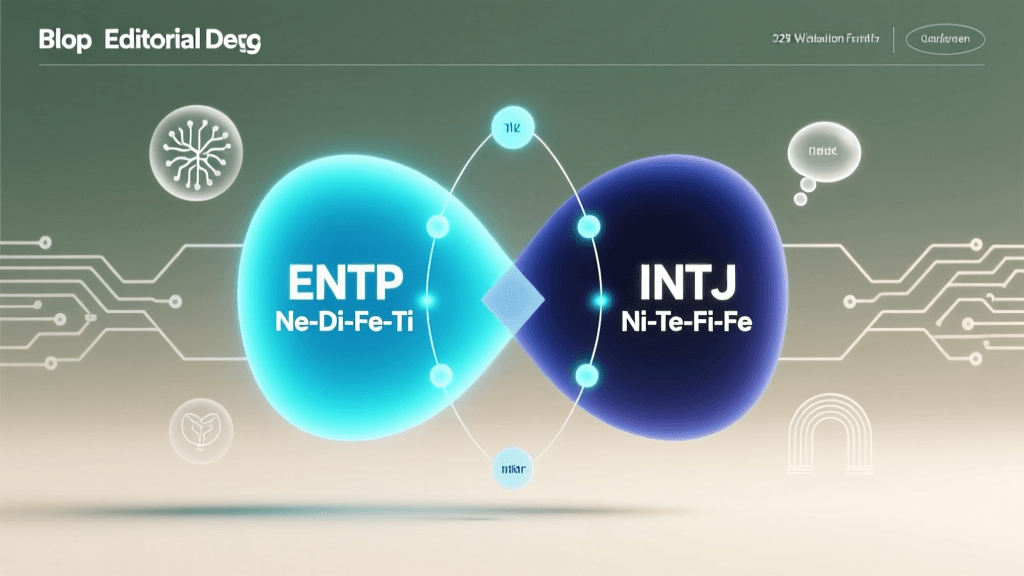
ENTP Cognitive Stack Overview
The ENTP personality type—often dubbed the 'Debater' or 'Inventor'—is defined by a dynamic, outwardly exploratory cognitive stack rooted in extraverted intuition (Ne) as its dominant function. This primary mode of perception fuels an insatiable curiosity, pattern recognition across disparate domains, and a relentless drive to generate possibilities. ENTPs don’t just see what *is*; they instantly perceive what *could be*, what *might contradict it*, and what *hasn’t been considered yet*. Their mental energy is directed outward—toward ideas, debates, systems, and future potentials.
Their auxiliary function is introverted thinking (Ti), which serves as a rigorous internal logic engine. Ti allows ENTPs to deconstruct arguments, refine concepts, and build precise, self-consistent mental models. While Ne casts a wide net of hypotheses, Ti acts as the filter—testing, comparing, and discarding inconsistencies with surgical precision. This pairing makes ENTPs exceptionally adept at intellectual sparring, innovation, and conceptual problem-solving—but can also lead to over-analysis, premature dismissal of emotional nuance, or difficulty committing to a single path when alternatives remain tantalizingly open.
Their tertiary function is extraverted feeling (Fe), which matures later in life (typically post-30s) and manifests as situational social awareness, diplomatic phrasing, and a desire to harmonize group dynamics—not out of deep emotional attunement, but as a strategic tool to keep conversations flowing and ideas circulating. Under stress, however, Fe can become volatile: ENTPs may swing between performative charm and blunt, tactless criticism when their Ti-Ne loop dominates.
Finally, the inferior function is introverted sensing (Si). This is the Achilles’ heel—the unconscious, often repressed anchor to past experience, bodily sensation, routine, and concrete detail. When overwhelmed or insecure, ENTPs may experience Si-related stress responses: obsessive rumination on past mistakes, hyperfocus on minor physical discomforts (e.g., fatigue, diet, health metrics), or sudden rigidity around trivial habits. Healthy integration of Si involves learning to ground abstract visions in tangible steps, honoring bodily signals, and appreciating the stabilizing value of consistency—not as constraint, but as scaffolding for innovation.
INTJ Cognitive Stack Overview
The INTJ—commonly known as the 'Architect' or 'Mastermind'—operates from a deeply structured, future-oriented cognitive architecture anchored by introverted intuition (Ni) as its dominant function. Unlike ENTP’s expansive Ne, Ni works like a convergent lens: it synthesizes vast amounts of information into singular, long-term insights or 'visions'. INTJs don’t brainstorm endlessly—they incubate. They absorb data quietly, detect underlying patterns, and arrive at conclusions that feel inevitable, even if initially inexplicable. This gives them extraordinary strategic foresight and an uncanny ability to anticipate consequences several moves ahead.
Their auxiliary function is extraverted thinking (Te), which executes Ni’s insights with efficiency, objectivity, and systemic rigor. Te organizes resources, optimizes processes, delegates tasks, and measures outcomes against clear benchmarks. It’s the engine that transforms vision into action—and makes INTJs formidable project leaders, analysts, and reformers. However, Te can override interpersonal nuance when efficiency becomes the sole metric, leading to perceived coldness or impatience with 'inefficient' emotional processing.
Tertiary introverted feeling (Fi) emerges more consciously in midlife and represents the INTJ’s private values core—their internal moral compass, authenticity standards, and deeply held ideals about integrity, competence, and meaning. Fi is rarely expressed overtly but surfaces in strong reactions to hypocrisy, injustice, or violations of personal ethics. When underdeveloped, Fi may appear as passive-aggressive withdrawal or sudden, disproportionate emotional outbursts after prolonged suppression.
Inferior extraverted sensing (Se) is the INTJ’s point of greatest vulnerability—and potential growth. Se governs real-time sensory engagement: presence in the physical world, aesthetic responsiveness, spontaneous action, and embodied awareness. Under chronic stress, INTJs may overindulge Se (e.g., binge-watching, reckless driving, impulsive spending) or reject it entirely (e.g., ignoring hunger, neglecting appearance, dismissing 'superficial' details). Mature Se integration looks like mindful presence during meetings, appreciation for design and craftsmanship, and the ability to pivot gracefully when reality contradicts the plan.
Where Functions Align
At first glance, ENTP and INTJ appear oppositional—Ne vs. Ni, Ti vs. Te—but their cognitive stacks contain profound, high-leverage points of alignment that form the bedrock of mutual respect and intellectual synergy.
Ni-Ne Symbiosis: Though opposites in direction (introverted vs. extraverted), Ni and Ne are both intuitive functions—and thus speak the same 'language' of possibility, abstraction, and systemic implication. ENTPs generate dozens of futures; INTJs select and refine one into a viable blueprint. This creates a powerful ideation-execution loop: the ENTP’s Ne rapidly stress-tests the INTJ’s Ni vision (“What if regulation changes? What if user behavior shifts? What if this tech becomes obsolete in 18 months?”), while the INTJ’s Ni provides coherence and long-term viability to the ENTP’s flurry of options. Research from the Myers & Briggs Foundation confirms that intuitive types—regardless of orientation—share a preference for conceptual complexity over concrete detail, enabling unusually deep metacognitive rapport.
Ti-Te Complementarity: While Ti (ENTP) seeks internal logical consistency and Te (INTJ) prioritizes external effectiveness, they converge on a shared reverence for rationality, evidence, and precision. An ENTP will challenge an INTJ’s assumption not to undermine it—but to fortify it. The INTJ, in turn, respects the ENTP’s Ti-driven scrutiny as a quality-control mechanism. In collaborative settings, this manifests as iterative refinement: the INTJ drafts a strategy; the ENTP pressure-tests every link in the causal chain; the INTJ revises with tighter logic and clearer metrics; the ENTP proposes alternative KPIs or risk-mitigation scenarios. Neither feels threatened—their shared commitment to truth overrides ego.
Shared Disdain for Inefficiency: Both types abhor arbitrary rules, bureaucratic inertia, and unexamined tradition. Their auxiliary/tertiary functions (Ti/Te and Ni/Fe respectively) coalesce into a potent aversion to 'doing things the way they’ve always been done.' This alignment fosters rapid trust in professional contexts—especially in startups, R&D, policy reform, or academic research—where dismantling outdated paradigms is the core mission.
Where Functions Clash
Despite strong alignment on higher-order cognition, friction arises predictably at the level of process, pace, and emotional calibration—rooted in fundamental functional mismatches.
Ne vs. Ni: Divergence vs. Convergence Under Pressure
When deadlines loom or stakes rise, ENTPs widen their Ne aperture—generating more angles, contingencies, and 'what ifs'—while INTJs narrow their Ni focus—consolidating variables, pruning options, and doubling down on the optimal path. To the ENTP, the INTJ appears prematurely closed-off, dogmatic, or dismissive of valid edge cases. To the INTJ, the ENTP seems indecisive, distractible, or unwilling to commit to a course of action. A 2021 study published in the Educational and Psychological Measurement journal found that intuitive-perceiving (NP) and intuitive-judging (NJ) types exhibit statistically significant differences in decision-making latency under ambiguity—NPs average 37% more time exploring alternatives before selecting, while NJs prioritize speed-to-resolution once a viable model is formed.
Ti vs. Te: Internal Logic vs. External Metrics
ENTPs use Ti to validate ideas against personal epistemic standards (“Does this hold up in my mental model?”), whereas INTJs use Te to validate against empirical outcomes and systemic impact (“Does this move the needle on our KPIs?”). This leads to recurring tension in implementation phases: the ENTP may resist adopting a 'good enough' Te-optimized solution because it violates an elegant Ti principle—even if it delivers results faster. Conversely, the INTJ may discard a Ti-refined concept as 'theoretically sound but operationally unscalable' without fully engaging its underlying architecture. Neither is wrong—but without explicit translation, each perceives the other as irrational.
Inferior Si vs. Inferior Se: Grounding Gaps
Both types struggle with sensory grounding—but in inverse ways. The ENTP’s inferior Si manifests as chronic underestimation of logistical realities: forgetting to charge devices, missing dietary needs during ideation binges, or misjudging timelines due to poor historical recall. The INTJ’s inferior Se shows up as disconnection from immediate context: walking into meetings unaware of room temperature or participant body language, overlooking typos in final deliverables, or failing to notice a colleague’s visible stress cues. Together, these blind spots compound—creating 'grounding black holes' where practical execution consistently falters unless deliberately scaffolded.
The Hidden Resonances (Tertiary/Inferior Function Connections)
Beneath the headline Ni-Ne and Ti-Te dynamics lie subtler, often overlooked resonances between tertiary and inferior functions—connections that, when acknowledged, unlock surprising depth and resilience in ENTP–INTJ relationships.
ENTP’s Tertiary Fe ↔ INTJ’s Tertiary Fi
Though seemingly opposite (extraverted feeling vs. introverted feeling), Fe and Fi form a quiet bridge of values-based alignment. The ENTP’s Fe—when mature—seeks harmony through intellectual inclusivity: ensuring all voices are heard in debate, reframing criticism constructively, and using humor to diffuse tension. The INTJ’s Fi—when integrated—demands authenticity, fairness, and principled consistency. These converge in shared intolerance for manipulation, dishonesty, or power imbalances. An ENTP won’t tolerate an INTJ gaslighting a teammate; an INTJ won’t abide an ENTP using rhetorical skill to win an argument devoid of integrity. This creates a robust ethical firewall—a 'mutual accountability pact' that strengthens trust far beyond intellectual compatibility.
ENTP’s Inferior Si ↔ INTJ’s Inferior Se: The Grounding Mirror
This is perhaps the most transformative hidden resonance. Because their inferior functions are direct opposites (Si = internal sensory memory; Se = external sensory immediacy), ENTPs and INTJs can serve as each other’s grounding partners—if intentional. The ENTP, attuned to past patterns and routine, can gently remind the INTJ: “You skipped lunch again—your focus drops after 3 p.m. without protein,” or “Last time you ignored sleep before the board meeting, your delivery was flat.” Conversely, the INTJ, attuned to present-moment sensory data, can anchor the ENTP: “Your voice just got quieter—that usually means you’re disengaging. What’s the disconnect?” or “The client shifted posture when you mentioned budget—let’s pause and explore that.” This isn’t about fixing each other; it’s about *functional delegation*: leveraging the other’s strength where your own is weakest.
A Structured Comparison: Cognitive Function Interaction Matrix
| ENTP Function | INTJ Function | Interaction Type | Manifestation (Healthy) | Risk (Stressed) |
|---|---|---|---|---|
| Dominant: Ne | Dominant: Ni | Symbiotic Ideation | ENTP generates 12 scenarios → INTJ identifies the 1 with highest leverage → ENTP stress-tests it → refined vision emerges | ENTP floods with options → INTJ shuts down → both accuse the other of 'not listening' |
| Auxiliary: Ti | Auxiliary: Te | Complementary Rigor | Ti refines conceptual integrity; Te validates real-world efficacy → dual-quality assurance | Ti rejects Te’s 'pragmatic compromise' as illogical; Te dismisses Ti’s 'theoretical purity' as irrelevant |
| Tertiary: Fe | Tertiary: Fi | Values Alignment | Shared commitment to fairness, intellectual honesty, and respectful discourse—even in disagreement | ENTP uses Fe to manipulate consensus; INTJ weaponizes Fi to morally isolate dissenters |
| Inferior: Si | Inferior: Se | Grounding Mirror | ENTP remembers follow-up dates & past commitments; INTJ notices nonverbal cues & environmental shifts → joint operational stability | ENTP obsesses over minor past errors; INTJ impulsively overcorrects with sensory indulgence (e.g., quitting caffeine cold turkey) |
Leveraging Cognitive Diversity
Compatibility isn’t about similarity—it’s about *orchestrated differentiation*. Here’s how ENTP–INTJ pairs can intentionally harness their cognitive diversity:
1. Co-Design a 'Function Handoff Protocol'
Create explicit agreements for when each person takes the lead based on functional strength—not role or title. Example protocol:
- Ideation Phase: ENTP owns Ne generation (brainstorming sessions, trend analysis, competitor scenario mapping). INTJ observes silently, taking notes—not to evaluate, but to identify emerging Ni patterns.
- Strategy Phase: INTJ owns Ni synthesis (drafting the 3-year vision, defining success metrics, sequencing milestones). ENTP reviews with Ti—asking 'What assumptions must hold true?' and 'What single variable would collapse this model?'
- Execution Phase: INTJ owns Te deployment (resource allocation, timeline enforcement, accountability tracking). ENTP owns Fe calibration—checking team morale, reframing setbacks constructively, and maintaining psychological safety during pivots.
- Review Phase: Both engage Si/Se intentionally: ENTP documents lessons learned (Si) and INTJ conducts a 'sensory audit' (Se)—e.g., 'What did we ignore in the environment that mattered?'
2. Institute 'Function Translation Time'
Set aside 15 minutes weekly to translate each other’s functional language. When an ENTP says, 'This feels off,' they mean: 'My Ti detected an inconsistency in the underlying logic.' When an INTJ says, 'We need to accelerate,' they mean: 'My Ni sees a narrowing window where this vision remains viable.' Practice stating the functional root *before* the conclusion: 'From my Ti perspective…', 'Based on my Ni projection…', 'My Fe is flagging tension in the room…'. This prevents misattribution of motive.
3. Build Shared Grounding Rituals
Counteract mutual inferior-function fragility with co-created routines:
- The 5-Minute Sensory Sync: Before high-stakes meetings, spend 5 minutes together noticing concrete inputs: 'What’s one thing you see, hear, and feel right now?' Activates Se for INTJ and Si for ENTP simultaneously.
- The Timeline Anchor: Use physical tools—whiteboards with color-coded deadlines, printed milestone calendars, or shared Notion dashboards with progress bars. Makes Ni/Ne abstractions tangible.
- The 'Past-Present-Future' Retrospective: After projects, review: (1) What past data informed our approach? (Si), (2) What present signals did we respond to—or miss? (Se), (3) What future implications does this have? (Ni/Ne). Ensures all four inferior/tertiary functions get airtime.
4. Normalize 'Function Fatigue' Signals
Agree on non-shaming signals when cognitive overload hits:
- ENTP says 'I need to wander' → means Ne is saturated; needs unstructured walk to reset.
- INTJ says 'I need silence for 90 minutes' → means Ni is over-incubating; needs Te-execution space.
- Both agree: If either uses sarcasm, abrupt topic shifts, or excessive jargon, it’s a sign Ti/Te has hijacked Fe/Fi—and it’s time for a 10-minute pause.
As noted by cognitive psychologist Dr. Dario Nardi in his neuroimaging work with MBTI types, Neuroscience of Personality, 'The most resilient type pairings aren’t those with matching stacks—but those who develop mutual fluency in each other’s neural pathways.' ENTP–INTJ pairs, when intentional, achieve precisely this fluency.
FAQ
Can ENTP and INTJ have a successful romantic relationship?
Yes—with higher-than-average potential for intellectual intimacy and mutual growth, provided both prioritize functional literacy over romantic idealism. Their shared love of ideas creates deep connection, but romance requires deliberate cultivation of Fe (ENTP) and Fi (INTJ) to meet emotional needs beyond stimulation. Successful couples establish 'non-negotiables' for emotional presence: scheduled device-free time, explicit check-ins ('How connected do you feel right now, 1–10?'), and shared creative projects (e.g., writing a speculative fiction story together—activating Ne, Ni, Ti, and Te in tandem). Avoid letting debate replace vulnerability.
Why do ENTPs and INTJs often clash at work despite being 'strategic thinkers'?
Because 'strategic' means different things cognitively: ENTP strategy is adaptive possibility-space expansion; INTJ strategy is convergent path-optimization. Clashes occur when the ENTP’s Ne-driven 'What if we tried X, Y, and Z?' is misread by the INTJ as indecision, rather than risk-mitigation. Conversely, the INTJ’s Ni-driven 'We execute Plan A, no deviations' is misread by the ENTP as authoritarian rigidity, rather than fidelity to a validated model. Solution: Adopt a 'Two-Track Strategy Framework'—one track for core vision (INTJ-led Ni/Te), one for innovation pipeline (ENTP-led Ne/Ti)—with quarterly integration points.
How do ENTP and INTJ handle conflict differently—and how can they bridge it?
ENTPs engage conflict as intellectual sparring (Ti-Ne): they escalate quickly to test ideas, then disengage just as fast when bored or convinced. INTJs withdraw to process (Ni-Te): they go silent to analyze root causes, then re-engage with a structured solution. This creates a 'push-pull rupture'—ENTP perceives silence as rejection; INTJ perceives rapid-fire debate as unserious. Bridge with a 'Conflict Protocol': (1) ENTP agrees to pause after 3 points and ask, 'What’s your Ni seeing here?'; (2) INTJ agrees to verbalize their processing in real-time ('I’m running three scenarios—here’s the weakest link I’m probing…'). This honors both styles.
What’s the biggest growth opportunity for ENTP–INTJ pairs?
Developing shared fluency in their inferior functions—Si and Se—to build operational resilience. Most ENTP–INTJ partnerships fail not from intellectual mismatch, but from chronic execution decay: missed deadlines, forgotten commitments, burnout from sensory neglect. The highest-return investment is co-building a 'Grounding Infrastructure': shared digital calendars with automated reminders (Si), bi-weekly 'sensory check-in' walks (Se), and quarterly 'past-present-future' reviews. As organizational psychologist Adam Grant emphasizes in Think Again, 'The most innovative teams aren’t those with the best ideas—they’re those with the best systems for turning insight into impact.' For ENTP–INTJ pairs, that system starts with honoring the body, the moment, and the record of what came before.