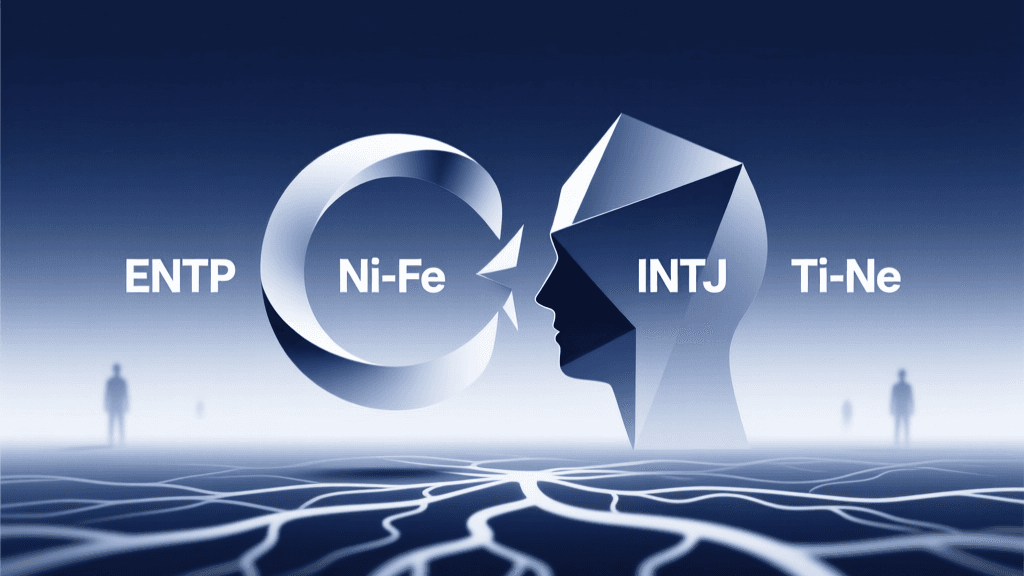
How ENTP Handles Conflict
The ENTP (Extraverted, Intuitive, Thinking, Perceiving) personality type approaches conflict not as a threat but as an intellectual sparring match — a dynamic arena for testing ideas, exposing flaws in logic, and refining truth through vigorous debate. Rooted in their dominant Extraverted Thinking (Te) and auxiliary Introverted Intuition (Ni), ENTPs engage conflict with rapid-fire reasoning, playful provocation, and a strong aversion to stagnation or unexamined assumptions. They rarely take disagreement personally; instead, they interpret opposition as an invitation to sharpen their arguments or uncover hidden contradictions.
However, this strength becomes a liability when emotional subtext is involved. ENTPs often misread silence, withdrawal, or measured tone as disengagement rather than processing — especially with types like INTJ who require internal synthesis before responding. Their tertiary Extraverted Sensing (Se) can fuel impulsive retorts or sarcasm under stress, while their inferior Introverted Feeling (Fi) may erupt unexpectedly as defensiveness or moral indignation if they feel unfairly labeled or dismissed. As psychologist Linda V. Berens notes in Understanding Yourself and Others: An Introduction to the Personality Type Code, "ENTPs use debate to explore possibilities — but others may experience it as destabilizing when their values or identity feel implicitly challenged."https://www.capt.org/books/understanding-yourself-and-others.htm
In practice, an ENTP’s conflict behavior follows a recognizable rhythm: initiate with curiosity (“Wait — why do you believe that?”), escalate through rapid counterpoints and hypothetical reframing (“What if the opposite were true?”), then pivot toward resolution by proposing alternatives or reframing the issue entirely. They rarely hold grudges — but they also rarely pause to acknowledge emotional impact unless explicitly guided to do so.
How INTJ Handles Conflict
The INTJ (Introverted, Intuitive, Thinking, Judging) engages conflict with surgical precision, strategic patience, and a deep commitment to long-term coherence. Their dominant Introverted Intuition (Ni) scans for underlying patterns, systemic implications, and future consequences of any disagreement. Their auxiliary Extraverted Thinking (Te) then marshals evidence, structures arguments, and deploys logic with disciplined economy. Unlike the ENTP’s improvisational energy, the INTJ prefers to enter conflict only after internal calibration — often delaying response until they’ve modeled outcomes, weighed trade-offs, and identified the most efficient path to resolution.
This deliberate pace is frequently misinterpreted by ENTPs as coldness, resistance, or passive aggression. In reality, the INTJ is protecting cognitive bandwidth: Ni-Te users exhaust quickly in emotionally volatile exchanges and prioritize clarity over speed. Their tertiary Introverted Feeling (Fi) surfaces subtly — as intensified conviction around core principles, quiet disappointment when trust is breached, or rigid adherence to self-defined standards of integrity. Under stress, inferior Extraverted Sensing (Se) may manifest as hyperfocus on minor logistical flaws (“You missed three data points in Slide 7”) or abrupt, detail-oriented criticism that feels disproportionately harsh.
According to research published by the Center for Applications of Psychological Type (CAPT), INTJs report significantly higher preference for “task-focused resolution” over “relationship-focused repair” — meaning they assume resolving the factual disagreement *is* resolving the relationship tension.https://www.capt.org/research/publications/mbti-manual-third-edition This assumption creates fertile ground for misunderstanding with ENTPs, whose relational safety hinges on verbal acknowledgment, mutual laughter, or spontaneous idea-bonding — even mid-disagreement.
The ENTP and INTJ Conflict Cycle
No MBTI pairing exemplifies the “brilliant friction” archetype more vividly than ENTP and INTJ. Both share dominant and auxiliary functions in reverse order — ENTP: Ne-Te-Fi-Se; INTJ: Ni-Te-Fi-Se. This shared Te-Fi-Ne-Ni stack yields extraordinary intellectual synergy *and* profound structural tension. Their conflict cycle is not random — it follows a predictable, recursive loop rooted in function mismatch and timing divergence:
- Trigger Phase: ENTP proposes a novel idea or challenges an existing framework (Ne-driven). INTJ perceives logical gaps or implementation risks (Ni-Te assessment) and responds with a concise, corrective statement (“That overlooks scalability constraints.”).
- Misinterpretation Phase: ENTP hears critique as dismissal and counters with rapid ideation (“What if we decouple the variables first?”). INTJ interprets this as avoidance of rigor and doubles down on structural analysis.
- Escalation Spiral: ENTP increases rhetorical velocity and humor to regain engagement; INTJ withdraws verbally to reprocess, appearing detached. ENTP perceives withdrawal as rejection; INTJ perceives ENTP’s persistence as disrespectful of cognitive boundaries.
- Stalemate: Communication halts. ENTP seeks external validation or reframes the issue entirely. INTJ documents inconsistencies and prepares a formal rebuttal or exit strategy.
- Repair Attempt: One initiates — ENTP with an olive-branch joke or new angle; INTJ with a written summary and proposed action plan. If mismatched in delivery, cycle repeats.
This cycle isn’t pathological — it’s functional divergence. As Jungian scholar John Beebe emphasizes in Energies and Patterns in Psychological Type, “Opposing attitudes of perception (Ne vs. Ni) don’t cancel each other out — they create a dialectical engine. The task is not to eliminate the tension, but to harness its generative force.”https://www.routledge.com/Energies-and-Patterns-in-Psychological-Type-The-Reservoir-of-the-Unconscious/Beebe/p/book/9781138645085
Escalation Patterns
While both types prize rationality, their escalation paths diverge sharply — making de-escalation efforts ineffective if applied generically. Below is a comparative breakdown of high-risk escalation markers and their functional origins:
| Behavior | ENTP Escalation Pattern | INTJ Escalation Pattern | Cognitive Root |
|---|---|---|---|
| Communication Speed | Accelerates dramatically — more examples, faster pivots, overlapping speech | Slows or stops entirely — pauses lengthen, responses become monosyllabic or delayed | ENTP: Ne-Te overdrive seeking resolution via volume of options INTJ: Ni-Te overload triggering Se-inferior shutdown |
| Tone Shift | Sarcasm intensifies; humor turns edged (“Oh, so we’re optimizing for theoretical purity now?”) | Language grows hyper-literal; metaphors vanish; syntax tightens (“Per your earlier statement on X, Y contradicts Z.”) | ENTP: Fi inferior surfacing as wounded irony INTJ: Fi inferior emerging as rigid moral framing |
| Engagement Strategy | Brings in third parties (“Let’s ask Sam what they think”) or shifts topic to analogous systems | Withdraws to write, diagram, or simulate outcomes independently | ENTP: Se tertiary seeking real-time feedback loops INTJ: Ni dominant requiring internal modeling space |
| Physical Cues | Fidgeting, leaning forward, rapid gestures, smiling tightly | Still posture, minimal eye contact, controlled breathing, note-taking | Both reflect Se-inferior stress responses — outward kinetic release (ENTP) vs. inward somatic containment (INTJ) |
Crucially, neither pattern is “wrong” — but without mutual recognition, each interprets the other’s escalation as hostility. The ENTP reads INTJ stillness as contempt; the INTJ reads ENTP animation as mockery. Recognizing these as neurocognitive signatures — not character flaws — is the first step toward intervention.
Repair and Reconciliation
Effective repair between ENTP and INTJ requires abandoning generic “I’m sorry” scripts in favor of functionally resonant gestures. Apologies must satisfy both Te’s demand for precision *and* Fi’s need for authenticity — while honoring Ne’s love of novelty and Ni’s desire for long-term alignment.
Actionable Repair Protocols
- For the ENTP initiating repair: Lead with a concrete observation + hypothesis + invitation. Example: “I noticed you stopped responding after I mentioned the timeline shift (Te observation). I think I misread your silence as disengagement, when you were likely modeling downstream impacts (Ni validation). Can we revisit the bottleneck together — maybe I draft options, you pressure-test them?” This satisfies INTJ’s need for structure while honoring ENTP’s generative impulse.
- For the INTJ initiating repair: Replace summary reports with co-created frameworks. Instead of emailing a 5-point rebuttal, say: “I mapped three implementation pathways based on our discussion. Would you help me stress-test the assumptions in Path B? Your ‘what-if’ lens would expose blind spots I missed.” This activates ENTP’s Ne while anchoring it in INTJ’s Te scaffolding.
- Joint ritual for post-conflict reset: Implement a 10-minute “Synthesis Sprint”: Set a timer. ENTP speaks uninterrupted for 3 minutes about what felt unresolved. INTJ listens without interjecting, then summarizes for 3 minutes — naming emotions *and* logic. ENTP then validates the summary (or corrects it), and together they co-write one actionable next step (e.g., “Research API latency benchmarks by Friday”). This ritual honors both types’ needs: ENTP gets heard; INTJ gets clarity; both get forward motion.
Research from the Harvard Negotiation Law Review confirms that dyads with high cognitive diversity achieve superior outcomes *only when* they implement explicit “translation protocols” — shared language and structured feedback loops that convert functional differences into collaborative advantage.https://hnlr.org/2021/04/15/cognitive-diversity-and-negotiation-effectiveness/ For ENTP-INTJ pairs, such protocols aren’t niceties — they’re operational necessities.
Prevention Strategies
Preventing destructive cycles is more efficient than repairing them. Prevention hinges on designing interaction architecture — intentional structures that preempt misfires before they ignite:
1. Pre-Conflict Calibration
Before tackling high-stakes topics, co-create a “Conflict Charter”: a one-page agreement defining mutually acceptable behaviors. Sample clauses:
- “If either says ‘Let me process,’ the other pauses for 15 minutes — no follow-ups.”
- “Sarcasm is permitted only when preceded by ‘[Playful]’ — e.g., ‘[Playful] What if we outsourced gravity?’”
- “When disagreement lasts >8 minutes without progress, we switch to written exchange for 24 hours.”
This transforms implicit expectations into explicit contracts — satisfying INTJ’s Te need for rules and ENTP’s Ne love of creative constraint.
2. Cognitive Function Mapping Sessions
Quarterly, review each other’s function stacks using visual aids. ENTP draws INTJ’s Ni-Te flow as a “strategic archer” (aiming, adjusting, releasing); INTJ diagrams ENTP’s Ne-Te as a “kaleidoscopic engine” (spinning, refracting, accelerating). Labeling mental processes demystifies behavior: “When you went silent, I now know your Ni was simulating 12 scenarios — not judging me.”
3. Idea-Buffer Protocols
Implement mandatory “idea incubation windows”: ENTP shares raw concepts in low-stakes formats (voice memo, bullet list) with a 48-hour buffer before INTJ responds. INTJ commits to replying with *one* strengths-based observation + *one* systems-level question — never a full critique upfront. This honors ENTP’s need for ideation freedom and INTJ’s need for analytical rigor, decoupling generation from evaluation.
4. Shared Language Development
Create a private glossary of translated terms:
- ENTP says “This feels off” → means “My Fi is flagging a values misalignment I can’t yet articulate.”
- INTJ says “That lacks fidelity” → means “My Ni sees cascading inconsistencies I haven’t time to explain.”
- ENTP says “Let’s table this” → means “My Ne needs cognitive whitespace to generate alternatives.”
- INTJ says “I’ll circle back” → means “My Ni requires integration time — expect structured output in 24–72 hrs.”
These translations prevent catastrophic misreads — turning “You never listen!” into “Your Fi needs validation before your Ni can engage.”
FAQ
Why do ENTPs and INTJs keep clashing despite mutual respect?
Respect exists at the level of capability — but conflict arises at the level of process. ENTPs admire INTJ’s strategic depth; INTJs value ENTP’s innovative agility. Yet their dominant functions (Ne vs. Ni) operate on opposing temporal axes: Ne explores infinite possibilities *now*; Ni converges on singular futures *later*. This creates chronic friction in pacing, priority-setting, and definition of “resolution.” Mutual respect doesn’t erase functional asymmetry — it demands conscious bridging.
Can ENTP-INTJ conflicts ever become productive instead of exhausting?
Absolutely — but only when both commit to *structured friction*. A 2022 MIT Sloan study found that innovation teams with complementary intuition styles (Ne/Ni) outperformed homogeneous groups by 41% on complex problem-solving — provided they used mandated reflection intervals and dual-track documentation (idea logs + feasibility matrices).https://mitsloan.mit.edu/ideas-made-to-matter/how-cognitive-diversity-drives-innovation For ENTP-INTJ pairs, “productive conflict” isn’t natural — it’s engineered.
What’s the biggest mistake ENTPs make during INTJ conflict?
Assuming silence equals agreement — or worse, apathy. INTJs often withhold verbal reaction not from disinterest, but because their Ni-Te is running parallel simulations of consequence chains. ENTPs who interrupt that process with “So… what do you think?” or flood the space with alternatives inadvertently sabotage the INTJ’s highest-value contribution: calibrated insight. Patience isn’t passivity — it’s active trust in the other’s cognitive rhythm.
How can INTJs avoid triggering ENTP defensiveness?
By front-loading relational intent. Before delivering critique, INTJs should state purpose and scope: “I’m optimizing this proposal for regulatory compliance — not questioning your creativity. My focus is Section 3.1.” This anchors ENTP’s Fi (needing affirmation of worth) and Ne (needing contextual framing) before Te analysis begins. Omitting this step makes even precise feedback feel like a personal audit.
Ultimately, the ENTP-INTJ relationship is less a compatibility test and more a joint R&D project in human cognition. Their conflicts aren’t failures — they’re data points in an ongoing experiment on how divergent minds can co-evolve. When approached with humility, structure, and shared fascination, every clash becomes a calibration opportunity — refining not just decisions, but the very architecture of understanding between two of psychology’s most fiercely independent thinkers.