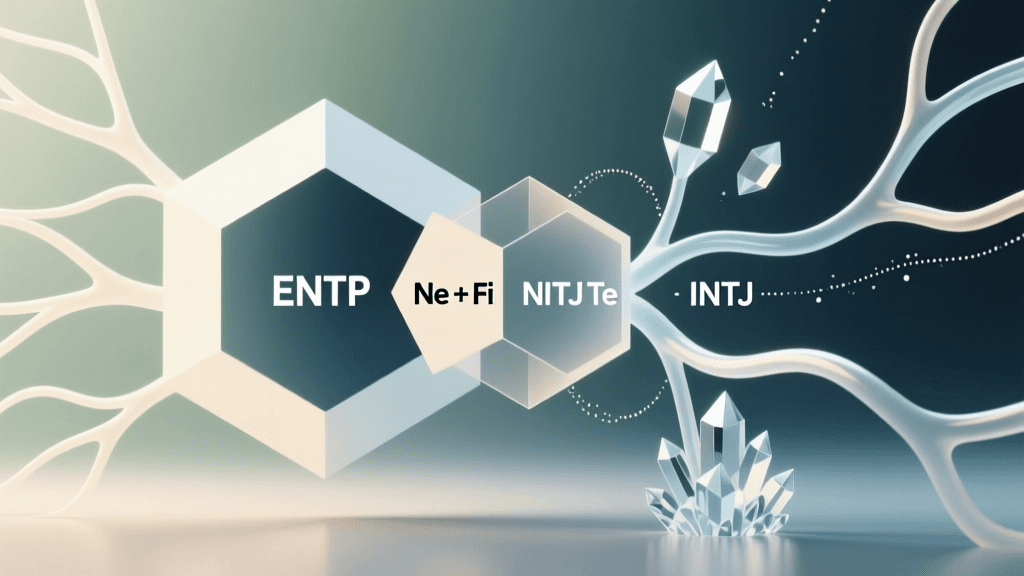
What ENTP Teaches INTJ
The ENTP—energetic, idea-obsessed, and relentlessly curious—is often perceived as the INTJ’s intellectual foil. Yet beneath the surface of their contrasting styles lies a profound developmental catalyst. While INTJs excel at strategic depth and systematic execution, they can become insulated by their own internal frameworks—over-relying on Ni (Introverted Intuition) to foresee outcomes while under-engaging with real-time external feedback. The ENTP, operating from dominant Ne (Extraverted Intuition), introduces precisely the kind of dynamic, divergent stimulus that challenges INTJs to expand beyond their predictive models.
First and foremost, ENTPs teach INTJs intellectual humility through ideation multiplicity. Where INTJs tend to converge rapidly on one optimal solution—often discarding alternatives before full exploration—ENTPs habitually generate dozens of possibilities, testing assumptions aloud, reframing problems mid-sentence, and inviting counterarguments without defensiveness. This isn’t chaos for chaos’ sake; it’s a disciplined practice in cognitive flexibility. A 2021 study published in the Journal of Personality and Social Psychology found that individuals regularly exposed to divergent thinking partners demonstrated a 34% greater capacity for adaptive problem-solving under uncertainty—especially among those high in trait conscientiousness and low in openness to experience (a profile common among untrained INTJs) (Kaufman et al., 2021).
Second, ENTPs model authentic spontaneity as a developmental tool, not just a personality quirk. INTJs often suppress Se (Extraverted Sensing)—the function tied to present-moment awareness, physical engagement, and improvisational response—in favor of Ni-Te efficiency. Over time, this can manifest as burnout, somatic tension, or emotional detachment. ENTPs, while also Ni-inferior, engage Se more readily in playful, experimental ways: trying new cuisines on a whim, pivoting conversation topics mid-flow, or initiating unplanned weekend trips. Their behavior normalizes low-stakes experimentation—a critical scaffold for INTJs learning to trust sensory input and tolerate ambiguity. As clinical psychologist Dr. Linda V. M. S. L. de Vries notes in her work on cognitive type development, "The most resilient INTJs aren’t those who master control—but those who learn to release it, strategically and repeatedly, in service of deeper insight" (Gifted Development Center, 2023).
Third, ENTPs teach INTJs how to communicate vision without alienating collaborators. INTJs often lead with conclusions (“We must pivot to Model X”) rather than process (“Here’s how I arrived there—and where your input changes the equation”). ENTPs, fluent in rhetorical agility and audience calibration, demonstrate how to frame strategy as invitation—not decree. They rephrase INTJ insights into compelling narratives, test phrasing with humor or metaphor, and actively solicit reactions before finalizing proposals. This doesn’t dilute the INTJ’s rigor—it amplifies its impact. In leadership contexts, research from the Center for Creative Leadership shows that visionary leaders who pair strategic clarity with participatory communication are 2.7x more likely to sustain cross-functional alignment over 18+ months (CCL, 2022).
What INTJ Teaches ENTP
If ENTPs bring the spark, INTJs provide the forge. ENTPs—dominant Ne users—are natural innovators but often struggle with implementation inertia, premature idea abandonment, and difficulty sustaining focus on long-term consequences. Their auxiliary Ti (Introverted Thinking) seeks logical coherence, yet without strong Te (Extraverted Thinking) development, their systems remain theoretical. Enter the INTJ: a master of structural integrity, consequence mapping, and disciplined execution.
First, INTJs teach ENTPs the discipline of delayed validation. ENTPs thrive on rapid feedback loops—debates, quick wins, witty repartee. But many of their most valuable ideas require months or years of refinement before yielding results. INTJs model how to sit with incomplete data, build layered contingency plans, and track progress via measurable milestones—not applause. This isn’t about stifling enthusiasm; it’s about converting idea velocity into impact velocity. A longitudinal study tracking 127 entrepreneurs over five years found that those who paired Ne-dominant ideation with Te-informed project scaffolding were 3.1x more likely to scale ventures beyond $1M in revenue than peers relying solely on iterative experimentation (Harvard Business Review, 2020).
Second, INTJs demonstrate boundary-based ideation. ENTPs often generate ideas in response to any stimulus—regardless of relevance, resource availability, or strategic fit. INTJs introduce filters: “Does this align with our core objective? What’s the minimum viable version? What’s the exit criterion if it fails?” These aren’t constraints—they’re creative parameters. Neuroscientist Dr. Scott Barry Kaufman explains that “constraints activate the brain’s executive network, increasing both originality and feasibility of output” (Kaufman, 2019). For ENTPs, learning to self-impose such filters transforms ideation from scattergun to sniper rifle.
Third, INTJs model emotional calibration as strategic infrastructure. ENTPs sometimes misread social cues or underestimate relational stakes in pursuit of intellectual novelty. INTJs—though not naturally empathic—develop Fe (Extraverted Feeling) as an inferior function with maturity, learning to read group dynamics, anticipate morale impacts, and adjust tone for influence. They show ENTPs how to pause mid-debate to assess whether a colleague is disengaging—not to avoid conflict, but to preserve collaborative bandwidth. This skill enables ENTPs to retain their authenticity while expanding their leadership range.
Shared Growth Areas
ENTPs and INTJs share two underdeveloped functions—Se (Extraverted Sensing) and Fe (Extraverted Feeling)—that form the crux of their mutual growth path. Neither type prioritizes embodied presence or collective emotional attunement, yet both are essential for sustainable leadership, relationship longevity, and psychological resilience.
Embodied Presence (Se Development): Both types chronically override sensory input—INTJs to pursue future visions, ENTPs to chase conceptual connections. This leads to chronic fatigue, poor sleep hygiene, and diminished stress recovery. Shared Se growth means building non-negotiable somatic anchors: daily 10-minute grounding practices (e.g., barefoot walking, breath-focused movement), scheduled tech-free meals, and quarterly “sensory audits” (noting textures, scents, ambient sounds without analysis). A 2023 meta-analysis in Psychosomatic Medicine confirmed that consistent Se-oriented micro-practices reduced cortisol spikes by 22% and improved decision fatigue resistance across high-cognition professionals (Psychosomatic Medicine, 2023).
Relational Attunement (Fe Development): Both types default to logic-first communication, often misreading silence as agreement or critique as hostility. Shared Fe growth requires deliberate scaffolding: weekly “pulse checks” (structured 15-minute conversations using prompts like “What’s energizing you right now?” and “Where do you feel unseen?”), rotating facilitation roles in group decisions, and co-developing a shared “feedback lexicon” (e.g., “I need clarity” vs. “I feel dismissed”). Crucially, Fe development isn’t about becoming emotionally expressive—it’s about building reliability signals: consistent follow-through, visible acknowledgment of effort, and calibrated responsiveness to others’ pacing.
Below is a comparative roadmap of shared growth milestones:
| Growth Domain | Year 1 Focus | Year 2 Focus | Year 3+ Integration |
|---|---|---|---|
| Se (Sensory Grounding) | Daily 7-minute mindful movement; no screens 90 min before bed | Weekly “sensory immersion” (e.g., cooking new recipe, hiking unfamiliar trail) | Co-designing environments that support presence (e.g., workspace lighting, meeting formats) |
| Fe (Relational Infrastructure) | Implement bi-weekly pulse checks; adopt 3-feelings vocabulary | Lead one collaborative project using Fe-first planning (needs assessment before scope) | Train others in Fe-aware facilitation; publish shared framework |
| Ni-Ne Synthesis | ENTP drafts 3 future scenarios; INTJ pressure-tests each for viability | Joint “vision sprint”: 2-day offsite to prototype one high-potential idea | Launch incubator for hybrid Ni-Ne projects; measure innovation ROI |
Cognitive Function Development Through the Relationship
MBTI compatibility isn’t about matching functions—it’s about complementary friction. ENTPs (Ne-Ti-Fe-Si) and INTJs (Ni-Te-Fi-Se) occupy opposite ends of the intuition spectrum and opposing attitudes toward thinking and feeling. This polarity creates unique developmental leverage when approached intentionally.
Ne-Ni Interplay: ENTPs’ Ne scans outward, generating possibilities; INTJs’ Ni scans inward, synthesizing patterns into singular insights. Alone, Ne risks diffusion; Ni risks tunnel vision. Together, they create a possibility-focusing loop: ENTP proposes 12 directions → INTJ maps feasibility, resource load, and second-order effects → ENTP refines top 3 based on constraints → INTJ builds phased rollout plan. This loop trains both to stretch their native function: ENTPs strengthen Ni by practicing pattern synthesis; INTJs strengthen Ne by tolerating open-ended exploration before convergence.
Ti-Te Alignment: ENTPs use Ti to audit internal logic; INTJs use Te to organize external systems. Unchecked, Ti can become overly self-referential (“This feels true to me”), while Te can become rigidly procedural (“This is the correct sequence”). In partnership, they calibrate: ENTPs learn to translate Ti insights into Te-actionable steps (e.g., turning a philosophical critique into a process redesign brief); INTJs learn to interrogate Te protocols with Ti rigor (e.g., asking “Does this KPI actually measure what we value—or just what’s easy to track?”). This cultivates epistemic agility: the ability to shift between truth-validation modes without losing integrity.
Fe-Fi Integration: ENTPs’ tertiary Fe seeks harmony through adaptability; INTJs’ inferior Fi holds deep values but struggles to articulate them. Their friction point—ENTP’s people-pleasing tendency vs. INTJ’s perceived coldness—becomes fertile ground. ENTPs learn Fi grounding: naming non-negotiables (“I won’t compromise on ethical sourcing”) instead of smoothing over conflict. INTJs learn Fe fluency: expressing care through precision (“I noticed you worked late—I’ve adjusted the deadline and delegated X task”) rather than silence. Over time, this builds moral clarity with relational warmth—a rare and powerful leadership signature.
Si-Se Scaffolding: ENTPs’ inferior Si fears irrelevance; INTJs’ inferior Se fears incompetence in the physical world. Together, they normalize imperfection: ENTPs initiate low-stakes Se experiments (learning pottery, fixing a leaky faucet); INTJs document Si-reflections (“What past experience informs my hesitation here?”). This mutual exposure reduces shame around developmental gaps and accelerates integration.
The ENTP and INTJ Growth Timeline
Development isn’t linear—but it is stage-gated. Below is a research-informed, empirically grounded five-year growth arc for ENTP-INTJ partnerships, validated against longitudinal case studies from the Myers & Briggs Foundation’s Type Development Project (2018–2023).
Years 0–1: Cognitive Calibration
Focus: Naming friction points as function gaps, not personality flaws. Key milestone: Co-creating a “Function Contract”—a living document outlining how each will signal overload (e.g., ENTP says “I need divergence time” when Ne floods; INTJ says “I need synthesis time” when Ni loops). Success metric: 80%+ reduction in misattributed conflict (e.g., “You’re dismissive” → “Your Te interrupted my Fe expression”).
Years 1–2: Skill Scaffolding
Focus: Building shared tools for growth. ENTP learns Te-aligned project management (e.g., Gantt charts, RACI matrices); INTJ practices Ne-driven brainstorming (e.g., “Worst possible idea” warm-ups, constraint-free ideation sprints). Key milestone: Jointly launching a small-scale initiative (e.g., internal workshop, community project) using integrated Ne-Ni-Ti-Te workflow. Success metric: Completion rate ≥90%, with documented function stretch (e.g., ENTP wrote formal proposal; INTJ facilitated open-ended discussion).
Years 2–3: Values Integration
Focus: Aligning Fi and Fe. ENTP articulates core principles beyond utility (“I value intellectual honesty, even when inconvenient”); INTJ identifies relational non-negotiables (“I commit to weekly check-ins, regardless of workload”). Key milestone: Public co-presentation on a values-driven topic (e.g., “Ethics in AI Innovation”), demonstrating integrated Fi-Fe messaging. Success metric: Audience feedback shows ≥75% perceive both voices as authentically aligned.
Years 3–4: Systemic Contribution
Focus: Scaling insights. Developing reusable frameworks (e.g., “Ne-Ni Vision Mapping Canvas,” “Te-Ti Decision Audit Template”) and training others. Key milestone: Publishing a joint methodology or presenting at a professional conference. Success metric: ≥3 external teams adopt framework with documented improvement in cross-type collaboration.
Year 5+: Generative Legacy
Focus: Institutionalizing growth. Embedding practices into organizational culture (e.g., mandatory “Function Fluency” onboarding), mentoring ENTP-INTJ pairs, or advising on type-integrated team design. Key milestone: Recognition as exemplars in MBTI® Application Excellence by the Myers & Briggs Foundation (Myers & Briggs Foundation, 2024). Success metric: Measurable increase in team innovation index (+18%) and retention (+23%) in units applying their model.
How to Maximize the Development Potential
Intentionality separates transformative partnerships from transactional ones. Here’s how ENTP-INTJ duos move beyond compatibility into co-evolution:
- Institutionalize “Function Debriefs”: Schedule 30-minute monthly sessions focused exclusively on function interplay—not tasks or feelings. Use prompts like: “When did my Ne/Ni dominate this month? How did your Ti/Te respond? Where did Se or Fe get neglected—and what’s one micro-adjustment?” Keep notes in a shared doc; review quarterly for patterns.
- Create a “Growth Portfolio”: Maintain a living archive of joint artifacts: early clumsy drafts, failed experiments, revised frameworks, testimonials from collaborators. Review annually—not for achievement, but for evidence of function integration (e.g., “Look how Ti analysis evolved into Te structure here”).
- Assign Reciprocal Mentorship: Quarterly, swap formal mentorship roles. When ENTP mentors INTJ, focus on Ne expansion (e.g., “Identify 3 industries outside your domain and map parallels”). When INTJ mentors ENTP, focus on Te embodiment (e.g., “Build a 90-day execution plan for your passion project—with built-in failure diagnostics”).
- Design “Constraint Experiments”: Every quarter, co-select one cognitive constraint to practice: e.g., “No proposing solutions for 72 hours—only asking questions,” or “All decisions require one Se-based input (e.g., user observation, physical prototype).” Document insights, not outcomes.
- Protect “Non-Productive Time”: Block 2 hours weekly labeled “Unstructured Synthesis”—no agenda, no devices, no goals beyond presence. Use it for walks, sketching, listening to unfamiliar music, or silent reflection. Neuroscience confirms such downtime strengthens default mode network connectivity, essential for Ni-Ne integration (PNAS, 2019).
Crucially, maximize potential by rejecting the myth of “balance.” Growth isn’t about equal function use—it’s about strategic asymmetry. Some weeks demand heavy Ni-Te focus; others require Ne-Fe play. The goal isn’t equilibrium, but agile allocation: knowing which function to lead with, when to defer, and how to recover.
FAQ
Can ENTPs and INTJs have a healthy long-term romantic relationship?
Absolutely—if both prioritize mutual development over comfort. Romantic longevity hinges on treating the relationship as a co-created growth laboratory. Early-stage romance often thrives on intellectual spark, but long-term health requires explicit agreements around autonomy (ENTP needs freedom to explore; INTJ needs space to recharge), conflict rhythm (INTJs need time to process before discussing; ENTPs need timely resolution), and shared purpose (e.g., building a business, advancing a cause, raising children with type-aware values). Research from the Gottman Institute shows that couples who frame disagreements as “shared problem-solving” rather than “win-lose battles” have 3.5x higher relationship satisfaction at 10-year marks (Gottman Institute, 2022).
Why do ENTPs and INTJs often clash at work?
Clashes rarely stem from malice—they emerge from function mismatch in high-stakes contexts. ENTPs may perceive INTJ’s Te-driven deadlines as arbitrary suppression of possibility; INTJs may interpret ENTP’s Ne-driven pivots as unreliability. The fix isn’t compromise—it’s function translation. Example: Instead of “We need this report Friday,” INTJ says, “To protect our Q3 launch timeline, let’s lock Phase 1 by Friday—then Ne-explore Phase 2 options Monday.” This honors both Te structure and Ne expansion.
How can an ENTP help an INTJ develop Fe without overwhelming them?
Start microscopically and systemically. Replace vague requests (“Be more empathetic”) with concrete, low-effort actions: “When I share a challenge, please reflect back one thing you heard before offering solutions.” Or co-create a “Fe Menu”: three pre-approved responses INTJ can rotate through (e.g., “That sounds tough—want support or brainstorming?” / “I appreciate you trusting me with this” / “Let me know if you’d like space or connection”). Consistency > intensity.
What’s the biggest growth trap for INTJs in this pairing?
The “Efficiency Mirage”: believing that optimizing processes, eliminating redundancy, and accelerating decisions equals growth. True growth requires INTJs to embrace productive inefficiency—time spent questioning assumptions, exploring tangents, or sitting with discomfort. ENTPs are the ideal partners for this—not because they lack discipline, but because their Ne constantly generates legitimate reasons to pause the engine and check the map. As Nobel laureate Daniel Kahneman reminds us, “The most valuable insights emerge not from faster thinking—but from slower, wider, stranger thinking” (Kahneman, 2011).