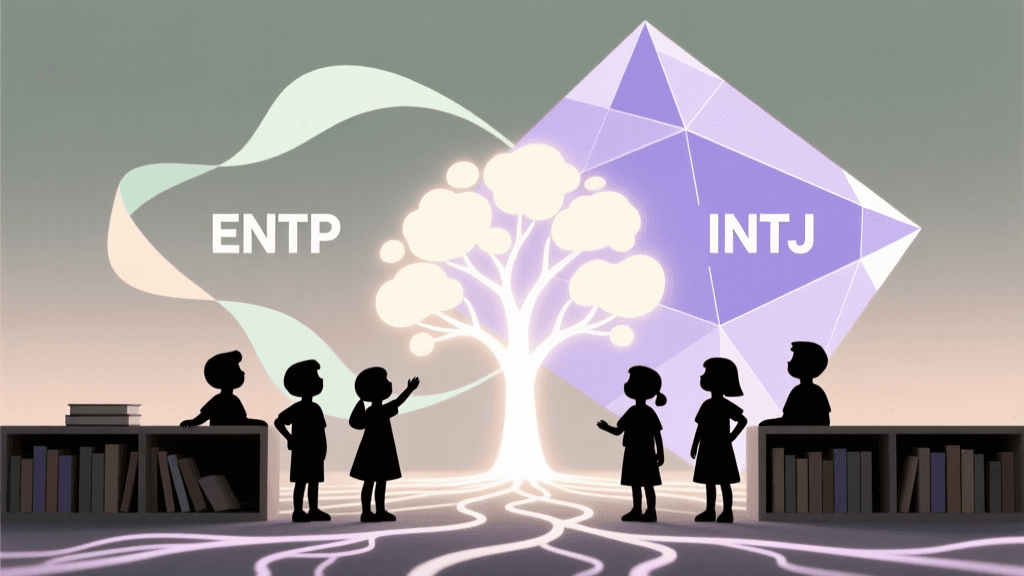
ENTP as a Parent
The ENTP (Extraverted, Intuitive, Thinking, Perceiving) parent is the intellectual sparkplug of the household—a dynamic, idea-driven force who approaches parenting with curiosity, flexibility, and an irreverent sense of humor. Often described as the ‘Debater’ or ‘Inventor,’ the ENTP parent thrives on mental stimulation, open-ended exploration, and collaborative problem-solving. They rarely enforce rigid routines; instead, they treat parenting as an evolving experiment—one where rules are negotiable, boundaries are discussed (not decreed), and learning happens through trial, error, and spirited dialogue.
ENTPs naturally foster autonomy in their children. They encourage questioning authority—not out of rebellion, but as a developmental imperative. An ENTP parent might respond to a child’s ‘Why?’ with another question: ‘What do you think the answer could be? What evidence would support it?’ This Socratic approach cultivates critical thinking early on. Research from the American Psychological Association confirms that children raised in environments that reward inquiry and reasoning demonstrate stronger metacognitive skills and academic resilience by adolescence.
However, ENTPs can struggle with consistency. Their love of novelty may lead to shifting expectations—e.g., one week enforcing screen-time limits, the next week abandoning them to test a ‘digital detox hypothesis.’ While intellectually stimulating, this inconsistency can confuse children who rely on predictability for emotional security—especially younger kids or those with Sensing (S) or Judging (J) preferences. ENTP parents also tend to under-prioritize logistical execution: forgotten permission slips, last-minute school project materials, or missed dentist appointments aren’t signs of neglect—they’re byproducts of cognitive bandwidth devoted to ideation over administration.
Practically, ENTP parents benefit from external scaffolding: shared digital calendars with color-coded reminders, weekly ‘family innovation huddles’ (where kids help design new weekend activities), and designated ‘execution partners’—often spouses, grandparents, or organized older siblings—who handle scheduling, follow-ups, and routine reinforcement. One effective tactic is the ‘3-Point Rule’: Before launching a new family initiative (e.g., a composting system or backyard science lab), the ENTP commits to defining exactly three concrete action steps, assigning ownership, and setting one non-negotiable deadline. This bridges their visionary energy with tangible outcomes.
INTJ as a Parent
The INTJ (Introverted, Intuitive, Thinking, Judging) parent—the ‘Architect’ or ‘Strategist’—approaches family life like a long-term systems engineering project. Calm, principled, and fiercely protective of intellectual integrity, the INTJ parent designs childhood as a structured pathway toward self-sufficiency, ethical reasoning, and strategic competence. They value depth over breadth, precision over popularity, and evidence over anecdote—and they expect the same rigor from their children.
INTJs invest heavily in education—not just academics, but in teaching frameworks for decision-making. A common INTJ parenting technique is the ‘Root-Cause Review’: after any conflict or mistake (e.g., a child failing a test or breaking a rule), they guide the child through a stepwise analysis: What was the observable behavior? What assumptions or beliefs preceded it? What alternative strategies existed? What data supports or contradicts your conclusion? This method builds what psychologists call ‘cognitive flexibility’—the ability to shift perspectives and revise conclusions based on new information—a skill strongly linked to adult success in complex professional environments.
Yet INTJs face distinct challenges. Their high standards can unintentionally convey conditional approval: praise is often reserved for exceptional performance, not effort or growth mindset. Children may internalize this as ‘I am only worthy when I excel,’ leading to perfectionism or avoidance of risk. Additionally, INTJs may underestimate the emotional labor required in daily caregiving—comforting nightmares, managing sibling rivalry, or soothing sensory meltdowns—preferring to ‘solve’ emotions rather than sit with them. As noted in a longitudinal study published in Journal of the American Academy of Child & Adolescent Psychiatry, children of highly analytical parents show elevated rates of anxiety when emotional validation is inconsistently offered—even when intellectual engagement is abundant.
Actionable solutions include scheduled ‘unstructured empathy time’: 15 minutes daily, device-free, where the INTJ listens without advising, fixes, or redirecting—simply reflecting feelings (‘That sounds frustrating’) and asking open-ended questions (‘What would feel helpful right now?’). Another tool is the ‘Values-Based Boundary Framework’: Instead of arbitrary rules (‘No video games before homework’), INTJs articulate principles (‘We prioritize focused learning before leisure because sustained attention strengthens neural pathways’)—then co-create implementation plans with children aged 8+. This honors their need for logic while inviting agency.
Co-Parenting Dynamics for ENTP and INTJ
At first glance, ENTP and INTJ seem like opposites: one thrives on improvisation, the other on architecture; one debates possibilities, the other refines probabilities. Yet this polarity is precisely why their co-parenting partnership—when consciously cultivated—can be exceptionally robust. Their differences form a natural checks-and-balances system: the ENTP prevents rigidity; the INTJ prevents chaos. But synergy doesn’t happen automatically—it requires deliberate calibration.
Core Strengths:
- Intellectual Alignment: Both types prize rationality, long-term vision, and evidence-based decisions. They’ll jointly research educational philosophies, debate vaccine schedules using peer-reviewed literature, and evaluate extracurriculars via cost-benefit analysis—not social pressure.
- Complementary Execution Styles: The ENTP generates 12 possible summer camp options; the INTJ narrows them to 3 using objective criteria (safety record, staff-to-child ratio, alignment with child’s learning profile) and drafts a comparison matrix.
- Conflict Resolution Maturity: Neither type avoids hard conversations. When disagreements arise (e.g., discipline philosophy), they’re more likely to engage in dialectical reasoning than emotional escalation—treating conflict as data collection, not threat.
Key Tensions & Mitigation Strategies:
| Area of Tension | ENTP Tendency | INTJ Tendency | Joint Solution |
|---|---|---|---|
| Routine vs. Spontaneity | Proposes impromptu road trips, changes bedtime stories mid-flow, cancels planned meals for ‘experimental cooking night’ | Designs weekly meal plans, color-coded chore charts, and semester-long academic calendars | The 80/20 Framework: 80% of weekly structure is pre-agreed (school nights = consistent bedtimes, homework windows, family dinner). 20% is ‘wildcard time’—one evening/week and one weekend half-day—where ENTP leads spontaneous adventures, INTJ observes, and both debrief afterward. |
| Discipline Approach | Uses humor, role-play, and philosophical reframing (‘Let’s simulate a courtroom for the cookie incident’) | Applies logical consequences tied to core values (e.g., ‘Breaking trust means rebuilding it via verifiable actions over 72 hours’) | The Dual-Track Response Protocol: Immediate response (INTJ-designed: clear, calm, principle-based) + reflective follow-up (ENTP-led: creative re-engagement—e.g., co-writing a comic strip about the incident, designing a ‘fairness algorithm’ for future conflicts). |
| Communication Style | Thinks aloud, revises opinions mid-sentence, uses sarcasm as bonding | Processes internally, speaks only after forming conclusions, interprets sarcasm as undermining | The ‘Pause-Clarify-Confirm’ Ritual: Before responding to each other on parenting matters, each pauses 5 seconds, clarifies intent (‘I’m offering an alternative, not rejecting your idea’), and confirms mutual understanding before proceeding. |
Crucially, ENTP–INTJ co-parents must protect their alliance from external dilution. Grandparents, teachers, or well-meaning friends may misinterpret the INTJ’s quiet reserve as coldness or the ENTP’s brainstorming as indecisiveness. Establishing a unified ‘family voice’—e.g., a shared Google Doc outlining non-negotiable values (intellectual honesty, kindness-as-action, growth orientation) and delegation norms (‘INTJ handles academic planning; ENTP handles social-emotional enrichment’)—creates coherence for outsiders and accountability within.
Family Traditions and Values
For ENTP–INTJ families, traditions are never mere rituals—they’re living expressions of shared epistemology. Rather than inheriting customs wholesale, these parents co-design traditions that reflect their joint commitment to curiosity, integrity, and continuous improvement.
Signature Traditions:
- The Annual ‘Future Self Summit’: Held on New Year’s Eve, each family member (including children) presents a 5-minute TED-style talk on one skill they’ll master, one bias they’ll examine, and one system they’ll improve in the coming year. The ENTP facilitates lively Q&A; the INTJ documents commitments in a shared Notion database with quarterly review prompts.
- ‘Bias-Busting Dinner Nights’: Once monthly, the family selects a cognitive bias (e.g., confirmation bias, sunk-cost fallacy) and applies it to real-life scenarios—from interpreting news headlines to evaluating a friend’s advice. Dessert is awarded for the most elegant counterexample.
- The ‘Legacy Library’ Project: Every birthday, each child adds one physical book (selected collaboratively) to a growing home library. Accompanying each book is a handwritten letter from parents explaining why this text matters to our family’s values—blending ENTP’s storytelling flair with INTJ’s thematic precision.
Underpinning all traditions are four non-negotiable values:
- Intellectual Courage: Asking uncomfortable questions—even about family dynamics—is encouraged, not punished.
- Evidence-Informed Care: Decisions about health, education, or ethics are grounded in reputable sources (e.g., CDC guidelines, peer-reviewed journals, verified expert consensus)—not trends or anecdotes.
- Constructive Disagreement: Conflict is framed as collaborative truth-seeking. Family meetings use Robert’s Rules-lite: timed speaking slots, no interruptions, resolution requires at least two viable options.
- Autonomy with Accountability: Children earn increasing decision rights (e.g., choosing electives, managing allowances) paired with measurable responsibilities (e.g., maintaining a grade tracker, submitting weekly budget reports).
This values framework doesn’t suppress individuality—it channels it. A Feeling (F)-dominant child learns to articulate emotions using precise language (‘I felt dismissed when my idea was interrupted’ vs. ‘You’re mean’); a Perceiving (P) child develops time-management tools without sacrificing spontaneity (e.g., ‘flexible deadlines’ with buffer zones). As developmental psychologist Dr. Ross Greene emphasizes in his collaborative problem-solving model, sustainability comes not from compliance, but from shared ownership of solutions.
Raising Children with Different Personality Types
With ENTP and INTJ parents, children rarely inherit identical types—and that diversity becomes the family’s greatest pedagogical resource. Each child’s type offers a lens into cognitive development, emotional needs, and communication preferences. The key is avoiding type-based determinism while leveraging typology for responsive scaffolding.
Practical Typology-Informed Strategies:
- For ESTJ or ISTJ Children (Sensing-Judging): These detail-oriented, duty-bound kids thrive on clarity. Provide written chore lists with checkmarks, advance notice of schedule changes, and explicit links between actions and outcomes (‘When you organize your backpack nightly, you save 7 minutes each morning—let’s track that time for a fun activity’). Avoid abstract ‘big picture’ rationales alone; pair them with concrete metrics.
- For ENFP or INFP Children (Intuitive-Feeling): Their idealism and empathy need anchoring. Co-create ‘values journals’ where they document moments of fairness, creativity, or compassion—and discuss how those align with family principles. ENTP parents naturally resonate here; INTJs should intentionally schedule ‘feeling-forward’ conversations (‘What made you feel proud today? What did that teach us about kindness?’).
- For ESTP or ISTP Children (Sensing-Perceiving): Hands-on learners require experiential grounding. Turn theoretical concepts into buildable models (e.g., physics → marble runs; history → diorama timelines). Assign ‘field agent’ roles: researching local recycling centers, testing snack recipes, or auditing home energy use. Reward initiative—not just completion.
- For ENTJ or INFJ Children (Intuitive-Judging or Intuitive-Feeling): These future-focused kids need long-term visioning. Co-develop 5-year ‘life maps’ with milestones (academic, relational, skill-based), reviewing them biannually. For INFJs, emphasize service-oriented goals (‘How will your talents serve others?’); for ENTJs, stress strategic resource allocation (‘What investments—time, money, relationships—will yield highest ROI?’).
A critical insight: ENTP–INTJ parents must guard against unconsciously privileging Intuition (N) and Thinking (T) functions. A child with dominant Sensing (S) may be labeled ‘unimaginative’; a Feeling (F) child may be told ‘don’t take things so personally.’ Counter this with deliberate type-affirming language:
“Your attention to how things actually work—that’s a superpower. Let’s use it to improve our garden irrigation system.”
“Your care for how others feel guides our family’s moral compass. That’s leadership—not weakness.”
Regularly audit family communication: Are S-children given equal airtime in discussions about practical logistics? Are F-children invited to co-design values statements? Tools like the Myers & Briggs Foundation’s Type Dynamics Guide offer age-appropriate explanations of cognitive functions—helping parents translate theory into daily interaction.
Navigating Extended Family as ENTP and INTJ
Extended family gatherings—holidays, reunions, multi-generational vacations—pose unique challenges for ENTP–INTJ couples. Their preference for intellectual depth and low-stimulation environments clashes with typical family events characterized by small talk, unexamined traditions, and emotional volatility.
Proactive Strategies:
- Pre-Gathering Alignment: Before any event, the couple holds a 20-minute ‘boundary briefing’: agreeing on exit triggers (‘If conversation turns to unsupported political claims, we’ll pivot to asking about Grandma’s gardening techniques’), delegation (ENTP engages cousins in debate club; INTJ coordinates gift logistics), and recharge protocols (‘One 15-minute walk alone every 90 minutes’).
- Role-Play Scenarios: Rehearse responses to common friction points: Aunt Carol questioning homeschooling, Uncle Mark dismissing climate science, or cousins mocking a child’s niche interest. ENTP practices concise, witty deflections; INTJ crafts evidence-backed soundbites (‘According to the National Center for Education Statistics, homeschooled students score 15–30 percentile points above national averages—here’s the report link’).
- Creating Micro-Traditions: Carve out intentional pockets of meaning: a ‘curiosity corner’ with rotating science kits, a ‘legacy interview station’ where kids record elders’ stories (with consent), or a ‘values reflection walk’ post-dinner. These honor extended family bonds while preserving cognitive integrity.
When generational gaps widen—e.g., grandparents insisting on gendered toys or fixed career paths—the couple deploys their combined strengths: the ENTP reframes resistance as historical context (‘Grandpa’s advice reflects 1950s labor markets—let’s explore how automation changes that’), while the INTJ provides data-rich alternatives (‘Here’s Bureau of Labor Statistics data on emerging AI-augmented careers’). This transforms potential conflict into intergenerational knowledge exchange.
FAQ
How do ENTP and INTJ parents handle discipline differently—and how can they unify their approach?
ENTPs favor restorative, process-oriented discipline—using role-play, hypotheticals, or creative restitution (e.g., writing a ‘how to fix trust’ comic). INTJs prefer consequential, principle-based discipline—tying outcomes directly to violated values (e.g., ‘Lying undermines our family’s truth standard; rebuilding requires three verifiable truthful acts’). Unification occurs through the Dual-Track Response Protocol: INTJ delivers the immediate, values-grounded consequence; ENTP leads the reflective, imaginative re-engagement 24 hours later. Consistency emerges not from identical tactics, but from shared underlying principles documented in a visible ‘Family Values Charter.’
What if our child tests as ESFP or ISFP—types seemingly opposite to ours? How do we support them authentically?
ESFP/ISFP children (‘Entertainers’/‘Adventurers’) prioritize sensory experience, present-moment joy, and aesthetic harmony—functions less emphasized in ENTP/INTJ cognition. Avoid labeling their spontaneity as ‘irresponsible’ or their empathy as ‘illogical.’ Instead: co-create sensory-rich learning (cooking chemistry, nature journaling), assign them as ‘family mood curators’ (planning music playlists, designing cozy spaces), and validate feelings with physical metaphors (‘That disappointment feels heavy—let’s shake it off with dance party’). Their strength isn’t linear logic—it’s embodied wisdom.
Our extended family thinks we’re ‘too intense’ or ‘over-intellectualizing’ parenting. How do we respond without alienating them?
Reframe intensity as intentionality. Say: ‘We’re not overthinking—we’re under-delegating. We’d love your help: Could you teach the kids your famous pie recipe? Or share stories about how your parents handled tough talks?’ Invite contribution aligned with their strengths, then publicly credit them. This shifts perception from ‘cold intellectuals’ to ‘thoughtful collaborators seeking wisdom.’
How can we ensure our children don’t feel pressured to ‘live up to’ our high-achieving MBTI reputations?
Explicitly decouple achievement from worth. Implement ‘failure résumés’: quarterly family shares of top 3 mistakes, lessons learned, and unexpected benefits. Celebrate effort metrics (‘You practiced piano 5 days straight—let’s analyze what made that sustainable’) over outcome metrics. Most powerfully, model vulnerability: Have parents share their own type-related growth edges (‘As an INTJ, I’m learning to ask for help before I’m overwhelmed’; ‘As an ENTP, I’m practicing finishing one project before starting the next’). Children internalize safety through witnessed imperfection.