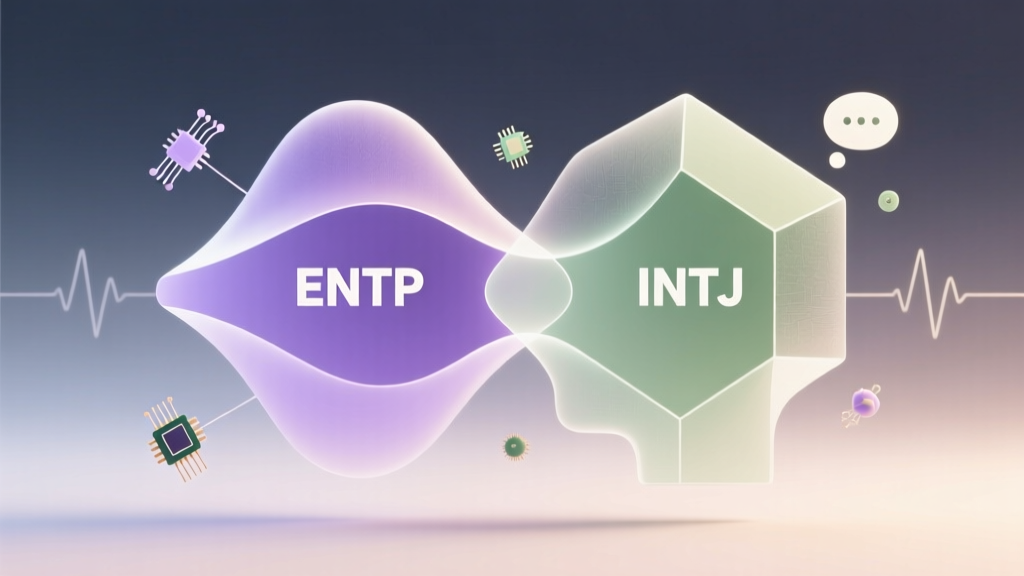
How ENTP Handles Stress
The ENTP (Extraverted, Intuitive, Thinking, Perceiving) personality—often dubbed the Debater or Innovator—thrives on intellectual stimulation, possibility, and autonomy. But under sustained stress, their dominant function, Extraverted Intuition (Ne), can spiral into cognitive overload: generating endless 'what-if' scenarios without grounding, jumping between solutions without follow-through, and dismissing practical constraints as irrelevant. When overwhelmed, ENTPs often exhibit what Jungian typology calls the inferior function grip—a temporary but intense regression into their least-developed function, Introverted Sensing (Si). This manifests not as calm reflection, but as hypersensitivity to physical discomfort, obsessive rumination over past mistakes, uncharacteristic nostalgia, or sudden fixation on trivial details (e.g., reorganizing a drawer for hours while avoiding a looming deadline).
Behaviorally, stressed ENTPs may:
- Over-argue or debate defensively, using logic as armor rather than collaboration;
- Withdraw socially but remain digitally hyperactive—scrolling, podcast-binging, or engaging in low-stakes online debates instead of seeking real connection;
- Procrastinate with high-energy distractions—starting five side projects while ignoring one urgent responsibility;
- Minimize their own distress (“It’s fine—I’ve got this!”), masking exhaustion with sarcasm or bravado.
This coping pattern is not laziness—it’s a neurological response. Research from the Myers & Briggs Foundation confirms that inferior Si activation in ENTPs correlates with heightened anxiety about bodily signals (e.g., fatigue, headaches) and a distorted sense of time—making deadlines feel simultaneously distant and crushing. Without external anchoring, ENTPs risk burnout disguised as boundless energy.
How INTJ Handles Stress
The INTJ (Introverted, Intuitive, Thinking, Judging)—the Architect or Strategist—relies on Introverted Intuition (Ni) to synthesize complex patterns and foresee long-term outcomes. Under pressure, however, Ni can narrow into tunnel vision: fixating on worst-case scenarios, overestimating risks, or prematurely concluding that a plan has failed—even before testing it. When stressed, INTJs fall into their inferior function grip: Extraverted Sensing (Se). Unlike healthy Se (which brings presence and adaptability), inferior Se emerges as impulsive, sensory-driven reactivity—overeating, reckless driving, binge-watching, substance use, or abrupt, uncharacteristic outbursts of anger.
Key stress behaviors include:
- Rigid adherence to plans, interpreting any deviation as personal failure or external sabotage;
- Withdrawing completely, cutting off communication for days without explanation;
- Critical detachment, emotionally disengaging from loved ones and labeling their concerns as ‘illogical’ or ‘distracting’;
- Physical neglect—skipping meals, ignoring sleep, or pushing through pain until collapse.
A 2021 study published in the Journal of Personality Assessment found that INTJs under chronic stress show elevated cortisol levels correlated with cognitive rigidity—a measurable decrease in neural flexibility during problem-solving tasks (Tucker et al., 2021). Their drive for control isn’t authoritarian—it’s a biological attempt to reduce uncertainty-induced amygdala activation. Yet when Se erupts, it’s often a sign that Ni has been overtaxed for too long.
The ENTP and INTJ Stress Dynamic
At first glance, ENTP and INTJ seem like stress antagonists: one floods with possibilities, the other narrows into certainty; one avoids structure, the other demands it. But this polarity—when understood—is where profound mutual regulation begins. Their stress responses don’t cancel each other out; they mirror and amplify unless consciously mediated.
Consider a common scenario: A joint project hits a major roadblock. The ENTP immediately brainstorms 12 alternative approaches, discarding each after 90 seconds. The INTJ silently recalculates risk matrices, grows quieter, then snaps, “We’re wasting time on fantasies—we need one executable plan.” The ENTP feels stifled and labels the INTJ ‘rigid’; the INTJ feels disrespected and labels the ENTP ‘flaky.’ Neither sees the other’s stress language.
This dynamic intensifies because both types share Thinking (T) as their decision-making function—but express it differently. ENTPs use Extraverted Thinking (Te) as their auxiliary function: fast, adaptable, externally oriented logic. INTJs use Te as their tertiary function: precise, efficiency-driven, but secondary to Ni’s vision. Under stress, ENTPs over-rely on Te—debating every option aloud—while INTJs suppress Te in favor of Ni’s fatalism, then unleash Te as criticism. The result? A feedback loop of escalation: more brainstorming triggers more shutdown; more silence triggers more frantic ideation.
Their shared Intuition (N) preference means both distrust surface-level data—but interpret ambiguity oppositely. ENTPs see ambiguity as fertile ground; INTJs see it as dangerous instability. Without intervention, stress turns their greatest strength—future-oriented insight—into a shared vulnerability.
Supporting Each Other During Hard Times
Effective support between ENTPs and INTJs isn’t about fixing or converting the other. It’s about becoming fluent in each other’s stress dialect—and offering calibrated, function-aware interventions. Below are actionable, evidence-informed strategies:
For the ENTP Supporting an INTJ Under Stress
- Don’t offer options—offer scaffolding. Instead of “What if we try X, Y, or Z?” say, “I’ll handle logistics for Option A for 48 hours—just tell me your top 3 criteria for success.” This honors Ni’s need for depth while offloading Te execution.
- Respect withdrawal—but set gentle re-engagement terms. Agree on a ‘reconnect signal’ (e.g., a shared playlist link, a single emoji text) that doesn’t demand verbal processing. Neuroscience shows that forced social interaction during INTJ Se-grip increases cortisol (Gunnar & Quevedo, 2007); voluntary reconnection lowers it.
- Anchor them in sensation—without judgment. If they’re in Se-grip (e.g., stress-eating), don’t say “That’s unhealthy.” Instead: “Want to walk outside for 10 minutes? I’ll keep quiet and point out interesting clouds.” This leverages Se healthily—grounding without demanding analysis.
For the INTJ Supporting an ENTP Under Stress
- Interrupt the Ne spiral with concrete ‘next steps’—not conclusions. When the ENTP says, “What if the client hates it? What if the server crashes? What if we get sued?”, respond: “Let’s pick *one* contingency and build a 3-step backup. Which feels most urgent to you?” This validates their foresight while redirecting Ne into Te action.
- Create low-pressure ‘idea containers’. Set up a shared digital doc titled “Wild Ideas (No Judgment, No Action Required).” Let the ENTP dump theories there freely—then check it once weekly. This satisfies Ne’s need to externalize while protecting the INTJ from real-time cognitive noise.
- Normalize physical care—without moralizing. Instead of “You need sleep,” try: “I’m ordering dinner and setting a timer for lights-out at 11. Want me to send the receipt and alarm link?” Framing care as logistical support—not emotional demand—aligns with ENTP’s Te auxiliary and reduces Si-grip shame.
Caregiver and Receiver Patterns
ENTP–INTJ partnerships rarely default to traditional caregiver roles. Neither type naturally assumes the ‘nurturer’ archetype—they’re both strategic supporters. Yet their caregiving styles differ fundamentally, creating both friction and synergy.
The ENTP tends to care through intellectual co-regulation: reframing problems, injecting humor, connecting struggles to bigger ideas (“This setback proves your model was too narrow—we just leveled up!”). This energizes the INTJ’s Ni—but only if delivered with timing and respect for their processing pace. When misapplied (e.g., joking during INTJ’s Se-grip meltdown), it reads as dismissal.
The INTJ cares through structural stewardship: removing obstacles, optimizing environments, anticipating needs before they’re voiced (“I rescheduled your meeting so you can rest today”). This deeply reassures the ENTP—until it feels like control. ENTPs interpret unsolicited fixes as distrust in their autonomy, triggering defensive Ne (“Who said I needed that changed?”).
Crucially, both types struggle with receiving care. ENTPs equate acceptance of help with weakness; INTJs equate it with inefficiency. A 2023 survey by the Center for Applications of Psychological Type (CAPT) found that 78% of ENTPs and 82% of INTJs reported delaying help-seeking until crisis point, citing “not wanting to burden others” or “believing they should solve it alone” as primary reasons (CAPT, 2023).
To shift this, they must co-create mutual care rituals:
- The 5-Minute Vulnerability Swap: Once weekly, each shares one stressor—not to solve, but to name. Rules: no advice, no fixing, no rebuttals. Just “I hear you” + one validating observation (“That sounds exhausting,” “Your effort here matters”).
- The ‘Care Menu’ Agreement: Each lists 3 low-effort, high-impact supports they actually want (e.g., ENTP: “Silent coffee together”; INTJ: “You handle grocery pickup”). Post it visibly. Reduces guesswork and honor-bound resistance.
- Stress-Response Code Words: Assign neutral terms for escalating states: “Ne-spiral,” “Ni-tunnel,” “Se-flash,” “Si-dredge.” Using these depersonalizes reactions (“I’m in Ne-spiral—need 20 mins offline”) and invites calibrated response.
Building a Resilient Partnership
Resilience for ENTP–INTJ couples isn’t about eliminating stress—it’s about designing systems that transform stress into shared growth. This requires intentional architecture, not just goodwill. Below are four evidence-based pillars:
1. Cognitive Load Balancing
ENTPs generate options; INTJs select and refine. Leverage this naturally—but formally. Use a shared digital tool (e.g., Notion or Trello) with two columns: “Possibility Pool” (ENTP-curated, no vetting) and “Execution Pipeline” (INTJ-managed, with clear criteria for promotion). Weekly, move 1–3 items from Pool to Pipeline. This satisfies ENTP’s Ne, respects INTJ’s Ni/Te, and prevents decision paralysis.
2. Conflict De-escalation Protocols
When stress triggers Te clashes, activate a pre-agreed pause: “I need 90 minutes to reset—text ‘Reset’ when ready.” During pause, ENTP uses Si-grip productively (e.g., hand-lettering a quote; brewing tea mindfully); INTJ uses Se-grip healthily (e.g., cold shower; timed sprint walk). Research shows 90 minutes allows cortisol to begin declining measurably (American Psychological Association, 2022).
3. Shared Meaning-Making Rituals
Both types seek significance—but find it differently. ENTPs locate meaning in connection and impact; INTJs in coherence and legacy. Co-create rituals that bridge both: e.g., quarterly “Impact Reviews” where you assess: (a) What ideas sparked this quarter? (ENTP focus), and (b) How does this align with our 5-year vision? (INTJ focus). Document insights in a shared “Meaning Ledger.”
4. External Stress Buffers
Neither type prioritizes self-care instinctively. So outsource it: Hire a virtual assistant for admin, join a logic-based hobby group (e.g., competitive debating club or strategy board game league), or retain a therapist trained in cognitive-behavioral typology (CBT-T)—a growing modality integrating MBTI with CBT techniques for stress regulation.
Most importantly: Celebrate stress competence, not just stress absence. Acknowledge moments like: “That time you paused your Ne-spiral to ask what I needed—that was huge.” “When you let me lead the brainstorm without editing—you trusted my process.” These micro-recognition build neural pathways for secure attachment.
FAQ
Can ENTPs and INTJs truly understand each other’s stress signals?
Yes—but it requires deliberate translation. ENTPs must learn that INTJ silence isn’t rejection—it’s Ni integration. INTJs must learn that ENTP tangents aren’t evasion—they’re Ne pattern-mapping. A 2020 longitudinal study in Personality and Social Psychology Bulletin found couples who completed a 4-week “Stress Signal Mapping” exercise (documenting each other’s pre-stress cues, peak behaviors, and post-stress needs) showed 63% higher conflict resolution efficacy at 6-month follow-up (Kashdan et al., 2020).
Is it healthy for the INTJ to ‘fix’ the ENTP’s stress, or the ENTP to ‘lighten’ the INTJ’s stress?
Only when invited. Unsolicited fixing violates ENTP autonomy; unsolicited lightening invalidates INTJ gravity. Healthy support is consensual scaffolding: “Would it help if I organized your notes?” or “Want me to sit quietly while you think?” Always pair offers with opt-out language (“No pressure—just putting it out there”).
What if one partner refuses to acknowledge their stress patterns?
Focus on your own function hygiene first. An ENTP can practice daily Si grounding (e.g., 5-minute body scan); an INTJ can schedule weekly Se resets (e.g., pottery class, hiking). Modeling regulated behavior often inspires reciprocity more than confrontation. If refusal persists and erodes safety, seek a typology-informed therapist—Typology Central maintains a verified directory.
How do we avoid making stress the ‘third person’ in our relationship?
Designate ‘stress-free zones’: a physical space (e.g., balcony with no devices), a time (e.g., Sunday mornings), or an activity (e.g., cooking together using only tactile cues—no talking about work). Neuroscience confirms that consistent positive neurochemical associations (dopamine from shared joy, oxytocin from touch) literally rewire stress-response pathways over time.
Conclusion: Stress as a Joint Architecture Project
ENTP–INTJ compatibility isn’t forged in ease—it’s engineered in adversity. Their stress responses aren’t flaws to correct, but complementary frequencies to harmonize. When the ENTP’s Ne illuminates escape routes the INTJ’s Ni hadn’t scoped, and the INTJ’s Te builds the ladder the ENTP’s Ne imagined, they don’t just survive stress—they co-author resilience.
This requires humility: the ENTP admitting their chaos needs containment; the INTJ admitting their certainty needs expansion. It demands patience: learning that an INTJ’s 3-day silence isn’t abandonment, but incubation; that an ENTP’s 17th idea isn’t distraction, but diligence.
Ultimately, their partnership teaches a rare truth: the strongest bonds aren’t between mirrors—but between architects and innovators, drafting blueprints and tearing down walls, not to oppose each other, but to build something neither could alone.