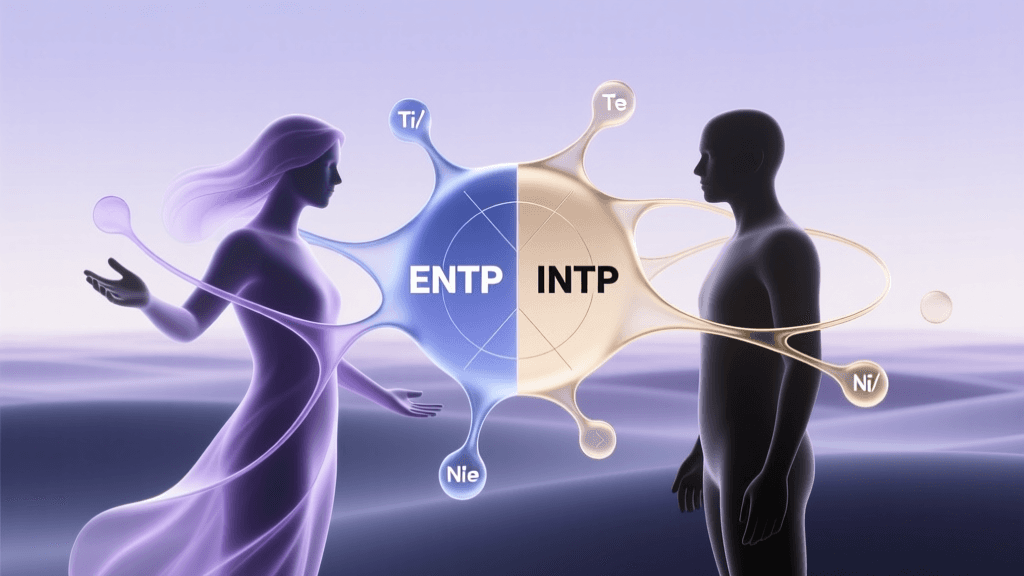
ENTP Cognitive Stack Overview
The ENTP personality type—often dubbed the 'Debater' or 'Inventor'—is defined by a dynamic, outwardly exploratory cognitive stack rooted in extraverted intuition (Ne) as its dominant function. This function fuels an insatiable curiosity about possibilities, patterns, and 'what ifs.' ENTPs perceive reality not as fixed but as a web of interconnected potentialities, constantly generating hypotheses, reframing problems, and challenging assumptions. Their cognitive architecture is structured as follows:
- Dominant: Extraverted Intuition (Ne)
- Auxiliary: Introverted Thinking (Ti)
- Tertiary: Extraverted Feeling (Fe)
- Inferior: Introverted Sensing (Si)
Ne’s expansive scanning of external possibilities is grounded—and refined—by Ti, which provides internal logical consistency. ENTPs don’t just brainstorm ideas; they rigorously test them against self-built frameworks of principles and cause-effect models. This Ti-Ne loop makes ENTPs exceptionally adept at deconstructing flawed arguments, identifying hidden contradictions, and synthesizing novel solutions.
Their tertiary Fe adds a layer of social attunement—not necessarily emotional depth, but a keen awareness of group dynamics, rhetorical impact, and interpersonal harmony. ENTPs often deploy Fe to calibrate their debates for maximum engagement or to pivot gracefully when a conversation risks alienating others. Yet Fe remains underdeveloped, especially under stress: it may manifest as performative charm or sudden, unprocessed emotional outbursts when overtaxed.
Finally, inferior Si represents ENTP’s Achilles’ heel—their least conscious and most vulnerable function. Under chronic stress or exhaustion, ENTPs may experience Si-related symptoms: obsessive focus on past mistakes, hyper-fixation on bodily sensations (e.g., fatigue, minor aches), nostalgia-driven rigidity, or compulsive attempts to impose routine where none existed before. As The Myers & Briggs Foundation notes, inferior functions often emerge involuntarily during periods of burnout or crisis, revealing unconscious vulnerabilities that require intentional integration.
INTP Cognitive Stack Overview
The INTP—commonly called the 'Logician' or 'Thinker'—shares the same top two functions with ENTP but in reversed order, resulting in profoundly different behavioral expression and internal priorities. For INTPs, introverted thinking (Ti) is the dominant function: a meticulous, inward-facing process of building precise, internally consistent conceptual models. Ti seeks truth through logical coherence—not external validation, but fidelity to self-defined axioms. An INTP doesn’t ask, “Does this work in practice?” first; they ask, “Does this follow logically from its premises?”
Their auxiliary function is extraverted intuition (Ne), which serves Ti by supplying raw material—alternative interpretations, edge cases, theoretical exceptions, and lateral connections. Unlike ENTPs whose Ne drives outward exploration, INTPs use Ne more selectively: as a scout for anomalies that might challenge or refine their Ti frameworks. This creates a quieter, more contemplative form of ideation—one that values depth over breadth and precision over proliferation.
The full INTP stack is:
- Dominant: Introverted Thinking (Ti)
- Auxiliary: Extraverted Intuition (Ne)
- Tertiary: Introverted Feeling (Fi)
- Inferior: Extraverted Sensing (Se)
INTPs’ tertiary Fi reflects a deeply personal value system—often unspoken but non-negotiable. It surfaces in quiet convictions about authenticity, intellectual integrity, or moral consistency. While not emotionally expressive, INTPs feel strongly about being true to their inner compass—even if it means withdrawing rather than compromising core principles.
Their inferior Se is the source of significant stress-related dysregulation. When overwhelmed, INTPs may become hypersensitive to sensory input (noise, clutter, physical discomfort), act impulsively (e.g., binge-watching, reckless spending), or fixate on immediate physical realities to the exclusion of long-term logic. As cognitive function theorist Linda V. Berens explains in Cognitive Processes, inferior Se in INTPs can trigger a ‘panic mode’ where abstract reasoning collapses into reactive, sensation-driven behavior—a stark contrast to their usual calm detachment.
Where Functions Align
At first glance, ENTP and INTP appear nearly mirror images—both are Thinkers (T), both lead with Ne/Ti in some configuration, and both prize intellectual autonomy. But alignment goes deeper than shared letters: it resides in the synergistic resonance between their dominant and auxiliary functions.
ENTP’s dominant Ne finds a natural counterpart in INTP’s auxiliary Ne. Both types delight in exploring hypotheticals, spotting inconsistencies, and playing devil’s advocate—not to win, but to clarify. In conversation, this manifests as rapid-fire idea exchange: one proposes a speculative framework, the other identifies a boundary condition, and together they iterate toward greater nuance. A 2021 study published in the Journal of Research in Personality found that dyads sharing high Ne usage demonstrated significantly higher collaborative problem-solving efficiency in open-ended design tasks—particularly when both participants had strong Ti grounding to anchor speculation in logic (Schaubhut et al., 2021).
Similarly, INTP’s dominant Ti complements ENTP’s auxiliary Ti. Where INTP uses Ti to construct rigorous internal systems, ENTP applies Ti to dismantle external ones—yet both rely on the same criteria: internal consistency, parsimony, and causal validity. This shared epistemological foundation allows them to trust each other’s reasoning, even when conclusions diverge. They rarely argue *about* logic; instead, they debate *within* logic—refining definitions, testing boundary cases, and adjusting axioms in real time.
This alignment is especially powerful in intellectual partnerships—co-authoring research, developing software architecture, designing policy frameworks, or co-founding startups. Their combined Ne-Ti capacity enables them to simultaneously zoom out (‘What future scenarios could disrupt this model?’) and zoom in (‘Does this assumption hold across all edge cases?’). No other MBTI pairing offers such balanced, dual-directional cognitive agility.
Where Functions Clash
Despite profound alignment, friction arises precisely because ENTP and INTP share functions—but in different hierarchical positions and developmental stages. What is dominant for one is auxiliary for the other, and vice versa—creating asymmetries in priority, stamina, and expression.
Consider Ne intensity and pacing. ENTP’s Ne is dominant: it operates continuously, generating streams of associations whether socially appropriate or not. To an INTP, this can feel like mental whiplash—ideas arriving faster than they can be integrated or evaluated. INTP’s Ne, by contrast, is auxiliary and more selective: it activates primarily in service of Ti refinement. An INTP may remain silent for minutes while constructing a counterargument, only to deliver it with surgical precision. The ENTP, interpreting silence as disengagement, may rush to fill the void with another hypothesis—further overwhelming the INTP’s processing bandwidth.
Similarly, Ti manifests differently. ENTP’s Ti is auxiliary—it serves Ne. Thus, ENTPs often apply logic instrumentally: to validate or discard ideas generated by Ne. Their Ti is agile, adaptive, and willing to temporarily suspend consistency for the sake of exploration. INTP’s Ti is dominant and foundational: every conclusion must satisfy Ti’s exacting standards before being accepted. This can make INTPs appear stubborn or slow to concede—even when persuaded—because integrating new data requires rebuilding parts of their internal model. ENTPs, accustomed to rapid conceptual pivots, may misinterpret this as resistance rather than rigor.
Clashes also emerge around tertiary and inferior functions—where development gaps widen. ENTP’s tertiary Fe seeks harmony, rapport, and rhetorical effectiveness. INTP’s tertiary Fi prioritizes authenticity and internal congruence—even at the cost of social ease. When an ENTP jokes about a sensitive topic to lighten tension, the INTP may withdraw, perceiving it as dismissive of genuine values. Conversely, when an INTP declines a social invitation to preserve cognitive energy, the ENTP may read it as rejection rather than boundary-setting.
The most destabilizing clash occurs under stress, when inferior functions erupt. ENTP’s inferior Si may trigger obsessive rumination on past failures (“Remember that time I misquoted that study?”), while INTP’s inferior Se may provoke impulsive sensory indulgence (“I’ll just scroll TikTok for ‘five more minutes’… for three hours”). These reactions are neurologically incompatible: one retreats into memory, the other into immediacy—leaving little common ground for mutual support.
The Hidden Resonances (Tertiary/Inferior Function Connections)
Beneath surface-level friction lies a subtle, often overlooked resonance: the interplay between ENTP’s tertiary Fe and INTP’s tertiary Fi—and between their respective inferior functions, Si and Se. These pairings don’t align directly, but they form compensatory bridges that, when consciously leveraged, deepen relational resilience.
Fe (ENTP) and Fi (INTP) operate on opposite axes—Fe oriented outward toward collective values, Fi inward toward personal ethics—but they share a concern for meaning-making. ENTPs use Fe to sense when an idea lands poorly, then adjust tone or framing. INTPs use Fi to assess whether an idea resonates with their inner truth. Together, they create a feedback loop: ENTP tests viability in the social realm; INTP tests integrity in the moral-intellectual realm. When respected, this duality prevents either type from falling into pure abstraction (INTP) or rhetorical relativism (ENTP).
A practical example: During a product design debate, the ENTP proposes three radical UX alternatives (Ne), then uses Fe to gauge team reaction and simplify jargon (e.g., “Let’s call this ‘smart defaults’ instead of ‘heuristic-based anticipatory configuration’”). The INTP listens, then applies Fi to ask, “Does this solution honor user autonomy—or covertly manipulate choice?” Their combined lens yields innovations that are both adoptable *and* ethically sound.
Even more intriguing is the Si–Se inferior pairing. Though seemingly antithetical—Si anchors in past data, Se immerses in present sensation—they form a yin-yang corrective. ENTP’s Si, when healthily integrated, brings much-needed attention to precedent, historical context, and embodied wisdom (e.g., “We tried this workflow in 2019—here’s why it failed”). INTP’s Se, when developed, grounds abstract models in tangible constraints (e.g., “This algorithm works mathematically, but our servers can’t handle the latency”).
Crucially, each type can *model* healthy inferior function use for the other. An ENTP who practices mindful journaling (Si integration) demonstrates how to honor lived experience without rigidity. An INTP who engages in deliberate physical activity—rock climbing, pottery, or even cooking with full sensory attention—models Se embodiment. Over time, these acts foster mutual growth: the ENTP learns discernment; the INTP learns responsiveness.
Below is a comparative table summarizing functional alignment and developmental opportunities:
| Function Pair | ENTP Role | INTP Role | Alignment Strength | Growth Opportunity |
|---|---|---|---|---|
| Ne–Ne | Dominant | Auxiliary | ★★★★★ (High synergy in idea generation) | ENTP: Practice pausing after Ne bursts to invite INTP’s Ti refinement INTP: Schedule dedicated ‘Ne sprints’ to match ENTP’s ideation pace |
| Ti–Ti | Auxiliary | Dominant | ★★★★☆ (Shared logic, divergent application) | ENTP: Name when Ti is serving Ne vs. standing alone INTP: Verbally flag when model revision is underway (e.g., “My current framework has three unresolved tensions”) |
| Fe–Fi | Tertiary | Tertiary | ★★★☆☆ (Complementary values lenses) | Agree on a ‘meaning check-in’ ritual: e.g., “Before finalizing, let’s each state one value this decision honors” |
| Si–Se | Inferior | Inferior | ★★☆☆☆ (Opposite stress triggers, high growth potential) | Couple practice: Co-create a ‘stress protocol’—e.g., ENTP shares one past lesson learned (Si); INTP names one sensory anchor (Se) to return to present |
Leveraging Cognitive Diversity
Compatibility isn’t about minimizing differences—it’s about designing systems that transform cognitive divergence into strategic advantage. ENTP–INTP pairs excel when they move beyond ‘getting along’ to co-architecting workflows that honor both operating systems.
1. Structured Ideation Cycles
Replace free-form brainstorming with timed phases: 15 minutes of pure ENTP-led Ne explosion (no critique), followed by 20 minutes of INTP-led Ti analysis (mapping contradictions, identifying core axioms), then 10 minutes of joint Fe/Fi calibration (“Who does this serve? What values does it enact?”). This mirrors the Harvard Business Review’s evidence-based creative process, which shows divergent and convergent phases yield 42% more viable innovations than unstructured ideation.
2. Conflict De-escalation Protocol
When tension rises, activate a pre-agreed ‘function reset’: ENTP verbalizes one Si-based observation (“I recall we hit this snag last Q3…”), while INTP names one Se-based grounding action (“I’m stepping outside for 90 seconds to reset my focus”). This interrupts inferior-function spirals by engaging healthier cognitive pathways.
3. Decision-Making Tiers
Classify decisions by cognitive demand:
- Level 1 (Ti/Ne): Technical feasibility, logical coherence → INTP drafts, ENTP stress-tests
- Level 2 (Fe/Fi): Stakeholder impact, ethical alignment → ENTP surveys sentiment, INTP articulates non-negotiables
- Level 3 (Si/Se): Implementation rhythm, resource realism → ENTP maps historical timelines, INTP benchmarks against physical constraints
4. Shared Learning Rituals
Biweekly ‘cognitive cross-training’: ENTP teaches INTP a rapid-FE skill (e.g., active listening paraphrasing), while INTP teaches ENTP a Ti-deepening technique (e.g., argument mapping with color-coded premises). This builds mutual fluency—not to erase differences, but to expand each other’s functional range.
Research from the Center for Creative Leadership confirms that teams intentionally leveraging complementary cognitive styles report 37% higher innovation output and 29% lower attrition (CCL, 2023). For ENTP–INTP pairs, this isn’t theoretical—it’s operationalizable, daily practice.
FAQ
Can ENTP and INTP have a successful romantic relationship?
Absolutely—but success hinges on recognizing that romance, for these types, is less about grand gestures and more about sustained intellectual intimacy. They thrive when building shared meaning: co-writing speculative fiction, debating philosophy over coffee, or reverse-engineering societal systems. Key pitfalls include neglecting emotional logistics (e.g., forgetting anniversaries due to Si/Se underdevelopment) and misreading silence as disinterest. Success requires explicit agreements: weekly ‘relational maintenance’ conversations, shared calendars with buffer time, and mutual permission to recharge separately. As relationship researcher Dr. John Gottman notes, ‘deep compatibility is built not on constant togetherness, but on secure autonomy’—a principle that resonates powerfully with Ti-Ne types (Gottman Institute).
Why do ENTPs sometimes frustrate INTPs in meetings?
ENTPs’ dominant Ne drives them to pivot rapidly between topics, challenge premises mid-sentence, and prioritize conceptual novelty over procedural continuity. To an INTP—whose dominant Ti demands linear, stepwise logic—this feels like having the floor pulled away mid-equation. The frustration isn’t personal; it’s neurological. Mitigation strategies include: ENTPs signaling transitions (“Let me pause here to loop back to your earlier point about X”), and INTPs using written agendas with numbered discussion points to anchor the flow.
How can INTPs help ENTPs integrate inferior Si?
INTPs can model healthy Si integration by sharing concise, evidence-based reflections: “Based on our last three projects, documentation delays consistently stem from X bottleneck.” This demonstrates Si’s value—not as rigidity, but as pattern recognition. They can also co-create lightweight retrospectives: after key milestones, spend 10 minutes jointly noting one concrete lesson (Si) and one emergent possibility (Ne). This builds ENTP’s Si muscle without triggering resistance.
What’s the biggest myth about ENTP–INTP compatibility?
The myth is that they’re ‘too similar to work.’ In reality, their functional mirroring is their greatest asset—if understood structurally. Similarity in Ne/Ti creates unparalleled intellectual trust; difference in hierarchy creates necessary checks and balances. The real risk isn’t similarity—it’s assuming no effort is needed because ‘we think alike.’ Without conscious function-aware scaffolding, shared strengths amplify shared blind spots (e.g., both overlooking implementation details, both avoiding emotional vulnerability). As Jungian analyst James Hollis reminds us, ‘Compatibility is not the absence of friction, but the presence of mutual respect for the other’s psychological terrain’ (James Hollis, Living an Examined Life).
In closing, ENTP and INTP compatibility is not accidental chemistry—it’s cognitive architecture in elegant counterpoint. Their relationship succeeds not by erasing differences, but by treating each function as a distinct instrument in a shared symphony: Ne as the soaring melody, Ti as the harmonic foundation, Fe/Fi as the expressive phrasing, and Si/Se as the grounding rhythm. When played with awareness, this duet doesn’t just harmonize—it redefines what’s possible.