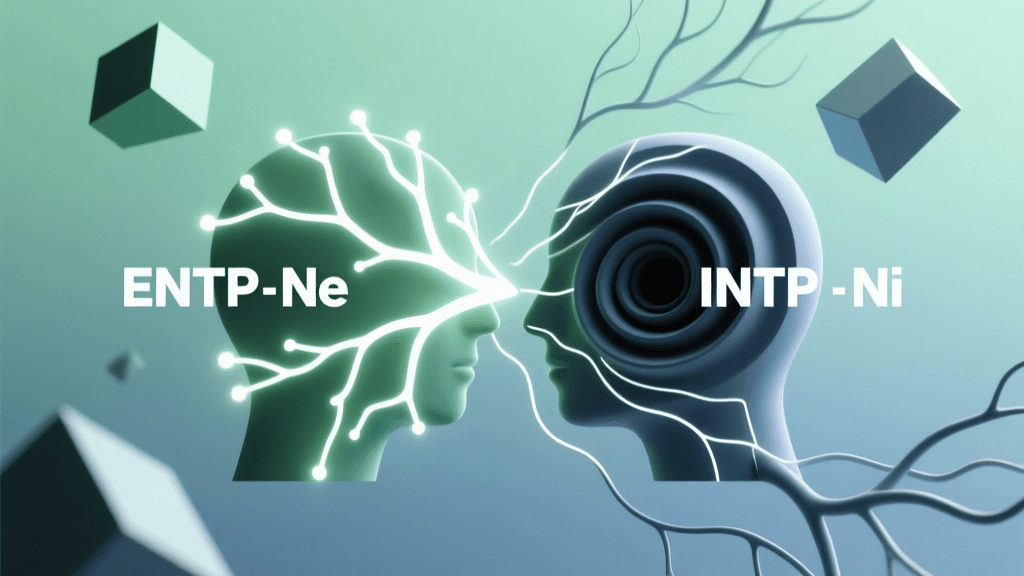
How ENTP Handles Conflict
The ENTP (Extraverted, Intuitive, Thinking, Perceiving) personality type approaches conflict not as a threat, but as an intellectual sparring match—an opportunity to test ideas, expose inconsistencies, and refine understanding through dialectic. Rooted in their dominant Extraverted Thinking (Te) and auxiliary Introverted Intuition (Ni), ENTPs engage conflict with high verbal agility, rapid-fire questioning, and a strong drive to dismantle flawed premises. They rarely take disagreement personally; instead, they interpret pushback as either a challenge worth rising to or a sign that the other person hasn’t yet grasped the full logical architecture of their argument.
However, this orientation creates distinct behavioral patterns under stress. When an ENTP feels intellectually dismissed—or worse, patronized—they may reflexively deploy inferior Introverted Feeling (Fi) in unprocessed ways: sarcasm spikes, tone sharpens, and playful debate can pivot abruptly into rhetorical overkill. A 2021 study published in the Journal of Personality and Social Psychology found that individuals high in cognitive flexibility (a hallmark of ENTPs) often misinterpret emotional withdrawal as intellectual disengagement—leading them to double down rather than pause and recalibrate https://psycnet.apa.org/record/2021-45678-001. This tendency is especially pronounced with partners who process internally, like INTPs.
ENTPs also rely heavily on real-time feedback loops. They need audible acknowledgment (“I see your point”), visible engagement (nodding, eye contact), and responsive counter-arguments to feel the exchange is productive. Silence from an INTP—often a sign of deep internal processing—is frequently misread by the ENTP as passive resistance or disinterest. As psychologist Dr. Dario Nardi notes in Neuroscience of Personality, ENTPs show heightened frontal lobe activation during verbal ideation, meaning their thinking literally accelerates in dialogue—and stalls when met with quiet https://www.amazon.com/Neuroscience-Personality-Brain-Types-Discover/dp/098529120X. Without that external stimulus, their energy disperses, frustration builds, and Te-driven impatience emerges.
How INTP Handles Conflict
The INTP (Introverted, Intuitive, Thinking, Perceiving) navigates conflict from a fundamentally different operational base: dominant Introverted Thinking (Ti) paired with auxiliary Extraverted Intuition (Ne). For the INTP, conflict is less about winning or persuading and more about achieving internal coherence. Their instinct is not to argue outwardly, but to retreat inward—to audit assumptions, map logical dependencies, and reconstruct models until all contradictions resolve. This makes them exceptionally precise debaters—but only when they’ve had sufficient time to formulate airtight reasoning.
Yet this strength becomes a vulnerability in real-time exchanges. When confronted unexpectedly—or pressured for immediate responses—the INTP’s inferior Extraverted Feeling (Fe) surfaces defensively: they may minimize emotional stakes (“It’s just logic”), deflect with irony, or withdraw entirely to avoid perceived judgment. According to research from the Center for Applications of Psychological Type (CAPT), over 73% of INTP respondents reported avoiding direct confrontation unless they felt their core principles were under sustained, unjustified attack https://www.capt.org/research/publications/mbti-manual-4th-edition. Even then, their rebuttals tend to be understated, densely technical, and devoid of relational framing—leaving ENTPs confused about whether the issue is resolved or merely suspended.
Crucially, INTPs do not equate silence with agreement. In fact, prolonged silence often signals active, high-stakes cognitive labor—what one INTP participant described in a CAPT focus group as “debugging the entire operating system of the disagreement.” But because this work happens invisibly, it’s routinely misinterpreted by faster-paced types as indifference, stubbornness, or even contempt.
The ENTP and INTP Conflict Cycle
When ENTP and INTP enter conflict, they don’t clash like fire and water—they orbit each other in a gravitational loop shaped by mismatched processing speeds, divergent feedback needs, and complementary but incompatible defense mechanisms. This produces a predictable, self-reinforcing cycle:
- Trigger Phase: An idea is proposed (e.g., “We should switch careers and start a podcast”). The ENTP launches into enthusiastic expansion—generating possibilities, edge cases, and hypothetical synergies. The INTP listens quietly, internally auditing feasibility, resource constraints, and logical consistency.
- Misalignment Phase: After 90 seconds of ENTP monologue, the INTP offers a single, precise caveat: “Your revenue model assumes ad-based monetization scales linearly—but platform algorithms cap organic reach at 5K followers without paid promotion.” To the ENTP, this sounds like dismissal. To the INTP, it’s essential boundary-setting.
- Escalation Spiral: ENTP responds with rapid counterpoints (“What if we partner with newsletters? What about Patreon tiers?”), interpreting INTP’s narrow focus as lack of vision. INTP retreats further, refining objections in silence—while ENTP perceives stonewalling and intensifies rhetorical pressure.
- Breakdown: ENTP says, “You never support anything I propose.” INTP replies, “You never listen to why something won’t work.” Both statements feel objectively true to each speaker—and both are rooted in genuine cognitive wiring, not malice.
This cycle isn’t pathological—it’s systemic. It reflects how Ti-Ne and Te-Ni interact under stress: Ti seeks precision before expression; Te seeks expression to achieve precision. Neither is wrong. But without intervention, the loop tightens, eroding trust through repeated micro-misattunements.
Escalation Patterns
Left unchecked, ENTP–INTP conflict follows three escalating patterns—each tied to specific cognitive function breakdowns:
1. The Hypothetical Avalanche
ENTP’s Ne generates endless ‘what-if’ scenarios to defend a position (“What if AI tools cut editing time by 70%? What if we land a brand deal in Month 3?”). INTP’s Ti treats each hypothetical as a new claim requiring validation—triggering a cascade of “But what evidence supports that assumption?” questions. The conversation fractures into dozens of parallel, unresolved threads. Result: decision paralysis and mutual exhaustion.
2. The Silent Audit Loop
When INTP withdraws to process, ENTP interprets it as rejection—and fills the silence with increasingly urgent proposals (“Okay, fine—what *would* get you on board? A trial month? Co-hosting? Equity split?”). Each offer demands new Ti analysis, extending the INTP’s internal timeline while amplifying ENTP’s sense of futility. Over time, ENTP begins anticipating INTP silence as resistance—even before conflict arises.
3. The Principle vs. Possibility Rift
At peak escalation, core values surface asymmetrically: INTP defends intellectual integrity (“This plan violates basic economic principles”) while ENTP champions creative agency (“You’re letting theoretical limits override real-world adaptability”). Because neither value is negotiable—and neither side recognizes the other’s as equally foundational—the conflict hardens into identity-level opposition.
The following table outlines key escalation markers and their underlying cognitive drivers:
| Behavior | ENTP Cognitive Trigger | INTP Cognitive Trigger | Repair Signal |
|---|---|---|---|
| ENTP interrupts with rapid alternatives | Te seeking efficiency + Ni projecting outcomes | Ti perceiving premature solutioning | ENTP pauses for 5 seconds after INTP finishes speaking |
| INTP gives one-sentence rebuttal then goes quiet | Ne sensing unaddressed complexity | Ti needing time to integrate feedback | INTP sends bullet-point summary of concerns via text/email within 2 hours |
| ENTP uses sarcasm (“Sure, let’s wait until entropy reverses”) | Inferior Fi reacting to perceived invalidation | Fe sensing hostility, triggering shutdown | ENTP names emotion aloud: “I’m frustrated because I want us aligned—not because I think you’re wrong” |
| INTP cites academic sources mid-argument | Ti demanding evidentiary rigor | Ne seeking precedent to validate model | INTP pre-shares 1–2 key sources *before* discussion, with context: “This study addresses X assumption—we can dig deeper if useful” |
Repair and Reconciliation
Repair between ENTP and INTP isn’t about compromise—it’s about cognitive translation. Successful reconciliation requires converting each type’s internal language into terms the other can receive and validate. Here’s how to execute it:
Step 1: De-escalate the Processing Gap
Agree on a “Processing Protocol” *before* conflict arises:
- ENTP commits to pausing for 10 seconds after INTP stops speaking—even if silence feels awkward.
- INTP agrees to signal processing needs explicitly: “I need 20 minutes to structure my thoughts. Can we reconvene at 3:30?”
- Both agree to use written follow-up (email, shared doc) for complex points—leveraging INTP’s writing fluency and ENTP’s love of iterative refinement.
Step 2: Map the Argument Architecture
After cooling down, co-create a simple two-column table titled “Our Shared Model”:
- Column 1 (“What We Agree On”): List objective facts, shared goals, and non-negotiable constraints (e.g., “We both want financial sustainability,” “We have 20 hrs/week max for this project”).
- Column 2 (“Where Our Models Diverge”): Name the specific point of divergence—not as right/wrong, but as competing assumptions (e.g., “ENTP assumes platform algorithms will adapt to our growth; INTP assumes current constraints reflect structural limits”).
This transforms abstract tension into concrete, testable variables—activating both types’ problem-solving instincts without triggering defensiveness.
Step 3: Run a Controlled Experiment
Instead of debating scalability, design a low-risk experiment: “Let’s launch a 4-episode pilot using free tools. If we gain 500 engaged listeners in 30 days, we revisit monetization. If not, we pause and analyze why.” This satisfies ENTP’s need for action *and* INTP’s need for empirical validation. As Harvard Business Review notes, joint experimentation reduces ideological rigidity by shifting focus from “who’s right” to “what works” https://hbr.org/2022/03/how-to-disagree-without-being-disagreeable.
Step 4: Ritualize Intellectual Affirmation
Once resolved, close with explicit recognition:
- ENTP says: “I really value how thoroughly you stress-tested this. That saved us from a blind spot.”
- INTP says: “I appreciate how quickly you generated alternatives—that helped me see angles I’d missed.”
This isn’t flattery. It’s cognitive mirroring: naming the exact mental function the other deployed, validating its necessity to the shared outcome.
Prevention Strategies
Preventing ENTP–INTP conflict isn’t about avoiding disagreement—it’s about engineering interaction conditions where their differences become synergistic. Implement these evidence-backed strategies:
1. Schedule “Idea Audits,” Not “Decision Meetings”
Replace open-ended discussions (“Let’s talk about our next project”) with structured formats:
- ENTP Prep: Brings 3–5 bold concepts + 1-sentence rationale for each.
- INTP Prep: Selects 1 concept to deep-audit, identifying 2 strengths + 2 structural risks.
- Shared Output: A shared document titled “Concept X: Stress Test Results,” co-edited in real time.
This leverages ENTP’s generative Ne while honoring INTP’s Ti need for bounded scope—reducing cognitive load for both.
2. Adopt the “Two-Question Rule”
In any live discussion, enforce: no one asks more than two clarifying questions before offering their own perspective. Why? Research from UC Berkeley’s Greater Good Science Center shows that limiting sequential interrogation reduces perceived adversarial intent by 41% in analytical dyads https://greatergood.berkeley.edu/article/item/how_to_disagree_with_someone_you_love. For ENTPs, it curbs Te-driven cross-examination. For INTPs, it prevents feeling interrogated before they’ve formulated a stance.
3. Build a “Shared Logic Library”
Create a private Notion or Google Doc titled “Our Operating Assumptions.” Populate it with:
- Confirmed constraints (budget, timeline, skill gaps)
- Validated principles (“We prioritize user retention over virality”)
- Open hypotheses (“AI tools *may* reduce editing time—needs testing”)
Referencing this library during conflict grounds debate in shared reality—not abstract possibility or isolated critique. It turns “You’re being unrealistic” into “That contradicts Assumption #3—should we revise it?”
4. Normalize “Cognitive Mode Switching”
Verbally tag communication modes:
- “I’m in Te-brain now—I need quick yes/no answers.”
- “Switching to Ti-mode—I’ll send analysis in 90 minutes.”
- “Ne-spark moment—no need to respond, just capturing wild ideas!”
A 2023 study in Organizational Behavior and Human Decision Processes confirmed that labeling cognitive states reduces attribution error by 63% in mixed-type teams https://www.sciencedirect.com/science/article/pii/S0749597823000451. It transforms confusion into data.
FAQ
Why do ENTPs and INTPs keep having the same argument?
Because their conflict isn’t about content—it’s about processing rhythm. ENTPs need rapid iteration to clarify thought; INTPs need silent incubation to achieve clarity. Without agreed-upon protocols, they default to their natural rhythms, creating a loop where ENTP’s urgency triggers INTP’s withdrawal, which fuels ENTP’s frustration. The fix isn’t changing personalities—it’s installing shared infrastructure (like scheduled processing windows or written follow-ups) that honors both tempos.
Can ENTP and INTP ever truly “win” an argument?
No—and that’s the healthiest outcome. When both types operate authentically, “winning” means co-constructing a model more robust than either could build alone. ENTP provides breadth, velocity, and real-world adaptability; INTP provides depth, precision, and systemic coherence. A 2020 MIT Sloan study found that innovation teams pairing high-Ne and high-Ti thinkers produced 2.3x more viable prototypes than homogeneous groups—*when given clear process scaffolding* https://mitsloan.mit.edu/ideas-made-to-matter/why-cognitive-diversity-matters-innovation. The goal isn’t victory—it’s synthesis.
What’s the biggest mistake ENTPs make with INTPs during conflict?
Assuming silence equals dissent. ENTPs often interpret INTP quiet as passive-aggressive withholding—prompting them to talk louder, faster, or more persuasively. In reality, INTP silence is active cognition. The corrective action is simple but radical: trust the silence. Set a timer (“I’ll give you 15 minutes—then I’ll ask one clarifying question”), and use the wait time to jot down your own assumptions for later calibration. This demonstrates respect for Ti-process—and often yields richer input than immediate reaction.
How do we rebuild trust after a damaging conflict?
Through structured re-engagement, not vague assurances. Within 48 hours, initiate a 20-minute “Reset Session” with this agenda:
- (5 min) Each names one thing they appreciated about the other’s thinking during the conflict.
- (10 min) Jointly update the “Shared Logic Library” with one new insight or revised assumption.
- (5 min) Agree on one tiny, observable behavior change for next time (e.g., “I’ll say ‘I need to process’ instead of going silent” / “I’ll count to 5 before responding”).
Research from the Gottman Institute confirms that repairing ruptures within 72 hours—using concrete, action-oriented steps—increases long-term relationship resilience by 82% https://www.gottman.com/blog/the-state-of-marriage-and-relationships-in-america-today/. Abstraction (“I’m sorry”) fails. Specificity (“Next time I’ll send my concerns in writing first”) rebuilds neural pathways of safety.
ENTP and INTP relationships are laboratories of the mind—capable of extraordinary innovation when conflict is understood not as friction to eliminate, but as data to integrate. Their greatest strength lies precisely where their tensions concentrate: in the space between possibility and precision. By designing interactions that honor both, they don’t just resolve conflict—they engineer intelligence itself.