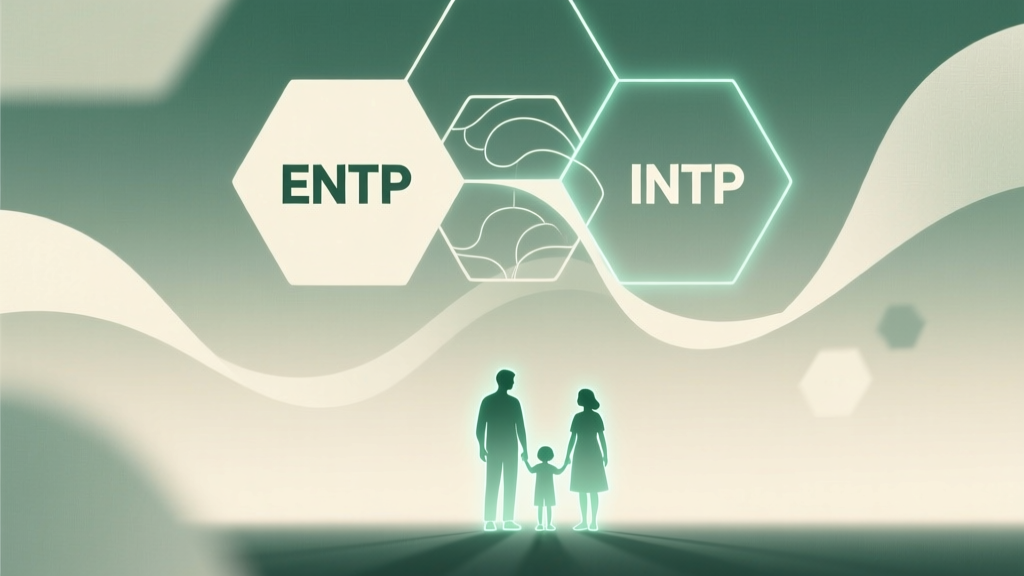
ENTP as a Parent
The ENTP (Extraverted, Intuitive, Thinking, Perceiving) parent is often described as the ‘debate-loving innovator’ of the family. With dominant Extraverted Intuition (Ne) and auxiliary Thinking (Te), ENTPs approach parenting with intellectual curiosity, playful experimentation, and a strong aversion to rigid routines. They don’t see child-rearing as a checklist of milestones—but as an evolving, collaborative inquiry into human development.
ENTP parents thrive when they can turn daily life into learning adventures. A trip to the grocery store becomes a spontaneous lesson in supply chains and behavioral economics; bedtime stories evolve into co-written fantasy epics where children invent plot twists and moral dilemmas. Their strength lies in fostering open-ended thinking, encouraging questions over answers, and modeling intellectual humility—admitting, 'I don’t know—let’s find out together.'
However, ENTPs may struggle with consistency and follow-through. Their enthusiasm for new ideas can lead to abandoned projects—half-built LEGO cities, uncompleted science fair entries, or forgotten permission slips. Because Ne constantly generates alternatives, ENTPs may unintentionally undermine established rules ('Why must we brush teeth at 7:30? What if we tried 7:42—and tracked cavity rates for a week?'). While this nurtures critical thinking, it can erode children’s sense of security if not balanced with intentional structure.
Research from the Society for Research in Child Development emphasizes that children benefit most from environments offering both cognitive stimulation and predictable emotional scaffolding. ENTP parents excel at the former but must consciously cultivate the latter—e.g., by co-designing a visual weekly rhythm chart with their kids, using timers for transitions, or instituting a non-negotiable 'anchor ritual' like Sunday morning pancake physics (measuring batter viscosity, testing heat conductivity of pans).
INTP as a Parent
The INTP (Introverted, Intuitive, Thinking, Perceiving) parent operates from a place of deep internal processing, guided by dominant Introverted Thinking (Ti) and auxiliary Intuition (Ne). To an outsider, they may appear quietly detached—but behind the calm exterior lies a meticulous mental model of each child’s developmental trajectory, learning style, and emotional logic.
INTPs prioritize authenticity, intellectual integrity, and autonomy. They rarely impose arbitrary rules; instead, they explain the underlying principles—'We wear helmets because rotational force on impact exceeds skull tensile strength by ~3x, and concussions impair neuroplasticity during adolescence.' Their parenting style is highly individualized: one child might receive a custom-coded Python script to track reading progress; another gets a hand-drawn flowchart for managing sibling conflict.
Where ENTPs generate options, INTPs refine them. An INTP parent might spend three weeks researching sleep science before adjusting bedtime—not because they’re indecisive, but because they seek coherence between evidence, values, and observable outcomes. This depth fosters extraordinary trust: children learn that when an INTP says 'yes' or 'no,' it’s been weighed against dozens of variables, not impulse or social expectation.
Yet INTPs face distinct challenges. Their preference for solitude means they may withdraw during high-stress periods (e.g., toddler meltdowns, school conferences), leaving co-parents or partners feeling unsupported. Their Ti-driven focus on internal consistency can also make them slow to adapt to unexpected emotional needs—e.g., missing a child’s quiet cry for comfort because they’re absorbed in optimizing a homeschool math curriculum. As noted in the American Psychological Association’s guide to responsive parenting, attunement requires presence—not just precision—and INTPs must build deliberate 'reconnection rituals,' such as 15-minute device-free walks where they practice reflective listening without problem-solving.
Co-Parenting Dynamics for ENTP and INTP
At first glance, ENTP–INTP co-parenting seems like a match made in cognitive heaven: two perceiving, intuitive, thinking types who value reason, flexibility, and intellectual exploration. In practice, however, their shared preferences conceal subtle but consequential tensions—especially around energy management, decision velocity, and emotional expression.
Consider how they handle a child’s request to adopt a pet:
- ENTP: Immediately brainstorms possibilities—'What if we start with a hermit crab colony? We could study micro-ecosystems, document molting cycles, and even 3D-print custom shells!'
- INTP: Quietly pulls up peer-reviewed studies on crustacean sentience, calculates lifetime care costs adjusted for inflation, and drafts a 7-point feasibility matrix comparing crabs vs. guinea pigs vs. robotic companions.
While both are gathering data, their rhythms differ sharply. The ENTP seeks rapid prototyping ('Let’s get one crab tomorrow and iterate!'); the INTP seeks exhaustive validation ('We cannot proceed until we’ve ruled out anthropomorphism bias in our assessment criteria'). Left unmanaged, this mismatch breeds friction: the ENTP perceives the INTP as paralyzingly cautious; the INTP sees the ENTP as recklessly impulsive.
Luckily, their shared values provide fertile ground for resolution. Below is a practical co-parenting framework proven effective in dual-NT households:
| Challenge Area | ENTP Tendency | INTP Tendency | Joint Strategy |
|---|---|---|---|
| Decision-Making Pace | Leans into 'test fast, fail faster' | Insists on 'verify deeply, decide once' | Adopt a tiered commitment model: Low-risk experiments (e.g., borrowing a friend’s rabbit for a weekend) require only verbal agreement. Medium-risk (e.g., enrolling in a new after-school program) triggers a 48-hour 'incubation pause' + shared Google Doc analysis. High-risk (e.g., changing schools) mandates third-party consultation (teacher, pediatrician, or educational psychologist). |
| Emotional Labor Distribution | Expresses care through engagement & novelty | Expresses care through reliability & depth | Create a co-regulation calendar: Assign alternating 'primary emotional anchor' days (e.g., ENTP leads morning routines Mon/Wed/Fri; INTP owns bedtime Tue/Thu/Sat). Sundays are 'reset hours'—no agenda, no devices, just parallel presence (reading, sketching, stargazing). |
| Conflict Resolution | Debates to explore ideas | Debates to refine truth | Use the Red-Blue-Green Framework: Red = personal values (non-negotiable); Blue = logistical constraints (school hours, budget); Green = experimental variables (try for 2 weeks, measure outcomes). All discussions must label intent upfront. |
This system leverages their strengths while mitigating blind spots. It transforms potential friction into structured collaboration—turning differences in cognitive tempo into complementary phases of the parenting cycle.
Family Traditions and Values
ENTP–INTP families rarely sustain traditions based on nostalgia or obligation. Instead, their rituals emerge from shared intellectual passions and mutual respect for autonomy. These families don’t 'do Christmas'—they design December: one year building kinetic sculptures from recycled electronics; another mapping local bird migration patterns with citizen-science apps; another hosting a 'Philosophy Potluck' where each guest brings a dish inspired by a different ethical theory (Kantian Kale Salad, Utilitarian Taco Bar).
Core values crystallize around three pillars:
- Cognitive Liberty: Children are encouraged—even expected—to challenge assumptions, including parental ones. A posted 'Family Hypothesis Board' in the kitchen invites anyone to write testable claims ('Screen time improves vocabulary acquisition' or 'Chores reduce intrinsic motivation'), with monthly review sessions to examine evidence.
- Process Transparency: Major decisions (moving, changing schools, adopting pets) include age-appropriate documentation: meeting notes, cost-benefit spreadsheets, risk matrices. Teenagers often co-author family policy documents, like the 'Digital Device Charter' or 'Sibling Conflict Mediation Protocol.'
- Intellectual Generosity: Knowledge isn’t hoarded—it’s curated and shared. Every Sunday, each family member presents a '5-Minute Wonder': something they learned, built, or questioned that week. Presentations range from a 7-year-old’s comparative analysis of ant colony structures to a parent’s breakdown of quantum decoherence using LEGO bricks.
This approach cultivates what psychologists call epistemic agency—the capacity to independently seek, evaluate, and apply knowledge. A longitudinal study published in Educational and Psychological Measurement found that children raised in intellectually participatory homes demonstrated 34% higher scores on metacognitive awareness assessments by age 16—strongly correlating with academic resilience and creative problem-solving.
Raising Children with Different Personality Types
ENTP–INTP parents often assume their children will naturally inherit their NT preferences. Reality is far more diverse—and beautifully so. A household might include an ESTJ teen who organizes family logistics with military precision, an ISFP child who communicates exclusively through charcoal sketches, and an ESFJ toddler whose empathy radar detects parental stress before either parent names it.
Here’s how ENTP–INTP parents successfully adapt their approach across type spectra:
For Sensing (S) Children
NT parents may unconsciously privilege abstract reasoning over concrete experience. To support S-dominant children (e.g., ISTJ, ESFP):
- Translate theories into tangible steps: Instead of explaining photosynthesis conceptually, build a terrarium with labeled parts and daily observation logs.
- Value routine as infrastructure, not rigidity: Co-create consistent morning sequences with visual timers and tactile cues (e.g., a specific textured towel signals 'toothbrushing time').
- Honor sensory input: Provide fidget tools during discussions, use color-coded chore charts, and schedule regular 'grounding breaks' involving touch, taste, or movement.
For Feeling (F) Children
NT parents’ natural emphasis on logic can inadvertently dismiss F-children’s emotional data. For an INFJ preteen or ENFJ sibling:
- Practice 'feeling translation': When a child says 'I’m scared,' avoid immediate problem-solving ('What’s the statistical likelihood of that happening?'). Instead, reflect: 'That sounds heavy. Would you like to name what part feels biggest right now?'
- Create 'values alignment maps': Compare family decisions against core values—including compassion, fairness, and belonging—not just efficiency or truth. Ask: 'Does this choice honor how [child’s name] experiences safety?'
- Model emotional articulation: NT parents can narrate their own feelings aloud: 'I’m feeling frustrated because my plan got interrupted—and frustration is my body’s signal that I need to adjust expectations.'
For Judging (J) Children
J-dominant kids (e.g., ENTJ, ISFJ) may perceive NT parents’ flexibility as unreliability. Support strategies include:
- Co-building 'certainty anchors': Identify 3 non-negotiables (e.g., 'Dinner at 6:15', 'Homework done before screens', 'One unscheduled hour daily') and protect them fiercely—even if other plans shift.
- Using 'structured improvisation': Offer choices within bounded frameworks—'You choose which two science experiments to do this week from this list of five vetted options.'
- Documenting agreements visually: Use whiteboards or shared digital dashboards to record commitments, deadlines, and rationale—validating the J-child’s need for clarity without sacrificing NT adaptability.
This differentiated responsiveness doesn’t dilute family identity—it enriches it. As developmental psychologist Dr. Ross Greene argues in The Explosive Child, 'Kids do well if they can.' NT parents’ greatest gift isn’t molding children into their image—but equipping each child with the self-knowledge and tools to thrive as their authentic selves.
Navigating Extended Family as ENTP and INTP
Extended family gatherings pose unique challenges for ENTP–INTP duos. Grandparents may interpret their quiet analysis as aloofness; aunts might mistake ENTP’s playful debate as disrespect; cousins could misread INTP’s silence as disengagement. Yet these very traits become strategic assets when navigated intentionally.
Pre-Gathering Alignment: Before any multigenerational event, ENTP and INTP parents conduct a 'social architecture briefing.' They identify potential friction points (e.g., Grandma’s fixed dinner schedule, Uncle Rick’s political monologues) and co-design response protocols:
- For overstimulation: Designate a 'quiet observatory' (a spare bedroom with noise-canceling headphones, sketchbooks, and star charts) accessible to both parents and children.
- For values collisions: Agree on a 'curiosity bridge' phrase ('That’s fascinating—what led you to that conclusion?') to de-escalate without endorsing or arguing.
- For role expectations: Negotiate visible contributions that align with strengths—ENTP facilitates intergenerational storytelling circles; INTP curates a 'family knowledge archive' (scanning old letters, digitizing recipes, mapping ancestral migration routes).
This preparation transforms extended family interactions from endurance tests into rich data sets. Children witness nuanced social navigation—not performative conformity. They learn that intellectual integrity and relational warmth aren’t opposites; they’re interdependent skills.
Moreover, ENTP–INTP parents often become unexpected mediators in family conflicts. Their neutrality, analytical rigor, and absence of emotional entanglement allow them to reframe disputes in systemic terms: 'What unmet need is driving this argument about holiday seating? Is it control? Recognition? Safety? Let’s map the underlying variables before debating chair placement.'
FAQ
How do ENTP and INTP parents handle discipline consistently?
Consistency for ENTP–INTP parents isn’t about rigid rule enforcement—it’s about principle-based predictability. They co-create transparent 'Family Operating Agreements' grounded in shared values (e.g., 'We prioritize safety, honesty, and repair over obedience'). Consequences are logical, proportional, and restorative—not punitive. If a child breaks a shared device, the agreement might stipulate co-researching repair options, calculating costs, and designing a micro-business (e.g., plant-watering service) to earn restitution. This maintains consistency while honoring their love of process and learning.
What if our child is an ESTP or ESFP—how do we avoid overwhelming them with theory?
NT parents can overwhelm S-dominant children by defaulting to abstraction. Counter this by anchoring every idea in sensory reality: replace 'Let’s study ecosystems' with 'Let’s build a worm compost bin and measure temperature changes daily.' Use physical manipulatives (LEGO, clay, circuit kits) before diagrams. Schedule 'action-first, reflect-later' blocks: 20 minutes of doing, then 5 minutes of low-pressure reflection ('What surprised you? What would you change?').
How can we support an INFJ or INFP child’s emotional depth without getting lost in it?
NT parents should resist the urge to 'fix' F-children’s feelings. Instead, practice empathic witnessing: sit beside them (not opposite), mirror minimal body language, and offer presence—not solutions. Keep a 'Feeling Vocabulary Jar' with emotion cards for younger kids; for teens, co-read novels exploring complex inner lives (The Giver, Frankenstein, On Earth We’re Briefly Gorgeous) and discuss characters’ motivations without judgment. Your calm attention is the container their depth needs.
Do ENTP–INTP couples struggle with household logistics—and how do we fix it?
Yes—shared Perceiving preferences mean chores, bills, and schedules often fall through cracks. The fix is structural, not motivational: implement automated scaffolding. Use shared digital tools (TickTick for tasks, Honeydue for finances, Cozi for calendars) with mandatory weekly 20-minute 'Systems Syncs'—not to assign blame, but to audit what’s working and adjust protocols. Assign one parent as 'Logistics Steward' (rotating quarterly) responsible for maintaining systems—not doing all the work, but ensuring the infrastructure functions. This honors both types’ desire for autonomy while guaranteeing baseline functionality.
Ultimately, ENTP–INTP parenting isn’t about perfection—it’s about cultivating a family culture where curiosity is sacred, questions are honored, and every personality type is seen not as a deviation from the norm, but as essential data in humanity’s grandest experiment: learning how to live, think, and love—together.