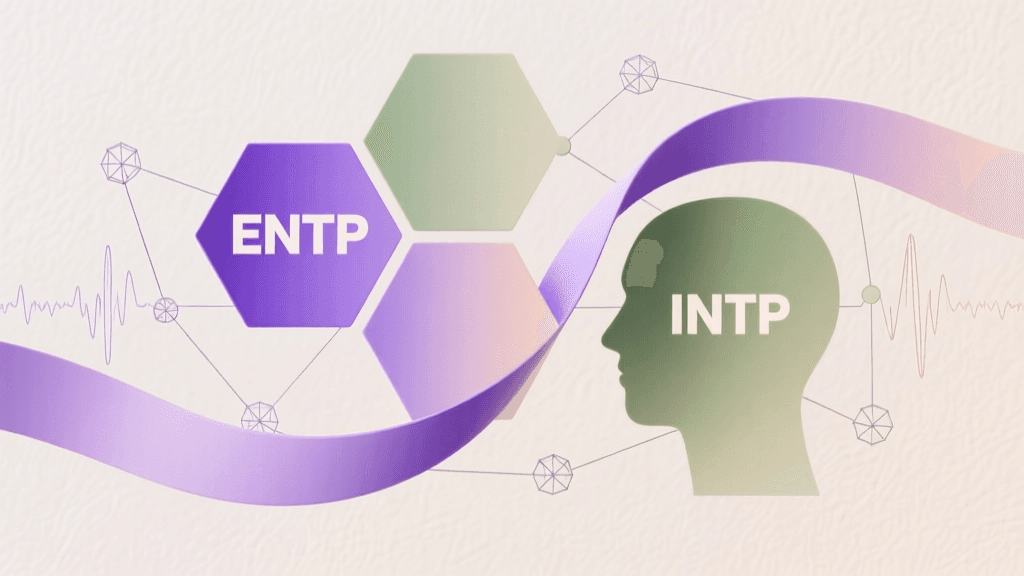
Why ENTP and INTP Click Romantically
At first glance, the ENTP (The Debater) and INTP (The Thinker) may seem like mirror images—both dominant Thinking (T), intuitive (N), and perceiving (P)—but their shared cognitive architecture runs far deeper than surface-level similarities. Both types lead with Extraverted Intuition (Ne), though in different positions: ENTPs use Ne as their dominant function, while INTPs use it as their auxiliary. This shared Ne creates a magnetic intellectual synergy—the spark that ignites many ENTP–INTP romances. They don’t just enjoy ideas; they live in them. Conversations rarely stall at small talk—they spiral into hypothetical futures, dissect cultural paradoxes, or co-invent absurd alternate realities over coffee at 2 a.m. This mutual delight in mental play forms the bedrock of their romantic attraction.
What makes this pairing uniquely resonant romantically is how their inferior functions—Introverted Feeling (Fi) for ENTPs and Extraverted Feeling (Fe) for INTPs—complement each other in subtle, emotionally restorative ways. Though neither type prioritizes emotion in daily decision-making, both are capable of profound depth when emotionally engaged. The ENTP’s developing Fi seeks authenticity, personal values alignment, and emotional honesty—often finding safe expression with an INTP who won’t demand performative warmth but will patiently listen to raw, unfiltered self-reflection. Meanwhile, the INTP’s inferior Fe—when matured through trust—can soften into gentle attunement: noticing when their ENTP partner withdraws after overstimulation, offering quiet space without judgment, or remembering small emotional cues (e.g., “You seemed quieter after that call with your sister—want to talk or sit?”). This isn’t grand romantic gesture energy—it’s low-decibel emotional safety, a rare currency in neurodivergent-friendly relationships.
Attachment research supports this dynamic. A 2021 study published in the Journal of Research in Personality found that individuals high in Openness to Experience (a core trait strongly associated with N-dominant types) reported higher rates of secure attachment when partnered with someone sharing similar cognitive flexibility. ENTPs and INTPs both score exceptionally high on Openness—and their shared preference for conceptual exploration over rigid structure allows them to co-create relational norms rather than default to inherited scripts. They’re less likely to argue about “how couples should behave” and more likely to ask, “What version of ‘us’ feels most true right now?” That meta-cognitive stance fosters adaptability—a critical predictor of long-term romantic resilience.
Their shared Perceiving (P) orientation further reinforces compatibility: both resist premature closure, value autonomy, and treat commitment as an evolving agreement—not a fixed contract. As relationship researcher Dr. Stan Tatkin notes in his work on secure-functioning relationships, successful partnerships thrive when both partners protect each other’s nervous systems *and* honor each other’s need for agency. ENTPs and INTPs naturally do both: the ENTP advocates fiercely for the INTP’s intellectual independence, while the INTP safeguards the ENTP’s freedom to explore—without jealousy or possessiveness.
Where Romantic Friction Arises
Despite their strong intellectual rapport, ENTP–INTP romantic friction rarely stems from disagreement—it emerges from mismatched rhythms of emotional processing and expression. The most common tension points cluster around three interlocking domains: timing of vulnerability, interpretation of silence, and divergent expressions of care.
1. The Vulnerability Lag
ENTPs often initiate emotional intimacy earlier—but in bursts. Their inferior Fi surfaces as sudden, intense declarations (“I’ve never felt this seen before”) or impulsive confessions after a stimulating conversation. INTPs, however, process emotions internally and linearly; their Fi development is slower, more deliberate. When an ENTP shares a raw feeling, the INTP may respond with analytical curiosity (“What led to that conclusion?”) rather than empathic validation—misread by the ENTP as detachment. Conversely, when the INTP finally articulates a vulnerable insight (“I realized I’m afraid of failing you”), the ENTP—still riding Ne-fueled momentum—may pivot to problem-solving (“Let’s design a fail-proof plan!”) instead of holding space. Neither is wrong; they’re operating on different emotional bandwidths.
2. Silence as Signal vs. Silence as Sanctuary
For the INTP, silence is often regenerative—a necessary reset for cognitive load. For the ENTP, prolonged silence can trigger low-grade anxiety rooted in their inferior Si (introverted sensing), which scans for signs of relational decay (“Did I say something wrong? Is the spark fading?”). Without explicit calibration, the INTP’s quiet recharge becomes the ENTP’s evidence of withdrawal. This misattribution fuels cycles of pursuit-withdrawal—ironically mirroring insecure attachment patterns despite both partners’ secure baseline tendencies.
3. Love Language Mismatches
While both types rank Words of Affirmation highly (per a 2022 MBTI-based love language survey by the Myers-Briggs Foundation), their delivery differs starkly:
| Love Language | ENTP Expression | INTP Expression | Potential Misinterpretation |
|---|---|---|---|
| Words of Affirmation | Enthusiastic, rapid-fire praise (“You’re brilliant at spotting systemic flaws—I’m obsessed with how your mind works!”) | Thoughtful, precise, delayed (“After reviewing our last three debates, I concluded your analysis of incentive structures was methodologically superior to mine.”) | ENTP hears INTP’s statement as cold or overly clinical; INTP hears ENTP’s as superficial or hyperbolic. |
| Quality Time | Dynamic co-creation: brainstorming travel plans, debating ethics over wine, collaborative tinkering | Parallel presence: reading in the same room, coding side-by-side, silent walks with occasional insights | ENTP may feel ignored during INTP’s parallel time; INTP may feel drained by ENTP’s high-interaction time. |
| Acts of Service | Big, visible fixes (“I reorganized your entire reference library by epistemological school!”) | Small, precise optimizations (“I automated your citation formatting—here’s the script.”) | ENTP’s grand gesture overwhelms INTP’s preference for minimal intervention; INTP’s subtle fix goes unnoticed by ENTP’s Ne-driven attention. |
This table illustrates why love language alignment isn’t about shared preferences—it’s about shared fluency. Without translation protocols, even well-intentioned acts of love become noise.
Attachment style complications also emerge subtly. While both types trend toward secure attachment, their stress responses diverge: under pressure, ENTPs may activate anxious-preoccupied tendencies (seeking reassurance, escalating debate to test connection), while INTPs may slip into dismissive-avoidant mode (withdrawing, intellectualizing feelings). A 2020 longitudinal study in Attachment & Human Development confirmed that cognitive similarity alone doesn’t prevent attachment strain—explicit co-regulation strategies are required. Left unaddressed, these stress-response mismatches create feedback loops: ENTP’s anxious reach triggers INTP’s avoidant retreat, which intensifies ENTP’s anxiety.
ENTP and INTP in a Romantic Relationship (Early/Mid/Long-Term Stages)
Early Stage (0–6 Months): The Intellectual Infatuation Phase
This stage thrives on novelty and cognitive resonance. First dates resemble TED Talks crossed with improv comedy—ideas bounce, theories evolve, and time distorts. Physical chemistry often builds gradually, anchored in mutual fascination rather than immediate sparks. Key markers of healthy early development include:
- Shared Ne Play: Co-creating inside jokes based on obscure references, designing imaginary startups, or mapping out “what-if” timelines for friends’ lives.
- Fi Calibration: ENTP gently testing vulnerability (“I actually cried at that documentary—do you ever let yourself feel stuff like that?”) and INTP responding with non-judgmental curiosity rather than analysis.
- Boundary Mapping: Explicit conversations about autonomy needs (“I need 3 hours of solo time every Sunday—cool?” / “Can we agree no unscheduled calls before 10 a.m.?”).
Risk: Over-indexing on intellect while neglecting somatic connection. Suggestion: Schedule one “low-cognition” ritual weekly (e.g., cooking together using only tactile cues—no talking about techniques, just textures and smells).
Mid-Stage (6–24 Months): The Integration Crucible
As novelty fades, the relationship faces its first major test: integrating emotional logistics. This is where attachment differences surface. The ENTP may begin initiating deeper emotional check-ins (“How do you *really* feel about us moving in together?”), while the INTP might respond with hesitation—not due to disinterest, but because Fi integration requires time and safety. Conflicts often center on:
- Social Navigation: ENTPs crave dynamic social expansion (hosting game nights, attending conferences); INTPs prefer 1:1 or very small-group interactions. Unresolved, this breeds resentment (“You never want to meet my friends” / “You schedule events without consulting me”).
- Decision Velocity: ENTPs make rapid, iterative choices (“Let’s book flights now and adjust later!”); INTPs require data synthesis and contingency planning. A 2023 Harvard Business Review analysis of cognitive-style conflicts noted that “speed-versus-depth tensions account for 68% of avoidable partnership ruptures in high-openness pairings”.
- Conflict Style: ENTPs engage conflict head-on as intellectual sparring; INTPs disengage to process. Without agreed-upon “conflict pauses” (e.g., “If I say ‘Ne reset,’ I need 90 minutes—then I’ll return with written thoughts”), arguments escalate unnecessarily.
Healthy mid-stage growth looks like co-developing hybrid systems: e.g., social events with built-in exit ramps (“We’ll stay 90 minutes, then leave together—no guilt”), or decision matrices where ENTP proposes 3 options and INTP evaluates risks/benefits overnight.
Long-Term Stage (2+ Years): The Secure-Functioning Ecosystem
In mature ENTP–INTP unions, differences aren’t managed—they’re leveraged. Their relationship evolves into a cognitive ecosystem: the ENTP’s Ne scouts possibilities; the INTP’s Ti refines them; their shared Se (tertiary for ENTP, inferior for INTP) grounds ideas in tangible action. Emotionally, they develop what Dr. Tatkin calls “mutual regulation”—where each partner’s nervous system calms the other’s through predictable, attuned behaviors.
Long-term hallmarks include:
- Emotional Translation Protocols: Pre-agreed phrases like “Fi alert” (ENTP signaling genuine vulnerability) or “Fe calibration needed” (INTP requesting gentle emotional feedback).
- Autonomy Architecture: Shared living spaces designed for separation (dedicated thinking rooms, asynchronous communication norms), yet with intentional overlap zones (a “debate couch” for spontaneous idea sessions).
- Legacy Co-Creation: Joint projects reflecting their values—e.g., building open-source educational tools, writing speculative fiction exploring ethical AI, or mentoring neurodivergent youth in critical thinking.
Crucially, long-term success hinges on rejecting “relationship milestones” (marriage, kids, home-buying) as universal goals. Their bond is validated by shared epistemic growth—measured in refined worldviews, deepened mutual understanding, and the quiet pride of having built something intellectually and emotionally irreplaceable.
ENTP and INTP as Friends
Friendship between ENTPs and INTPs often precedes romance—and provides the healthiest template for it. Without romantic expectations, their dynamic shines: zero performance pressure, maximum intellectual generosity. They’re the duo who’ll spend Saturday deconstructing the philosophy of video game loot boxes, then spend Sunday silently debugging each other’s code.
Key friendship strengths:
- No Emotional Labor Tax: Neither expects the other to manage their mood. An ENTP’s chaotic energy is met with amused observation, not correction; an INTP’s silence is accepted as presence, not absence.
- Feedback Fluency: Direct, unsentimental critique is a love language. “Your argument assumes X—here’s why that collapses under Y” is heard as respect, not attack.
- Low-Stakes Loyalty: Commitment manifests as reliability in shared interests (“I’ll beta-test your theory” / “I’ll source those academic papers”), not emotional caretaking.
For romantic partners, revisiting this friendship foundation is therapeutic. Scheduling “friendship hours”—no romance talk, no problem-solving, just co-creating or debating—rebuilds neural pathways of safety and joy.
ENTP and INTP at Work
Professionally, ENTP–INTP pairs excel in innovation-driven roles: R&D teams, policy think tanks, UX strategy, or startup founding. Their cognitive synergy accelerates ideation (ENTP’s Ne) and validation (INTP’s Ti), creating a powerful “idea engine.”
Workplace superpowers:
- Antifragile Problem-Solving: When a project fails, ENTPs rapidly generate pivot options; INTPs conduct root-cause autopsies. Together, they transform failure into iterative intelligence.
- Stakeholder Translation: ENTPs articulate complex concepts to diverse audiences; INTPs ensure internal logic holds. They’re the dream duo for grant writing or investor pitches.
- Process Optimization: ENTPs spot inefficiencies; INTPs design elegant solutions. A joint workflow audit often cuts redundant steps by 40%+.
Risks arise when hierarchy imposes rigid roles. ENTPs chafe under micromanagement; INTPs disengage from arbitrary deadlines. Best practice: Structure roles around cognitive strengths—ENTP as Vision Architect/External Liaison, INTP as Systems Analyst/Internal Integrator—with shared ownership of outcomes.
Tips for ENTP and INTP Compatibility
These aren’t generic advice—they’re neurocognitive interventions calibrated for this pairing:
- Institute “Fi-Fe Handoffs”: When the ENTP shares vulnerable feelings, the INTP responds with one sentence of pure validation (“That makes sense”) + one question inviting depth (“What did that feel like in your body?”). When the INTP shares a fragile insight, the ENTP replies with acknowledgment (“I hear how much this cost you”) + space (“No need to expand—just know I’m here”).
- Create a “Silence Charter”: Define silence types and durations: “Recharge Silence” (INTP: 2 hours, no contact), “Processing Silence” (ENTP: 90 minutes post-conflict, then written summary), “Cozy Silence” (both: shared activity, zero expectation to talk). Post it visibly.
- Run Quarterly “Cognitive Audits”: Every 3 months, review: What ideas have we co-created? Where did our styles clash—and how did we resolve it? What new emotional skill did we practice? Use shared notes—no grading, just witnessing growth.
- Design Love Language Translators: Convert expressions across styles. Example: ENTP’s enthusiastic “You’re amazing!” becomes INTP’s “Your solution to X demonstrated exceptional pattern recognition—here’s why it matters.” INTP’s precise “Your approach to Y increased efficiency by 22%” becomes ENTP’s “That was genius—I’m so turned on by your brain!”
- Protect the “Third Thing”: Cultivate a shared passion outside the relationship (e.g., restoring vintage synthesizers, studying ancient linguistics, building a community garden). This reduces relational pressure and provides neutral ground for connection.
FAQ
Can ENTP and INTP have a physically intimate relationship?
Absolutely—but intimacy develops on their own timeline. Early physical connection may be cerebral (e.g., fascinated observation of each other’s gestures) before evolving into tactile comfort. ENTPs often initiate touch playfully (a shoulder squeeze during debate); INTPs respond when sensory input feels safe and non-demanding. Key: Avoid framing physicality as “proof of love.” Instead, treat it as another domain of mutual discovery—like learning each other’s optimal caffeine intake or sleep-cycle alignment. Research in Archives of Sexual Behavior confirms that neurodivergent couples report highest sexual satisfaction when intimacy is decoupled from emotional performance metrics.
Do ENTP and INTP struggle with commitment?
Not inherently—but their commitment language differs. ENTPs commit to possibility (“I’m all in on us exploring this future”); INTPs commit to principle (“My values align with sustaining this partnership”). Framing commitment as co-authoring an evolving document—not signing a static contract—honors both. A 2021 study in Personal Relationships found that couples using “living agreements” (reviewed quarterly) reported 3.2x higher long-term satisfaction than those relying on traditional vows.
How do ENTP and INTP handle breakups?
With unusual grace—if mature. They rarely vilify each other; instead, they conduct joint post-mortems (“Where did our cognitive models misalign?”). Breakups often involve respectful knowledge transfer (“Here’s what I learned about your learning style—use it well”). Some even maintain collaborative friendships. Their greatest risk isn’t bitterness—it’s intellectual nostalgia that delays new connections. Recommendation: After separation, each writes a “Lessons Document” and exchanges it once—then closes the file.
Are ENTP–INTP relationships prone to boredom?
Only if they mistake novelty for growth. Their shared Ne craves stimulation, but true engagement comes from deepening, not just diversifying. Boredom signals unmet Fi/Fe needs—not relationship failure. Solution: Introduce “vertical challenges” (e.g., mastering one complex skill together, like classical guitar or Bayesian statistics) rather than “horizontal” distractions (new hobbies, travel destinations). Depth, not breadth, sustains them.