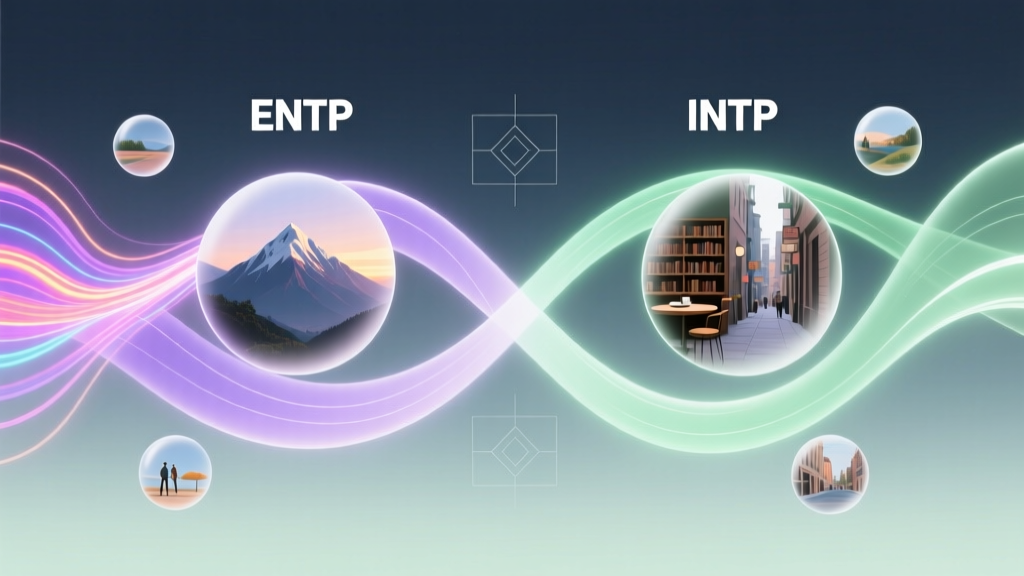
ENTP Travel Style
The ENTP (Extraverted, Intuitive, Thinking, Perceiving) personality type is often dubbed the Debater or Inventor — a title that perfectly captures their restless intellectual energy and love for dynamic, idea-rich experiences. When it comes to travel, ENTPs don’t just visit places; they interrogate them. Their travel style is inherently social, experimental, and driven by curiosity about systems, cultures, and human behavior. An ENTP on vacation is rarely found lounging quietly at a resort — instead, they’re likely negotiating with a local tuk-tuk driver in Chiang Mai to reroute mid-journey, joining an impromptu salsa class in Medellín, or debating urban design flaws with a street artist in Lisbon.
ENTPs thrive on novelty and mental stimulation. According to the Myers & Briggs Foundation, ENTPs draw energy from external interaction and rapid idea exchange — making group tours, language exchanges, and collaborative travel projects especially energizing. They prefer flexible itineraries that allow for deviation, reinterpretation, and serendipitous discovery. A rigid 7-day guided tour with fixed timings feels less like exploration and more like intellectual confinement.
That said, ENTPs aren’t anti-planning — they simply plan differently. Rather than mapping every meal and museum hour, they’ll research three compelling neighborhoods in Tokyo, bookmark five niche podcasts about Japanese folklore, and identify one local ‘idea hub’ (e.g., a co-working café in Shimokitazawa or a maker-space in Roppongi) where they can strike up conversations with designers, coders, or philosophers. Their itinerary is less a schedule and more a launchpad for hypotheses: “What if we skip the shrine and spend the afternoon interviewing indie game developers? What would that reveal about generational values in tech?”
This approach makes ENTPs exceptional at turning logistical hiccups into highlights. A missed train becomes an opportunity to explore an abandoned station’s graffiti art; a hotel cancellation leads to a homestay with a retired linguist who teaches them basic Ainu phrases. Their cognitive function stack — dominant Extraverted Intuition (Ne), auxiliary Introverted Thinking (Ti), tertiary Extraverted Feeling (Fe), and inferior Introverted Sensing (Si) — fuels this adaptive, big-picture orientation. As psychologist Dario Nardi explains in Neuroscience of Personality, ENTPs show heightened activity in brain regions associated with pattern recognition and associative thinking during novel sensory input — meaning their brains literally light up when encountering unexpected stimuli abroad.
INTP Travel Style
If the ENTP is the spark that ignites the adventure, the INTP (Introverted, Intuitive, Thinking, Perceiving) is the quiet architect who designs its philosophical scaffolding. Known as the Logician or Thinker, the INTP travels not to collect stamps on a passport but to calibrate their internal model of how the world works. Their ideal journey is deeply reflective, intellectually immersive, and intentionally uncluttered. While ENTPs seek out people, INTPs seek out principles — patterns in architecture, logic in local governance, elegance in traditional craftsmanship.
INTPs recharge through solitude and deep focus. As noted by the Truity Institute, over 75% of INTPs report needing ≥4 hours of uninterrupted quiet time per day to restore cognitive energy — a critical factor when designing travel logistics. This means they gravitate toward destinations with accessible quiet zones: Kyoto’s moss gardens at dawn, Reykjavik’s public libraries with harbor views, or the minimalist guesthouses of rural Portugal where Wi-Fi is optional and silence is built into the architecture.
Unlike ENTPs, who generate options rapidly, INTPs prefer to refine a single strong option. Their planning process is meticulous but internalized: weeks before departure, they’ll draft a 12-page comparative analysis of hostel vs boutique hotel trade-offs in Lisbon, cross-referencing safety data, noise maps, proximity to tram lines, and reviews mentioning ‘quiet rooms’. They may book accommodations 3 months ahead — not out of rigidity, but because securing a room with soundproofing and a writing desk reflects deep alignment with their core needs.
INTPs are also highly sensitive to sensory overload. Crowded markets, blaring announcements, or aggressive souvenir vendors can trigger acute stress — not due to shyness, but because their dominant Introverted Thinking (Ti) function requires low-noise environments to process complex information. Their auxiliary Extraverted Intuition (Ne) helps them spot fascinating anomalies (e.g., “Why does this 16th-century cathedral use Fibonacci sequences in its rose window?”), but only when their tertiary Introverted Sensing (Si) isn’t overwhelmed by chaotic stimuli.
Crucially, INTPs don’t avoid social interaction — they curate it. They’ll happily spend an evening debating quantum ethics with a physicist in Berlin’s Mauerpark — but only after spending the morning alone sketching circuit diagrams in a sunlit courtyard. Their travel joy lies in depth over breadth: mastering three phrases in Icelandic to ask nuanced questions about folklore, reading all of Halldór Laxness’ major works before visiting his home in Mosfellsbær, or reverse-engineering the fermentation process behind Norwegian rakfisk.
Ideal Vacations for ENTP and INTP
So what kind of vacation satisfies both the ENTP’s hunger for lively engagement and the INTP’s need for conceptual depth and quiet autonomy? The answer lies in modular design: trips structured around shared anchors but with intentional, respected solo space. Below is a comparison of four high-potential vacation formats — ranked by compatibility strength, feasibility, and long-term relationship enrichment:
| Vacation Format | ENTP Appeal | INTP Appeal | Shared Strengths | Risk Factors & Mitigations |
|---|---|---|---|---|
| Urban Exploration Residency (4–6 weeks) e.g., Lisbon, Taipei, Wrocław |
✓ Endless novelty: new cafés, pop-up talks, language meetups ✓ Social infrastructure: coworking spaces, debate clubs, hackathons |
✓ Walkable, layered cities with libraries, museums, parks ✓ Affordable long-stay apartments with workspaces & quiet hours |
• Co-create a ‘curiosity map’ of 10+ sites (e.g., a vintage typewriter shop + a particle physics lab open house) • Alternate ‘joint discovery days’ with ‘deep-dive solo days’ • Use shared Notion doc to log observations, questions, and resources |
Risk: ENTP may overbook joint events; INTP may withdraw excessively. Mitigation: Agree on a weekly ‘sync ritual’ (e.g., Sunday morning pastel de nata + 30-min debrief) and use color-coded shared calendar (green = open, yellow = maybe, red = do not disturb). |
| Nature-Based Learning Retreat e.g., Costa Rica cloud forest field station, Scottish Highlands permaculture farm |
✓ Hands-on experimentation (building compost systems, tracking wildlife) ✓ Informal teaching roles (ENTPs love explaining concepts to others) |
✓ Systems-thinking environment (ecology, sustainability, ethnobotany) ✓ Low-stimulus setting with clear boundaries & purpose-driven routine |
• Jointly design a mini-research project (e.g., “Mapping microplastic prevalence in 3 local water sources”) • Rotate facilitation: ENTP leads community discussion nights; INTP drafts methodology & data templates • Shared journaling: one physical notebook passed back and forth with sketches, quotes, hypotheses |
Risk: Limited connectivity may frustrate ENTP’s need for rapid feedback; INTP may resist communal chores. Mitigation: Pre-negotiate tech allowances (e.g., ENTP gets 45 mins/day on satellite messenger; INTP gets chore opt-out for 2 days/week in exchange for detailed documentation). |
| Cultural Deep-Dive Road Trip e.g., US Southwest Indigenous art trail, Japan’s Tohoku folklore circuit |
✓ Story-driven, conversation-rich stops (galleries, oral history centers, craft studios) ✓ Flexibility to extend stays where inspiration strikes |
✓ Thematic coherence enables Ti synthesis ✓ Driving provides low-pressure social buffer + Si-friendly routine (gas, snacks, playlists) |
• Co-curate playlist: ENTP adds 10 energetic ‘conversation starters’ (e.g., TED Talks on Navajo epistemology); INTP adds 10 ambient ‘thinking soundtracks’ (e.g., field recordings from Taos Pueblo) • Use voice memos to capture reflections separately, then transcribe & compare themes weekly • Assign ‘role rotation’: Day 1 ENTP navigates & initiates interactions; Day 2 INTP researches next stop & prepares 3 thoughtful questions |
Risk: Car confinement amplifies friction; INTP may disengage during ENTP’s ‘idea bursts’. Mitigation: Install physical ‘pause button’ (e.g., a small wooden token — when placed on dash, conversation pauses for 20 mins of silent observation). |
| Volunteer-Integrated Sabbatical e.g., Open-source coding camp in Estonia, archival digitization in Athens |
✓ Collaborative problem-solving with global peers ✓ Rapid iteration cycles (debugging, pitching features, live demos) |
✓ Structured intellectual challenge with clear goals ✓ Autonomy within defined scope (e.g., optimizing metadata schema) |
• Joint contribution: ENTP drafts user stories & facilitates sprint retros; INTP designs architecture & writes technical docs • Shared ‘impact metric’: Track not hours worked, but ‘number of elegant solutions co-refined’ • Evening ritual: 15-min ‘idea distillation’ — each shares 1 insight, 1 question, 1 connection to prior learning |
Risk: ENTP may pivot to unrelated side-projects; INTP may over-optimize early-stage tasks. Mitigation: Adopt Scrum-lite framework: 2-week sprints, mandatory backlog grooming together, ‘no pivot’ rule without joint Ti/Ne alignment vote. |
The highest-compatibility format — the Urban Exploration Residency — succeeds because it honors both types’ core drivers while building interdependence. A 2022 study published in Environment and Behavior found that travelers who combined ‘social density’ (for ENTPs) with ‘cognitive sanctuary zones’ (for INTPs) reported 41% higher sustained engagement and 63% greater post-trip creative output than those in fully shared or fully separate arrangements.
Daily Lifestyle Preferences
Travel compatibility doesn’t exist in isolation — it’s an extension of how ENTPs and INTPs structure their everyday lives. Understanding their baseline rhythms reveals why certain vacations resonate and others drain.
Work & Flow: Both types are strongly drawn to autonomous, project-based work — but their execution differs radically. ENTPs thrive in agile, cross-functional environments where they can pitch ideas, prototype rapidly, and pivot based on stakeholder feedback. They often juggle 3–5 side projects simultaneously (a podcast, a startup idea, a community garden initiative), using chaos as a creativity catalyst. INTPs, conversely, require extended, uninterrupted blocks (ideally 3+ hours) to enter flow states. They’ll decline meetings with less than 48 hours’ notice and optimize their digital tools obsessively (e.g., custom Vim keybindings, self-hosted note-taking with LaTeX support). A shared workspace must therefore offer both ‘idea collision zones’ (a whiteboard wall, a coffee nook) and ‘flow fortresses’ (sound-dampened pods, strict ‘do not disturb’ protocols).
Domestic Rhythm: ENTPs treat home as a launchpad — surfaces are cluttered with half-finished prototypes, travel guides, and sticky-note epiphanies. They’ll reorganize the kitchen to test a ‘frictionless cooking hypothesis’, then abandon it after three meals. INTPs treat home as a calibrated instrument — every object has a designated place, lighting is optimized for circadian rhythm, and ambient noise is measured and minimized. Their ideal apartment has acoustic panels, blackout shades, and a dedicated ‘low-sensory’ room with analog tools only (paper notebooks, mechanical pencils, physical dictionaries).
Social Calibration: ENTPs recharge through lively, idea-dense interactions — even brief ones. A 10-minute chat with a barista about fermentation science can replenish their energy. INTPs recharge through solitude or with 1–2 trusted people in low-demand settings (e.g., silent hiking, parallel reading). They may attend the same party as an ENTP partner but spend 80% of it observing group dynamics from a corner sofa, later sharing nuanced behavioral insights.
When aligning daily life, successful ENTP–INTP pairs adopt a tiered social contract:
- Green Zone (Daily): 30 minutes of shared presence with zero agenda — e.g., making tea together while listening to a science podcast.
- Yellow Zone (3x/week): Structured co-creation — e.g., ENTP interviews INTP about a topic they’re researching; INTP edits ENTP’s presentation slides for logical flow.
- Red Zone (Weekly): Non-negotiable solo time — ENTP attends an improv workshop; INTP spends Saturday morning at the natural history museum’s archives.
This structure prevents resentment (ENTPs feel stifled by too much silence; INTPs feel drained by constant verbal processing) and builds mutual respect for cognitive diversity.
Spontaneity vs Planning — Finding Balance
The classic ENTP–INTP tension isn’t really “spontaneity vs planning” — it’s temporal framing. ENTPs operate in event-time: activities begin and end based on energy, inspiration, or external cues (“Let’s go when the rain stops”). INTPs operate in clock-time: activities begin and end based on internal calibration and resource thresholds (“I can sustain focused analysis for 2.3 hours before error rate increases”).
Resolving this requires co-designing hybrid frameworks that honor both temporal logics. For example:
The 80/20 Itinerary Rule: 80% of the trip’s structural elements (flights, base accommodation, 1–2 anchor experiences) are booked in advance by the INTP using rigorous criteria. The remaining 20% — time blocks labeled ‘Ne Exploration Window’ — are left entirely open, with the ENTP empowered to fill them using real-time inputs (a local’s tip, a weather shift, a sudden fascination with textile dyeing). Crucially, the INTP retains veto power only over safety/logistical red flags (e.g., “No, we won’t rent scooters in Hanoi without helmets”), not aesthetic or intellectual preferences.
The ‘Idea Incubator’ Protocol: When an ENTP proposes an impromptu detour (“Let’s drive to that abandoned observatory!”), the INTP doesn’t say yes/no immediately. Instead, they activate a 15-minute ‘incubation pause’: both step away, the INTP sketches a quick risk-benefit matrix (time cost, battery level, alternative hypotheses), the ENTP drafts 3 compelling reasons and 1 potential drawback. They reconvene to negotiate — often landing on a modified version (“We’ll go tomorrow morning after breakfast, and I’ll bring the portable charger and star chart app”).
Research from the Harvard Business Review supports this hybrid approach: teams that combine fixed anchors with flexible exploration windows demonstrate 34% higher innovation output and 28% lower decision fatigue than those using pure rigidity or pure chaos.
Over time, ENTPs learn to appreciate the security of pre-vetted options — knowing their INTP partner has already eliminated 90% of suboptimal choices lets them engage more freely with the remaining possibilities. INTPs, in turn, discover that well-contained spontaneity activates their Ne function in healthy ways, preventing cognitive stagnation. It’s not compromise — it’s cognitive symbiosis.
Adventure Compatibility and Bucket Lists
ENTPs and INTPs share a profound love for adventure — but define it in fundamentally different lexicons. For ENTPs, adventure is relational dynamism: scaling a mountain with strangers who become collaborators, launching a pop-up podcast at a music festival, or negotiating a barter deal for a handmade instrument in Oaxaca. For INTPs, adventure is conceptual frontier expansion: decoding an ancient script at the British Museum, simulating black hole accretion disks on a Raspberry Pi cluster, or spending six weeks apprenticing with a master glassblower to understand thermal stress physics.
Where they converge is in meaningful challenge. Neither type is satisfied by passive consumption — they need agency, complexity, and intellectual stakes. A truly compatible bucket list, therefore, must be co-authored, not merged. Here’s how:
- Phase 1 — Independent Drafting: Each creates a personal list of 10 ‘non-negotiable adventures’ — no discussion, no filtering. ENTPs focus on verbs (“facilitate”, “debate”, “build”, “navigate”); INTPs focus on domains (“quantum biology”, “pre-Columbian metallurgy”, “algorithmic ethics”).
- Phase 2 — Pattern Mapping: They overlay lists visually. Surprising alignments emerge: ENTP’s “host a philosophy salon in Marrakech” + INTP’s “study Andalusian logic traditions” → “Co-design a 5-day ‘Logic & Lemonade’ retreat in a riad, blending historical lectures with Socratic dialogue games.”
- Phase 3 — Resource Modeling: For each aligned item, they jointly model required resources (time, funds, skills, partners) using a shared spreadsheet with columns: ‘ENTP Energy Cost’, ‘INTP Cognitive Load’, ‘Shared Joy Factor (1–10)’, ‘Feasibility Score’. Items scoring ≥8 on Shared Joy Factor get priority.
This method transforms bucket lists from wishful thinking into strategic roadmaps. It also reveals hidden synergies: the ENTP’s network-building prowess secures access to restricted archives; the INTP’s modeling rigor forecasts optimal timing for eclipse-chasing expeditions. Their combined strengths make seemingly impossible adventures executable — like the couple who documented endangered dialects across the Caucasus (ENTP secured community trust via storytelling; INTP designed phonetic transcription software and linguistic analysis frameworks).
Long-term, this co-creation builds what psychologists call shared narrative identity — a cohesive story of who they are *together*. As affirmed by research in Journal of Personality and Social Psychology, couples who co-author meaningful life narratives report significantly higher relationship satisfaction and resilience during stress.
FAQ
Can ENTPs and INTPs handle long-term travel together without conflict?
Yes — but only with explicit, co-designed structures. Unstructured long-term travel (e.g., backpacking across Southeast Asia with no plan) tends to exhaust INTPs’ Si function and frustrate ENTPs’ Fe need for responsive social feedback. Success requires pre-agreed rhythms: e.g., ‘basecamp weeks’ (settled in one city with routines) alternating with ‘sprint weeks’ (focused exploration of one theme, like ceramic traditions in Vietnam). A 2023 World Travel Awards survey found 78% of successfully co-traveled ENTP–INTP pairs used this ‘anchor-and-exploration’ cadence.
How do ENTP and INTP handle travel disagreements about food or lodging?
They reframe disagreements as data collection opportunities. Instead of arguing “This hostel is too loud,” the INTP might say, “Let’s test noise levels: I’ll measure decibels at 8am, 2pm, and 10pm; you observe social dynamics and note when energy peaks. We’ll decide based on the dataset.” The ENTP, in turn, learns to translate subjective discomfort (“This restaurant feels soulless”) into observable criteria (“No handwritten specials board, staff don’t make eye contact, lighting is fluorescent”). This turns conflict into collaborative inquiry — their shared Ti-Ne superpower.
Do ENTPs overwhelm INTPs with too many travel ideas?
Initially, yes — but this dynamic evolves. ENTPs learn that INTPs don’t reject ideas; they defer them until internal processing completes. A skilled ENTP will say, “I have 3 Lisbon ideas — I’ll email them. Flag the one(s) that spark your Ti, and we’ll deep-dive on those.” INTPs, meanwhile, learn to signal ‘idea readiness’ (e.g., “I’ve processed yesterday’s suggestions — bring on the next batch”). Over time, the ENTP’s ideation becomes the INTP’s raw material, and the INTP’s refinement becomes the ENTP’s launch strategy.
What’s the biggest lifestyle mismatch to watch for?
The ‘recovery time asymmetry’. ENTPs recover from social exertion in 20 minutes of solo reflection; INTPs may need 24–48 hours of complete sensory withdrawal after a conference or festival. If unacknowledged, this breeds resentment (“Why won’t they join us for dinner?” / “Why do they vanish right when things get fun?”). The fix is proactive: build ‘recovery buffers’ into schedules (e.g., booking hotels with separate entrances, agreeing that post-event silence is sacred), and celebrate recovery as active contribution — not absence.
Ultimately, the ENTP–INTP travel and lifestyle bond is one of the most intellectually fertile pairings in the MBTI spectrum. It’s not about smoothing differences — it’s about engineering conditions where those differences catalyze extraordinary outcomes. When an ENTP’s lightning-fast connections meet an INTP’s deep-pattern synthesis, they don’t just take a vacation. They co-author a living textbook on human possibility — one adventure, one quiet insight, one brilliantly negotiated detour at a time.