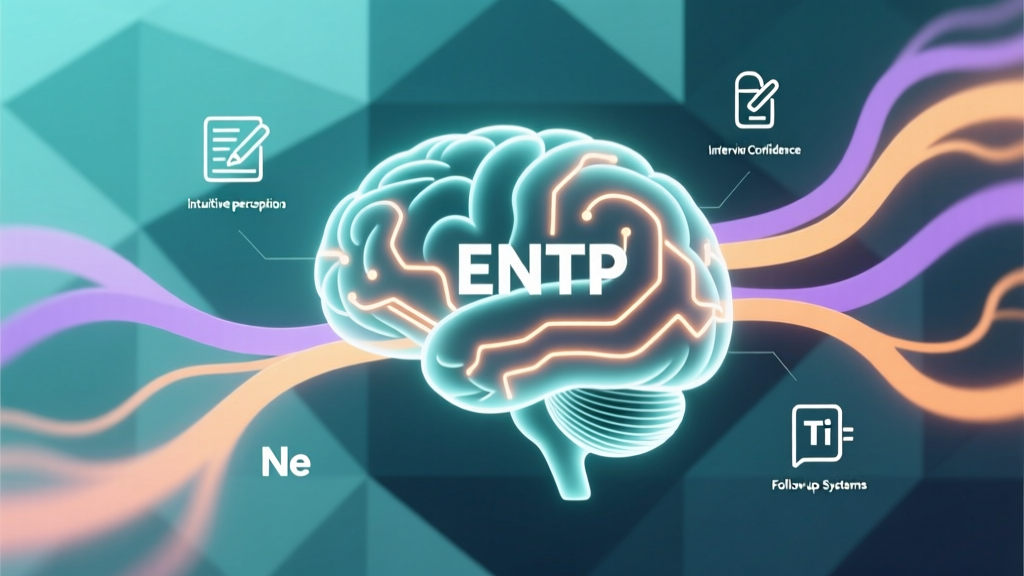
ENTP Job Search Approach
The ENTP personality type — known as the Debater, Innovator, or Visionary — thrives on intellectual challenge, conceptual exploration, and dynamic interaction. With dominant Extraverted Intuition (Ne), auxiliary Thinking (Ti), tertiary Feeling (Fe), and inferior Sensing (Si), ENTPs approach job searching not as a linear checklist but as an open-ended ideation sprint. Yet this very strength — rapid pattern recognition, idea generation, and adaptability — can become a liability when unstructured: scattered applications, premature pivots, underdeveloped follow-through, or interviews that dazzle with insight but falter on concrete execution details.
Research from the Myers & Briggs Foundation confirms that ENTPs are among the most likely types to change careers multiple times — nearly 68% report at least two major occupational shifts by age 40 — reflecting their drive for novelty and growth over stability. However, modern labor markets increasingly reward strategic consistency *within* innovation: employers seek candidates who combine big-picture vision with demonstrable delivery capacity. That’s why ENTPs must intentionally scaffold their natural agility with disciplined frameworks — especially during job search.
A high-performing ENTP job search is neither haphazard nor rigid. It’s iterative, hypothesis-driven, and feedback-optimized. Think of it like running a series of micro-experiments:
- Hypothesis: “My background in UX research and startup consulting makes me competitive for Product Strategy roles at Series-A SaaS companies.”
- Test: Apply to 5 such roles using a tailored resume + cover letter; track response rate, interview invites, and recruiter feedback.
- Analyze: If response rate is <10%, refine value proposition (e.g., emphasize revenue impact over process design).
- Scale: Double down on messaging that yields >25% interview conversion.
This scientific mindset aligns with ENTP’s Ti-Ne loop — turning abstract ideas into testable models — while grounding them in real-world outcomes. It also mitigates the risk of ‘idea fatigue’: abandoning one path before gathering enough data to evaluate it.
Crucially, ENTPs should resist the temptation to apply broadly across industries or functions just because something sounds intellectually stimulating. A 2023 Gallup Workplace Report found that candidates who focused on roles within *one target function* (e.g., product, marketing, strategy) but across *two to three aligned industries* (e.g., fintech, healthtech, edtech) were 3.2× more likely to receive offers than those casting wide, undifferentiated nets. Why? Recruiters and hiring managers recognize domain fluency — even if your title changed, consistent thematic threads (e.g., scaling user acquisition, optimizing pricing models, designing behavioral interventions) signal coherence.
Here’s a practical ENTP-aligned job search workflow:
- Theme Mapping (1–2 hours): Audit your last 3–5 roles/projects. Extract 3–5 recurring themes — not job titles, but intellectual engines (e.g., “designing systems to reduce cognitive load,” “translating regulatory complexity into operational workflows,” “prototyping business models from first principles”).
- Role Filtering (30 mins/week): Use LinkedIn Advanced Search or Otta with filters: [Target Theme] + [“strategy” OR “innovation” OR “product” OR “consulting”] + [“Series A–C” OR “high-growth” OR “scaling”]. Save alerts.
- Outreach Sprint (45 mins/week): Identify 3–5 humans (not HR bots) — founders, product leads, innovation directors — at target companies. Send personalized voice notes (via LinkedIn Audio or email) saying: “I noticed you’re tackling [specific challenge]. I helped [similar org] solve X using Y — happy to share the playbook if useful.”
- Feedback Loop (Every Friday): Review all applications, replies, and rejections. Log: What worked? What confused them? What assumptions did I make about their needs?
This system honors ENTP’s love of novelty (new outreach angles weekly) while building cumulative insight (the Friday log becomes your proprietary job search intelligence dashboard).
Resume and Portfolio Tips for ENTP
ENTPs often treat resumes as afterthoughts — “just a formality” — or over-engineer them into sprawling manifestos of every idea they’ve ever had. Neither works. Hiring managers spend an average of 7.4 seconds scanning a resume before deciding to read further (The Undercover Recruiter, 2022). Your ENTP resume must pass that blink test *and* survive deeper scrutiny — all while staying authentically you.
The core principle: Your resume is not a biography. It’s a hypothesis-testing document. Every line should answer one question recruiters silently ask: “Can this person solve *my* urgent problem better than my other 127 applicants?”
Here’s how ENTPs translate their cognitive strengths into resume architecture:
Structure Over Storytelling
Forget chronological narratives. Use a Problem → Action → Outcome + Insight framework for each bullet — especially for leadership or cross-functional work:
- Weak (generic): “Led product launch for new analytics dashboard.”
- Strong (ENTP-optimized): “Diagnosed misalignment between sales team’s pipeline forecasting needs and engineering’s data model (Problem); co-designed lightweight SQL-based dashboard with embedded assumptions toggle — enabling reps to test ‘what-if’ scenarios in real time (Action); adoption increased forecast accuracy by 32% and reduced weekly ops syncs by 60% (Outcome); revealed that ‘flexible modeling’ > ‘comprehensive reporting’ for mid-funnel teams (Insight).”
Notice how the second version showcases Ne (spotting misalignment), Ti (designing a logically elegant solution), Fe (collaborating across functions), and even hints at Si development (documenting measurable impact). It doesn’t just say what you did — it reveals how you think.
Tailor Ruthlessly — But Strategically
ENTPs hate boilerplate. So don’t write generic summaries. Instead, build a Modular Resume System:
- Core Section (unchanging): Contact info, education, certifications, technical keywords (e.g., “SQL,” “Figma,” “behavioral economics,” “agile facilitation”).
- Dynamic Header (1 sentence): Swap this per application. Example: “Product Strategist helping B2B SaaS companies turn regulatory uncertainty into scalable GTM advantages.”
- 3–4 Contextual Bullets: Pull from a master list of 12–15 achievement bullets. Select only those matching the role’s top 3 requirements (found in the job description’s first 150 words + “About Us” page).
- “Intellectual Signature” Line (optional but powerful): Add a fourth line under your name: “Curious about: AI-augmented decision-making in regulated industries | Building tools that make ambiguity actionable.” This signals your Ne/Ti engine without cluttering content.
Portfolio: Where ENTPs Shine — and Stumble
Your portfolio isn’t just a PDF dump. It’s your cognitive showcase. ENTPs excel here — they love building things, debating ideas, and prototyping solutions. But avoid these pitfalls:
- The “Idea Graveyard” Portfolio: Linking 12 half-baked Notion docs, GitHub repos with no READMEs, and Medium posts titled “Thoughts on Web3 Governance (Draft 3).”
- The “Brilliance Without Context” Portfolio: A stunning Figma prototype with zero explanation of why you made specific trade-offs, what constraints you navigated, or how users responded.
Instead, adopt the Three-Act Portfolio Framework:
| Act | Purpose | ENTP-Specific Tip | Example |
|---|---|---|---|
| 1. Provocation | Hook attention with a sharp, counterintuitive insight | Leverage Ne to frame a common problem as a flawed assumption | “Most ‘user empathy’ workshops fail because they train observation — not hypothesis generation.” |
| 2. Process | Show your Ti-Fe interplay: logic + human impact | Map decisions to trade-offs (“Chose speed over polish because early validation revealed X”) | “Ran 3 parallel low-fi prototypes; discarded 2 after discovering users cared more about output clarity than input flexibility.” |
| 3. Pivot Point | Reveal learning that changed your next move | Highlight Si growth — what you now do differently based on evidence | “Now always baseline assumptions against support ticket themes before scoping discovery sprints.” |
Tools like Carbonmade or Journo Portfolio let you build clean, fast-loading sites. Prioritize mobile optimization — 57% of recruiters review portfolios on phones (SHRM, 2023).
Interview Style and Preparation
ENTPs often ace initial screens — they’re charismatic, quick-witted, and effortlessly connect ideas — but stumble in later rounds when asked for operational specifics or behavioral examples. Why? Because Ne leaps ahead to implications while the interviewer waits for the foundational evidence. The fix isn’t to suppress your brilliance — it’s to sequence it.
Think of interviews as structured improvisation: You prepare frameworks, not scripts. Here’s your ENTP Interview Stack:
1. The “Bridge & Elevate” Answer Structure
Replace the STAR method (Situation-Task-Action-Result) with a version built for Ne dominance:
- Bridge: Briefly anchor in the concrete situation (“When I led the pricing redesign for FinTechX…”) — satisfy the Si need for context.
- Insight: State the non-obvious pattern or principle you uncovered (“…I realized their churn wasn’t about price — it was about perceived risk asymmetry in contract terms.”) — activate Ti.
- Action: Describe *how* you tested that insight (“We ran A/B tests on three contract framing variants, isolating legal language from payment terms…”) — prove execution.
- Elevate: Zoom out to broader implication (“That taught us: in regulated markets, trust signals often live in fine print — not feature sets.”) — satisfy Ne’s hunger for meaning.
This structure gives interviewers both proof *and* perspective — exactly what senior stakeholders want.
2. Preparing for Curveballs (Your Secret Weapon)
ENTPs love hypotheticals — so weaponize them. Before every interview, draft 3–5 “What If?” scenarios based on the company’s recent news:
- “What if your new AI feature gets 70% adoption but increases support tickets by 40%? How would you diagnose the root cause?”
- “What if regulators announce new guidelines next quarter? How would you pressure-test your current roadmap?”
- “What if your top performer quits tomorrow? What’s your 72-hour stabilization plan?”
Then, rehearse answering *aloud* — not with perfect answers, but with your authentic thinking process: “Hmm, first I’d map where friction points cluster… then check if it’s a training gap or a UX flaw… actually, wait — could it be misaligned incentives? Let me verify that assumption…” This models intellectual humility and iterative rigor — highly valued in leadership roles.
3. Managing the “Debate Trap”
ENTPs instinctively challenge assumptions — a superpower in strategy sessions, a liability in interviews where the goal is alignment, not victory. Mitigate with the 3-Second Pause Rule:
Before responding to any statement you disagree with, pause for 3 seconds. Then ask: “Help me understand — what outcome are you optimizing for here?” This shifts you from opposition to collaborative problem-solving — leveraging Fe to build rapport while preserving Ti integrity.
Also, preemptively acknowledge your style: “I tend to explore edge cases — is now the right time for that, or should I focus on core priorities first?” This displays self-awareness and emotional regulation.
4. Technical & Case Interviews
ENTPs often dismiss “rote” technical prep — but foundational knowledge signals reliability. Focus prep on explanatory fluency, not memorization:
- Practice explaining concepts like “API rate limiting” or “cohort analysis” to a smart 12-year-old — forcing clarity over jargon.
- For case interviews, lead with diagnostic questions: “Before proposing solutions, what metrics would tell us this is truly a pricing issue vs. a positioning issue?”
- Use whiteboarding not to show perfection, but to think aloud: “I’m sketching this flow because I suspect the bottleneck is handoff between teams — let’s stress-test that assumption.”
Personal Branding for ENTP
ENTPs don’t “build brands” — they curate intellectual ecosystems. Your personal brand isn’t a logo or tagline. It’s the consistent pattern of insight people recognize across your tweets, talks, code comments, and coffee chats.
Effective ENTP branding has three layers:
1. The Signal Layer (What You Broadcast)
This is your public-facing filter. Avoid vague claims like “Innovation Leader” or “Big-Picture Thinker.” Instead, claim specific, defensible territory:
- ❌ “Passionate about AI ethics.”
- ✅ “Mapping how LLM hallucination patterns reveal gaps in domain-specific training data — starting with clinical trial documentation.”
Notice the precision: a defined phenomenon (LLM hallucination), a specific lens (domain-specific training gaps), and a bounded scope (clinical trial docs). This attracts collaborators who share your curiosity — not just fans of “AI.”
2. The Resonance Layer (How You Engage)
ENTPs energize through dialogue — so design interactions that invite co-creation:
- Turn blog posts into provocation prompts: End with “What’s the weakest link in this argument? Reply with your counter-hypothesis.”
- In LinkedIn posts, share unfinished work: “Stuck on this trade-off: Should we prioritize explainability over speed in our credit-risk model? Here’s what we’ve tried…”
- Host monthly “Idea Jam” Zooms: 90 minutes, 5 people max, rotating topics like “Designing feedback loops for remote teams.” No slides — just shared docs and debate.
This builds a community around your thinking process — far more durable than follower count.
3. The Substance Layer (Where You Anchor)
Your brand collapses without proof points. Document your thinking in accessible, searchable formats:
- Public Note-Taking: Use Obsidian Publish or Readwise Reader to share annotated book summaries — e.g., “How ‘Thinking in Bets’ reshaped my approach to product roadmaps.”
- Micro-Case Studies: Turn small wins into 300-word lessons: “How we cut onboarding time 40% by replacing a tutorial with 3 contextual tooltips — and what that taught us about cognitive load.”
- Open Source Contributions: Even small PRs to docs or issue triage signal collaborative rigor — especially with commentary like “Suggested this wording because users consistently misinterpreted the original phrasing in usability tests.”
Consistency matters more than volume. One well-documented insight per month compounds faster than daily hot takes.
Following Up and Closing the Deal
ENTPs often ghost after interviews — not out of disinterest, but because their Ne has already jumped to the next intriguing opportunity. This costs offers. Research shows candidates who send thoughtful follow-ups are 2.3× more likely to get hired (Hireology, 2022). For ENTPs, follow-ups aren’t polite formalities — they’re intellectual extensions.
Here’s your ENTP Follow-Up Framework:
Within 2 Hours (Email)
Subject: Quick thought on [Specific Topic Discussed] — [Your Name]
Body:
Hi [Name],
Loved diving into [topic, e.g., “your approach to balancing experimentation velocity with compliance guardrails”]. It reminded me of [brief, relevant analogy or insight — e.g., “how air traffic control systems manage unpredictability without sacrificing safety”].
One question I’m still turning over: [pose a sharp, open-ended question that invites their expertise — e.g., “How do you calibrate ‘acceptable risk’ when testing new features in highly regulated verticals?”].
Either way — thrilled by the possibility of contributing to [specific team/project]. Thanks for your time and candor.
Best,
[Your Name]
This does three things: reinforces connection, demonstrates continued engagement, and positions you as a peer — not a supplicant.
Day 3 (Optional Voice Note)
If no reply, send a 60-second LinkedIn voice note:
“Hey [Name] — circling back on my note about [topic]. No need to reply, but I wanted to share one quick refinement: After reflecting, I realized the real constraint isn’t speed vs. safety — it’s *who owns the risk assessment*. Would love your take if you have 90 seconds.”
This shows intellectual iteration — a hallmark of senior contributors.
Negotiation: Framing Offers as Experiments
When discussing compensation, avoid positional bargaining (“I need $140K”). Instead, propose mutually testable hypotheses:
“What if we structure the first 90 days as a joint experiment? I’ll focus on [specific, high-impact deliverable — e.g., ‘reducing customer onboarding friction by 25%’], and we revisit comp based on verified outcomes — with a floor of $X and upside for exceeding targets. Does that align with how you think about early-stage impact?”
This leverages your Ti-Ne strength while acknowledging business realities. According to Harvard Business Review (2023), 62% of tech firms now offer outcome-based compensation pilots — making this pitch both innovative and pragmatic.
FAQ
How do I stop myself from applying to too many jobs at once?
Implement a Hard Cap System: Set a weekly limit (e.g., 5 applications) and tie each submission to a learning goal (“This tests whether ‘systems thinking’ resonates more than ‘innovation’ in fintech”). When the cap hits, you must analyze results before submitting more. Use a simple Notion table to log: Role, Company, Key Theme Tested, Response Received, Key Insight. ENTPs respect data — let your own metrics enforce focus.
My resume feels too ‘idea-heavy’ — how do I add more concrete results?
Reverse-engineer impact from your Ne insights. Ask: “What behavior changed because of this idea? How was that measured?” If you proposed a new feedback mechanism, find the metric: “Adoption increased from 12% to 68% in 3 weeks.” If you reframed a problem, trace the outcome: “Shifted engineering focus from feature bloat to reliability — reducing P1 incidents by 41%.” Quantify the before-and-after state your idea created. Tools like Quantified Self principles help — treat your career like a dataset.
How do I handle interview questions about weaknesses without sounding evasive?
ENPTs’ classic weakness is “I get bored easily” — which screams unreliability. Reframe using growth framing: “I used to chase novelty at the cost of depth. Now I use ‘impact sprints’ — committing to 90-day deep dives on one high-leverage problem (e.g., ‘improving retention for power users’) before exploring adjacent challenges. My last sprint reduced churn by 18% — proving sustained focus *amplifies* my ideation strength.” This shows self-awareness, strategy, and results.
Should I mention my MBTI type in interviews or on my resume?
No — not as a label. But yes as demonstrated behavior. Instead of saying “I’m an ENTP,” show it: “I run weekly cross-functional ideation sessions where we deliberately assign ‘devil’s advocate’ and ‘blue-sky visionary’ roles to prevent groupthink — last month that surfaced a pricing model we’d overlooked.” Personality frameworks belong in your preparation toolkit, not your pitch deck. Your actions — not your type — are your credentials.