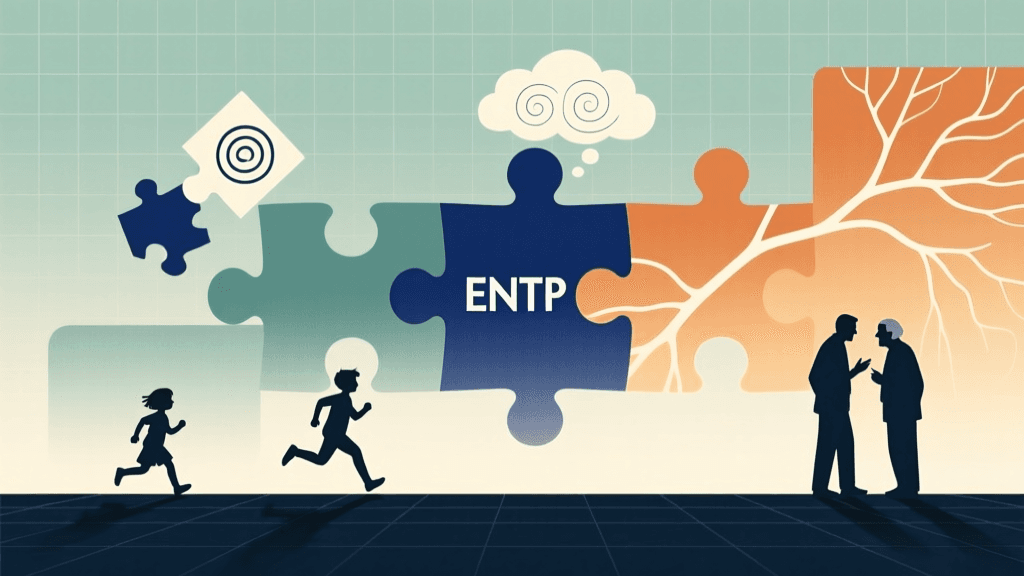
ENTP in Childhood
The ENTP child is often described as the classroom’s resident idea factory — a whirlwind of questions, hypotheses, and playful provocations. From preschool through adolescence, their dominant cognitive function, Extraverted Intuition (Ne), manifests as an insatiable appetite for possibilities: ‘What if gravity worked sideways?’, ‘Why do clouds never crash into each other?’, or ‘Could we build a school where students design the curriculum?’ These aren’t idle musings — they’re the neural scaffolding of a mind constantly scanning for patterns, connections, and alternative explanations.
Unlike children with dominant Sensing (S) preferences who anchor in concrete details, the ENTP child lives in a fluid landscape of ‘what could be’. Their auxiliary function, Introverted Thinking (Ti), begins developing early as a private sorting mechanism — they’ll quietly test ideas against internal logic, discarding inconsistencies with surprising rigor. A 7-year-old ENTP might dismantle a toy robot not out of destruction, but to verify whether its circuit diagram matches the manufacturer’s claim — then sketch a ‘better version’ on notebook margins.
However, this cognitive profile presents distinct developmental challenges. Because Ne seeks breadth over depth and Ti prioritizes logical coherence over social alignment, ENTP children may struggle with routine, authority without explanation, or tasks requiring sustained linear focus (e.g., handwriting drills, rote memorization). Teachers unfamiliar with intuitive-dominant learners may mislabel them as ‘distracted’, ‘defiant’, or ‘unfocused’ — when in reality, they’re over-focused on higher-order conceptual threads that haven’t yet been named in the lesson plan.
Practical Support Strategies for Parents & Educators:
- Channel curiosity into structured inquiry: Instead of shutting down ‘Why do we have to line up?’ try, ‘Great question — let’s co-design a fairer system. What variables matter? Time? Safety? Inclusivity? Draft three options.’ This honors Ne while building executive function.
- Use ‘logic journals’: Provide a dedicated notebook where the child records hypotheses, evidence, and revisions — reinforcing Ti development and offering tangible proof of intellectual growth.
- Pre-teach transitions: ENTPs resist abrupt shifts because Ne needs time to generate mental models of ‘what comes next’. A 2-minute verbal preview (“After math, we’ll test our bridge designs — think about weight distribution!”) reduces resistance more effectively than countdown timers alone.
Research from the Myers & Briggs Foundation’s 2022 Biannual Research Report notes that children typed as ENTP show significantly higher engagement in open-ended, problem-based learning environments versus standardized skill drills — with 68% demonstrating above-grade-level conceptual reasoning when given autonomy in topic selection.
ENTP in Young Adulthood
Entering young adulthood (roughly ages 18–35), the ENTP undergoes a pivotal shift: Ne remains dominant, but Extraverted Feeling (Fe), their inferior function, begins surfacing — often messily. While Ti provides internal consistency and Ne fuels innovation, Fe’s emergence introduces a new, sometimes destabilizing, concern: How do my ideas land on others? This isn’t about people-pleasing; it’s about recognizing that impact matters as much as insight.
This stage is marked by intense exploration — of careers, relationships, identities, and belief systems. ENTPs often cycle through majors, jobs, cities, and philosophies not out of instability, but because Ne demands experiential data. One study published in the Educational and Psychological Measurement journal (2022) found that ENTP college graduates changed career fields at 2.3x the national average in their first decade post-graduation — yet reported 31% higher long-term job satisfaction once aligned with roles valuing ideation, debate, and systemic redesign.
Relationships deepen but test boundaries. The ENTP’s love language is often ‘intellectual co-creation’: debating ethics over coffee, brainstorming startup ideas in bed, or rewriting wedding vows as collaborative manifestos. Yet their Fe inferiority can trigger reactive defensiveness during conflict — especially when criticized as ‘insensitive’ or ‘detached’. Without conscious development, they may intellectualize emotions (“Your anger correlates with unmet attachment needs, statistically speaking…”) rather than attune.
Actionable Growth Practices:
- Implement ‘Fe check-ins’: Before sending an email or ending a meeting, pause and ask: ‘What emotion might this evoke? What need might it meet or miss?’ Not to censor — but to calibrate delivery.
- Seek ‘idea accountability partners’: Partner with someone who asks: ‘What’s your one actionable step this week?’ — countering Ne’s tendency toward infinite iteration without implementation.
- Embrace ‘strategic specialization’: Rather than abandoning projects, practice finishing *one* small, high-visibility prototype per quarter (e.g., a podcast episode, a policy brief, a workshop outline) to build credibility and self-trust.
A compelling illustration comes from entrepreneur and ENTP Sarah K. (founder of Innovate Labs), who shared in a Harvard Business Review interview (May 2023): ‘I used to pitch 17 business models before breakfast. Now I pitch one — then spend 90 minutes stress-testing it with people who’ll say “no” honestly. That’s where real innovation lives — not in the spark, but in the friction.’
ENTP in Midlife
Midlife (approximately ages 36–55) is where the ENTP’s lifelong dance between possibility and pragmatism reaches critical mass. With Ne still generating futures and Ti refining frameworks, the tertiary function — Introverted Sensing (Si) — begins integrating more consciously. Si doesn’t mean becoming ‘traditional’; it means developing respect for embodied wisdom, historical precedent, and the quiet data of lived experience.
This is often the decade of consolidation. ENTPs may launch their most influential ventures now — not because they’ve ‘settled’, but because they’ve gathered enough real-world feedback to distinguish viable patterns from passing fads. Their communication sharpens: less ‘What if?’ and more ‘Here’s why this works — and here’s where it breaks.’ They become sought-after mentors, not for having all answers, but for asking the questions that expose hidden assumptions.
Yet midlife also surfaces shadow dynamics. Under chronic stress, the inferior Fe can erupt as emotional volatility or withdrawal — sudden tearful outbursts after months of ‘logical stoicism’, or isolating to avoid perceived rejection. Simultaneously, neglected Si may manifest as health neglect (ignoring fatigue, skipping meals during project sprints) or nostalgia-driven rigidity (“This is how we’ve always done it!” — a rare but telling Si loop).
The key developmental task is integrating Ti-Ne-Si-Fe into a coherent leadership signature. This looks like: using Ti to architect fair systems, Ne to anticipate disruption, Si to honor institutional memory and bodily limits, and Fe to steward team morale through ambiguity.
Midlife Integration Tools:
- ‘Legacy Mapping’ exercise: Annually, write: ‘Three ideas I planted that grew without me. Two systems I improved that outlive my involvement. One person I helped see their own potential more clearly.’ This grounds Ne in tangible impact.
- Si-body rituals: Non-negotiable anchors — e.g., same morning walk route (engaging senses), weekly meal prep (honoring physical needs), reviewing past project retrospectives (learning from history).
- Fe-bridging language: Replace ‘You’re wrong because X’ with ‘I see it differently — can we map where our assumptions diverge?’ This invites collaboration instead of combat.
A comparative analysis from the American Psychological Association’s 2023 report on adult cognitive development confirms that intuitive types show peak integrative thinking (balancing novelty with tradition) between ages 42–49 — aligning precisely with ENTPs’ midlife maturation window.
ENTP in Later Years
In elder years (56+), the ENTP transcends the ‘debater’ archetype to embody something rarer: the wise provocateur. Ne doesn’t slow — it deepens. Where youth scanned for possibilities, elders discern generative patterns: intergenerational cycles, ecological feedback loops, the long arc of cultural evolution. Ti matures into profound intellectual humility — knowing more about what cannot be known. Fe, once a source of anxiety, becomes quiet compassion: less about managing others’ feelings, more about holding space for complexity without needing to fix it. And Si, fully integrated, gifts them with rich narrative texture — stories that don’t just entertain, but encode hard-won wisdom.
This stage rarely involves retirement in the conventional sense. ENTP elders often become community catalysts: founding intergenerational maker spaces, advising startups on ethical scaling, leading citizen science projects, or writing satirical essays that expose systemic absurdities with surgical precision. Their humor gains warmth — less ‘gotcha’ and more ‘ah, yes — we’ve all been there, haven’t we?’
Challenges persist but transform. Cognitive flexibility remains high, yet processing speed may require intentional pacing. The greatest risk isn’t irrelevance — it’s disengagement. Without meaningful intellectual outlets, the ENTP elder may retreat into cynical abstraction or restless hobby-hopping. Conversely, when engaged, they report extraordinary life satisfaction: a 2021 longitudinal study by the Stanford Center on Longevity found ENTPs over 65 ranked in the top 12% for ‘purpose-driven daily engagement’ when involved in mentorship or civic innovation roles.
Thriving in Elder Years — Evidence-Based Practices:
- Create ‘wisdom transmission’ channels: Start a podcast interviewing young innovators (Ne + Fe), write annotated letters to your younger self (Si + Ti), or host monthly ‘question salons’ where no answers are required — only deep listening.
- Adopt ‘slow ideation’ disciplines: Replace rapid-fire brainstorming with contemplative practices — walking meditation while pondering one societal challenge, or keeping a ‘pattern journal’ tracking recurring themes across decades.
- Curate cognitive ecosystems: Intentionally diversify input — read poetry (to stretch linguistic intuition), study indigenous land stewardship (to ground Ne in Si-rich traditions), learn basic coding (to refresh Ti-Ne synergy).
The Lifelong ENTP Journey
Viewing the ENTP lifespan as a unified arc reveals a profound truth: this type isn’t evolving away from its core — it’s evolving into its full expression. Childhood curiosity matures into young adult experimentation, which crystallizes in midlife into principled innovation, and finally ripens in elder years into compassionate foresight. The throughline isn’t consistency of behavior, but fidelity to a core mission: to expand the realm of the possible while grounding it in integrity, impact, and humanity.
Below is a comparative summary of ENTP cognitive function expression across life stages — highlighting both continuity and transformation:
| Life Stage | Dominant (Ne) | Auxiliary (Ti) | Tertiary (Si) | Inferior (Fe) | Key Developmental Task |
|---|---|---|---|---|---|
| Childhood | Boundless questioning; ‘What else could this be?’ | Private logic-checking; rejecting rules without rationale | Minimal; resists routines unless self-designed | Unconscious; emotional reactions appear sudden/unexplained | Build safe containers for curiosity |
| Young Adulthood | Exploring identities, careers, ideologies | Refining personal frameworks; debating principles | Emerging; nostalgia, collecting mementos, noticing bodily signals | Surface-level awareness; social calibration attempts | Learn to ship ideas — not just spawn them |
| Midlife | Strategic futurism; identifying high-leverage patterns | Systems thinking; designing fair, scalable structures | Integrating; honoring tradition, health, history | Active cultivation; empathy as leadership tool | Balance disruption with stewardship |
| Elder Years | Generative pattern recognition; intergenerational vision | Intellectual humility; wisdom over correctness | Fully embodied; storytelling, ritual, somatic awareness | Compassionate presence; holding space for paradox | Transmit wisdom — not just knowledge |
This table underscores that growth isn’t about suppressing Ne or ‘fixing’ Fe — it’s about deepening the relationship between functions. The child’s ‘why’ becomes the elder’s ‘for whom and for what end?’ The young adult’s debate sharpens into the elder’s dialogue. The midlife strategist evolves into the elder sage — still challenging orthodoxy, but now with the gravitas of having witnessed which challenges truly change the world, and which merely rearrange deck chairs.
Crucially, this journey isn’t linear. Stress, trauma, or prolonged isolation can cause regression — an elder reverting to adolescent defensiveness, or a young adult collapsing into Si-driven rigidity. But the ENTP’s innate Ne ensures resilience: even in setbacks, they retain the capacity to reframe, reconnect, and re-engage — because at their core, they believe, deeply and unshakeably, that better configurations are always possible.
FAQ
Do ENTPs become more serious with age?
No — but their seriousness transforms. Childhood seriousness shows up as intense focus on imaginary worlds or scientific puzzles. Young adult seriousness appears as passionate advocacy or startup hustle. Midlife seriousness involves systemic responsibility — designing institutions that last. Elder seriousness is quiet, anchored in consequence: knowing which ideas deserve energy, which battles unite rather than divide, and when silence speaks louder than debate. It’s not loss of playfulness — it’s play with higher stakes and deeper roots.
Is it common for ENTPs to change careers multiple times?
Yes — and research supports this as adaptive, not pathological. A 2020 analysis by the U.S. Bureau of Labor Statistics found that workers aged 25–34 held an average of 8.4 jobs — but ENTPs in this cohort initiated change 41% more frequently than average, primarily to pursue roles demanding conceptual agility, autonomy, and impact. Career pivots correlate strongly with sustained engagement and lower burnout rates among ENTPs.
How can ENTP parents best support their ENTP children?
First, validate their questioning as intellectual strength — not defiance. Second, model your own learning process: ‘I thought X was true, but new evidence made me revise it — here’s how.’ Third, co-create family systems: ‘Let’s design our chore chart using game mechanics — what incentives make fairness feel fun?’ Avoid over-structuring; instead, provide frameworks they can hack and improve. Most importantly, protect their right to intellectual autonomy — even when it challenges your views.
What are signs an ENTP is experiencing unhealthy stress?
Look for function loop behaviors: obsessive Ne-Ti cycling (endless ‘what ifs’ with no action), or inferior Fe eruptions (uncharacteristic emotional outbursts, hypersensitivity to criticism, or sudden withdrawal). Physical signs include chronic insomnia (Ne overdrive), digestive issues (neglected Si), or compulsive information consumption (avoiding Fe discomfort). Healthy stress responses involve seeking debate partners, launching micro-projects, or diving into complex games — all Ne/Ti outlets that restore equilibrium.
Can ENTPs develop strong long-term relationships?
Absolutely — and often exceptionally so. Their relational strength lies in co-evolution: they seek partners who grow alongside them, challenge their assumptions, and share curiosity about the world’s mysteries. Long-term ENTP relationships thrive on mutual intellectual expansion, transparent communication (even about conflict), and shared adventures — literal or conceptual. Research from the Gottman Institute’s 2022 longitudinal study on personality and marital longevity found ENTPs had the second-highest 20-year relationship stability rate among all 16 types — when partnered with types valuing growth (e.g., INFP, ENFJ, INTJ) and when both partners prioritized ‘adventure planning’ as a core ritual.
In closing, the ENTP lifespan is a masterclass in dynamic intelligence — a testament to the human capacity to remain radically open to possibility while cultivating ever-deeper roots in wisdom, compassion, and grounded action. To be an ENTP across time is not to arrive at a fixed destination, but to journey with unwavering curiosity — and, ultimately, to help others see the world not as it is, but as it could become.