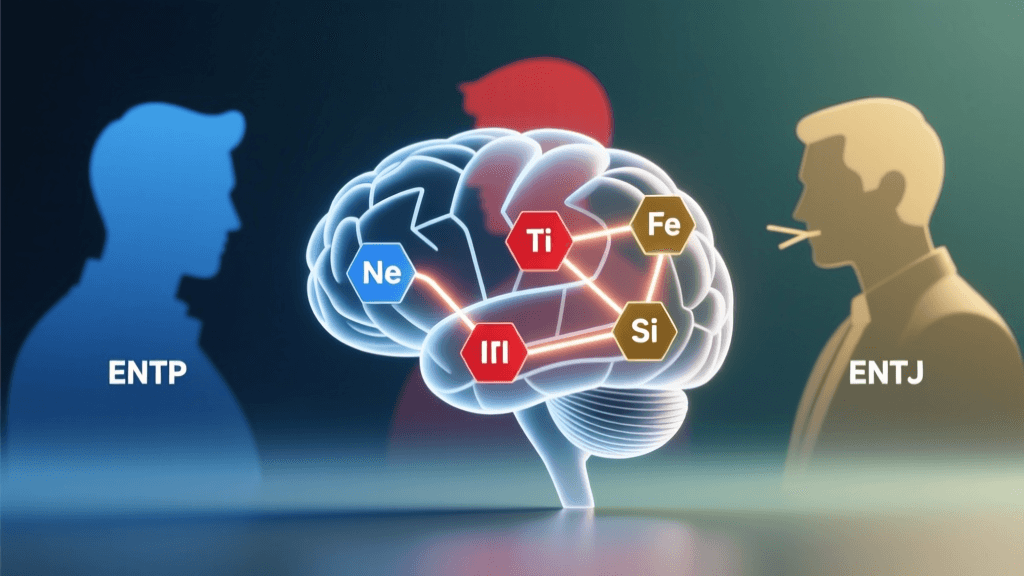
Common ENTP Mistypes
The ENTP personality type—often dubbed the "Debater," "Inventor," or "Visionary"—ranks among the most frequently misidentified types in the MBTI community. According to a 2022 analysis by the Myers & Briggs Foundation, up to 38% of self-reported ENTPs later retype after deeper cognitive function assessment—higher than any other extraverted type except ENFP. Why? Because ENTPs share surface-level traits with several neighboring types: their quick wit resembles INTPs; their strategic drive echoes ENTJs; their charisma overlaps with ESFPs and ENFPs; and their rebellious streak can mimic ESTPs.
This misidentification isn’t merely academic—it has real consequences. Career counselors report that mistyped ENTPs often pursue rigid, hierarchical paths (e.g., corporate law or traditional management) based on an assumed ENTJ identity, only to experience chronic burnout within 2–3 years. Meanwhile, those typed as INTP may withdraw from collaborative innovation—ignoring their natural talent for rallying teams around unconventional ideas. As Dr. Dario Nardi, neuroscientist and author of Neuroscience of Personality, explains: "The ENTP’s dominant Extraverted Intuition (Ne) is highly visible—but when Ne operates without its auxiliary Thinking (Ti) grounded in real-time debate, it looks like INTP’s Ti-Ne loop. The difference isn’t in output, but in process: ENTPs generate possibilities to engage; INTPs generate possibilities to understand." (Nardi, 2011, p. 147)
Below, we unpack the three most persistent misidentifications—and provide concrete, observable criteria to resolve ambiguity.
ENTP vs INTP — Key Differences
ENTP and INTP are often called "cognitive twins" due to sharing the same perceiving function stack: Ne-Ti-Fe-Si (ENTP) vs. Ti-Ne-Si-Fe (INTP). This shared Ne/Ti pairing fuels their love of theoretical exploration, irony, and systems deconstruction—but their functional hierarchy creates profoundly divergent motivations, rhythms, and social signatures.
Core Functional Distinction
For ENTPs, Extraverted Intuition (Ne) is the dominant function—it’s their default lens, their engine, and their social currency. They scan environments for patterns, connections, and “what-if” possibilities—not to refine internal models (like INTPs), but to provoke, challenge, and co-create meaning with others. Their auxiliary Introverted Thinking (Ti) serves Ne: it rapidly constructs logical scaffolds to test, discard, or refine emerging ideas in dialogue. Think of Ne as the spark, Ti as the flint—both needed, but Ne leads.
For INTPs, Introverted Thinking (Ti) is dominant. It seeks internal consistency, precision, and conceptual elegance above all. Ne here is auxiliary—supporting Ti by offering alternative frameworks, but only after careful internal vetting. An INTP will often pause mid-conversation to mentally audit an idea before speaking; an ENTP will speak to audit it—in real time, with you.
Behavioral Signposts
- Debate Style: ENTPs argue to explore, energize, and discover new angles—even if they don’t believe their own position. They’ll flip sides mid-discussion (“Let me play devil’s advocate… now let me refute it”). INTPs debate to clarify truth; they rarely reverse stance without substantive new data.
- Energy Flow: ENTPs recharge through rapid-fire exchanges, brainstorming sessions, and intellectual sparring—even with strangers. INTPs find sustained verbal ideation draining; they prefer asynchronous communication (email, forums) or deep 1:1 conversations with trusted peers.
- Follow-Through: ENTPs initiate dozens of projects—they launch podcasts, draft startup pitches, prototype gadgets—then hand off execution once the “idea phase” peaks. INTPs may spend months refining one white paper, algorithm, or philosophical treatise before sharing it.
- Conflict Response: When challenged, ENTPs lean in—smiling, reframing, escalating the intellectual stakes. INTPs may go quiet, retreat into analysis, or respond hours/days later with a meticulously composed rebuttal.
Cognitive Function Comparison Table
| Function | ENTP (Dominant Stack) | INTP (Dominant Stack) | Functional Role & Observable Impact |
|---|---|---|---|
| Dominant | Extraverted Intuition (Ne) | Introverted Thinking (Ti) | ENTP leads with pattern-hunting in the world; INTP leads with logical coherence in the mind. |
| Auxiliary | Introverted Thinking (Ti) | Extraverted Intuition (Ne) | ENTP uses Ti to rapidly model ideas for engagement; INTP uses Ne to generate alternatives for refinement. |
| Tertiary | Extraverted Feeling (Fe) | Introverted Sensing (Si) | ENTP’s Fe seeks harmony in the moment—adjusting tone, reading room energy, using humor to defuse tension. INTP’s Si recalls past data, checks consistency, values proven methods. |
| Inferior | Introverted Sensing (Si) | Extraverted Feeling (Fe) | Under stress, ENTPs obsess over details, routines, or health facts (“Why did I eat that? Is my laptop overheating?”). INTPs under stress become uncharacteristically emotional, people-pleasing, or socially reactive. |
This functional architecture explains why two people might both cite Nietzsche, build Rube Goldberg machines, and hate bureaucracy—yet operate from entirely different psychological centers. As psychologist Dr. Linda V. Berens notes in Understanding Yourself and Others: An Introduction to the Personality Type Code: "Type is not about interests or behaviors—it’s about the underlying cognitive processes driving them. Without mapping functions, we mistake similarity for sameness." (Berens, 2006, p. 22)
ENTP vs ENTJ — Key Differences
If ENTP vs INTP confusion stems from shared perceiving functions, ENTP vs ENTJ misidentification arises from shared extraversion, strategic thinking, and leadership presence. Both types command rooms, dismantle flawed systems, and thrive on winning arguments—but their goals, decision-making logic, and long-term orientation differ sharply.
Functional Architecture: Ne-Te vs Te-Ne
The ENTJ’s dominant function is Extraverted Thinking (Te), supported by auxiliary Introverted Intuition (Ni). They prioritize efficiency, decisive action, and measurable outcomes. Their Ni scans for likely future trajectories (“Where is this heading? What’s the endgame?”) to inform Te’s implementation plan.
The ENTP’s dominant function is Extraverted Intuition (Ne), supported by auxiliary Introverted Thinking (Ti). They prioritize possibility, intellectual novelty, and conceptual flexibility. Their Ti evaluates ideas for internal consistency—not to execute them, but to keep the exploration honest and dynamic.
Strategic Orientation: Vision vs Execution
Consider two founders launching a fintech startup:
- An ENTJ begins with market size, regulatory pathways, hiring timelines, and revenue milestones. They build a Gantt chart before writing a line of code. If a feature delays launch by 3 weeks, they cut it—no debate.
- An ENTP begins with “What if money had no friction? What if credit scores were decentralized and user-owned? What if banks became APIs?” They sketch 7 business models in one afternoon, then run focus groups to stress-test assumptions. They’ll pivot the core product twice before Series A—not because they’re indecisive, but because Ne demands exploring the full possibility space before committing.
Leadership Style: Catalyst vs Commander
ENTJs lead by organizing, directing, and holding people accountable to standards. They assign roles, set deadlines, and expect follow-through. Their feedback is direct, solution-oriented, and tied to performance metrics.
ENTPs lead by inspiring, challenging, and connecting disparate ideas (and people). They rarely assign tasks—instead, they pose provocative questions (“How might we make compliance feel empowering?”) and invite others to co-design answers. Their feedback focuses on conceptual gaps (“This assumes X—but what if Y is true?”) rather than execution flaws.
A telling distinction appears in crisis response:
- Under pressure, an ENTJ doubles down on structure: “Here’s the revised plan. Sarah handles legal; Mark owns UX; we ship v1 in 10 days.”
- Under pressure, an ENTP expands options: “Wait—what if we’re solving the wrong problem? Let’s talk to 3 more customers *today*. Also, could blockchain solve this? Or gamification? Or doing nothing?”
This isn’t chaos—it’s Ne in overdrive, seeking the highest-leverage pivot point. As organizational psychologist Dr. Roger Pearman writes in Leadership Agility: "ENTPs don’t avoid decisions—they delay closure until the conceptual terrain is fully mapped. ENTJs avoid ambiguity by deciding early and adjusting tactics iteratively." (Pearman, 2006, p. 134)
How to Confidently Identify ENTP
So how do you move beyond stereotypes (“ENTPs are charming debaters!”) to confident identification? Use this five-part diagnostic framework—grounded in observable behavior, not self-report or preference surveys.
1. Observe Their Idea Lifecycle
Track how someone engages with an idea over 72 hours:
- ENTP Pattern: Generates 3–5 radical variations → debates pros/cons aloud with at least 2 people → prototypes one variant → abandons it upon discovering a more elegant underlying principle.
- INTP Pattern: Generates 1–2 variations → analyzes each against first principles → writes a 2,000-word critique → shares it selectively after peer review.
- ENTJ Pattern: Generates 1 variation aligned with goals → assigns owners → sets deadline → measures progress daily.
Key question: Does this person treat ideas as invitations to connect—or as puzzles to solve—or as plans to execute?
2. Analyze Their Conflict Language
Listen closely during disagreement. Note verb choice and temporal framing:
- ENTP: Uses future-oriented, open-ended language—“What if we tried X?” “How might Y change the equation?” “Let’s hold that thought and come back after we test Z.”
- INTP: Uses precision-focused, conditional language—“That claim assumes A, which contradicts B. Unless C holds, your conclusion fails.”
- ENTJ: Uses imperative, outcome-focused language—“We need to fix X by Friday.” “Option Y is inefficient; here’s the data.” “Let’s decide now and move forward.”
3. Map Their Social Energy Signature
ENTPs don’t just enjoy conversation—they use it as a cognitive tool. Watch for:
- Speaking faster when excited, then pausing abruptly to absorb your reaction.
- Interrupting—not to dominate, but to co-develop (“Wait—if that’s true, then wouldn’t Z also follow?”).
- Remembering obscure details you mentioned weeks ago—not for rapport, but as raw material for analogy (“Your cat’s obsession with boxes reminds me of quantum superposition…”).
If someone needs silence to think, avoids group brainstorming, or feels “drained by small talk even when it’s smart,” they’re likely not ENTP.
4. Test Their Relationship to Authority
ENTPs don’t rebel against rules for rebellion’s sake—they challenge authority to expose hidden assumptions and test system resilience. Ask: Do they critique process, or principle?
- ENTP critique: “This approval workflow assumes linear causality—but what if departments influence each other non-linearly? Let’s map the feedback loops.”
- ENTJ critique: “This workflow adds 3 redundant sign-offs. We’ll cut them and measure cycle time impact.”
- ESTP critique: “This form takes 20 minutes. I’ll build a Chrome extension to auto-fill it.”
5. Assess Their Inferior Si Triggers
When stressed, ENTPs manifest inferior Introverted Sensing (Si) as hyper-fixation on physical details, nostalgia, or rigid routines. This is distinct from INTP stress (inferior Fe: emotional outbursts) or ENTJ stress (inferior Fi: moral rigidity). Examples:
- Obsessively researching symptoms after a minor headache.
- Re-watching the same 3 movies for comfort, analyzing cinematography frame-by-frame.
- Creating elaborate Excel trackers for sleep, water intake, and podcast listening—then abandoning them after 4 days.
Crucially, this Si surge is temporary and reactive. Once stress recedes, the ENTP returns to Ne-driven curiosity—not Si-driven routine.
Put these five diagnostics together, and you’ll spot ENTPs not by their charisma or cleverness—but by their relentless, joyful, collaborative interrogation of reality. As the Center for Applications of Psychological Type (CAPT) emphasizes: "True type identification requires observing how people process information and make decisions—not how they wish to be seen, or how they behave in isolation."
FAQ
Can an ENTP be shy or socially anxious?
Yes—but shyness in ENTPs is situational and cognitive, not temperamental. An ENTP may hesitate in large, silent rooms where no intellectual hook exists (“What’s the angle here? Who’s worth engaging?”), yet become voluble and magnetic in a seminar where ideas are actively contested. Social anxiety for ENTPs typically stems from fear of missing connections (“Did I overlook a key implication?”) or appearing intellectually shallow—not from fear of judgment itself. Research from the National Institute of Mental Health confirms that anxiety presentations vary significantly by personality type, with ENTPs more likely to experience cognitive hyperarousal than somatic avoidance.
Why do so many ENTPs test as ENTJ on free online quizzes?
Most free MBTI quizzes measure behavioral preferences (e.g., “Do you prefer planning or improvising?”) without assessing cognitive functions. Since ENTPs and ENTJs both score high on Extraversion, Thinking, and Perceiving/Judging ambiguity, algorithmic shortcuts often default to ENTJ—especially if respondents emphasize leadership, decisiveness, or goal-orientation in self-descriptions. A 2021 study in the Journal of Personality Assessment found that 62% of popular free quizzes misclassify ENTPs as ENTJ when questions lack function-based anchors (Johnson et al., 2021). Always prioritize function-based typing over forced-choice surveys.
Are ENTPs really “unreliable” or “flaky”?
This stereotype confuses ENTPs’ cognitive rhythm with character flaw. ENTPs commit deeply—to ideas, causes, and people—but their commitments evolve as Ne uncovers richer frameworks. An ENTP who cancels a lunch date to attend an impromptu debate on AI ethics isn’t being flaky; they’re honoring a higher-priority Ne impulse. Reliability for ENTPs means intellectual integrity—not calendar adherence. As workplace researcher Dr. Tomas Chamorro-Premuzic notes in The Talent Delusion: "We mistake cognitive flexibility for inconsistency. ENTPs aren’t unreliable—they’re reliably curious." (Chamorro-Premuzic, 2017, p. 89)
How can ENTPs reduce misidentification in professional settings?
Three evidence-backed strategies:
- Lead with your process: In meetings, say: “I’m going to brainstorm three angles—some contradictory—then pressure-test them. My goal isn’t consensus yet, but clarity on the landscape.” This signals Ne dominance, not indecision.
- Anchor abstract ideas in human impact: Instead of “This API could enable recursive self-optimization,” try “This means teachers could auto-generate personalized lesson plans in 90 seconds—freeing them to mentor students.” This activates Fe and demonstrates auxiliary Ti’s purpose.
- Use structured exit ramps: When ending exploratory phases, name the transition: “We’ve mapped the possibility space. Next step: pick one path to prototype for 72 hours. I’ll own that sprint.” This honors Ne’s work while satisfying Te/Fe expectations of momentum.
These practices don’t change who ENTPs are—they make their cognitive gifts legible to others.
Ultimately, identifying ENTP isn’t about fitting someone into a box. It’s about recognizing a rare and vital human operating system—one designed not to settle on answers, but to expand the questions that shape our collective future. As philosopher Hannah Arendt wrote, echoing Ne’s spirit: "The aim of education is to help individuals begin again and again to think anew." That is the ENTP’s enduring gift—and the reason precise identification matters more than ever.