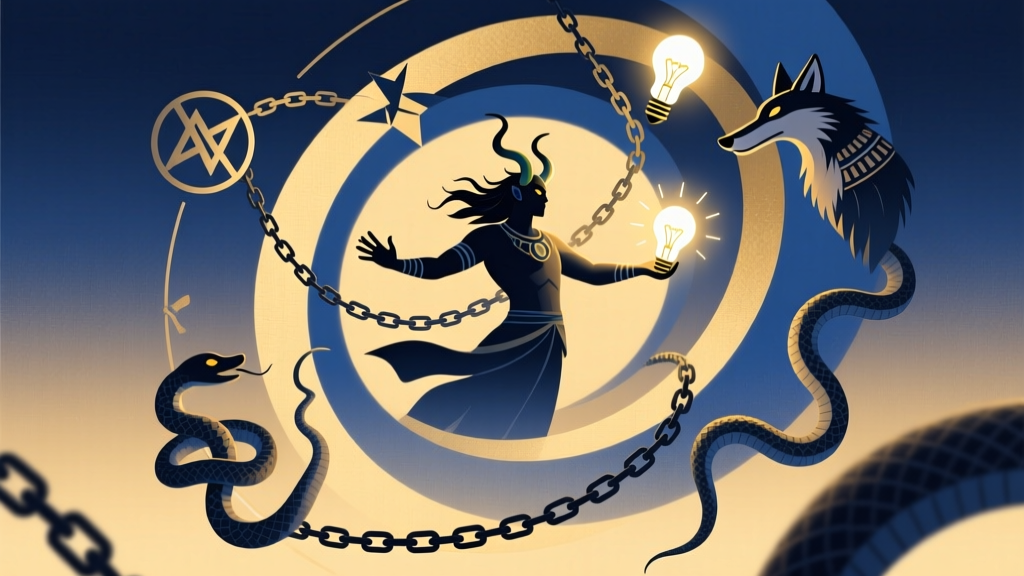
ENTP in Mythology and Folklore
The ENTP personality type — known as the Debater, Inventor, or Champion of Possibility — is defined by Extraversion (E), Intuition (N), Thinking (T), and Perceiving (P). ENTPs thrive on intellectual stimulation, pattern-breaking ideas, rhetorical agility, and systemic disruption. They are not merely contrarians; they are architects of alternative frameworks, drawn to paradox, irony, and the deconstruction of dogma. Unsurprisingly, this cognitive profile finds profound resonance in the oldest strata of human storytelling: mythology, folklore, and fantasy literature.
Across cultures, the ENTP archetype rarely appears as a stoic king or a pious priest. Instead, it emerges as the trickster who steals fire, the inventor who outwits gods, the rebel who questions cosmic order, or the charismatic sage whose wisdom destabilizes more than it soothes. These figures do not seek power for domination — they seek leverage for insight, influence for experimentation, and chaos for catalysis. Their stories are not about moral purity but about cognitive sovereignty: the right and capacity to question, reframe, and reinvent reality itself.
Anthropologist Claude Lévi-Strauss observed that myth functions as a ‘logic of the concrete’ — a way to resolve structural contradictions through narrative. The ENTP figure occupies a privileged role in this logic: they are the embodied contradiction — simultaneously sacred and profane, wise and foolish, creator and destroyer — whose very existence forces societies to confront the limits of their own categories. As folklorist William J. Hynes notes, the trickster is ‘the mythic embodiment of liminality’, existing at thresholds — between worlds, species, truths, and rules — precisely where ENTPs feel most alive.
This article maps the ENTP psyche onto cross-cultural mythological traditions, canonical fantasy literature, and enduring folklore patterns — moving beyond superficial 'type matching' to examine how ENTP cognition shapes narrative function, thematic resonance, and cultural utility. We identify not just *who* embodies ENTP energy, but *why* these figures recur across millennia — and what modern ENTPs can learn from their mythic forebears about wielding intellect ethically, navigating ambiguity, and transforming rebellion into generative innovation.
Famous ENTP Mythological Figures
Below are eight mythological figures whose narratives, motivations, symbolic roles, and behavioral patterns align robustly with core ENTP traits: dominant Extraverted Intuition (Ne) — generating endless possibilities and connections — supported by auxiliary Introverted Thinking (Ti) — refining internal logical models — and tertiary Extraverted Feeling (Fe) — engaging audiences with charisma and rhetorical flair. These are not 'MBTI quizzes for gods'; rather, they are figures whose mythic functions mirror ENTP’s signature cognitive dance between idea-generation, systemic critique, and persuasive reframing.
| Figure | Culture/Tradition | Core ENTP Narrative Function | Key Behaviors Aligning with ENTP | Symbolic Contribution |
|---|---|---|---|---|
| Loki | Norse | The Paradigm-Shifter | Shapeshifting, linguistic deception, engineering catastrophic change (e.g., Baldr’s death), proposing solutions that create new problems | Forces gods to confront entropy, interdependence, and the limits of order |
| Prometheus | Greek | The Liberating Innovator | Defies Zeus to gift fire and knowledge; uses cunning (not strength) to outmaneuver Olympian authority; embraces eternal suffering for the sake of human potential | Embodies the ethical imperative of intellectual autonomy and technological empowerment |
| Anansi | Akan (Ghanaian) / Caribbean Folklore | The Resourceful Story-Weaver | Solves impossible problems through wit over force; negotiates with sky gods and death; transforms oral tradition into adaptive social technology | Preserves cultural memory while enabling communal reinterpretation and resilience |
| Coyote | Indigenous North America (e.g., Navajo, Nez Perce) | The Sacred Disruptor | Commits taboo acts that inadvertently create natural law (e.g., stealing sun, releasing animals); teaches through ironic failure; blurs boundaries between teacher and fool | Maintains cosmological flexibility — ensuring the world remains open to revision and renewal |
| Eshu/Elegba | Yoruba (West Africa) | The Crossroads Logician | Mediates between realms (human/divine, past/future); speaks in riddles; demands intellectual honesty before blessing; punishes rigid thinking | Guarantees that choice, interpretation, and consequence remain dynamically linked |
| Mercury/Hermes | Roman/Greek | The Boundary-Transcending Messenger | Invents the lyre and caduceus; steals Apollo’s cattle then negotiates immunity; guides souls and interprets divine will with playful ambiguity | Enables translation, commerce, and hermeneutics — the infrastructure of meaning-making |
| Sun Wukong | Chinese (Journey to the West) | The Self-Made Sage | Leads a celestial rebellion; masters 72 transformations; debates Buddha on ontology; achieves Buddhahood only after integrating chaos with compassion | Demonstrates that enlightenment requires dismantling hierarchy *and* cultivating wisdom |
| Br’er Rabbit | African American Folklore (Uncle Remus) | The Adaptive Strategist | Escapes predators using reverse psychology and feigned vulnerability; turns opponents’ assumptions against them; survives through narrative intelligence | Models resistance rooted in cognitive agility, not physical dominance — vital under oppression |
What unites these figures is not moral alignment — Loki and Coyote cause immense suffering; Prometheus and Anansi uplift humanity — but their cognitive signature: relentless curiosity, irreverence toward fixed hierarchies, fluency in multiple symbolic systems, and an almost compulsive drive to test boundaries. Psychologist Carl Gustav Jung identified the trickster as an autonomous archetypal complex — not a ‘character’ but a psychic force representing the unconscious breaking into consciousness. In his seminal work The Archetypes and the Collective Unconscious, Jung writes: ‘The trickster is a forerunner of the savior… [he] must be overcome if the hero is to emerge’. For ENTPs, this is not a flaw to correct but a developmental mandate: to evolve Ne-driven provocation into Ti-informed discernment, and Fe-mediated responsibility.
Modern ENTPs often misinterpret their mythic lineage as permission for perpetual disruption. But mythology offers corrective nuance: Prometheus endures chains; Anansi pays debts in stories; Sun Wukong serves a pilgrimage. The ENTP’s mythic task is not to reject structure, but to upgrade it — to build scaffolds that hold complexity without collapsing into dogma. This requires deliberate cultivation — which brings us to practical application.
ENTP Fantasy Literature Archetypes
Fantasy literature formalizes mythic patterns into sustained narrative architecture. While myth operates in sacred time, fantasy constructs secondary worlds governed by internally consistent — yet philosophically porous — laws. ENTP energy thrives here, animating characters who expose cracks in worldbuilding, challenge authorial authority, or embody the genre’s central tension: the allure of absolute power versus the ethics of its use.
Three recurring ENTP archetypes dominate high and epic fantasy:
The Rogue Sage (e.g., Gandalf the Grey, Elrond, Tywin Lannister)
Not defined by age or robes, but by strategic omnivorousness: they gather intelligence across domains (magic, politics, linguistics, history), synthesize it into predictive models, and deploy wisdom selectively — often withholding truth to provoke growth. Gandalf doesn’t defeat Sauron with force; he engineers conditions where Frodo’s choice matters more than his strength. His famous line — ‘All we have to decide is what to do with the time that is given us’ — is pure ENTP: rejecting fatalism while affirming agency within constraint. As Tolkien scholar Tom Shippey observes in The Road to Middle-earth, Gandalf functions as ‘a catalyst of free will’, deliberately avoiding direct intervention to preserve moral causality — a hallmark of mature ENTP Ti-Fe integration.
The Revolutionary Architect (e.g., Kvothe, Vin, Tyrion Lannister)
These characters master systems — sympathy, allomancy, Westerosi law — not to dominate, but to reveal their arbitrary foundations. Kvothe deconstructs magical theory to rebuild it; Vin weaponizes emotional Allomancy to dismantle the Lord Ruler’s theology; Tyrion parses inheritance law to expose its racialized violence. Their power lies in epistemic leverage: knowing how a system works allows them to bend, break, or replace it. Author N.K. Jemisin notes in a 2020 NPR interview that such characters ‘don’t just live in worlds — they interrogate them’. For ENTP readers and writers, this archetype models how intellectual mastery becomes ethical praxis.
The Unbound Chronicler (e.g., The Nameless One, Bast, The Librarian)
Found in urban fantasy and metafiction, this archetype treats reality as editable text. The Nameless One (Planescape: Torment) regenerates from death while losing memory — forcing him to reconstruct identity through dialogue and deduction. Bast (The Kingkiller Chronicle) shifts forms and truths like languages, refusing fixed ontology. The Librarian (Discworld) organizes infinite knowledge while acknowledging its inherent absurdity. These figures embody ENTP’s comfort with ontological uncertainty — and their warning: without grounding in values (inferior Si), boundless possibility collapses into nihilism.
Actionable Advice for ENTPs Inspired by Fantasy Archetypes:
- Adopt the ‘Rogue Sage Protocol’: Before offering a solution, ask: ‘What assumption am I protecting? What would happen if I withheld this answer for 48 hours?’ This builds Ti discipline and Fe patience.
- Practice ‘Systemic Red-Teaming’: Select one personal belief (e.g., ‘I must always be productive’) and spend one week identifying every cultural, biological, and historical contingency that shaped it — then draft three alternative operating principles. This mirrors Kvothe’s sympathetic deconstruction.
- Create a ‘Boundary Ledger’: Track daily interactions where you crossed someone’s boundary (even with good intent). Note the Ne impulse (e.g., ‘I wanted to show them a better way’) and the Ti/Fe cost (e.g., ‘They withdrew; I felt misunderstood’). Review weekly to calibrate impact vs. intention.
Fantasy doesn’t offer escape — it offers rehearsal space. By studying how ENTP archetypes navigate magic systems, political intrigue, and metaphysical crises, real-world ENTPs gain templates for ethical innovation: how to challenge without destroying, lead without commanding, and imagine without abandoning responsibility.
Legendary Heroes, Creatures and ENTP
Beyond anthropomorphic deities and literary protagonists, ENTP energy manifests in legendary creatures and heroic motifs whose very existence defies categorization — functioning as living metaphors for cognitive flexibility, adaptive intelligence, and transformative chaos.
The Chimera & Hybrid Beings
The Chimera (lion-goat-serpent), the Sphinx (woman-lion-eagle), and the Manticore (human face, lion body, scorpion tail) are not monsters of mindless destruction — they are ontological puzzles. Their hybridity mirrors ENTP’s Ne: synthesizing disparate elements into novel configurations that demand new modes of understanding. Ancient Greeks didn’t just fear the Chimera; they studied its anatomy to decode divine messages. Similarly, ENTPs don’t avoid complexity — they map it, name it, and prototype interfaces for it. Modern applications include designing interdisciplinary curricula, building AI ethics frameworks, or creating inclusive policy that integrates economic, ecological, and cultural variables.
The Phoenix & Cyclical Renewal
Unlike linear heroes who ‘win forever’, the Phoenix embodies ENTP’s relationship with failure: not as endpoint, but as data point. Its rebirth isn’t restoration — it’s evolutionary iteration. Psychologist James Hollis emphasizes in Swamplands of the Soul that ‘the phoenix motif represents the ego’s necessary dissolution before authentic selfhood emerges’. For ENTPs prone to discarding projects mid-stream, the Phoenix teaches: burning down is only wise when you’ve extracted the pattern, not just the frustration. Action step: When abandoning a project, write a ‘Phoenix Post-Mortem’ — listing exactly what cognitive model failed, what assumption was disproven, and what 3 principles will inform the next iteration.
The Hero Who Refuses the Sword
Contrast Achilles (ISTP — decisive action, sensory mastery) with Odysseus (ENTP — stratagems, disguise, linguistic manipulation). Odysseus wins Troy not with strength, but with the Trojan Horse — a nested system of deception, timing, and psychological insight. His 20-year journey home is less about geography than epistemology: testing identities (‘I am Nobody’), negotiating with gods on equal terms, and choosing knowledge over immortality (Calypso’s offer). This archetype validates ENTPs’ instinct to solve problems through reframing, not force — and cautions against mistaking cleverness for wisdom. As classicist Emily Wilson notes in her award-winning translation, Odysseus’s greatest triumph is ‘learning when to stop talking and start listening’ — a crucial integration of Ne with inferior Si.
The Living Library (e.g., The Bodhi Tree, The Akashic Records, The Library of Babel)
Mythic repositories of all knowledge aren’t static archives — they’re dynamic, often paradoxical systems requiring interpretation. The Bodhi Tree (under which Buddha attained enlightenment) doesn’t contain answers; it hosts the conditions for insight. Borges’ Library of Babel contains every possible book — including false ones — demanding readers develop discernment algorithms. For ENTPs drowning in information, this archetype prescribes curation over consumption: building personal ‘knowledge ecologies’ where sources are tagged by reliability, bias, and applicability — not just saved.
Collectively, these legendary forms teach ENTPs that their superpower — seeing connections others miss — carries a stewardship duty. Hybridity demands ethics; renewal requires memory; reframing necessitates accountability. Ignoring this leads to the ‘Loki Trap’: brilliant ideas that unravel social fabric. Embracing it unlocks the ‘Prometheus Path’: innovations that expand human dignity.
FAQ
Why do so many ENTP mythological figures get punished or ostracized?
Because ENTP cognition inherently threatens static power structures. Loki is bound with serpent venom; Prometheus is chained to a rock; Coyote is laughed at even when right. Punishment reflects society’s fear of epistemic destabilization — not moral failure. However, mythology also shows punishment’s purpose: containment, not erasure. Loki’s binding preserves his voice for Ragnarök; Prometheus’ suffering sanctifies human progress. For modern ENTPs, this signals that resistance to your ideas may indicate their significance — but also that sustainable influence requires building coalitions (Fe development), not just winning arguments (Ne-Ti dominance).
Can ENTPs embody ‘good’ archetypes, or are they always tricksters and rebels?
Absolutely — and mythology proves it. Anansi uplifts communities through storytelling; Eshu ensures fair judgment at crossroads; Hermes guides souls to peace. The ‘trickster’ label reflects function, not morality. ENTPs excel as educators (Socrates), innovators (Nikola Tesla), diplomats (Benjamin Franklin), and crisis negotiators — roles requiring rapid pattern-matching, empathic framing, and systemic redesign. The key is directing Ne toward collective flourishing, not just intellectual sport. As organizational psychologist Adam Grant documents in his research on ‘originals’, the most impactful ENTP-like figures combine idea generation with ‘strategic procrastination’ — delaying action to refine feasibility and build buy-in.
How can ENTPs avoid the ‘Coyote Fallacy’ — causing chaos without learning from it?
The Coyote Fallacy occurs when ENTPs mistake disruption for progress. Coyote’s failures teach because he observes consequences and adapts — unlike ENTPs who abandon projects post-critique. Prevention requires two habits: (1) Consequence Journaling: After any major idea or intervention, record predicted outcomes, actual outcomes, and the gap between them — then analyze what mental model was incomplete. (2) Feedback Loops: Commit to checking in with 3 stakeholders 30/60/90 days after implementing a change. This grounds Ne in real-world Ti calibration and Fe accountability.
What folklore practices help ENTPs develop their inferior Sensing (Si)?
Inferior Si manifests as neglect of routine, bodily signals, or historical continuity — leading to burnout or ‘idea fatigue’. Folklore offers embodied remedies: (1) Seasonal Ritual Anchoring: Adopt one small, repeatable practice per season (e.g., lighting a candle on solstices, planting herbs at equinoxes) to build somatic memory. (2) Ancestral Story Mapping: Interview elders or research family migration patterns — not for genealogy, but to feel time as texture, not abstraction. (3) Tactile Knowledge Work: Hand-copy meaningful quotes or diagrams — the physical act encodes memory deeper than typing. As neuroscientist Daniel Levitin explains in The Organized Mind, ‘The hand is the brain’s first tool’ — engaging Si through touch strengthens neural pathways for retention and presence.
Mythology does not flatter ENTPs — it initiates them. Loki’s bindings, Prometheus’ vulture, Anansi’s debts — these are not penalties, but initiation rites. They say: Your brilliance is necessary. Your responsibility is non-negotiable. Your growth lies not in silencing your Ne, but in teaching it to build bridges, not just burn them. By studying these archetypes with humility and rigor, ENTPs don’t just understand themselves — they reclaim their ancestral role: not as destroyers of order, but as architects of evolution.