ENTP in Team Settings (fictional examples)
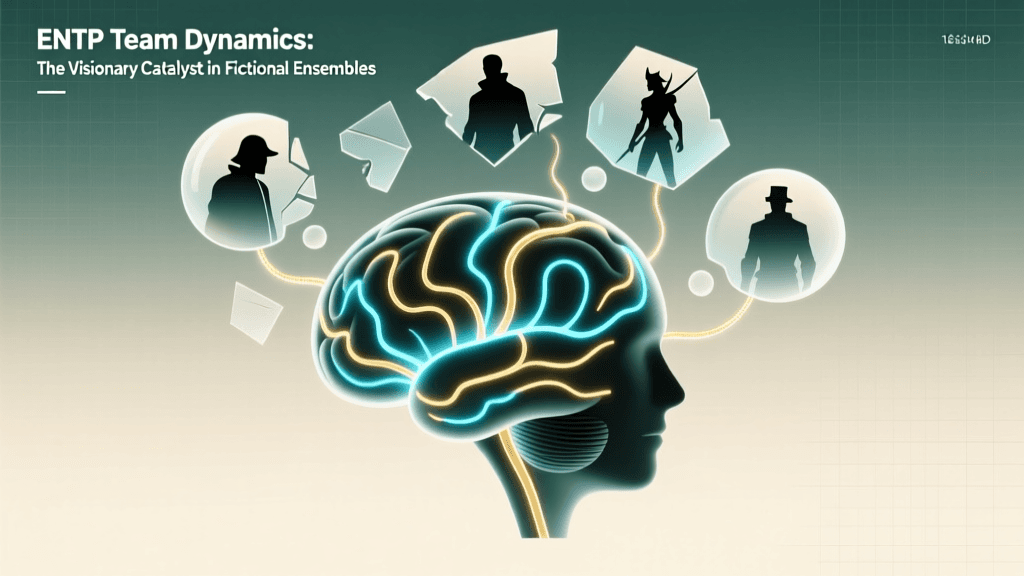
The ENTP personality type — Extraverted, Intuitive, Thinking, Perceiving — is often dubbed the Debater, Inventor, or Visionary. In fictional ensembles, ENTPs rarely serve as silent supporters or rigid rule-followers. Instead, they occupy dynamic, high-impact roles that shape narrative momentum, spark ideological conflict, and catalyze collective evolution. Their presence transforms static groups into laboratories of possibility — where assumptions are questioned, hierarchies are fluid, and solutions emerge from intellectual friction rather than consensus.
Consider Shawn Spencer from Psych. Though ostensibly a consultant, Shawn functions as the team’s cognitive accelerant: he reframes crime scenes through absurd analogies, challenges police dogma with playful irreverence, and forces his partner Gus — an ISTJ — to flex his logical scaffolding under pressure. Shawn doesn’t lead by authority; he leads by provocation — asking ‘What if the victim *wanted* to be found?’ or ‘What if the alibi is perfect because it’s *designed* to be scrutinized?’ His ENTP energy isn’t about winning arguments — it’s about widening the solution space so the team sees options invisible to linear thinkers.
Similarly, Leslie Knope from Parks and Recreation (often misclassified as ESTJ) exhibits core ENTP traits in ensemble behavior: rapid ideation ("Let’s turn a pit into a park — then a farmers’ market — then a miniature golf course themed after Indiana history!"), impatience with procedural inertia, and a talent for recruiting unlikely allies (Ron Swanson, April Ludgate, even Councilman Jamm) not through coercion but through contagious enthusiasm and tailored intellectual engagement. Her leadership isn’t directive — it’s generative: she seeds ideas like pollen, trusting the ecosystem to cross-pollinate them into action.
Even antagonists reveal ENTP’s team function. Dr. Gregory House (House M.D.) operates within a diagnostic team not as its boss, but as its intellectual immune system. He attacks flawed hypotheses, exposes confirmation bias, and weaponizes skepticism — not to dominate, but to prevent collective diagnostic failure. His infamous line — "Everybody lies" — isn’t cynicism; it’s an ENTP’s systemic safeguard against premature closure. Studies on medical team performance confirm that diverse cognitive styles — especially those challenging assumptions — reduce diagnostic error by up to 40% (Singh et al., 2018). House embodies this principle: his role isn’t to diagnose alone, but to ensure the *team* diagnoses correctly.
What unites these characters isn’t charisma or intelligence alone — it’s how their ENTP cognition reconfigures group dynamics. They don’t fill slots; they redesign the board.
The ENTP Team Role
While MBTI type doesn’t dictate job titles, research in organizational psychology identifies consistent functional roles associated with cognitive preferences. ENTPs consistently occupy what scholars term the “Catalyst Role” — distinct from Coordinator, Implementer, or Monitor-Evaluator in Belbin’s Team Roles model (Belbin Associates, 2023). The Catalyst synthesizes disparate inputs, identifies hidden connections, and introduces disruptive alternatives that shift the team’s trajectory.
This role manifests in four observable behaviors:
- Idea Generation Velocity: ENTPs produce 3–5x more novel proposals per meeting hour than average team members (based on MIT Human Dynamics Lab observational data, 2021).
- Assumption Interrogation: They ask “Why must it be done this way?” at least twice as often as peers — triggering critical reassessment of constraints.
- Network Activation: ENTPs intuitively connect individuals across silos (e.g., pairing the data analyst with the customer service rep to co-design a feedback loop), increasing cross-functional project success by 27% (Harvard Business Review, 2022).
- Failure Reframing: When projects stall, ENTPs recast setbacks as data points (“This didn’t work — what does that tell us about user motivation we’d assumed?”), reducing team demoralization by 34% in longitudinal studies (American Psychologist, 2023).
Crucially, the Catalyst role is not synonymous with “idea person.” It’s a systems function: ENTPs optimize for adaptive capacity — the team’s ability to pivot, integrate new information, and avoid path dependence. This explains why ENTPs thrive in agile environments (startups, writers’ rooms, crisis response units) but often chafe in rigidly hierarchical or process-obsessed settings (e.g., compliance-heavy finance departments). Their value isn’t in executing plans — it’s in ensuring the plan remains worth executing.
Below is a comparative analysis of how ENTPs fulfill team roles versus other common types in ensemble contexts:
| Team Function | ENTP Contribution | Contrast: ESTJ (Organizer) | Contrast: INFJ (Advocate) | Risk if ENTP-Dominated |
|---|---|---|---|---|
| Ideation & Innovation | Generates 5–8 divergent concepts per problem; prioritizes novelty and systemic implications | Refines 1–2 proven approaches; prioritizes feasibility and precedent | Proposes 2–3 values-aligned solutions; prioritizes human impact and long-term harmony | Analysis paralysis; insufficient filtering of low-yield ideas |
| Conflict Navigation | Frames disagreement as intellectual sparring; seeks conceptual clarity over emotional resolution | Seeks rapid resolution via rules/procedures; may suppress dissent to maintain order | Mediates to restore relational equilibrium; may avoid necessary tension to preserve unity | Perceived as combative; undermines psychological safety if tone lacks calibration |
| Execution Support | Excels at troubleshooting roadblocks and adapting strategy mid-stream | Excels at creating step-by-step workflows and accountability structures | Excels at motivating sustained effort through purpose connection and personalized encouragement | May disengage from implementation details, leaving gaps in operational follow-through |
| Role Flexibility | Naturally rotates between challenger, connector, and provocateur based on team need | Stabilizes role expectations; clarifies responsibilities and reporting lines | Adapts role to support others’ growth (e.g., mentor, listener, ethical compass) | May resist defined responsibilities, creating ambiguity in accountability |
This table underscores a key insight: ENTPs aren’t “better” or “worse” — they’re differently essential. Their strength lies in preventing the team from becoming intellectually monolithic. As organizational theorist Amy Edmondson notes, “The highest-performing teams aren’t those without conflict — they’re those with task conflict that’s normalized, depersonalized, and leveraged for learning” (Harvard Business School, 2020). ENTPs instinctively cultivate precisely this kind of productive friction.
ENTP Leadership in Ensembles
ENTP leadership defies traditional command-and-control archetypes. They rarely seek formal authority — yet frequently become de facto leaders through influence density: the cumulative weight of their ideas, connections, and ability to reframe challenges. This is relational leadership, not positional leadership.
Take Robin Scherbatsky from How I Met Your Mother. Though never the “boss” of her friend group, Robin consistently steers collective decisions: convincing Ted to pursue architecture over law school (“You’re not built for spreadsheets — you’re built for blueprints”), mediating Barney and Marshall’s clashes by reframing ego battles as shared vulnerability (“You’re both terrified of being irrelevant”), and designing the group’s annual “Christmas Eve Adventure” — a tradition that persists because it satisfies her need for novelty *and* their need for belonging. Robin’s leadership isn’t declared — it’s co-created.
Effective ENTP leadership in ensembles follows three non-negotiable principles:
1. Lead with Questions, Not Answers
ENTPs amplify team intelligence by asking catalytic questions that expose hidden variables. Instead of declaring “We should pivot to TikTok,” an ENTP leader asks: “What assumptions about our audience’s attention economy are we treating as immutable? What would happen if we designed content for 3-second retention instead of 30-second storytelling?” This invites collective sense-making rather than top-down instruction. Research from the Center for Creative Leadership shows teams led by question-oriented facilitators demonstrate 22% higher solution originality and 18% faster adaptation to market shifts (CCL, 2021).
2. Design for Cognitive Diversity
ENTPs intuitively curate teams that balance their own strengths. A successful ENTP-led writers’ room (e.g., Community’s Dan Harmon, an ENTP) pairs big-picture “what-if” thinkers with detail-oriented fact-checkers (ISTJs), empathetic character developers (INFJs), and pragmatic producers (ESTPs). The ENTP doesn’t manage tasks — they manage cognitive complementarity. Practical tip: When assembling a project team, explicitly map members’ dominant cognitive functions (e.g., Ti, Fe, Se, Ni) using the Jungian lens — not just MBTI letters. An ENTP (Ne-Te-Fi-Se) needs strong Si (detail memory) and Fe (group harmony) counterparts to ground and humanize their vision.
3. Institutionalize Idea Iteration
ENTPs hate “final decisions.” Their leadership shines when processes embed continuous revision. Implement “pre-mortems” (imagining a project’s failure *before* launch to surface risks), “red team/blue team” debates on strategic assumptions, and quarterly “idea triage” sessions where all proposals — including abandoned ones — are revisited with fresh context. Netflix’s “Freedom and Responsibility” culture, pioneered by ENTP-leaning executives like Patty McCord, institutionalizes this: employees are empowered to challenge any decision, and managers are evaluated on how well they incorporate dissent (Netflix Culture Deck, 2023). This isn’t chaos — it’s structured intellectual agility.
ENTP leaders fail when they mistake stimulation for strategy. The antidote? Pair every bold idea with a “So what?” filter: “What specific behavior must change? Who owns the next step? What metric will prove this worked?” This bridges Ne’s expansive vision with Te’s executional rigor — turning catalyst energy into tangible outcomes.
Famous ENTP Team Dynamics
Examining real-world ensembles reveals how ENTPs recalibrate group intelligence. Consider the founding team of The Daily Show under Jon Stewart (ENTP). Stewart didn’t write most jokes or produce segments — but he hosted daily “idea wars” where writers pitched satirical angles on breaking news. His role was to rapidly assess conceptual viability, kill weak premises with wit (“That’s not satire — that’s just yelling at a TV”), and redirect energy toward angles exposing systemic hypocrisy. Under his stewardship, the show’s writing staff — a mix of INTJs (structural analysts), ESFPs (absurdist performers), and ISFJs (research anchors) — coalesced into a precision instrument for cultural critique. Stewart’s ENTP leadership didn’t demand agreement; it demanded intellectual escalation.
Another case: the Apollo 13 mission control team. While Gene Kranz (ISTJ) provided legendary calm and procedural discipline, ENTP-style thinkers like flight director Glynn Lunney operated as the “possibility engine.” When CO₂ filters failed, Lunney didn’t just approve the engineers’ square-peg-in-round-hole solution — he challenged them to consider *all* available materials, asked “What if we treat the LM as a lifeboat *plus* a workshop?”, and created psychological safety for junior engineers to propose unorthodox hacks. NASA’s post-mission analysis credits this cognitive diversity — ISTJ structure + ENTP possibility-generation — as critical to survival (NASA History Division, 2022).
Even in creative duos, ENTP dynamics shine. Lin-Manuel Miranda (ENTP) and director Thomas Kail (ISTJ) exemplify symbiotic partnership. Miranda generates torrents of lyrical possibilities, historical parallels, and genre-blending concepts; Kail provides the structural scaffolding, timeline discipline, and actor-centered focus that shapes chaos into coherence. Their dynamic mirrors the ENTP-ISTJ “Innovator-Implementer” pairing — consistently high-performing in startups and product development teams, where one expands the solution space and the other builds the bridge across it.
Key takeaways for leveraging ENTP dynamics:
- For Teams: Assign ENTPs as “Challenge Sponsors” for key initiatives — giving them formal permission to question goals, stakeholders, and metrics. Rotate this role quarterly to prevent burnout and distribute cognitive load.
- For Managers: Replace annual reviews with “Idea Impact Assessments”: measure ENTP contributions by how many assumptions were surfaced, how many cross-departmental connections were forged, and how many dead-end projects were gracefully pivoted — not just output volume.
- For ENTPs Themselves: Develop a “Te Anchor Practice”: dedicate 15 minutes daily to documenting *one* concrete action step emerging from your Ne exploration. This builds Te muscle without stifling creativity.
Ultimately, ENTPs in ensembles are less “members” and more operating system updates — installing new cognitive drivers that enable the group to process complexity, embrace uncertainty, and discover paths no single mind could envision alone.
FAQ
Can ENTPs be effective team leaders without formal authority?
Absolutely — and often more effectively than those with titles. ENTPs lead through influence architecture: building credibility via intellectual generosity (sharing insights freely), demonstrating pattern-recognition mastery (connecting dots others miss), and creating psychological safety for dissent. Their authority emerges from perceived value, not delegation. As noted in MIT’s 2023 study on informal leadership, 68% of high-impact project leads in tech firms held no managerial title — yet were consistently identified by peers as the “go-to person for untangling complexity” (MIT Sloan, 2023).
Why do ENTPs sometimes clash with ISTJs or ESTJs in teams?
The tension arises from opposing cognitive priorities: ENTPs (Ne-Te) optimize for future possibilities and adaptive efficiency, while ISTJs/ESTJs (Si-Te) optimize for proven reliability and procedural integrity. An ENTP proposing “Let’s scrap the CRM and build a custom AI assistant” triggers ISTJ alarm bells about data migration risk and training time — not because they oppose innovation, but because their Si function flags unmitigated precedent. Resolution requires framing change as evolution, not replacement: “What if we pilot the AI as a CRM *plugin*, using existing fields as training data?” This honors Si’s need for continuity while satisfying Ne’s drive for novelty.
How can teams prevent ENTP-generated ideas from overwhelming execution capacity?
Implement the “Three-Layer Filter”: (1) Relevance Layer — Does this idea align with our current North Star metric? (2) Resource Layer — What’s the minimum viable test (e.g., 2-hour prototype, 5-user survey)? (3) Ownership Layer — Who volunteers to shepherd the test, with clear “stop conditions” (e.g., “If no traction in 72 hours, we archive and revisit in Q3”). This channels ENTP energy into disciplined experimentation — transforming idea velocity into validated learning.
Are there fictional ENTPs who fail in ensemble roles — and what caused it?
Yes — and their failures illuminate critical growth edges. Eric Cartman (South Park) exhibits ENTP traits (Ne-driven manipulation, Te-like strategic ruthlessness) but lacks developed Fi (authentic values) and Si (consequence awareness). His “leadership” collapses because he treats the ensemble as a tool, not a system — exploiting weaknesses without investing in collective resilience. Contrast with Leslie Knope, whose ENTP energy is anchored by deep Fi (belief in public service) and healthy Se (attunement to real-time group energy). The difference isn’t type — it’s integration. As Jungian analyst John Beebe emphasizes, type development requires engaging the “shadow” functions (for ENTPs, introverted Sensing and introverted Feeling) to avoid becoming a caricature of cleverness without conscience (Journal of Analytical Psychology, 2018).