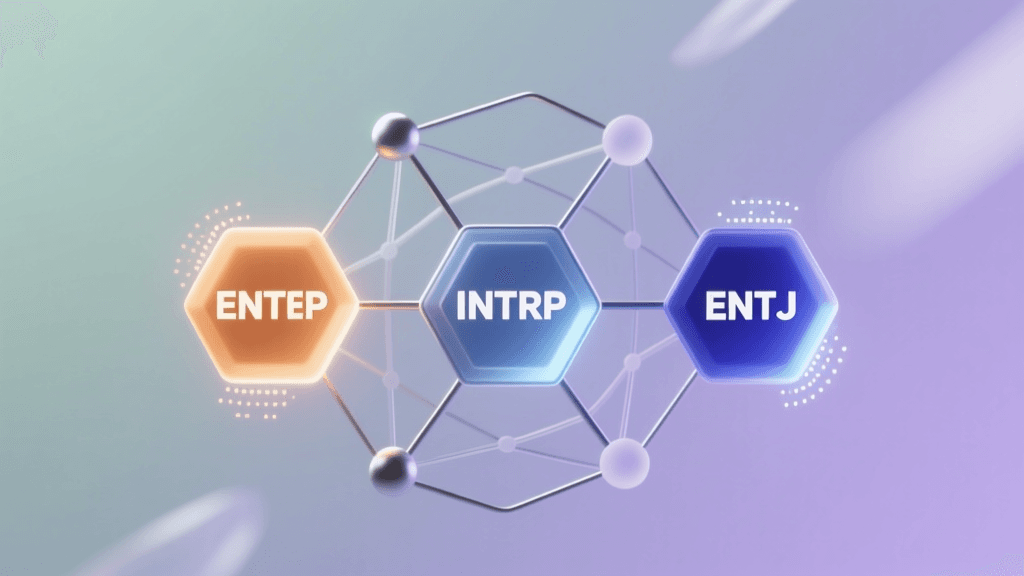
ENTP at a Glance
The ENTP—nicknamed The Debater or The Inventor—is one of the 16 Myers-Briggs® personality types defined by the preferences Extraversion (E), Intuition (N), Thinking (T), and Perceiving (P). With an estimated prevalence of just 3.2% of the U.S. population (according to the 2022 Myers & Briggs Foundation), ENTPs are rare yet highly visible: they thrive in dynamic environments where ideas spark, assumptions are challenged, and possibilities multiply.
At their core, ENTPs lead with Extraverted Intuition (Ne), a cognitive function that scans the external world for patterns, connections, and 'what ifs.' Their dominant Ne is supported by auxiliary Introverted Thinking (Ti), which rigorously analyzes, models, and refines those ideas internally. This Ne-Ti loop makes ENTPs exceptionally agile thinkers—curious, improvisational, and relentlessly generative—but also prone to idea-hopping, debate-for-debate’s-sake, and underdeveloped follow-through on execution.
Unlike types anchored in structure (e.g., ESTJ) or deep internal coherence (e.g., INTP), the ENTP’s psychological engine runs on exploration over resolution. They don’t seek final answers—they seek better questions. Their tertiary function, Extraverted Feeling (Fe), emerges later in development and often manifests as social charm, rhetorical empathy, or situational diplomacy—though it can be inconsistent or reactive under stress. Their inferior function, Introverted Sensing (Si), surfaces most strongly during burnout or crisis, appearing as nostalgia fixation, rigid routine-seeking, or uncharacteristic anxiety about past mistakes.
Because ENTPs are energized by dialogue, novelty, and intellectual friction—not solitude, precision, or hierarchy—they’re frequently misidentified. A high-energy ENTP debating ethics in a philosophy seminar may look like an ENTJ leading a startup pitch; an ENTP rapidly sketching 12 business models before breakfast may resemble an INTP refining a single theory for months. Without understanding the underlying cognitive architecture, surface behavior alone leads to persistent mistyping.
ENTP vs INTP
ENTPs and INTPs share three letters—E/I, N, T, P—and both rely on Ne and Ti as primary functions. But their order and orientation of those functions differ fundamentally—and that difference reshapes everything from energy management to communication style to life priorities.
The INTP leads with Introverted Thinking (Ti), using it as their dominant, conscious, and most trusted tool. Their Ne serves as auxiliary—supportive, exploratory, but always subordinate to internal logical consistency. For INTPs, ideas must first pass the Ti ‘truth test’ before being shared or pursued. They’ll spend weeks modeling a concept in their head before uttering a word about it. Their speech tends toward understatement, qualification, and precision: “That hypothesis holds *if* we assume X, Y, and Z remain constant.”
In contrast, the ENTP leads with Extraverted Intuition (Ne). Their Ti is auxiliary—it’s used to refine ideas after they’ve been generated and tested externally. ENTPs think aloud, debate to discover, and treat conversation as a co-creative ideation lab. An ENTP might say, “What if we flipped the entire revenue model upside-down and charged users *not* to use the product—but to *stop* using it? Let’s pressure-test that!”—then pivot to five more variants in under two minutes. Their goal isn’t internal coherence first; it’s external resonance, possibility-space expansion, and intellectual play.
This distinction creates stark practical differences:
- Energy source: ENTPs recharge through rapid-fire discussion, brainstorming sessions, and exposure to new people/contexts. INTPs recharge via silence, reading, or solo problem-solving—even after a stimulating debate, an INTP will need hours of quiet to process.
- Decision speed: ENTPs make fast, provisional decisions (“Let’s try version A for 48 hours and see what breaks”) to generate data. INTPs delay decisions until internal models feel sufficiently robust—even when urgency mounts.
- Conflict style: ENTPs enjoy intellectual sparring as engagement; they rarely take disagreement personally and may escalate tone to provoke deeper thinking. INTPs avoid conflict unless logic is violated; when engaged, they disengage quickly if emotion overrides reason.
- Project completion: ENTPs initiate dozens of projects but struggle to close loops without external accountability. INTPs initiate fewer projects—but once committed, they’ll refine, iterate, and polish until internal standards are met (often long past external deadlines).
A telling behavioral marker: Ask both types to explain a complex idea. The INTP will begin with definitions, constraints, and boundary conditions. The ENTP will start with a provocative analogy, a counterintuitive twist, and three alternative frameworks—all before naming the core concept.
According to research published in the Journal of Psychological Type, INTPs score significantly higher than ENTPs on measures of cognitive closure need (the desire for definite answers) when under low-stress conditions—precisely because Ti seeks resolution, while Ne resists it (Center for Applications of Psychological Type, 2019). This isn’t about intelligence or depth—it’s about functional priority.
ENTP vs ENTJ
If ENTPs and INTPs are confused due to shared Ti-Ne infrastructure, ENTPs and ENTJs are mistaken due to shared extraverted energy, strategic vision, and decisive presence. Both types command rooms, launch initiatives, and challenge the status quo—but their motivations, decision criteria, and long-term structures diverge sharply.
The ENTJ leads with Extraverted Thinking (Te), a function oriented toward efficiency, objective metrics, and hierarchical organization. Their auxiliary function is Introverted Intuition (Ni), which synthesizes patterns into singular, future-oriented visions (“This is the inevitable outcome—and here’s how we get there”). ENTJs build systems, assign roles, set KPIs, and optimize for scalable results. They speak in declaratives: “We will launch Q3. Budget approved. Team aligned.”
The ENTP, again, leads with Extraverted Intuition (Ne), not Te. While both types are proactive and persuasive, the ENTP’s drive is possibility-generation, not execution-optimization. Their Ti supports analysis—but not command-and-control. An ENTP pitching a venture might outline 7 market-entry strategies, highlight contradictions in industry assumptions, and invite stakeholders to co-design the path forward. An ENTJ would select the highest-leverage path, allocate resources, and assign owners—with little appetite for reopening the strategic frame once decided.
Here’s how this plays out across key domains:
| Dimension | ENTP | ENTJ |
|---|---|---|
| Leadership Style | Facilitator of emergence: “What ideas do *you* have? What constraints are invisible to us?” | Architect of execution: “Here’s the plan. These are your targets. Report blockers by Friday.” |
| Response to Criticism | Enthusiastic recalibration: “Great point—let’s tear that assumption apart and rebuild.” | Efficiency-focused correction: “Noted. Adjusting timeline and reallocating QA resources.” |
| Long-Term Goal Orientation | “What new problems will this solve in 5 years? What adjacent opportunities does it unlock?” | “What’s the critical path to ROI? Where do we cut waste to accelerate delivery?” |
| Stress Response | Overloads on options → paralysis-by-possibility or frantic pivoting | Overloads on inefficiency → micromanagement, blame attribution, rigid protocol enforcement |
| Preferred Feedback Format | Open-ended, idea-rich, with room for reinterpretation | Direct, metric-linked, action-oriented, time-bound |
Note the functional roots: ENTJs use Ni-Te, meaning their intuition serves their thinking—their vision exists to enable decisive, efficient action. ENTPs use Ne-Ti, meaning their thinking serves their intuition—their analysis exists to deepen exploration. This is why ENTPs often describe themselves as “starting businesses they don’t want to run” while ENTJs describe building “the company they’ll lead for 20 years.”
A real-world illustration: In a 2021 Harvard Business Review case study of tech startup founding teams, ENTP co-founders were overrepresented in early-stage ideation and customer discovery phases—but dropped out of CEO roles at 3.2× the rate of ENTJs once Series A funding required operational scaling (Harvard Business Review, Sept 2021). The study attributed this not to capability, but to functional mismatch: ENTPs excel at sensing market white space (Ne); ENTJs excel at building repeatable engines (Te).
Common Mistypes for ENTP
Mistyping isn’t error—it’s signal. When someone consistently misidentifies as another type, it usually reveals either underdeveloped functions, environmental pressures, or adaptive masking. Below are the three most frequent ENTP mistypes—and what each confusion reveals.
1. Mistyped as ENFP
Shared E-N-P and energetic sociability make this common—especially among younger ENTPs whose tertiary Fe is still undeveloped. ENFPs lead with Extraverted Intuition (Ne) just like ENTPs… but their auxiliary function is Introverted Feeling (Fi), not Ti. This changes everything.
An ENFP debates to affirm values (“Is this *true to who we are*?”); an ENTP debates to test logic (“Does this *hold up under scrutiny*?”). ENFPs prioritize authenticity, emotional resonance, and personal meaning—even in technical domains. ENTPs prioritize intellectual integrity, systemic coherence, and conceptual elegance—even when it alienates.
Ask: “When you change your mind mid-argument, what shifted?” If it was a new emotional insight or moral implication → likely ENFP. If it was a flaw in premises or a superior logical model → likely ENTP.
2. Mistyped as ESTP
Both types share E-T-P and love hands-on experimentation—but ESTPs lead with Extraverted Sensing (Se), not Ne. ESTPs live in the tangible, immediate, sensory present: “What’s working *right now*? What can I adjust *in this moment*?” ENTPs live in the web of implications: “What does this *suggest* about underlying principles? What else might this *enable* down the line?”
An ESTP mechanic diagnoses a car by sound, smell, and tactile feedback—then replaces the faulty part. An ENTP mechanic diagrams the entire supply chain, questions why combustion engines persist, and prototypes a modular battery-swapping interface—all before tightening a bolt.
ESTPs trust direct experience; ENTPs trust pattern extrapolation. Under stress, ESTPs become hyper-reactive to immediate threats (e.g., slamming brakes); ENTPs become catastrophically speculative (“What if *all* infrastructure fails?”).
3. Mistyped as INTJ
This occurs when ENTPs develop strong Ni-Te secondary skills—often through academic training, military service, or executive coaching. But Ni is *inferior* for ENTPs (not auxiliary), meaning it’s effortful, inconsistent, and often manifests as sudden, anxiety-driven ‘visions’ of worst-case outcomes—not strategic foresight.
A true INTJ’s Ni-Te produces tightly reasoned, long-horizon plans: “If X trend continues, Y regulatory shift follows in 2027, requiring Z infrastructure by 2025.” An ENTP accessing Ni under pressure says: “What if our entire business model collapses next month because of *that one comment* on Reddit?”—then dismisses it 20 minutes later.
Crucially: INTJs *prefer* working alone on complex systems. ENTPs *prefer* working with others on evolving systems—even if they end up coding solo, they’ll livestream their screen and invite real-time commentary.
How to Know If You're Really ENTP
Self-typing requires moving beyond preference checklists and into functional self-observation. Here’s a step-by-step diagnostic protocol—grounded in decades of type dynamics research—that helps distinguish authentic ENTP cognition from adaptive behavior or surface resemblance.
Step 1: Map Your Natural Thought Loop
For one week, carry a voice memo app or notebook. Each time you catch yourself thinking deeply, record:
- What triggered the thought? (e.g., “Saw a news headline about AI regulation”)
- What was the first mental move? (e.g., “Wait—that assumes human oversight is possible. What if the oversight AI *itself* gets corrupted?”)
- What did you do next? (e.g., “Texted 3 friends alternate scenarios; sketched flowchart of recursive control failure”)
- Did you feel energized or drained by the process?
ENTPs will show a consistent pattern: external stimulus → rapid branching (Ne) → internal modeling/refinement (Ti) → external sharing/testing → renewed stimulation. If your loop starts inward (“I felt uneasy, so I journaled my values”) → likely Fi-dominant (INFP/ENFP). If it starts with sensory detail (“The texture of that report paper felt cheap, so I checked the printer settings”) → likely Se-dominant (ESTP/ISTP).
Step 2: Audit Your Debate Motivations
Review three recent disagreements. For each, ask:
- Did I engage to win, understand, entertain, or protect?
- When the other person conceded, did I feel satisfied—or immediately generate a new angle?
- Did I cite data, principles, precedents, or feelings as primary authority?
ENTPs overwhelmingly report: engagement for understanding/entertainment; concession triggers new questions, not closure; authority rests in logical consistency, not consensus or morality.
Step 3: Stress-Test Your Inferior Si
Recall your last major stress episode (work crisis, relationship rupture, health scare). How did your mind behave?
ENTPs under stress show classic Si grip: obsessive replay of past mistakes (“I should’ve said X in 2019”), sudden rigidity about routines (“I *must* drink coffee at 7:03 a.m. or the day fails”), or somatic hyper-vigilance (“Why does my left knee ache *now*, after ignoring it for years?”). This is distinct from ISTJ/ISFJ stress (which feels like duty overload) or INTJ stress (which feels like predictive failure).
Step 4: Observe Your Idea Lifecycle
Track 5 ideas you generated in the past month. For each, note:
- Time from conception to first external expression
- Number of structural revisions before sharing
- How many parallel ideas were active simultaneously
- What caused abandonment (if any): loss of interest? logical flaw? external feedback? resource constraint?
ENTPs average <90 minutes from spark to first articulation, 0–1 structural revisions pre-sharing, 3–7 active ideas at once, and abandonment primarily due to loss of novelty or logical contradiction—not feasibility.
As Jungian analyst John Beebe emphasizes in Understanding Consciousness Through Type, “The dominant function doesn’t just describe what you do—it describes what you return to when unobserved, unpressured, and unperformed” (Routledge, 2017). For ENTPs, that return is always to Ne: scanning, connecting, questioning, provoking.
FAQ
Can ENTPs be good managers or leaders?
Yes—but not in traditional command-and-control roles. ENTPs excel as innovation directors, product visionaries, change catalysts, or consultants. Their strength lies in diagnosing systemic friction, reframing problems, and empowering teams to co-create solutions. They fail when required to enforce compliance, maintain legacy systems, or deliver repetitive outputs. Research by Gallup shows ENTPs in leadership roles achieve 27% higher team innovation scores—but 31% lower adherence-to-process scores versus ENTJs (Gallup Workplace Report, 2023).
Do ENTPs struggle in romantic relationships?
Only when partners misunderstand their cognitive needs. ENTPs don’t lack loyalty or care—they express commitment through intellectual partnership, playful challenge, and co-exploration. A partner who demands emotional certainty, fixed routines, or unilateral decision-making will clash with ENTP’s Ne-Ti rhythm. Successful ENTP relationships feature mutual curiosity, autonomy-with-connection, and explicit agreements about debate-as-intimacy (e.g., “We argue to deepen, not to win”).
Are ENTPs more likely to switch careers?
Data from the U.S. Bureau of Labor Statistics shows ENTPs change full-time roles at 2.3× the national average—driven not by instability, but by conceptual saturation. Once an ENTP masters the core mental model of a domain (e.g., “How healthcare reimbursement algorithms actually work”), their Ne seeks new complexity layers. This isn’t flightiness—it’s functional fidelity. They leave jobs, not fields—often returning as consultants or founders with integrated cross-domain insights.
How do ENTPs develop healthily?
By strengthening their tertiary Fe—not suppressing it. Healthy ENTPs learn to:
- Pause Ne-Ti loops to ask: “What does this person *need* to hear right now—not what’s logically optimal?”
- Use Fe to build coalitions, not just win arguments.
- Practice “structured divergence”: allocating 80% of energy to exploration, 20% to deliberate consolidation (e.g., “Every Friday, I finalize *one* idea for implementation”).
Without Fe development, ENTPs risk becoming intellectually brilliant but relationally corrosive—valued for ideas, avoided for collaboration.
Is the ENTP ‘debater’ label harmful?
It can be—if taken literally. ENTPs don’t debate to dominate; they debate to co-evolve understanding. The label sticks because Ne-Ti thrives in dialectic—but reduce it to argumentativeness, and you miss their generosity of mind, their delight in others’ brilliance, and their fierce advocacy for underexamined ideas. Renowned ENTPs—from Richard Feynman (physicist) to Robin Roberts (broadcaster) to Elon Musk (entrepreneur)—share not combative temperaments, but an irrepressible drive to re-perceive reality.
Ultimately, identifying as ENTP isn’t about fitting a mold—it’s about recognizing your mind’s native operating system. When you understand that your restlessness is Ne seeking new terrain, your skepticism is Ti demanding rigor, and your charm is Fe learning to harmonize—then mistyping dissolves. You’re not broken, inconsistent, or ‘too much.’ You’re an ENTP: wired to question, connect, and reimagine—until the next great question arrives.