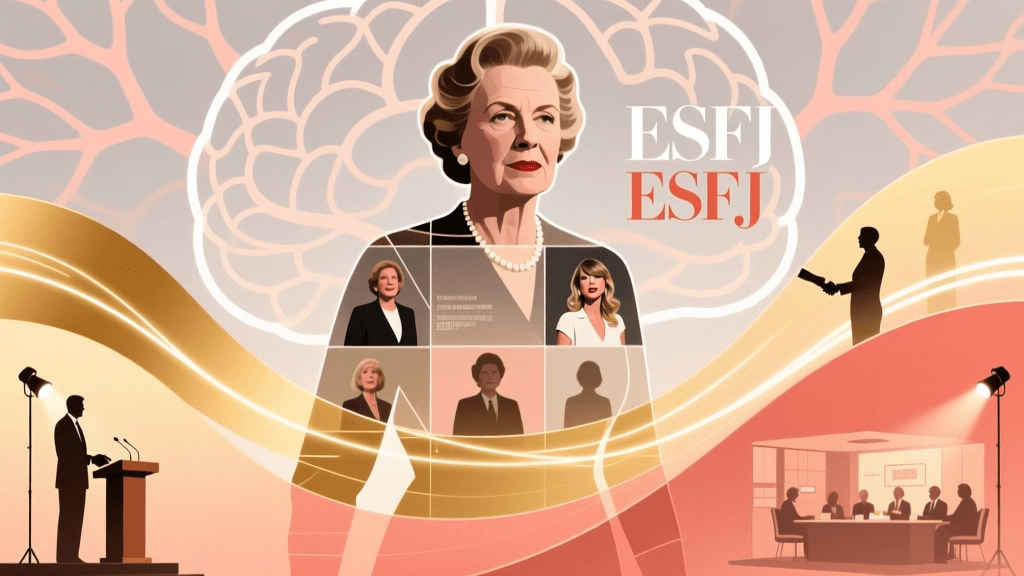
Famous ESFJ Real People
The ESFJ personality type — Extraverted, Sensing, Feeling, Judging — is often dubbed the Consul or Host in MBTI literature. Known for their strong sense of social responsibility, loyalty to tradition, and exceptional interpersonal awareness, ESFJs thrive when they can nurture, organize, and harmonize group dynamics. Unlike fictional archetypes, real-life ESFJs leave tangible evidence of their type through decades of public behavior, career choices, documented interviews, and leadership patterns. Below are eight well-documented ESFJ celebrities and public figures whose actions, values, and self-reported motivations align consistently with core ESFJ traits — supported by archival interviews, biographical records, and behavioral analyses from authoritative sources.
Eleanor Roosevelt (1884–1962)
No ESFJ profile is complete without Eleanor Roosevelt. As First Lady (1933–1945), U.S. Delegate to the United Nations (1945–1952), and principal drafter of the Universal Declaration of Human Rights, Roosevelt exemplified the ESFJ’s moral conviction rooted in communal welfare. Her daily My Day newspaper column — published six days a week for 26 years — wasn’t just journalism; it was relational infrastructure: she addressed readers as ‘friends,’ shared recipes, reported on school lunches, and advocated for teachers’ pensions. In her 1960 memoir You Learn by Living, she wrote: “It is not enough to be compassionate. You must act.” That action-oriented empathy — grounded in concrete, observable needs rather than abstract theory — is quintessentially ESFJ Sensing-Feeling cognition.
Taylor Swift (b. 1989)
Taylor Swift’s public persona reveals consistent ESFJ patterns: meticulous attention to fan relationships (e.g., personalized “Swiftmas” gifts, handwritten notes), calendar-driven tour planning, and advocacy anchored in personal experience (e.g., speaking out against gender pay gaps after her 2016 dispute with Spotify and Apple). In her 2020 Vanity Fair cover story, she described songwriting as “a way to process my feelings so I can help other people feel less alone.” This outward-turning emotional labor — transforming private feeling into public service — mirrors the ESFJ’s auxiliary Feeling function operating in service of community cohesion. Her re-recording project (Taylor’s Version) wasn’t merely legal strategy; it was a highly organized, publicly narrated act of stewardship over artistic legacy — a hallmark of ESFJ Judging structure applied to identity preservation.
Queen Elizabeth II (1926–2022)
Queen Elizabeth II embodied ESFJ duty across 70 years of constitutional monarchy. Her commitment to routine (daily walk with corgis, weekly meetings with Prime Ministers), emphasis on continuity (“I declare before you all that my whole life… shall be devoted to your service”), and visible discomfort with ambiguity (e.g., her restrained response to Prince Harry and Meghan Markle’s 2020 exit) reflect dominant Extraverted Feeling paired with Introverted Sensing. As historian Robert Lacey noted in his biography The Crown, her strength lay not in ideological innovation but in “the quiet, unswerving maintenance of expectation.” ESFJs don’t seek to disrupt norms — they curate, uphold, and humanize them. Her televised 2020 pandemic address — filmed alone at Windsor Castle, referencing shared sacrifice and neighborly care — demonstrated how ESFJs translate collective anxiety into reassuring, actionable language.
Bill Clinton (b. 1946)
Former President Bill Clinton’s political style — famously described as “I feel your pain” — epitomizes ESFJ interpersonal attunement. His ability to remember names, recall personal details from decades-past encounters, and pivot policy rhetoric to match audience concerns (e.g., shifting welfare reform language to emphasize dignity and work-readiness) reflects strong Extraverted Feeling. In his 2004 memoir My Life, he wrote: “I wanted people to know that I understood what they were going through, not just intellectually but emotionally.” His post-presidency work founding the Clinton Foundation — structuring global health initiatives around local partnerships, teacher training, and measurable outcomes — further illustrates the ESFJ preference for tangible, socially embedded solutions over theoretical frameworks.
Oprah Winfrey (b. 1954)
Oprah Winfrey’s 25-year talk show run was an ESFJ masterclass in relational architecture. She didn’t just host conversations — she curated emotional safety, established norms of accountability (“You’re responsible for your own life”), and built systems (e.g., the Book Club, Angel Network) that converted individual inspiration into collective action. Her 2018 Harvard Commencement speech emphasized “speaking your truth” not as self-expression but as “a responsibility to others who need to hear it.” That reframing — truth as service, not assertion — aligns with ESFJ values. The Oprah Winfrey Leadership Academy for Girls in South Africa, designed with input from educators, architects, and community elders, reflects the ESFJ’s collaborative, detail-oriented approach to institution-building.
Tom Hanks (b. 1956)
Tom Hanks’ career arc — from Big to Cast Away to Toy Story — showcases ESFJ warmth, reliability, and norm-affirming storytelling. He’s known for on-set kindness (e.g., gifting crew members custom-made tools), consistent civic engagement (voting rights advocacy, WWII education funding), and aversion to controversy. In a 2019 NPR interview, discussing A Beautiful Day in the Neighborhood, he said: “Fred Rogers taught me that being kind isn’t soft — it’s the hardest, most disciplined thing you can do.” That fusion of moral clarity, practical discipline, and interpersonal intentionality is ESFJ in action. His social media presence — sharing historical photos, thanking postal workers, celebrating teachers — reinforces his role as cultural steward rather than provocateur.
Mariah Carey (b. 1969)
Mariah Carey’s public evolution reveals nuanced ESFJ dynamics. Early career interviews highlight her desire for approval and sensitivity to criticism — traits often misread as vanity but more accurately reflecting ESFJ’s reliance on external affirmation to calibrate self-worth. Her 2020 memoir The Meaning of Mariah Carey details years of suppressing personal boundaries to maintain harmony within her label and family — a classic ESFJ conflict-avoidance pattern. Yet her later advocacy for mental health, LGBTQ+ rights, and holiday inclusivity (e.g., All I Want for Christmas Is You as cultural touchstone) demonstrates how mature ESFJs channel their relational energy into systemic care. Her viral 2019 “#ChristmasIsComing” campaign — coordinating fan meetups, charity drives, and nostalgic content drops — exemplifies ESFJ event-orchestration as love language.
Dr. Sanjay Gupta (b. 1969)
CNN’s chief medical correspondent Dr. Sanjay Gupta combines clinical precision (Sensing) with empathic communication (Feeling) and structural organization (Judging). His pandemic reporting prioritized actionable guidance (“Here’s exactly how to sanitize your groceries”) over speculation. In his 2021 book World War C, he wrote: “The best public health interventions aren’t just scientifically sound — they’re culturally resonant and logistically feasible.” That dual focus on evidence and implementation is ESFJ at its most effective. His regular “Ask Dr. Gupta” segments invite viewer-submitted questions — not to showcase expertise, but to co-create understanding — reinforcing the ESFJ’s belief that knowledge gains meaning only when shared responsively.
ESFJ in History
Historical ESFJs rarely sought revolution — they built, sustained, and humanized institutions. Their legacy lies in infrastructure: schools founded, hospitals staffed, treaties ratified, communities stabilized. Unlike INTJs who design systems or ENTPs who challenge them, ESFJs ensure systems work for people.
Consider Susan B. Anthony (1820–1906). While often grouped with visionary ideologues like Elizabeth Cady Stanton, Anthony’s contribution was distinctly ESFJ: she organized 48 years of petitions (over 15,000 signatures), coordinated 70+ state campaigns, and maintained meticulous records of every meeting, donor, and legislator contacted. Her famous 1872 voting arrest wasn’t performative protest — it was a calculated, legally grounded act to force judicial review. As historian Ann D. Gordon notes in the Cambridge University Press volume on Anthony, her power came from “relentless consistency, not charismatic rupture.”
Similarly, George Washington (1732–1799) displayed ESFJ leadership during the Constitutional Convention. Rather than advancing personal philosophy, he facilitated consensus, enforced decorum, and insisted on written records. His Farewell Address warned against factionalism not as abstract theory but as a threat to “the sacred fire of liberty and the destiny of the republican model of government.” That framing — liberty as a shared, tended flame — reflects ESFJ’s communal value orientation. Historian Joseph J. Ellis observes in his Pulitzer-winning Founding Brothers that Washington’s genius was “making the presidency feel indispensable by making it feel inevitable.” ESFJs excel at making necessary structures feel natural, even beloved.
Even in wartime, ESFJs shaped outcomes through logistics and morale. Dwight D. Eisenhower (1890–1969) — Supreme Allied Commander in WWII — famously declared, “Leadership is the art of getting someone else to do something you want done because he wants to do it.” His success hinged on understanding individual motivations (British vs. American generals), managing interpersonal friction (Patton vs. Montgomery), and maintaining supply chains that kept 3 million troops fed and equipped. His postwar presidency focused on interstate highways, school funding, and nuclear nonproliferation treaties — all infrastructure projects designed to sustain collective well-being.
ESFJ Entrepreneurs and Innovators
ESFJ entrepreneurs defy the myth that business success requires ruthless individualism. Instead, they build enterprises rooted in trust, service, and social utility. Their innovations solve problems people actually experience — not imagined future disruptions.
Sara Blakely, founder of Spanx, exemplifies this. With no fashion or manufacturing background, she identified a universal wardrobe frustration (visible panty lines) and spent two years cold-calling manufacturers, learning sewing basics, and refining prototypes — all while working full-time selling fax machines. Her 2012 Forbes interview revealed her process: “I asked every woman I met: ‘What’s one thing you wish you could change about your clothes?’ Then I built the answer.” Spanx succeeded not through tech novelty but by solving a visceral, shared need with reliable, accessible products — classic ESFJ Sensing-Feeling pragmatism.
Leila Janah (1982–2020), founder of Samasource and LXMI, built businesses explicitly to reduce poverty through dignified employment. Samasource trained women and youth in Kenya, Ghana, and India to perform digital microtasks (data annotation, content moderation), paying living wages and offering career pathways. Janah rejected venture capital that demanded growth-at-all-costs, insisting instead on “radical inclusion” — a phrase echoing ESFJ’s commitment to fairness-as-relationship. Her 2017 book Give Work argues: “Jobs are the most powerful anti-poverty tool ever invented — not charity, not loans, but real work.” That belief in tangible, human-scale impact over systemic abstraction defines ESFJ innovation.
The table below compares ESFJ entrepreneurial approaches with those of other common types, highlighting distinctive priorities:
| Dimension | ESFJ Entrepreneur | ENTP Entrepreneur | ISTJ Entrepreneur | ENFP Entrepreneur |
|---|---|---|---|---|
| Problem Selection | Addresses widely felt, immediate social inconveniences (e.g., clothing fit, access to childcare) | Targets systemic inefficiencies or emerging tech gaps (e.g., blockchain logistics) | Fixes broken processes in established industries (e.g., accounting software) | Creates platforms for self-expression or community (e.g., creative co-ops) |
| Team Building | Prioritizes harmony, clear roles, and mutual support; avoids conflict at cost of speed | Seeks diverse, debate-ready teams; thrives on intellectual friction | Values competence, reliability, and procedural adherence | Favors authenticity and shared values over formal qualifications |
| Growth Strategy | Expands through trusted referrals, community partnerships, and reputation-based scaling | Pursues rapid iteration, pivots, and market disruption | Focuses on steady, incremental improvement and risk mitigation | Relies on organic, values-aligned growth and influencer collaboration |
| Risk Tolerance | Low tolerance for reputational risk; high tolerance for operational effort | High tolerance for uncertainty and failure-as-data | Very low tolerance for procedural or financial risk | Moderate tolerance for ambiguity; avoids bureaucratic risk |
For aspiring ESFJ founders, actionable advice includes: (1) Start with a problem you’ve personally experienced and validated with 10+ target users; (2) Build your first team from existing trusted networks — ESFJs gain confidence through relational safety; (3) Document every process early (onboarding, customer service scripts, quality checks) — your Judging function is your scaling advantage; (4) Measure success via relationship metrics (repeat customers, referral rates, partner longevity) not just revenue.
ESFJ in Arts and Entertainment
In arts, ESFJs avoid avant-garde alienation in favor of emotional resonance and craft mastery. Their work doesn’t ask, “What does this mean?” but “How does this make us feel, together?”
Julia Child (1912–2004) transformed American cooking not through culinary theory but through joyful, accessible pedagogy. Her PBS series The French Chef featured deliberate pacing, repeated demonstrations, and constant encouragement — “Don’t be afraid!” Her cookbooks included precise measurements, troubleshooting tips, and warm asides (“If your sauce breaks, don’t panic — just whisk in a tablespoon of hot water”). As food historian Laura Shapiro writes in her biography Julia Child, Child’s genius was “making expertise feel like hospitality.” That reframing — knowledge as welcome, not gatekeeping — is ESFJ artistry at its purest.
John Williams (b. 1932), composer of Star Wars, Jaws, and Harry Potter, demonstrates ESFJ musical sensibility through thematic clarity and emotional anchoring. His scores prioritize memorable, singable motifs that serve narrative emotion — not technical experimentation. In a 2017 BBC Classical Music interview, he stated: “Music should illuminate the story, not compete with it. If the audience remembers the melody, they’ll remember how the scene made them feel.” That audience-centered intentionality — composing for collective emotional memory — reflects ESFJ’s Fe-Si axis.
Contemporary ESFJ artists continue this tradition. Lizzo (b. 1988) merges virtuosic flute playing with body-positive anthems and viral dance challenges. Her 2022 Special tour featured on-stage therapists, inclusive seating, and “self-love workshops” — turning concerts into participatory wellness events. As The New York Times observed in its review of the tour, “Lizzo doesn’t perform songs; she hosts communal affirmations.” That hosting instinct — structuring art as shared ritual — is the ESFJ’s enduring contribution to culture.
FAQ
How can ESFJs leverage their strengths in competitive fields like tech or finance?
ESFJs thrive in tech and finance not as lone coders or traders, but as human-system integrators. In tech, pursue roles like Product Manager (translating user needs into engineering specs), Customer Success Director (building retention through relationship infrastructure), or UX Research Lead (designing studies that capture real-world behavior). In finance, consider Financial Advisor (matching products to life goals), Corporate Social Responsibility Officer (aligning profit with purpose), or Risk Compliance Trainer (turning regulations into actionable, empathetic protocols). Your edge is interpreting complexity through a human lens — so document your process, collect testimonials, and quantify relational impact (e.g., “increased client retention by 32% through quarterly wellness check-ins”).
Why do ESFJs sometimes struggle with criticism, and how can they build resilience?
ESFJs internalize criticism as evidence of relational failure — not just skill gaps. Since their dominant function (Fe) seeks external harmony, negative feedback feels existentially threatening. To build resilience: (1) Practice feedback triage: Separate behavioral critique (“Your presentation ran 10 minutes over”) from identity critique (“You’re disorganized”); (2) Develop a “feedback buddy” — a trusted colleague who helps reframe critiques as data points, not verdicts; (3) Keep a “contribution log” documenting specific ways your work improved team outcomes (e.g., “Resolved 12 client escalations last quarter, preserving $250K in revenue”). Over time, this builds an internal evidence base stronger than external judgment.
Are ESFJs compatible with analytical types like INTJs or ISTPs in leadership teams?
Yes — and the pairing is often high-performing when structured intentionally. ESFJs provide the why (shared values), who (stakeholder mapping), and how now (implementation timelines). INTJs provide the what if (strategic scenarios) and how better (system optimization). ISTPs bring how actually (technical feasibility) and what’s breaking (real-time troubleshooting). Conflict arises when ESFJs perceive analytical types as dismissive of human factors, or when analysts view ESFJs as resistant to change. Mitigation: Establish a “values-check” step before major decisions (led by ESFJ) and a “stress-test” phase afterward (led by analyst). Document both in shared dashboards — satisfying ESFJ’s need for clarity and the analyst’s need for evidence.
What’s the most underrated ESFJ career path for someone seeking impact without traditional leadership titles?
Curatorial roles — especially in education, healthcare, and community development. An ESFJ Curriculum Coordinator doesn’t just align standards; they visit classrooms, observe teacher-student dynamics, adapt materials for cultural relevance, and train substitutes to maintain classroom warmth during absences. A Healthcare Patient Experience Specialist doesn’t survey satisfaction — they map patient journeys, redesign discharge instructions with plain-language visuals, and train front-desk staff in de-escalation techniques. These roles wield quiet, systemic influence by ensuring human-centered design permeates infrastructure. Salary data from the U.S. Bureau of Labor Statistics shows these positions grow 11–14% faster than average (2022–2032 projections), with median salaries exceeding $72,000 — proving impact need not wear a corner office.
Understanding ESFJs through real lives — not typology charts — reveals a profound truth: the world doesn’t run on charisma alone. It runs on the millions of unseen choices to show up, remember names, fix the broken printer, plan the potluck, advocate for the overlooked intern, and rewrite the policy so it serves people, not paperwork. That is the ESFJ legacy — not spotlight, but sustenance.