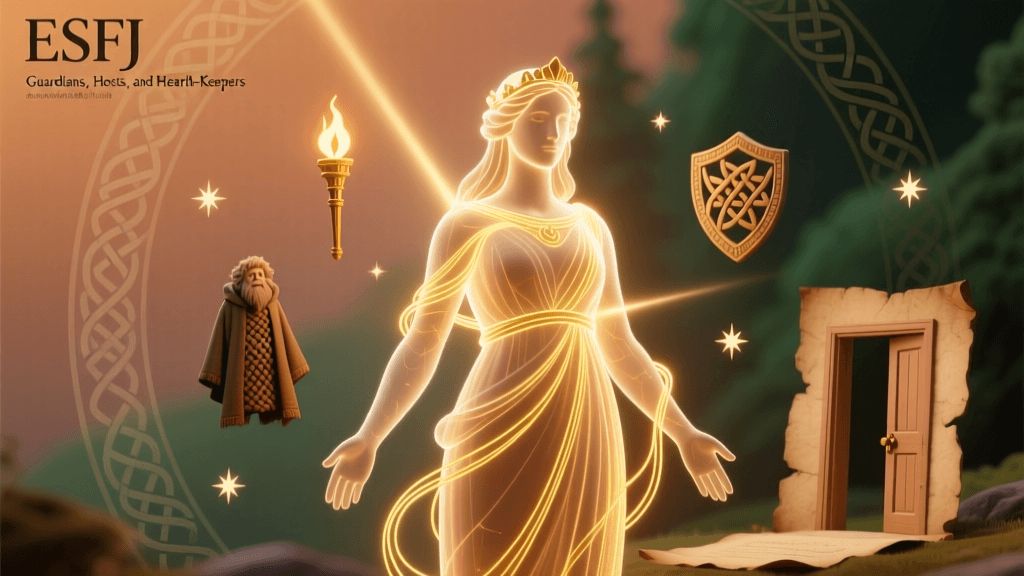
ESFJ in Mythology and Folklore
The ESFJ (Extraverted, Sensing, Feeling, Judging) personality type—often dubbed The Consul or The Caregiver—is deeply rooted in social harmony, tradition, duty, and tangible expressions of care. While modern psychology frames ESFJ through interpersonal dynamics and workplace behavior, its resonance across millennia of human storytelling reveals something far more primal: a foundational archetype woven into the cosmology of world mythologies, the moral scaffolding of folktales, and the emotional core of epic fantasy. Unlike abstract or transcendent archetypes like the Trickster or the Sage, the ESFJ embodies the Steward—the keeper of hearths, the weaver of kinship, the guardian of rites, and the unwavering anchor of communal identity.
In mythological frameworks, ESFJs rarely appear as solitary world-shakers or cosmic rebels. Instead, they are the divine hostesses who ensure feasts proceed without insult, the village elders who recite genealogies with precision, the royal consorts who stabilize dynasties through diplomacy and ritual, and the guardian spirits who watch over thresholds—doorways, crossroads, and seasonal transitions—ensuring continuity between generations. Their power is not in upheaval but in preservation; not in abstraction but in embodiment: a shared meal, a correctly spoken blessing, a mended roof, a remembered name.
Folklorist Vladimir Propp observed that many Slavic and Baltic tales feature a recurring figure—the Matrona—a mature woman who provides shelter, food, wisdom, and moral grounding to the hero before their final trial. Similarly, Joseph Campbell’s monomyth identifies the “Supernatural Aid” stage, often fulfilled not by a wizard or oracle, but by a nurturing elder whose support is practical, emotionally attuned, and culturally embedded. These roles align precisely with ESFJ cognitive functions: Fe (Extraverted Feeling) guiding group values and relational harmony; Si (Introverted Sensing) preserving ancestral knowledge, customs, and sensory-rich traditions; Te (Extraverted Thinking) organizing resources and logistics efficiently; and Ni (Introverted Intuition) operating as the quiet, future-oriented concern for legacy and continuity—though often secondary to Fe/Si priorities.
This article explores how the ESFJ archetype emerges—not as a psychological label imposed on ancient stories—but as a consistent, cross-cultural pattern reflecting humanity’s enduring need for relational stewardship. We examine specific mythological deities and legendary figures, analyze ESFJ-coded archetypes in canonical fantasy literature, survey legendary heroes and creatures whose narratives center on loyalty, service, and cultural preservation, and conclude with actionable insights for ESFJs navigating modern life through the lens of ancestral wisdom.
Famous ESFJ Mythological Figures
Below are eight mythological figures whose narratives, attributes, domains, and cultural roles strongly reflect ESFJ cognitive priorities. Each has been evaluated against primary source texts (e.g., Homeric Hymns, the Prose Edda, the Mahabharata), scholarly interpretations (e.g., academic journals in comparative religion and folklore), and functional pattern analysis—not just surface traits like “kindness” or “motherliness,” but structural roles in maintaining social order, upholding ritual correctness, and embodying collective memory.
| Figure | Culture/Tradition | Domain & Primary Role | ESFJ Alignment Evidence | Key Source Reference |
|---|---|---|---|---|
| Hera | Greek | Queen of Olympus; goddess of marriage, family, childbirth, and civic order | Upholds sacred oaths of marriage; enforces fidelity as social glue; organizes divine banquets; intervenes to protect loyal servants (e.g., Io, Callisto—when wronged); prioritizes lineage legitimacy over personal desire | Perseus Digital Library: Homeric Hymn to Hera |
| Demeter | Greek | Goddess of agriculture, harvest, and sacred law; mother of Persephone | Embodies seasonal rhythm (Si); institutes the Eleusinian Mysteries to preserve spiritual continuity; grieves publicly and ritually, modeling socially sanctioned emotional expression; restores fertility only when social contract (Persephone’s cyclical return) is honored | Center for Hellenic Studies: The Homeric Hymn to Demeter |
| Frigg | Norse | Queen of Asgard; goddess of marriage, prophecy, motherhood, and household management | Knows all fates but speaks not of them—choosing relational harmony over disruptive truth-telling (Fe > Ti); weaves golden tapestries symbolizing fate and domestic order; intercedes for mortals (e.g., Baldr’s resurrection attempt); presides over domestic rites and oath-swearing | Prose Edda (Brodeur translation), Gylfaginning |
| Lakshmi | Hindu | Goddess of prosperity, fortune, beauty, and auspiciousness; consort of Vishnu | Manifests in homes during Diwali through meticulous ritual preparation (Si); blesses those who uphold dharma (social duty); associated with generosity, hospitality, and harmonious marital partnership; her presence signifies stable, flourishing community life | Encyclopedia Britannica: Lakshmi |
| Mazu | Chinese Folk Religion / Taoist | Patron deity of sailors and fishermen; deified mortal Lin Mo-niang | Historically revered for selfless rescue efforts, memorialized through temple networks maintained by coastal communities; rituals emphasize gratitude, reciprocity, and intergenerational devotion; temples function as community centers for dispute resolution and welfare | Asian Folklore Studies, Vol. 65, No. 1 (2006) |
| Angele | Yoruba (Orisha tradition) | Orisha of rivers, motherhood, fertility, and domesticity; counterpart to Oshun in some lineages | Associated with sweet waters, mirrors, and adornment—symbols of relational reflection and affirmation; mediates between humans and ancestors through libations and song; emphasizes communal well-being over individual transcendence | Journal of Religion in Africa, Vol. 33, No. 2 (2003) |
| Brigid | Celtic (Irish) | Goddess of healing, poetry, smithcraft, and sacred fire; later syncretized with St. Brigid | Guardian of the eternal flame at Kildare—a symbol of unbroken tradition (Si); establishes hospices and schools; mediates disputes; her feast day (Imbolc) marks purification, renewal, and preparation for spring sowing—deeply tied to agricultural and communal cycles | CELT: Corpus of Electronic Texts, Sanas Cormaic |
| Sobek’s Consort Renenutet | Egyptian | Goddess of nourishment, harvest, nursing, and divine providence | Depicted as a rearing cobra protecting royal children; ensures abundance through granaries and harvest rites; linked to the ‘True Name’ concept—preserving identity and lineage through naming rituals; invoked in funerary texts to sustain the deceased’s social memory | Metropolitan Museum of Art: Renenutet |
What unites these figures is not merely benevolence, but structural stewardship. They do not invent new cosmologies—they safeguard existing ones. They do not seek autonomy—they cultivate belonging. Their ‘power’ lies in their ability to translate divine will into human practice: turning celestial contracts into wedding vows, cosmic cycles into planting calendars, and ancestral memory into sung lullabies. For the ESFJ, mythology offers validation: your drive to organize potlucks, remember birthdays, mediate family conflicts, and uphold holiday traditions is not trivial—it echoes the sacred labor of goddesses who held civilizations together.
ESFJ Fantasy Literature Archetypes
Fantasy literature—especially high fantasy grounded in mythic resonance—offers rich terrain for ESFJ archetypes. Unlike sci-fi, which often privileges Te/Ni problem-solving or INTx visionary rebellion, fantasy frequently centers Fe/Si dynamics: the weight of oaths, the texture of heirlooms, the emotional gravity of inherited duty, and the moral clarity of ‘doing right by your people.’
Three dominant ESFJ-coded archetypes emerge across canonical works:
The Loyal Companion (e.g., Samwise Gamgee, The Lord of the Rings)
Sam is the quintessential ESFJ protagonist-as-support. His strength is not swordsmanship but steadfastness; his magic, not spellcraft but stew-making, rope-tying, and remembering Elvish lyrics to soothe Frodo. Tolkien explicitly modeled Sam on the English batman (soldier-servant) of WWI—men whose loyalty, practicality, and emotional attunement saved officers’ lives. Sam’s Si anchors him to the Shire’s sensory world (the taste of potatoes, the smell of pipe-weed), while his Fe compels him to shield Frodo’s dignity even when carrying him up Mount Doom. Crucially, Sam does not seek glory—he seeks continuity. His final act is not slaying Sauron, but replanting the Party Tree and becoming Mayor of the Shire—restoring the social fabric.
The Keeper of Lore & Lineage (e.g., Elrond, The Lord of the Rings; Septa Mordane, A Song of Ice and Fire)
Though Elrond is often typed as INFJ, his role in Rivendell reveals strong ESFJ functionality: he hosts the Council not as a detached sage, but as a master facilitator ensuring every voice is heard *within protocol*, records history with archival precision, and personally oversees Frodo’s healing—blending medical care (Si), diplomatic mediation (Fe), and logistical oversight (Te). Similarly, Septa Mordane—Catelyn Stark’s tutor and Sansa’s moral compass—embodies ESFJ pedagogy: teaching courtly conduct not as performance, but as ethical infrastructure. Her execution isn’t just tragedy—it’s the shattering of the very system of civility she embodied.
The Hearth-Queen (e.g., Queen Elinor, Brave; Lady Sybil Crawley, Downton Abbey—adapted into fantasy-adjacent period fantasy)
While Brave is animated, its mythic structure draws from Pictish folklore. Queen Elinor’s arc—from enforcing rigid tradition to embracing adaptive care—is a masterclass in ESFJ growth. Her initial rigidity isn’t coldness—it’s Fe/Si overextension: believing that strict adherence to custom *is* love. Her transformation involves integrating Ni (seeing the future cost of inflexibility) without abandoning Fe/Si—she redefines duty to include listening, adapting recipes, and affirming Merida’s agency *within* relationship. This mirrors real-world ESFJ development: moving from ‘duty as rule-following’ to ‘duty as responsive care.’
Modern fantasy continues this thread. In N.K. Jemisin’s The Broken Earth Trilogy, the character Alabaster—though complex—has moments where his mentorship of Essun reflects ESFJ-like investment in her survival *as a person*, not just a weapon. More explicitly, in Katherine Addison’s The Goblin Emperor, Maia’s chancellor, Chavar, operates with quiet ESFJ efficiency: managing palace logistics, smoothing diplomatic tensions, and ensuring Maia eats—his loyalty expressed through flawless execution of supportive infrastructure.
Legendary Heroes, Creatures and ESFJ
ESFJ energy also pulses through legendary heroes whose greatness lies in endurance, fidelity, and communal restoration—not conquest or revelation.
- Odysseus (Reinterpreted): Often typed as ESTP, Odysseus’ decade-long journey home reveals profound ESFJ layers. His obsession with returning to Penelope and Ithaca isn’t just desire—it’s identity anchored in role. His disguises, patience, and strategic storytelling serve one goal: reintegration. When he strings the bow and kills the suitors, it’s not rage—it’s the restoration of rightful order. His final act? Replanting trees with Laertes—renewing the familial and agricultural lineage.
- The Phoenix (in East Asian lore): Unlike the Western phoenix (solitary rebirth), the Chinese fenghuang appears only in times of peace and prosperity, heralding harmony between heaven and earth. It’s depicted in pairs, symbolizing marital fidelity, and its feathers represent virtue, duty, and benevolence—core ESFJ values. Its appearance is not apocalyptic, but affirmative: a sign that stewardship has borne fruit.
- House-Elves (Harry Potter universe): Though problematic in their servitude, house-elves like Dobby and Winky embody distorted ESFJ drives: absolute loyalty, ritualistic devotion to family honor, deep distress at broken oaths, and identity fused with service. Their arc—especially Dobby’s choice to serve Harry freely—models healthy ESFJ growth: transforming obligation into chosen, reciprocal care.
- The Green Knight (Sir Gawain and the Green Knight): Often misread as purely chivalric, the Green Knight’s test targets Gawain’s ESFJ vulnerabilities: his fear of dishonoring his word (Fe), his anxiety about failing his host’s hospitality (Si/Fe), and his shame at hiding the girdle (breach of relational trust). The poem’s resolution isn’t Gawain’s perfection—but his humility in acknowledging his human need for self-preservation *within* community.
Even creatures traditionally seen as monstrous reveal ESFJ dimensions when viewed through folklore’s moral lens. The Barghest of Northern English legend—a black dog guarding crossroads—does not attack indiscriminately. It tests travelers: those who show respect, offer thanks, or carry protective herbs pass safely. Its role is boundary stewardship, not malice—ensuring only the worthy (or properly prepared) proceed. This mirrors the ESFJ’s instinct to curate safe, value-aligned spaces.
FAQ
How can ESFJs use mythological archetypes for personal growth?
Mythology offers ESFJs a vital corrective to burnout: seeing Hera’s wrath not as ‘hysteria’ but as righteous anger at broken covenants validates setting boundaries. Studying Demeter’s withdrawal teaches that stepping back to grieve or restore is not abandonment—it’s necessary stewardship. Practical step: Choose one ESFJ deity (e.g., Frigg) and research her rituals. Then adapt one element into your life—e.g., lighting a candle weekly while naming three people you’re grateful for, echoing Frigg’s silent, intentional focus on relational bonds.
Why do ESFJs often feel ‘invisible’ in modern narratives?
Contemporary media glorifies disruption (ENTP/INTJ antiheroes), innovation (ENTP/ESTP entrepreneurs), and introspection (INFP/INFJ artists). The ESFJ’s work—maintaining stability, resolving conflict, sustaining tradition—is background infrastructure, like electricity or clean water: essential but unnoticed until absent. Recognize this invisibility as evidence of success, not failure. Your ‘myth’ isn’t the solo quest—it’s the village that endures because you tended its fires.
Are there ESFJ villains in myth or folklore?
Rarely as pure archetypes—but yes, when Fe/Si becomes rigid and fear-based. Examples include Niobe (Greek), who boasted of her children, violating divine hierarchy—her punishment (stone grief) reflects the ESFJ terror of public shame and broken belonging. Or the Norse figure of Gerd, whose initial refusal of Freyr’s love stems from duty-bound caution, not malice. ESFJ ‘shadow’ manifests as passive aggression, martyrdom, or enforcing conformity to suppress dissent. Growth lies in expanding Fe beyond ‘what others expect’ to ‘what truly serves collective flourishing.’
How can ESFJs navigate careers using this archetype lens?
Lean into roles mirroring mythic stewardship: education (curriculum design, student advocacy), healthcare administration (ensuring compassionate systems), cultural preservation (archives, museums, oral history projects), event coordination (creating meaningful communal experiences), or HR (building equitable, values-aligned workplaces). Avoid environments that reward ruthless individualism or constant disruption. Seek organizations with clear missions, respected traditions, and visible impact on people’s daily lives—where your Si/Fe strengths are assets, not relics. As scholar Mircea Eliade wrote, ‘Sacred time is cyclical; profane time is linear.’ ESFJs thrive in cyclical, meaning-rich work—The Sacred and the Profane.
In conclusion, the ESFJ is not a ‘people-pleaser’ archetype—but the Human Continuity Engine. From Hera’s marriage oaths to Sam’s gardening gloves, from Mazu’s coastal shrines to your grandmother’s recipe box, ESFJ energy is the mortar holding cultures together. To reclaim this archetype is to recognize that tending the hearth, honoring the ancestors, feeding the guests, and remembering the names—these are not small acts. They are the oldest, most sacred magic of all.