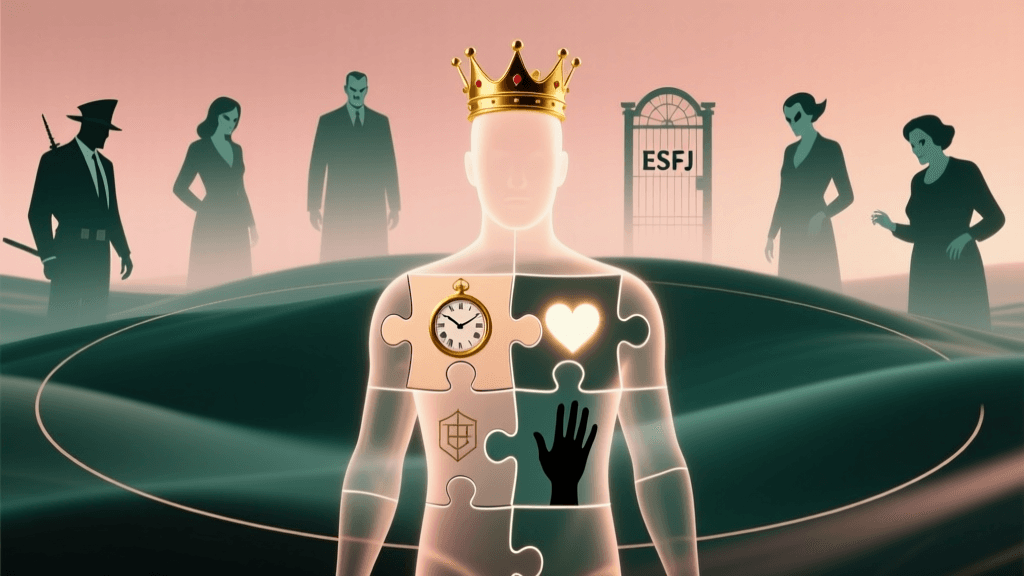
The Dark Side of ESFJ
The ESFJ personality type — often dubbed "The Consul" or "The Caregiver" — is widely celebrated in mainstream MBTI discourse for its warmth, loyalty, and unwavering commitment to social harmony. With dominant Extraverted Feeling (Fe) and auxiliary Introverted Sensing (Si), ESFJs naturally attune to group values, uphold tradition, and organize care with meticulous attention to detail. Yet when these strengths calcify under stress, trauma, or chronic insecurity, they can curdle into something far more unsettling: a rigid, morally absolutist, socially coercive force that weaponizes care, duty, and belonging.
This is not mere 'toxic positivity' — it’s the pathological inversion of Fe-Si. Where healthy ESFJs foster inclusion through empathy and structure, unhealthy ESFJs enforce conformity through shame, guilt, and institutionalized judgment. Their dark side doesn’t roar like an ESTP tyrant or scheme like an INTJ mastermind; it smiles while tightening the noose of expectation — all in the name of 'what’s best for everyone.'
According to the Myers & Briggs Foundation, Fe-dominant types prioritize collective emotional climate above individual authenticity — a trait that becomes dangerous when coupled with Si’s insistence on proven, traditional norms. When an ESFJ feels their worldview threatened — whether by dissent, nonconformity, or perceived moral decay — their coping mechanism isn’t withdrawal or rebellion. It’s corrective enforcement: re-educating, ostracizing, or restructuring reality to restore 'proper order.' This makes ESFJs uniquely potent as systemic antagonists — not because they seek chaos or domination for its own sake, but because they genuinely believe their control is benevolent, necessary, and even loving.
Dr. Dario Nardi, neuroscientist and MBTI researcher, notes in Neuroscience of Personality that Fe-dominant types show heightened neural activation in the anterior cingulate cortex (ACC) — the brain region linked to social monitoring, error detection, and norm enforcement. In stressed ESFJs, this system can hyperactivate, turning everyday deviations (a teenager’s pierced eyebrow, a colleague’s unconventional schedule, a student’s critical essay) into urgent moral infractions requiring intervention. Their 'care' becomes surveillance. Their 'support' becomes supervision.
Crucially, ESFJ villains rarely see themselves as villains. They are moral custodians, convinced their harshness is compassion in disguise — the tough love required to save others from themselves. This self-deception is what makes them so insidious: their cruelty wears the mask of concern, their control masquerades as protection, and their punishment is framed as rehabilitation. As clinical psychologist Dr. Linda M. Sapadin writes in Psychology Today, the 'Inner Critic' of Fe-dominant types often manifests as a 'Moral Judge' — internalized voices of authority that equate self-worth with compliance, and equate dissent with danger.
Famous ESFJ Villains
Below are seven canonical fictional antagonists whose motivations, behaviors, speech patterns, and narrative functions align strongly with unhealthy ESFJ cognitive dynamics. Each analysis draws on canon evidence, dialogue, and psychological consistency — not fan speculation — and highlights how Fe-Si distortion fuels their antagonism.
1. Dolores Umbridge (Harry Potter series)
Dolores Jane Umbridge is arguably the most textbook ESFJ villain in modern literature. Her obsession with 'proper conduct,' her saccharine tone masking venomous authoritarianism, and her belief that 'rules exist for a reason' reflect Si’s reverence for precedent fused with Fe’s need to regulate group affect. She doesn’t seek power for wealth or glory — she seeks control to eliminate 'unpleasantness' (i.e., dissent, emotion, truth). Her pink cardigans and kitten plates aren’t irony — they’re performative harmony, a visual assertion of 'normalcy' she demands others mirror.
Her Educational Decrees — banning student organizations, censoring curriculum, mandating 'detention' for speaking out — reveal Fe-Si pathology in action: using institutional authority to suppress emotional dissonance (Fe) by reverting to rigid, historically sanctioned structures (Si). As J.K. Rowling confirmed in a 2007 Bloomsbury Live Chat, Umbridge embodies 'the worst kind of bureaucrat: someone who uses rules to avoid feeling anything.' That is the essence of unhealthy Fe-Si: emotional regulation via control, not connection.
2. Nurse Ratched (One Flew Over the Cuckoo’s Nest)
Nurse Mildred Ratched operates within a literal institution designed to 'rehabilitate' — a perfect stage for ESFJ Fe-Si pathology. Her calm demeanor, immaculate uniform, and precise scheduling aren’t signs of competence alone; they’re tools of psychological containment. She doesn’t rant or rage — she documents, observes, and adjusts consequences with chilling consistency. Her power lies in making patients feel perpetually 'out of step' — too loud, too impulsive, too emotional — thereby triggering their own shame (Fe’s internalized judgment loop).
Ratched weaponizes care: offering medication, enforcing rest hours, praising 'good behavior' — all while stripping autonomy. Her famous line, 'I try to be fair… but I also try to be firm,' epitomizes the ESFJ moral binary: fairness = compliance; firmness = correction. Literary scholar Dr. James E. Miller Jr., in his analysis of Kesey’s novel, identifies Ratched as 'the embodiment of therapeutic authoritarianism — where healing is indistinguishable from submission.' That conflation is classic unhealthy ESFJ cognition.
3. Madame Leota (Disney’s Haunted Mansion – Expanded Lore & 2023 Film Adaptation)
In the expanded mythos of Disney’s Haunted Mansion, Madame Leota — the medium whose disembodied head floats inside a crystal ball — evolves from whimsical host to tragic antagonist. While her original incarnation leans ENTP, the 2023 film reimagines her as a 19th-century spiritualist who used her influence to manipulate grieving families, then later, after death, became obsessed with 'preserving' the mansion’s 'perfect' spectral community — exiling or silencing spirits who 'disrupted the harmony.' Her dialogue ('This house must remain *whole*') and fixation on curated nostalgia (replaying idealized moments, erasing conflict) signal strong Si-Fe alignment. She doesn’t want chaos — she wants *aesthetic cohesion*, enforced through psychic coercion.
This reflects what Jungian analyst John Beebe terms the 'Opposing Personality' — the unconscious shadow function that emerges under duress. For ESFJs, this is often Introverted Thinking (Ti), which, when undeveloped, manifests as brittle, self-referential logic: 'If my version of harmony is correct, then deviation is illogical — therefore, it must be removed.'
4. Mrs. Coulter (His Dark Materials)
Marisa Coulter presents a fascinating case study in ESFJ antihero-to-villain evolution. Initially charming, socially adept, and fiercely protective of her daughter Lyra, Coulter’s descent into villainy mirrors the collapse of Fe-Si under existential threat. Her leadership of the General Oblation Board — which kidnaps children to sever them from their daemons — is rationalized as 'necessary sacrifice for human progress.' She cites historical precedents (Si) and appeals to collective survival (Fe), reframing atrocity as stewardship.
What makes her ESFJ is her profound investment in social hierarchy and her visceral disgust at 'messiness' — whether emotional (Lyra’s defiance), biological (daemon bonding), or ideological (the Magisterium’s dogma). Author Philip Pullman describes her as 'a woman who believes deeply in order — so deeply that she will burn the world to keep it tidy.' That is the ultimate ESFJ shadow expression: care so intense it becomes erasure.
5. Principal Skinner (The Simpsons – “Dark Side” Episodes)
While largely comedic, Seymour Skinner’s character arc contains potent ESFJ antagonistic undertones — especially in episodes like 'The Principal and the Pauper' and 'Skinner’s Sense of Snow.' His identity crisis reveals deep Si dependency: his entire sense of self is built on inherited military discipline, school-board-approved pedagogy, and neighborhood expectations. When challenged — by Bart’s subversion, Superintendent Chalmers’ scrutiny, or his own impostor syndrome — he responds not with introspection, but with intensified rule-enforcement, public shaming, and performative rectitude.
His infamous chalkboard punishments ('I will not waste the teacher’s time'), obsessive hallway patrols, and desperate attempts to 'fix' Bart through behavioral charts all reflect Fe-Si rigidity: using external metrics to stabilize internal uncertainty. As media psychologist Dr. Robin R. Banner notes in a 2020 PMC study on animated archetypes, Skinner exemplifies 'the institutional ESFJ — whose authority derives not from charisma or vision, but from flawless adherence to protocol.'
6. Lady Tremaine (Cinderella)
Lady Tremaine is less a cartoonish hag and more a masterclass in passive-aggressive Fe-Si control. Her cruelty is never explosive; it’s surgical, relational, and steeped in propriety. She doesn’t ban Cinderella outright — she redefines her role ('You’re family, dear, but family has duties'), recalibrates household norms (Si), and isolates her through orchestrated exclusion (Fe). Every 'kind' remark — 'Such a sweet girl, if only she weren’t so clumsy' — is a micro-shaming event calibrated to erode self-worth while preserving appearances.
Her motivation isn’t envy of beauty, but preservation of domestic hierarchy. Cinderella’s kindness and resilience threaten the 'order' Lady Tremaine constructed post-widowhood — an order where grief is managed, daughters are compliant, and stepdaughters know their place. Her final act — locking Cinderella in her room during the ball — isn’t rage; it’s damage control. As Disney historian J.B. Kaufman observes in The Art of Cinderella, 'Tremaine doesn’t hate Cinderella — she fears what her existence says about the fragility of her own carefully maintained façade.'
7. Mr. Krabs (SpongeBob SquarePants – “The Krusty Love” & “Krusty Towers” Arcs)
Eugene Krabs may seem like an ESTP caricature of greed — but his deeper pathology aligns with ESFJ shadow dynamics. His obsession with profit isn't hedonistic; it's ritualistic. He treats the Krusty Krab like a sacred trust ('My father’s legacy!'), measures worth in tangible, historical metrics (Si), and frames exploitation as 'providing jobs' and 'upholding economic stability' (Fe). His manipulation of SpongeBob — praising his work ethic while denying raises, weaponizing gratitude ('Do you know how many fry cooks would kill for this opportunity?') — is textbook Fe-based guilt-tripping.
In 'Krusty Towers', his construction of a luxury apartment complex isn't ambition — it's a monument to 'how things should be': hierarchical, profitable, and aesthetically uniform. When tenants protest rent hikes, he doesn't negotiate; he installs surveillance, revokes privileges, and hosts mandatory 'financial literacy seminars' — all while insisting, 'I’m doing this for *you*.' That dissonance — between stated care and enacted control — is the hallmark of the unhealthy ESFJ antagonist.
Why ESFJ Makes Compelling Antagonists
ESFJs are uniquely effective antagonists not despite their warmth, but because of it. Their villainy bypasses the audience’s defenses — we lower our guard around people who smile, remember our names, and offer tea. That makes their betrayal more jarring, their control more insidious, and their moral certainty more terrifying than overt malice.
Three structural advantages make ESFJs narratively potent:
- Institutional Legitimacy: ESFJs thrive in systems — schools, hospitals, governments, corporations. Their antagonism isn’t rogue; it’s sanctioned. Umbridge has Ministry backing. Ratched has hospital policy. Tremaine has societal norms. This grants their cruelty legal, cultural, and procedural cover — making resistance feel futile or 'ungrateful.'
- Moral High Ground: Unlike chaotic evil villains, ESFJs anchor their actions in widely accepted values: safety, tradition, respect, duty. This forces protagonists (and audiences) into uncomfortable ethical negotiations. Is challenging Umbridge ‘disrespectful’? Is defying Ratched ‘ungrateful’? The ESFJ antagonist forces us to question whether ‘harmony’ is worth the cost of silence.
- Relational Weaponization: ESFJs don’t attack your body — they attack your belonging. Their punishments are social: exile, shaming, gaslighting, conditional love. This mirrors real-world power dynamics — workplace bullying, familial estrangement, cult indoctrination — giving their stories visceral resonance.
The following table compares ESFJ antagonists with other common villain archetypes to highlight their distinctive mechanics:
| Villain Archetype | Motivation Core | Primary Tool | How They Break Protagonists | ESFJ Distinction |
|---|---|---|---|---|
| INTJ Mastermind (e.g., Hannibal Lecter) | Intellectual superiority & control | Logic, manipulation, long-term strategy | Mind games, isolation, epistemic destabilization | ESFJs don’t seek intellectual victory — they seek emotional compliance. Their goal isn’t to outthink you, but to make you feel wrong for thinking differently. |
| ESTP Tyrant (e.g., Darth Vader) | Power, dominance, immediate gratification | Force, intimidation, spectacle | Physical fear, awe, submission through strength | ESFJs avoid overt force. Their power is relational infrastructure: policies, schedules, social expectations — invisible scaffolding that makes resistance feel irrational. |
| ENTP Trickster (e.g., Loki) | Chaos, disruption, proving superiority through unpredictability | Irony, deception, rule-breaking | Cognitive dissonance, loss of certainty, identity fragmentation | ESFJs revere rules. Their disruption is hyper-conformity — enforcing norms so rigidly they become oppressive. They break you by making your authenticity feel like a violation. |
| ESFJ Moral Enforcer (e.g., Umbridge) | Restoration of 'proper' emotional/social order | Policy, shame, surveillance, performative care | Internalized guilt, social alienation, eroded self-trust | They weaponize your desire to belong — making resistance feel like self-sabotage. |
Healthy vs Unhealthy ESFJ Expression
Understanding the spectrum is vital — not to pathologize ESFJs, but to recognize warning signs and cultivate resilience, both for ESFJs themselves and those navigating their influence.
Core Cognitive Functions Recap
- Dominant Fe (Extraverted Feeling): Reads and responds to group emotions; prioritizes harmony, values alignment, and collective well-being.
- Auxiliary Si (Introverted Sensing): Stores sensory details, traditions, past successes/failures; seeks stability through proven methods and familiar routines.
- Tertiary Ne (Extraverted Intuition): Explores possibilities, alternatives, and 'what ifs' — underdeveloped in stress, leading to tunnel vision.
- Inferior Ti (Introverted Thinking): Internal logic, objective analysis, personal truth — emerges healthily as self-reflection, unhealthily as brittle, self-justifying dogma.
The shift from healthy to unhealthy hinges on cognitive rigidity — when Fe and Si stop serving connection and start serving control.
Healthy ESFJ Traits
- Empathic leadership that uplifts diverse voices
- Tradition as living practice — adaptable, inclusive, meaningful
- Accountability without shame: 'How can we repair this together?'
- Generosity rooted in respect, not expectation
- Willingness to revise norms when evidence shows harm
Unhealthy ESFJ Patterns (Early Warning Signs)
- The 'Should' Cascade: Constant use of 'should'/'must'/'ought to' — especially regarding emotions ('You should be grateful'), identity ('A good daughter wouldn’t speak that way'), or outcomes ('This party must be perfect').
- Emotional Contagion Enforcement: Dismissing others’ feelings as 'too much,' 'inappropriate,' or 'bad for the group vibe' — then redirecting to 'positive' topics or tasks.
- Historical Literalism: Invoking 'how we’ve always done it' or 'what Grandma said' as irrefutable justification, refusing data or lived experience that contradicts it.
- Conditional Affection: Love, praise, or inclusion explicitly tied to compliance ('I’m only strict because I love you' — followed by withdrawal when boundaries are set).
- Victim-Perpetrator Flip: Framing accountability as persecution ('After all I’ve done for you, you accuse me?!').
Actionable Pathways to Health (For ESFJs & Those Around Them)
For ESFJs in Distress:
- Practice 'Fe Detox': Schedule 15 minutes daily with zero social input — no news, no messages, no people. Journal: 'What do I feel right now — not what I think others need me to feel?'
- Si Audit: List 3 'non-negotiable' rules/traditions. For each, ask: 'When was the last time this served actual well-being — not just comfort or control? What evidence would convince me to adapt it?'
- Develop Ti Gently: Read one article weekly from a perspective that challenges your core beliefs (e.g., Skeptic Magazine). Summarize it neutrally — no rebuttal, just comprehension.
For Those Affected by Unhealthy ESFJs:
- Boundary Scripts: Replace 'I understand why you feel that way' (validating their framing) with 'I hear your concern. My choice stands.'
- Externalize the System: Name the pattern: 'This feels like a rule I didn’t agree to. Can we discuss its purpose and my autonomy within it?'
- Seek Ti-Aligned Allies: Connect with ISTPs, INTPs, or ISTJs who can help articulate objective impacts ('This policy increased staff turnover by 40% — here’s the data').
FAQ
Can an ESFJ be a villain without being 'evil'?
Absolutely — and that’s what makes them psychologically rich. ESFJ antagonists rarely embrace malevolence; they embody moral injury. Their actions stem from genuine conviction that their control prevents greater harm. Umbridge believes she’s saving Hogwarts from Dumbledore’s 'dangerous populism.' Ratched believes she’s preventing psychosis through routine. This moral certainty — divorced from empathy for individual experience — is the heart of their darkness. As philosopher Hannah Arendt observed in Eichmann in Jerusalem, the 'banality of evil' often wears a polite, rule-following face.
Are ESFJ villains always authority figures?
Not exclusively — but they almost always occupy or seek positions that grant social leverage: teachers, nurses, parents, managers, community leaders, clergy. Their power isn’t derived from physical strength or wealth, but from their ability to define 'normal,' assign roles, and administer social consequences. A stay-at-home ESFJ parent enforcing rigid gender roles or punishing emotional expression fits the pattern as precisely as a CEO implementing 'culture-fit' hiring algorithms.
How do ESFJ villains differ from INFJ 'dark mentors' like Palpatine?
INFJ antagonists (e.g., Palpatine, Magneto) operate from Ni-Fe — a future-oriented, visionary drive to reshape reality according to a singular, often utopian ideal. ESFJs operate from Fe-Si — a present-oriented, past-referenced drive to preserve a specific emotional and structural status quo. Palpatine dreams of a new order; Umbridge fights to prevent any change to the old one. One seduces with possibility; the other coerces with precedent.
Is recovery possible for unhealthy ESFJs?
Yes — and it begins with humility. Healthy ESFJs integrate their inferior Ti by accepting that their version of 'care' or 'tradition' isn’t universally beneficial. Therapy modalities proven effective include Compassion-Focused Therapy (CFT), which addresses shame-based control patterns, and Schema Therapy, which targets early maladaptive schemas like 'Defectiveness' or 'Unrelenting Standards.' As the American Psychological Association notes, recognizing rigid schemas is the first step toward cognitive flexibility — allowing Fe-Si to serve connection, not containment.
The ESFJ villain reminds us that the most dangerous cages are woven from love, lined with memory, and locked with the key of 'for your own good.' Understanding this pattern isn’t about labeling — it’s about reclaiming agency, honoring authentic feeling, and building communities where harmony includes dissent, and care respects boundaries. Because true care doesn’t demand conformity. It creates space — for everyone — to belong, exactly as they are.