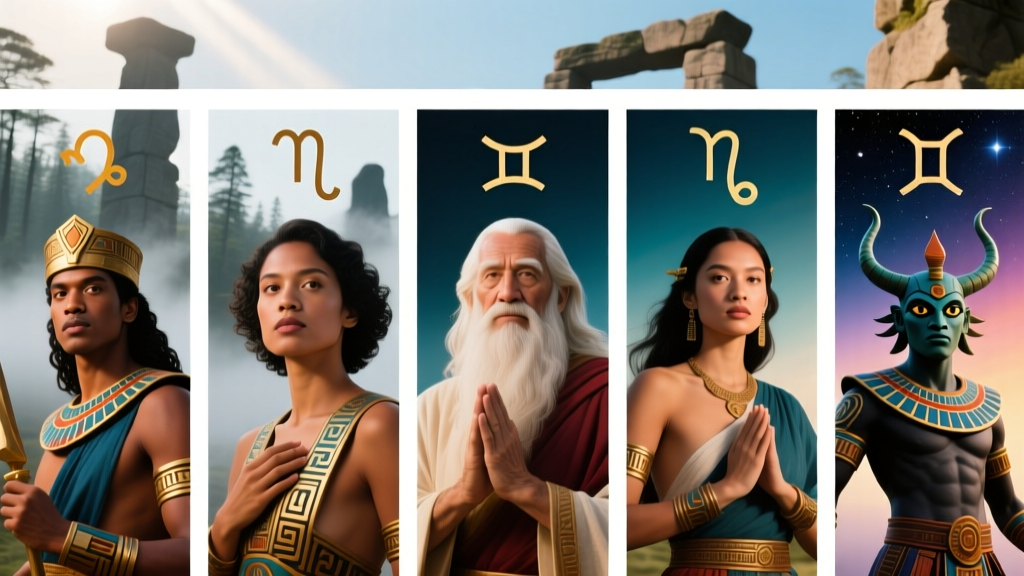
Ancient mythology stories are not merely primitive explanations for natural phenomena; they are complex psychological maps detailing the human experience. When we analyze global pantheons through the lens of analytical psychology, these narratives reveal recurring archetypes that shape modern personality structures and spiritual trajectories. From the Sumerian descent of Inanna to the Norse trickster exploits of Loki, these tales encode specific behavioral patterns, shadow integrations, and existential crises. This comprehensive guide deconstructs foundational mythology stories, mapping their symbolic architecture to Jungian frameworks and providing a concrete methodology for applying these ancient paradigms to contemporary personal development and self-actualization.
The Psychological Architecture of Mythology Stories
At the core of Carl Jung's theory of the collective unconscious is the premise that humanity shares a psychic substrate populated by universal, archaic patterns. Mythology stories serve as the primary cultural repository for these archetypes. Rather than viewing these narratives as historical artifacts, depth psychology treats them as dynamic projections of the psyche's internal mechanics.
When a culture produces a myth, it is externalizing an internal psychological conflict. The hero's battle with a dragon, for instance, is rarely about a literal reptile; it represents the ego's struggle to integrate the chaotic, untamed forces of the unconscious mind. Joseph Campbell's foundational research into the monomyth further demonstrates that the structural beats of global mythology stories—from the call to adventure to the abyss and subsequent resurrection—mirror the exact developmental stages of human ego maturation and spiritual individuation.
Cross-Cultural Motifs and Archetypal Resonance
To understand the universal utility of these narratives, we must examine how distinct cultures encode the same psychological imperatives into different mythological vessels. The following table maps core mythological motifs across Greek and Norse pantheons, identifying their underlying psychological functions.
| Mythological Motif | Greek Paradigm | Norse Paradigm | Psychological Function |
|---|---|---|---|
| Katabasis (Descent) | Orpheus and Eurydice | Hermod's ride to Hel | Shadow integration; confronting repressed trauma and grief |
| Trickster Disruption | Hermes stealing Apollo's cattle | Loki cutting Sif's hair | Breaking ego rigidity; forcing cognitive adaptation and humility |
| Axis Mundi (World Tree) | The Oak of Dodona | Yggdrasil | Connecting the conscious ego with unconscious depths and higher self |
| Hubris and Nemesis | Arachne's weaving contest | Thjazi's abduction of Idunn | Regulating narcissistic inflation; enforcing ego boundaries |
Katabasis: The Descent into the Unconscious
The katabasis, or underworld descent, is one of the most vital structures in mythology stories. In the Sumerian myth of Inanna, the Queen of Heaven voluntarily descends into the Kur (underworld) to visit her sister Ereshkigal. At each of the seven gates, Inanna is stripped of a piece of her royal regalia until she enters the throne room naked and bowed low, ultimately resulting in her death and subsequent resurrection.
Psychologically, this is a precise blueprint for nekyia—the journey into the unconscious. The stripping of regalia represents the systematic dismantling of the persona (the social mask). To achieve genuine psychological depth, the ego must surrender its attachments to status, identity, and conscious control. The confrontation with Ereshkigal represents facing the Shadow: the repressed, unacknowledged aspects of the self. Inanna's resurrection, facilitated by external intervention (the gala-tura and kur-jara), signifies that ego-rebirth requires integrating the shadow rather than destroying it.
The Trickster: Agent of Enantiodromia
Trickster figures in mythology stories—such as the West African Anansi, the Greek Hermes, and the Norse Loki—are frequently misunderstood as mere comic relief. In analytical psychology, the trickster is the agent of enantiodromia, a principle coined by Jung describing the tendency of things to turn into their opposites when pushed to an extreme.
When a personality becomes overly rigid, hyper-rational, or morally inflated, the trickster archetype activates to disrupt the stagnation. Loki's malicious acts, while destructive on a narrative level, invariably force the Aesir gods to adapt, innovate, and acquire new tools (such as Thor's hammer, Mjölnir, which was forged as a direct result of Loki's wagers). In personal development, the trickster manifests as synchronicities, Freudian slips, or sudden life disruptions that shatter an inflated ego, forcing the individual to develop cognitive flexibility and a more nuanced worldview.
Decoding Creation and Cosmogonic Myths
Cosmogonic mythology stories detail the genesis of the universe, but their true subject is the genesis of consciousness. The Babylonian Enuma Elish, where Marduk slays the chaos-dragon Tiamat and uses her body to fashion the ordered world, is a profound metaphor for the development of the conscious mind.
Tiamat represents the primordial unconscious—a state of undifferentiated, chaotic potential. Marduk represents the emergent ego-consciousness. The act of slaying and dividing the dragon symbolizes the mind's ability to categorize, distinguish, and create order out of sensory chaos. However, the myth warns that the chaos is never truly destroyed; Tiamat's blood becomes humanity, and her waters still flow. This reflects the psychological reality that the unconscious mind remains the foundational substrate of the conscious ego, constantly threatening to overwhelm it if the ego becomes too arrogant or disconnected from its source.
Applied Mythology: A Framework for Individuation
Understanding mythology stories is an intellectual exercise; applying them is a transformative practice. To utilize these ancient narratives for psychological integration and spiritual growth, implement the following three-step framework.
1. Identify Your Dominant Archetypal Narrative
Audit your recurring life patterns, dreams, and interpersonal conflicts to identify which mythology story your psyche is currently enacting. Are you trapped in a Sisyphean cycle of burnout and recovery? Are you experiencing a Promethean rebellion against an internalized authoritarian structure? Pinpointing the active myth allows you to step outside the narrative and observe it objectively, shifting you from an unconscious participant to a conscious director of your psychological development.
2. Engage in Directed Shadow Work via Mythic Personification
When confronting difficult emotions or repressed traits, assign them to a specific mythological deity or monster. If you are dealing with destructive anger, conceptualize it as the Norse Jörmungandr (the World Serpent). Using Jung's technique of Active Imagination, enter a meditative state and initiate a dialogue with this personified aspect of your shadow. Ask what it requires to be integrated rather than banished. This creates the necessary psychological distance to engage with volatile emotions without being consumed by them.
3. Map Your Personal Axis Mundi
In archetypal criticism and literary theory, the Axis Mundi is the center of the world, connecting heaven, earth, and the underworld. To ground your personality, establish a daily practice that connects your higher aspirations (heaven), your physical reality (earth), and your unconscious depths (underworld). This can be achieved through a structured journaling protocol: recording a dream or intuitive flash (underworld), executing a tangible physical task or workout (earth), and engaging in a period of philosophical study or meditation (heaven). This tripartite alignment prevents the ego from inflating into pure abstraction or sinking into pure materialism.
Mythology stories remain relevant not because they explain the physical universe, but because they perfectly diagram the internal universe. By treating these ancient texts as operational manuals for the human psyche, we can navigate the complexities of modern identity with the accumulated wisdom of our ancestors.