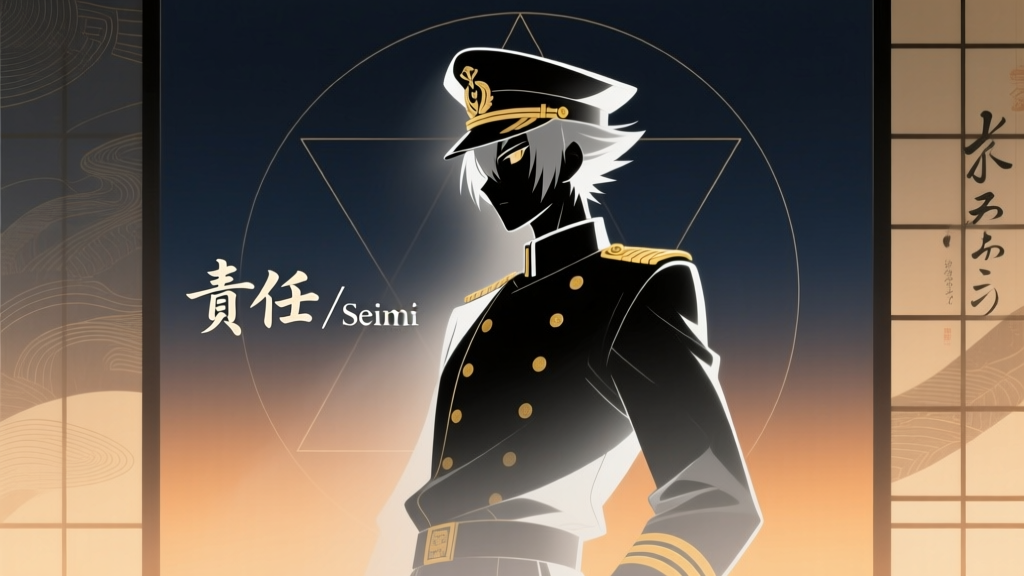
ESTJ in Anime and Manga
The ESTJ personality type — Extraverted, Sensing, Thinking, Judging — is often dubbed the Executive, Supervisor, or Duty-Bound Leader. In Western psychological frameworks like MBTI®, ESTJs are characterized by strong organizational skills, a commitment to rules and tradition, decisive action, loyalty to institutions, and an innate drive to maintain order. But when translated into the rich narrative ecosystem of anime and manga — where values like giri (social obligation), seishin (spirit/discipline), and meiyo (honor) shape character motivation — the ESTJ archetype takes on uniquely Japanese inflections.
Unlike Western portrayals that may emphasize corporate efficiency or political pragmatism, ESTJ-coded characters in Japanese media rarely appear as bureaucrats or middle managers. Instead, they emerge as military commanders, dojos masters, school committee presidents, police inspectors, and captains of elite squads — figures whose authority is earned not through title alone, but through visible sacrifice, unwavering consistency, and embodied discipline. Their leadership is performative, ritualized, and deeply tied to collective welfare rather than individual ambition.
This cultural reframing makes ESTJs among the most narratively stable — yet under-discussed — personality types in anime analysis. While INFPs and ENTPs dominate fan discourse for their internal conflict or rhetorical flair, ESTJs anchor stories with structural integrity: they enforce consequences, uphold continuity, and model what it means to stand firm in worlds governed by shifting loyalties, supernatural chaos, or moral ambiguity.
Famous ESTJ Anime Characters
Below is a curated list of 10 iconic anime and manga characters who consistently demonstrate core ESTJ cognitive functions — dominant Extraverted Thinking (Te), auxiliary Introverted Sensing (Si), tertiary Extraverted Feeling (Fe), and inferior Introverted Intuition (Ni). Each entry includes canonical evidence, behavioral patterns, and narrative function — grounded in both MBTI theory and Japanese media conventions.
| Character | Series | Role/Title | Key ESTJ Behaviors | Narrative Function |
|---|---|---|---|---|
| Sousuke Sagara | Full Metal Panic! | Special Forces Sergeant (Mithril) | Rigid adherence to protocol; hyper-vigilance; rule-based decision-making; discomfort with ambiguity; prioritizes mission success over personal rapport | Embodies Te/Si tension: his military training (Si) dictates every response, while Te drives rapid tactical assessment. His growth arc involves integrating Fe — learning when to bend rules for human connection. |
| Captain Jirō Kuroda | Ghost in the Shell: Stand Alone Complex | Section 9 Deputy Chief (later Chief) | Procedural rigor; institutional loyalty; calm command presence; emphasis on chain-of-command; data-driven briefing style | Serves as the moral and operational anchor of Section 9. Represents bureaucratic competence without cynicism — rare in cyberpunk settings. His Si manifests as deep knowledge of precedent and legal frameworks. |
| Shunsui Kyōraku | Bleach | Captain of Squad 8, Gotei 13 | Deceptively relaxed demeanor masking ironclad standards; enforces Soul Society law with quiet authority; remembers every regulation and historical incident; mentors via structured example, not abstraction | Subverts the 'laid-back captain' trope: his laziness is strategic rest, not apathy. His Si anchors him in centuries of Shinigami tradition; his Te activates only when duty demands — making his interventions exceptionally precise. |
| Principal Masaru Daimon | Assassination Classroom | Principal of Kunugigaoka Junior High | Unwavering belief in institutional reform; implements policy with surgical consistency; measures progress via observable metrics (test scores, attendance, disciplinary records); respects Koro-sensei’s efficacy but insists on procedural legitimacy | Represents the ESTJ as systemic reformer — not authoritarian, but architect. His Si informs his long-view understanding of educational decline; his Te designs interventions calibrated to real-world constraints. |
| Kaname Tōsen | Bleach | Former Captain of Squad 9 | Obsessive fairness; rigid moral calculus rooted in past trauma; equates order with justice; rejects emotional appeals that violate principle; speaks in measured, declarative sentences | A tragic ESTJ: his Te/Si loop collapses when ideals fail empirical validation. His fall illustrates the danger of suppressing Fe/Ni — refusing empathy (Fe) and failing to reinterpret meaning (Ni) leads to ideological absolutism. |
| Mikasa Ackerman | Attack on Titan | Elite Scout Regiment Soldier | Hyper-competent execution of orders; acute situational awareness; minimal verbal processing, maximal action; loyalty expressed through protection, not sentiment; discomfort with unstructured leadership vacuums | ESTJ expressed through embodied competence. Her Si is somatic — muscle memory, visual recall of threats, ingrained combat sequences. Her Te manifests as split-second threat assessment and optimal path selection. She does not debate ethics; she enacts them through motion. |
| Colonel Roy Mustang | Fullmetal Alchemist: Brotherhood | State Alchemist, Flame Alchemist | Strategic long-term planning; meritocratic leadership; uses rank to enable subordinates’ growth; documents everything; holds himself to higher standards than others; visibly frustrated by inefficiency | One of anime’s clearest Te-dominant leaders. His Si appears in meticulous record-keeping and reverence for military history. His Fe surfaces in protecting Hawkeye and nurturing younger alchemists — leadership as stewardship. |
| Sakura Haruno | Naruto | Medical-nin, later Head of Konoha Hospital | Relentless self-improvement via structured practice; diagnostic precision; administrative excellence; advocates for policy reform in medical ethics; confronts emotion with logic-first framing | Modern ESTJ evolution: shifts from sidekick to institutional leader. Her Si anchors her in medical textbooks and past cases; her Te designs triage protocols and training curricula. Her Fe matures into advocacy — ensuring systems serve people, not vice versa. |
| Inspector Megure | Case Closed (Detective Conan) | Tokyo Metropolitan Police Inspector | Procedure-first mindset; respects hierarchy but challenges incompetence; values forensic evidence over intuition; maintains composure under public scrutiny; mentors junior officers through demonstration | Grounds the series’ detective fantasy in institutional reality. His ESTJ traits validate Conan’s brilliance *only after* due process — reminding viewers that justice requires both genius and governance. |
| Yukimura Sanada | Sengoku Basara | Warrior General, Takeda Clan | Unquestioned loyalty to lord and code; battlefield discipline as spiritual practice; communicates through action and posture; judges character by conduct, not confession; trains relentlessly using time-tested methods | Historical ESTJ archetype: embodies bu (martial virtue) and rei (etiquette). His Si is ancestral — he fights as his forebears did; his Te optimizes formations and supply lines. His Fe expresses as fierce protection of comrades’ honor. |
What unites these characters is not just behavior, but epistemology: ESTJs in anime trust what is observable, repeatable, and historically validated. They distrust abstract philosophies untethered from consequence (e.g., Aizen’s solipsistic Ni or Light Yagami’s utilitarian Te-Ni loop). Their strength lies in implementation — turning vision into procedure, chaos into schedule, potential into performance.
Japanese Storytelling Archetypes for ESTJ
While MBTI® is a Western typology, Japanese storytelling has long codified ESTJ-like figures through classical and modern archetypes. These are not direct equivalents, but culturally resonant vessels that carry similar functional weight:
- The Kenjutsu Master (Swordsmanship Instructor): Seen in Rurouni Kenshin (Hiko Seijūrō), Vinland Saga (Thors), and Samurai Champloo (various dojo heads). Embodies Si-anchored tradition and Te-driven pedagogy — teaching not through inspiration, but repetition, correction, and incremental mastery. The master’s authority derives from having done the work, not theorized it.
- The Gakumon no Kami (God of Learning / School Administrator): Exemplified by My Hero Academia’s Nezu (Headmaster) and Haikyu!!’s Coach Ukai. Represents institutional wisdom — not just knowledge, but knowledge organized for transmission. They design curricula, enforce standards, and measure growth quantifiably. Their Fe appears as fierce investment in student outcomes, not emotional coddling.
- The Keisatsu Chō (Police Chief): From Patlabor’s Gotō to Psycho-Pass’s Tomomi Masaoka, this figure upholds civic order through procedural fidelity. Unlike Western ‘rogue cops’, Japanese police ESTJs rarely break rules — they reform systems from within, trusting process over charisma.
- The Onmitsu (Shadow Agent / Intelligence Officer): Think Ninja Scroll’s Jubei or Basilisk’s Ogen. ESTJ operatives prioritize mission integrity over personal glory. Their Si stores intelligence patterns; their Te deploys countermeasures with zero hesitation. Loyalty is non-negotiable — but it’s to duty, not personality.
Crucially, these archetypes rarely undergo ‘personality transformation’. An ESTJ in anime does not ‘become more open-minded’ — they refine their judgment. Shunsui doesn’t abandon tradition; he reinterprets its application. Mustang doesn’t stop planning; he expands his criteria to include human cost. This reflects a Japanese narrative preference for kaizen (continuous improvement) over henka (radical change).
Cultural Expression Differences in ESTJ Portrayal
Comparing ESTJ representation across cultures reveals profound divergence — not in core traits, but in value attribution and narrative consequence.
In American media, ESTJs often appear as:
• Corporate executives who prioritize profit over people (Succession’s Logan Roy)
• Politicians whose rigidity enables corruption (The West Wing’s Toby Ziegler, early seasons)
• Law enforcement figures whose adherence to procedure obstructs justice (Law & Order recurring ADA roles)
In contrast, Japanese media consistently frames ESTJ traits as socially vital and morally neutral — even heroic. Why?
- Collectivist Epistemology: Japanese culture emphasizes ba (shared context) over individual insight. ESTJ reliance on precedent, data, and observable cause-effect aligns with this worldview. As scholar Takie Lebra notes in Japanese Patterns of Behavior, “Authority in Japan rests less on charisma than on demonstrated reliability within a known framework.”
- Education System Influence: Japan’s exam-centric, hierarchical schooling rewards consistency, memorization, and procedural mastery — Si-Te strengths. Characters like Sakura or Daimon reflect aspirational educator ideals: competence as care, structure as compassion.
- Postwar Institutional Trust: Unlike post-Vietnam/Watergate U.S. narratives skeptical of authority, Japan’s post-1945 reconstruction emphasized functional governance. ESTJ figures symbolize the quiet efficacy that rebuilt infrastructure, education, and industry — a legacy reflected in anime like Girls’ Last Tour (civil engineering focus) or Shirobako (production management realism).
This cultural grounding makes ESTJ characters unusually resilient to deconstruction. While INTPs (e.g., L from Death Note) face existential doubt, or ENFPs (e.g., Naruto) battle self-worth, ESTJs confront systemic failure — not identity crisis. When Koro-sensei dismantles classroom hierarchies, Daimon doesn’t question his worth; he redesigns the syllabus. When the Soul Society’s laws prove unjust, Kyōraku doesn’t reject authority — he redefines its scope.
For creators and fans, this offers actionable insight: To write or analyze an ESTJ character authentically in Japanese media, focus on their relationship to systems — not self. Ask:
- What institution do they serve, and how do they improve its functionality?
- What precedents guide their decisions — and when do they cite them explicitly?
- How do they measure success? (e.g., graduation rates, arrest stats, mission completion %, injury reduction)
- When they compromise, what metric shifts? (e.g., “I’ll delay the report if it saves three lives” — Te recalibrating to Fe priority)
FAQ
Is there a ‘dark side’ to ESTJ characters in anime?
Yes — but it manifests differently than Western ‘villainous ESTJ’ stereotypes. Rather than greed or arrogance, anime ESTJ shadows appear as rigidity-induced harm: Kaname Tōsen’s descent into genocide stems from Te-Si loop collapse — rejecting all nuance once his fairness metric fails. Similarly, Monster’s Director of Public Security sacrifices civilians to preserve state stability, believing order justifies any means. These arcs warn not against duty, but against uncritical fidelity — a culturally specific critique of bureaucratic dehumanization. As the European Journal of Japanese Studies observes, Japanese narratives treat ‘blind obedience’ as a failure of shisei (conscientiousness), not intelligence.
Why are female ESTJs underrepresented in shōjo or magical girl anime?
They’re not absent — but coded differently. Shōjo protagonists typically emphasize relational growth (Fe-dominant NF types), while magical girl narratives privilege intuitive leaps (Ni) or empathic transformation (Fi). Female ESTJs appear instead in seinen or josei works: Princess Jellyfish’s Kuranosuke (disguised as woman, but ESTJ-coded in organizational skill), Ooku: The Inner Chambers’s Shogun Yoshimune (reforms Edo bureaucracy with Te/Si precision), or Blue Gender’s Marlene (military strategist). Their leadership is presented as functional necessity, not genre expectation — reflecting real-world Japanese workplace dynamics where women in authority often enter via specialized expertise, not generalist promotion paths.
Can an ESTJ be funny in anime?
Absolutely — but humor arises from contrast, not irony. ESTJ comedy relies on:
• Literalism: Sousuke misinterpreting idioms as tactical directives (“Break a leg” → attempts bone fracture)
• Over-Preparation: Sakura packing 17 antidotes for a picnic, each labeled in triplicate
• Systemic Absurdity: Inspector Megure solemnly filing paperwork about a talking dog
This differs from ENTP or ISTP humor (wordplay, improvisation) — it’s structural comedy, exposing gaps between ideal procedure and chaotic reality. As the Journal of Language and Social Psychology notes, Japanese situational comedy often targets role-incongruence, making ESTJ rigidity a perfect foil.
How can writers avoid stereotyping ESTJ characters as ‘boring’ or ‘authoritarian’?
By emphasizing their adaptive competence. Real ESTJs don’t resist change — they optimize it. Show them:
• Updating protocols after failure (e.g., Daimon revising anti-assassination drills weekly)
• Documenting lessons learned in shared repositories (Mustang’s annotated battle reports)
• Mentoring through scaffolding — assigning graduated responsibilities, not just orders
• Expressing care via resource allocation (e.g., Kyōraku quietly upgrading Squad 8’s medical supplies)
As Japan Culture and Customs explains, Japanese respect for diligence means audiences innately value such details — no exposition needed. Let their actions define their depth.
Ultimately, ESTJ characters in anime and manga are not relics of outdated hierarchy — they are the quiet architects of resilience. In a medium obsessed with transformation, they remind us that the most revolutionary act is often showing up, doing the work, and keeping the lights on. Whether commanding starships or grading exams, their presence affirms a fundamental truth: society runs not on inspiration alone, but on the relentless, honorable application of good sense — one documented, refined, and faithfully executed step at a time.