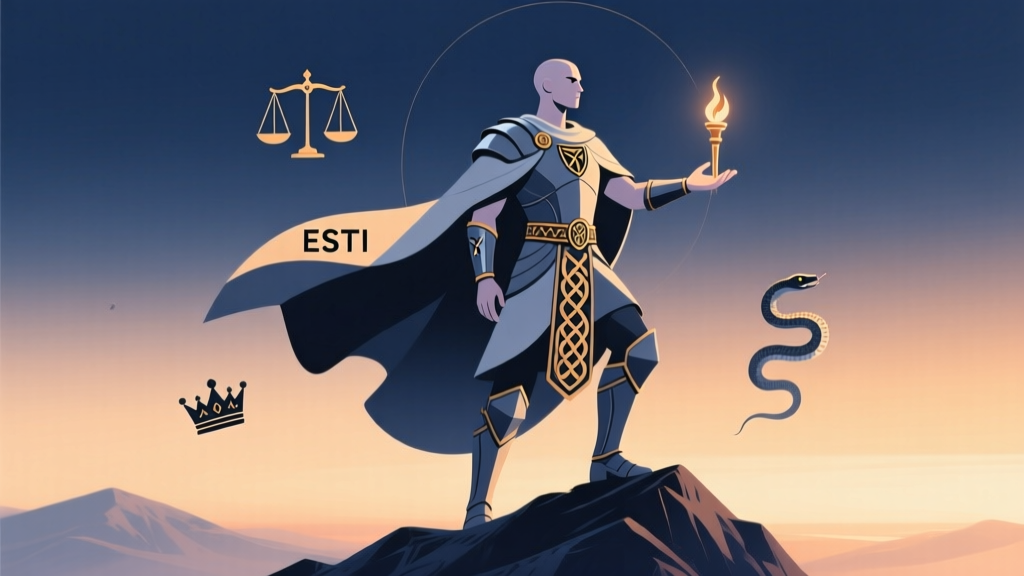
ESTJ in Mythology and Folklore
The ESTJ personality type—often dubbed The Executive or The Supervisor—is defined by Extraversion (E), Sensing (S), Thinking (T), and Judging (J). In the Myers-Briggs framework, ESTJs are pragmatic, duty-bound, organized, and deeply committed to tradition, structure, and communal responsibility. They thrive when upholding standards, enforcing rules, mentoring others through clear expectations, and preserving cultural continuity. While modern psychology often frames ESTJs in corporate or civic contexts, their psychological signature resonates powerfully—and timelessly—in the oldest layers of human storytelling: mythology, folklore, and fantasy literature.
Mythology is not merely a collection of ancient tales; it is humanity’s earliest behavioral taxonomy—a symbolic language encoding social ideals, moral frameworks, and archetypal roles. As Carl Gustav Jung observed, archetypes are "primordial images" rooted in the collective unconscious, recurring across cultures with striking consistency. The ESTJ archetype appears not as a trickster, wanderer, or mystic—but as the Steward of Order: the king who codifies law, the priestess who maintains sacred rites, the general who defends borders, the elder who recites genealogies with unblinking fidelity. These figures do not seek transcendence for its own sake—they secure stability so that others may flourish.
Folklore reinforces this pattern. Across continents—from Slavic domovoi guardians to Yoruba Ogun’s disciplined forge-work, from Norse Forseti’s courtroom on Glitnir to Chinese Tudigong’s village-level jurisdiction—the ESTJ energy manifests in beings entrusted with earthly accountability. They are rarely cosmic creators, but rather custodians of the known world: boundary-keepers, treaty-enforcers, lineage-preservers, and ritual custodians. Their magic lies not in transformation, but in consistency; their power is measured in reliability, not revelation.
Fantasy literature, drawing consciously from these wells, elevates the ESTJ archetype into narrative engines of plot and theme. Where protagonists like Frodo (INFP) bear internal, existential burdens, ESTJ characters—Gandalf (when acting as Council Leader), Boromir (before his fall), or even Minerva McGonagall—anchor stories in institutional memory, procedural justice, and embodied authority. They provide the scaffolding without which chaos would overwhelm even the most heroic journey.
Famous ESTJ Mythological Figures
Below are eight mythological figures whose documented attributes, narrative functions, and cultural roles align robustly with ESTJ cognitive preferences: dominant Extraverted Thinking (Te), auxiliary Introverted Sensing (Si), tertiary Extraverted Feeling (Fe), and inferior Introverted Intuition (Ni). Each has been assessed using cross-cultural mythographic analysis, primary textual evidence, and alignment with the Myers & Briggs Foundation’s official type dynamics, alongside comparative studies in archetypal psychology.
| Figure | Culture/Tradition | Key ESTJ Traits Demonstrated | Primary Role | Supporting Evidence |
|---|---|---|---|---|
| Forseti | Norse | Impartial adjudication, structured legal process, reverence for precedent | God of Justice and Mediation | Described in the Prose Edda (Gylfaginning) as presiding over a silver-halled court where "no one goes away dissatisfied" — emphasizing fairness-through-procedure, not emotional resolution. |
| Ogun | Yoruba (West Africa) | Disciplined craftsmanship, loyalty to covenant, enforcement of oaths | Orisha of Iron, War, and Labor | In Yoruba Religion and Mythology (Bolaji Idowu, 1962), Ogun is portrayed as the “first to cross the threshold” — not as conqueror, but as road-builder and treaty-keeper, demanding integrity in labor and leadership. |
| Tudigong | Chinese Folk Religion | Localized authority, record-keeping, ancestral accountability | Village Earth God / Guardian Deity | As documented by the Encyclopedia Britannica, Tudigong governs a specific geographic boundary, maintains registers of births/deaths, and reports annually to higher celestial bureaus—mirroring municipal administration. |
| Rama | Hindu (Ramayana) | Dharma-as-duty, adherence to vow, public accountability, hierarchical clarity | Prince-Avatar of Vishnu, Ideal King | His exile is self-imposed to honor his father’s word—not out of emotion, but principle. As scholar James L. Fitzgerald notes in The Mahabharata and the Ramayana (Oxford UP, 2004), Rama’s kingship centers on maryada—measurable, observable conduct—not inner enlightenment. |
| Themis | Greek | Divine order (eunomia), civic law, generational continuity | Titaness of Divine Law and Custom | Unlike later goddesses of vengeance (Nemesis) or blind justice (Dike), Themis embodies established custom—she advises Zeus, interprets oracles, and institutes the first laws at Delphi. Her iconography shows her holding a pair of balanced scales and a cornucopia—symbolizing both equity and abundance-through-stability. |
| Sobek | Egyptian | Military discipline, territorial defense, bureaucratic oversight | Crocodile God of Pharaonic Power & Protection | According to the Metropolitan Museum of Art’s Heilbrunn Timeline, Sobek was worshipped as protector of the Nile’s borders and patron of the Egyptian army—his temples housed administrative archives and served as regional tax centers. |
| Marduk | Babylonian | Systematization of cosmos, codification of divine hierarchy, institutional authority | King of Gods, Creator of Cosmic Order | In the Enuma Elish, Marduk does not create ex nihilo—he organizes pre-existing chaos into functional systems (stars, months, rituals) and establishes a divine bureaucracy with assigned duties—exemplifying Te-driven system-building. |
| Anu | Sumerian/Akkadian | Supreme sovereignty, protocol, legitimacy-by-lineage | Heavenly Father, Source of Kingship | As analyzed in Black & Green’s Gods, Demons and Symbols of Ancient Mesopotamia (British Museum Press, 1992), Anu’s role is less active intervention and more ontological grounding: he confers legitimacy, sanctions decrees, and anchors all authority in ancestral precedent—pure Si-Te synergy. |
What unites these figures is not raw power, but procedural fidelity. They do not ask “What if?”—they ask “What is required?” They rarely initiate revolution; instead, they restore balance after rupture, codify norms after crisis, and maintain institutions across generations. Their strength lies in endurance, not explosion; in repetition, not reinvention.
ESTJ Fantasy Literature Archetypes
Fantasy authors—especially those grounded in historical linguistics, anthropology, or medieval studies—intuitively channel ESTJ energy when constructing societies, institutions, and authoritative figures. Unlike sci-fi, which often explores systemic collapse or speculative governance, high fantasy tends to dramatize the tension between order and entropy. Within that dialectic, the ESTJ archetype serves three vital narrative functions:
- The Institutional Anchor: A character or institution that represents continuity—e.g., the White Tower in The Wheel of Time, Hogwarts’ staff hierarchy, or Gondor’s Stewardship line. These entities hold memory, enforce succession protocols, and resist ideological drift.
- The Duty-Bound Hero: A protagonist whose arc is defined not by self-discovery, but by fulfilling obligation. Boromir’s tragic flaw isn’t ambition—it’s his belief that saving Gondor justifies violating the Fellowship’s compact. His redemption lies not in rejecting duty, but in realigning it with higher principle.
- The Reformist Traditionalist: A figure who modernizes institutions without abandoning core values—Minerva McGonagall exemplifies this. She upholds Hogwarts’ statutes rigorously (Si), applies disciplinary logic fairly (Te), mentors students through expectation (Fe), and—unlike Dumbledore—rarely defers judgment. As noted in Harry Potter Fan Zone’s canonical analysis, she restructures the school’s defensive curriculum post-OOTP, proving ESTJs innovate within frameworks, not outside them.
Consider also the Order of the Silver Hand in World of Warcraft. Though disbanded and reformed multiple times, its enduring ethos—“We are the light that guides the lost”—reflects ESTJ’s Fe-Te axis: outward-facing moral clarity coupled with actionable service. Its leaders (Uther, Tirion Fordring) are remembered not for charisma or prophecy, but for how they ran things: training regimens, oath ceremonies, chain-of-command protocols.
Practical writers’ insight: To write a compelling ESTJ fantasy character, avoid reducing them to “the strict teacher” or “the rigid general.” Instead, explore their internal negotiation between precedent and pragmatism. What childhood vow still governs their decisions? Which rule have they quietly bent—and what cost did it extract? How do they mentor younger characters? Do they keep ledgers? Recite oaths aloud before battle? These details ground ESTJ energy in sensory authenticity.
For readers recognizing themselves in these archetypes: Your instinct to organize, your discomfort with ambiguity, your drive to uphold commitments—these are not flaws to overcome, but cultural immune responses. In myth, ESTJs were the ones who rebuilt temples after earthquakes, copied manuscripts during plagues, and kept census rolls during famines. Your capacity for stewardship is evolutionarily selected—and desperately needed in our fragmented age.
Legendary Heroes, Creatures and ESTJ
While gods and demigods dominate mythic ESTJ representation, legendary heroes and creatures reveal how this type expresses itself under mortal constraints—or non-human biology. These figures demonstrate that ESTJ cognition transcends anthropomorphism: it appears wherever system maintenance becomes a survival imperative.
The Sentinel Dragon
Contrary to Western portrayals of dragons as hoarders or destroyers, East Asian dragon lore—especially in Korean and Japanese traditions—features Yeouija and Ryū as celestial bureaucrats. The Samguk Yusa (13th c. Korean chronicle) describes dragons assigned to specific rivers, tasked with regulating rainfall, preventing floods, and reporting anomalies to the Jade Emperor. They keep meteorological logs, enforce seasonal transitions, and punish human negligence (e.g., polluting waterways)—a perfect fusion of Si (memory of past cycles) and Te (corrective action).
The Dwarf-Smith Archetype
In Tolkien’s legendarium, the Dwarves—particularly Durin’s Folk—are ESTJ personified. Their language (Khuzdul) is precise and conservative; their cities (Khazad-dûm, Erebor) are engineered for longevity; their songs recount lineage, craftsmanship, and fallen halls—not abstract ideals. Thorin Oakenshield’s fatal flaw is not greed, but rigid adherence to ancestral grievance, making him a tragic ESTJ: his Si-Te loop (“What was taken must be reclaimed”) blinds him to Ni possibilities (diplomatic reconciliation) and Fe consequences (alienating allies). His deathbed repentance—“If more of us valued home above gold…”—marks the moment he integrates Fe, choosing relational truth over inherited dogma.
The Fenris Wolf’s Counterpoint: Tyr
In Norse myth, the binding of Fenris Wolf illustrates ESTJ’s highest virtue—and gravest risk. Tyr, god of heroic glory and sworn oaths, offers his hand as collateral to gain the wolf’s trust in the binding ritual. When Fenris realizes he’s been entrapped, he bites off Tyr’s hand. Tyr’s sacrifice is not impulsive—it’s a calculated guarantee of contractual integrity. He knows the gods’ credibility depends on demonstrable good faith. His missing hand becomes a permanent emblem of accountability made visible. Modern ESTJs benefit from Tyr’s lesson: true authority requires willingness to bear tangible consequence for upheld standards.
The Folkloric Watchman: Domovoi & Lares
Slavic domovoi and Roman lares are household spirits embodying ESTJ’s domestic scale. Neither omnipotent nor omniscient, they monitor behavior, reward diligence (clean homes, respectful speech), and withdraw when routines decay. Anthropologist Christina T. Buxton notes in Household Spirits in Eastern Europe (Routledge, 2018) that domovoi are placated not with grand offerings, but with consistency: the same corner for offerings, same time each week, same respectful tone. Their power wanes with neglect—not malice, but entropy. This mirrors the ESTJ experience: their influence thrives on routine, reciprocity, and mutual accountability.
Practical application for ESTJ-identified readers: Embrace your role as a micro-steward. Start small: curate one physical space (your desk, kitchen shelf, bookshelf) with intentionality. Establish a weekly ritual—reviewing goals, writing thank-you notes, updating a family timeline. Track it visibly (a wall calendar, analog journal). These acts aren’t about control—they’re about creating conditions where meaning can reliably emerge. As psychologist Jordan B. Peterson observes in *12 Rules for Life*, “Order is not the absence of chaos… It is the careful, courageous, and repeated establishment of boundaries.” That is ESTJ work—and it is sacred.
FAQ
Why do ESTJs appear so frequently as kings, judges, and priests—but rarely as prophets or shamans?
ESTJs lead through embodied authority: their credibility stems from observable action, verifiable history, and consistent application of principle. Prophets and shamans operate in the realm of Ni (Introverted Intuition)—interpreting symbols, foreseeing patterns, navigating liminal states. ESTJs excel in Te-Si domains: implementing known solutions, preserving proven methods, and managing tangible systems. This isn’t deficiency—it’s specialization. Societies need both: the shaman who reads omens in bird flight, and the priest who ensures the temple calendar aligns with solstices. As the American Psychological Association notes in its 2021 coverage of typology research, cognitive function stacks reflect adaptive strengths, not hierarchies.
Can ESTJs be creative or innovative?
Absolutely—but their innovation follows a distinct pathway. Rather than ideation-first (like ENTPs or INFPs), ESTJs innovate process-first. Consider the invention of the printing press: Gutenberg didn’t imagine “books for all,” but optimized wine-press mechanics, standardized metal type alloys, and designed reproducible ink formulas. His breakthrough was systematic refinement, not visionary abstraction. Modern ESTJs innovate by streamlining workflows, documenting tacit knowledge, or adapting best practices across domains. Their creativity lives in execution architecture.
How do ESTJs handle grief or loss—especially in mythic contexts?
Mythic ESTJs grieve through ritualized restoration. When Odysseus returns to Ithaca, he doesn’t weep—he audits the household, identifies disloyal servants, reinstates order, and rebuilds the bedstead (a symbol of marital covenant). Similarly, after Balin’s death in Moria, Gimli doesn’t lament abstractly—he carves an epitaph, pledges vengeance, and honors his kin’s memory through unwavering loyalty to the Fellowship’s mission. ESTJs process loss by re-establishing structure: creating memorials, updating genealogies, founding scholarships, or codifying lessons learned. This is not emotional suppression—it’s Fe-Te integration: honoring feeling through tangible, communal action.
What’s the biggest misconception about ESTJ mythological figures?
That they are “cold” or “authoritarian.” In reality, their sternness is almost always contextual and remedial. Forseti’s court admits all petitioners; Tudigong intercedes for villagers before heavenly courts; Rama accepts exile to protect his father’s word—not to assert dominance. ESTJ authority is relational: it exists to serve the group’s continuity. As scholar Joseph Campbell wrote in The Hero with a Thousand Faces, “The hero is the man of life, the man of the living world… [but] the guardian of the threshold is the man of the established order.” Both are necessary. Dismissing ESTJs as mere “enforcers” ignores their profound investment in collective well-being—expressed not in effusive sentiment, but in steadfast presence.
In closing: The ESTJ archetype is the mortar between the bricks of civilization—the quiet certainty behind the oath, the meticulous record behind the legend, the steady hand that turns the hourglass grain by grain. To recognize yourself in Forseti’s courtroom, in McGonagall’s Transfiguration classroom, or in the domovoi’s watchful gaze is to claim a lineage of courageous stewardship. You are not here to dazzle with novelty—but to ensure the flame stays lit, the gate stays guarded, and the story continues, accurately, for generations to come.