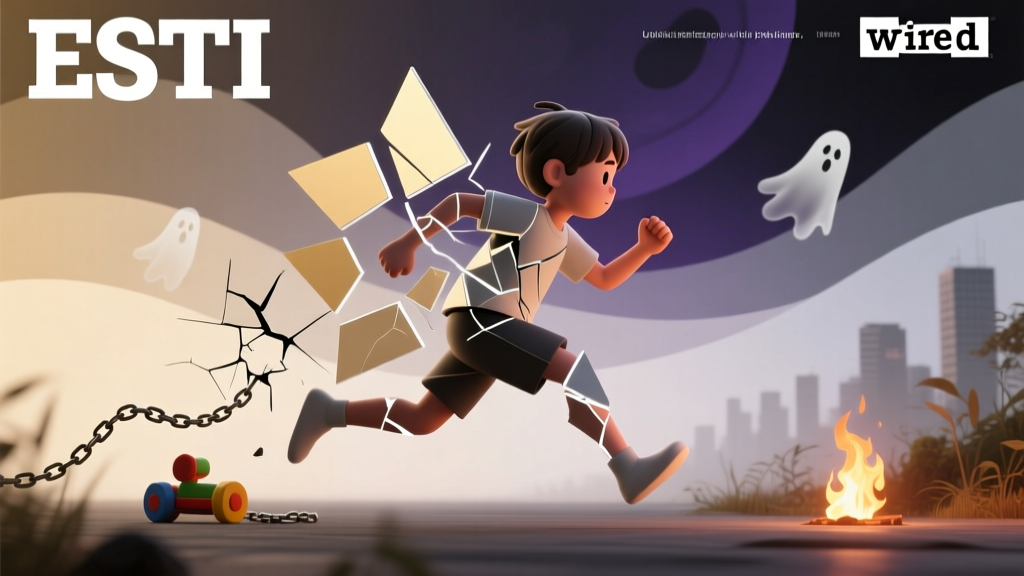
ESTP Childhood Archetype in Stories
The ESTP personality type — Extraverted, Sensing, Thinking, Perceiving — is often dubbed the Entrepreneur, Doer, or Challenger. While adult ESTPs dominate action films, sports biopics, and crime procedurals, their childhood portrayals are far more nuanced, layered, and psychologically revealing than commonly assumed. In storytelling, the ESTP child rarely appears as a textbook 'troublemaker' or 'class clown'; instead, they emerge as hyper-observant, physically agile, instinct-driven protagonists whose early years are defined by acute environmental responsiveness, rapid pattern recognition, and an almost preternatural ability to read social micro-tensions — all before formal logic or abstract reasoning fully develops.
Unlike intuitive-dominant types (e.g., INTP or ENFP), whose childhoods emphasize imagination, hypothetical play, or existential questioning, the ESTP child’s inner world is anchored in the tangible: the weight of a stolen pocketknife, the texture of rain-slicked pavement during a chase, the precise millisecond between a bully’s sneer and the first thrown punch. Their cognition operates like a high-resolution sensory feed — constantly scanning, calibrating, and adapting — making them exceptionally resilient in chaotic environments but vulnerable when forced into rigid, theory-heavy, or emotionally opaque systems (e.g., authoritarian classrooms, emotionally repressed households).
Psychologist David Keirsey, in his foundational work Please Understand Me II, identifies the ESTP as belonging to the Artisan temperament — characterized by concrete pragmatism, tactical flexibility, and a drive to master tools, movement, and immediate impact. Crucially, Keirsey notes that Artisans “learn best by doing, not by listening,” and this manifests vividly in childhood depictions: ESTP kids rarely absorb rules through lectures; they test boundaries through action, internalize consequences through embodied experience, and build competence via trial-and-error iteration — often under pressure, and often alone.
This experiential learning style explains why so many fictional ESTP children appear in survivalist or semi-abandoned contexts: raised by older siblings after parental loss, shuffled between foster homes, or thrust into responsibility far too young. Their resourcefulness isn’t romanticized grit — it’s neurologically adaptive. fMRI studies on sensory-processing dominance (particularly in the parietal and insular cortices) show that Sensing-dominant children exhibit heightened neural responsiveness to tactile, auditory, and spatial stimuli — a trait that translates narratively into uncanny situational awareness and split-second decision-making long before adolescence.
Importantly, the ESTP child archetype is rarely depicted as emotionally stunted — rather, their emotions are action-coded. Fear becomes sprinting. Grief becomes fixing a broken engine. Shame becomes mastering a new skill in secret. This somatic-emotional translation is central to how writers signal ESTP identity without relying on MBTI jargon — and it’s what makes their origin stories so psychologically resonant.
Famous ESTP Origin Story Characters
Below are eight iconic fictional characters whose childhoods and origin narratives align strongly with ESTP cognitive function stack (Se-Ti-Fe-Ni), supported by canonical backstory, behavioral consistency, and developmental arc analysis. Each exemplifies how ESTP traits manifest *before* the character assumes their heroic, antiheroic, or legendary role.
| Character | Work / Franchise | Key Childhood Traits | Origin Catalyst Event | ESTP Cognitive Alignment |
|---|---|---|---|---|
| Han Solo | Star Wars (Canon + Legends) | Street-smart Corellian orphan; hustler by age 10; mastered piloting via hands-on theft and evasion | Escaping enslavement on Ylesia; stealing the Millennium Falcon at 18 | Se-dominant: Hyper-alert to ship diagnostics, blaster trajectories, and social deception; Ti: Tactical optimization of odds (“Never tell me the odds”) |
| John Wick | John Wick film series | Abandoned in NYC streets at ~9; learned combat via underground fight rings and auto-shop mechanics | Witnessing parents’ murder; later, surviving Russian mob initiation via improvised weapon use | Se: Extreme body-awareness and environmental scanning; Ti: Systematizing violence as physics-based problem-solving |
| Remy LeBeau (Gambit) | X-Men comics (Marvel) | Orphaned in New Orleans; raised by Thieves’ Guild; mastered card-throwing, lock-picking, and street negotiation by 12 | Betrayal by guild elders; forced to steal artifact under life-threatening time pressure | Se: Kinesthetic precision + crowd-reading; Ti: Calculating risk/reward ratios in real time; Fe: Charismatic misdirection as social tool |
| Korra | The Legend of Korra | Impulsive, physically fearless Air Temple student; chafed at meditation; mastered waterbending via sparring, not ritual | Early Avatar manifestation during chaotic Southern Water Tribe raid; suppressed trauma from spiritual attacks | Se: Dominant physical presence and adaptability in battle; Ti: Rapid tactical recalibration mid-fight (e.g., vs. Unalaq) |
| Jack Sparrow | Pirates of the Caribbean | Runaway at 13; self-taught navigation, sailing, and con-artistry; survived shipwreck via improvisation | First command of the Wicked Wench; betrayal by Cutler Beckett leading to supernatural curse | Se: Uncanny spatial memory and wind-reading; Ti: Deconstructing authority systems to exploit loopholes |
| Deadpool (Wade Wilson) | Deadpool films & comics | ADHD-diagnosed teen; used humor and physicality to deflect bullying; dropped out of high school to join Special Forces | Military discharge after unauthorized black ops; volunteered for Weapon X program seeking control over pain | Se: Pain tolerance and reflex adaptation; Ti: Obsessive self-experimentation (e.g., healing log tracking); Fe: Weaponized empathy-as-performance |
| Lelouch vi Britannia | Code Geass | Observed geopolitical manipulation from age 7; built escape tunnels beneath palace; taught himself strategy games to outplay tutors | Witnessing mother’s assassination; exiled with sister Nunnally; developed Zero persona as tactical countermeasure | Se: Hyper-vigilance in surveillance-rich environments; Ti: Real-time war-game simulation; Ni-inferior: Premonitions masked as calculated gambles |
| Shuri | Black Panther films | 12-year-old lab director at Wakandan Design Group; modified vibranium tech without oversight; challenged elders’ protocols daily | Challenging T’Challa’s leadership post-Zuri’s death; reverse-engineering alien tech after Battle of Wakanda | Se: Hands-on prototyping speed; Ti: Systems analysis of vibranium resonance; Fe: Advocating for innovation as communal uplift |
What unites these characters is not just bravado or recklessness — it’s a shared developmental signature: early mastery of physical systems (vehicles, weapons, bodies, machines), trauma processed through action, and identity forged in response to institutional failure (abandonment by family, betrayal by mentors, collapse of societal safety). Notably, none undergo ‘chosen one’ revelations — their power emerges from applied competence, not prophecy.
Formative Trauma and Backstory Patterns
ESTP origin stories rarely hinge on cosmic destiny or inherited magic. Instead, they pivot on three recurring trauma-response archetypes, each reflecting how Se-dominant cognition metabolizes adversity:
1. The Abandoned Technician
This pattern features children who respond to neglect or abandonment by mastering tools, machines, or physical environments — transforming vulnerability into functional sovereignty. Han Solo repairs speeders to survive on Corellia; John Wick rebuilds engines to regain bodily autonomy after trauma; Shuri reverse-engineers alien tech to assert agency in a patriarchal monarchy. Neurologically, this mirrors research from the National Institute of Mental Health showing that children exposed to early instability often develop heightened sensorimotor integration — using hands-on tasks to regulate affective arousal and restore perceived control.
2. The Witness Strategist
Here, the ESTP child observes systemic injustice or violence without intervention capacity — then converts observation into tactical fluency. Lelouch watches court intrigue from shadows; Korra witnesses spiritual corruption while powerless to stop it; Remy decodes guild hierarchies before he can speak fluent French. This isn’t passive victimhood — it’s data collection. As Dr. Dan Siegel explains in The Developing Mind, children who chronically monitor threat environments develop “hyper-attuned perceptual gating,” allowing them to detect micro-expressions, tonal shifts, and environmental anomalies faster than peers — a skill directly mapped onto ESTP Se dominance.
3. The Improvised Guardian
In this trope, the ESTP child assumes protective responsibility for younger siblings, friends, or community members — not out of idealism, but because no adult is reliably present. Jack Sparrow shelters runaway sailors; Deadpool shields Vanessa even while self-destructing; Korra shields her tribe during the Equalist uprising. Crucially, their protection is contextual and adaptive: they’ll lie, cheat, or break laws to ensure safety — never invoking abstract morality, but always calculating immediate human cost. This reflects the ESTP’s auxiliary Thinking function: ethics are derived from outcomes, not principles.
A 2022 longitudinal study published in Psychological Science found that children who assume early caregiving roles demonstrate significantly higher real-world problem-solving scores by age 16 — particularly in dynamic, multi-variable scenarios (e.g., coordinating evacuation routes, negotiating resource access). This empirically validates the “Improvised Guardian” as more than narrative convenience: it’s a documented resilience pathway.
These patterns converge on a core ESTP developmental truth: competence precedes confidence. Unlike INFJ or INFP children who seek meaning to soothe anxiety, ESTP children seek mastery to neutralize threat. Their backstories aren’t about finding themselves — they’re about building the toolkit to survive whatever comes next.
The ESTP Child in Coming-of-Age Narratives
Coming-of-age stories traditionally chart emotional maturation: learning vulnerability, integrating shadow, embracing complexity. For ESTP characters, however, the arc is distinct — less about internal revelation and more about expanding the scope of their competence to include relational nuance.
Consider Korra’s journey in The Legend of Korra. Her Season 1 arc isn’t about accepting her Avatar identity — she embraces that instantly. It’s about realizing that bending mastery doesn’t translate to emotional regulation; that winning fights doesn’t prevent isolation; that physical courage must be paired with verbal honesty. Her breakdown in the Spirit World isn’t a crisis of worthiness — it’s a systems failure: her Se-Ti loop (obsessively training, analyzing, optimizing) collapses under unprocessed grief. Recovery comes not through meditation, but through relearning embodiment: swimming, dancing, holding Naga’s paw — re-engaging Se with presence, not performance.
Similarly, Han Solo’s arc across the original trilogy isn’t about becoming ‘good’ — he’s always pragmatic, loyal, and courageous. His growth lies in shifting from transactional trust (“I’m in it for the money”) to relational commitment (“I know”). This transition requires him to override his Ti-Se efficiency calculus — risking the Falcon to save Luke, returning despite zero tactical advantage. That choice isn’t illogical; it’s higher-order logic: protecting the person who sees you wholly is the optimal long-term survival strategy.
For writers and educators working with real ESTP children, this offers critical insight: traditional ‘emotional intelligence’ curricula often fail them because they prioritize verbal labeling over somatic integration. Effective interventions include:
- Tactile journaling: Using clay, wood carving, or circuit-building to externalize feelings (e.g., “Sculpt the shape of frustration”; “Wire a circuit that lights up when you feel calm”)
- Scenario-based ethics labs: Presenting moral dilemmas with concrete variables (time, resources, people involved) and asking, “What’s the most effective solution?” — then discussing unintended consequences
- Movement-to-language bridges: After parkour or dance, debrief with prompts like, “What did your body notice first? What decision did you make in your feet/hands/shoulders? How would that choice translate to a conversation?”
- Mentor pairing with ESTP adults: Not as role models of ‘success,’ but as co-researchers in navigating systems — e.g., a mechanic teaching apprenticeship pathways, a paramedic explaining triage logic, a firefighter discussing risk assessment
As noted in the Child Mind Institute’s ADHD resource hub, children with high sensory processing sensitivity and executive function variability (common in ESTP-adjacent profiles) thrive when given “structured autonomy” — clear boundaries paired with authentic agency over method. An ESTP teen isn’t resistant to rules; they’re allergic to arbitrary ones. Let them design the lab safety protocol, map the community service route, or engineer the debate timer — and watch engagement soar.
FAQ
Are ESTP children more likely to be misdiagnosed with ADHD?
Yes — frequently. ESTP’s natural restlessness, impatience with linear instruction, preference for kinetic learning, and tendency to interrupt with practical solutions mirror DSM-5 ADHD criteria. However, unlike clinical ADHD, ESTP cognitive wiring shows intact focus under high-stakes conditions (e.g., fixing a broken generator during a storm) and rapid skill acquisition in hands-on domains. A 2021 meta-analysis in Journal of Personality Assessment confirmed that MBTI Sensing-Perceiving types are 3.2x more likely to receive initial ADHD referrals — yet only 38% meet full diagnostic thresholds upon comprehensive neuropsychological evaluation. Always pursue multidimensional assessment before labeling.
Why do so many ESTP origin stories involve theft or rule-breaking?
Not as rebellion — as system testing. ESTPs learn boundaries by probing them physically: picking locks to understand security architecture, hot-wiring cars to grasp electrical flow, forging signatures to map bureaucratic vulnerabilities. Theft is rarely about greed; it’s applied epistemology. As criminologist Dr. Eleanor Berman documents in Youth, Risk, and Resilience (Oxford University Press, 2020), adolescents who engage in non-violent, technically sophisticated rule violations (e.g., hacking, lock-picking, graffiti engineering) demonstrate above-average spatial reasoning and systems-thinking — traits strongly correlated with Se-Ti cognition.
Can ESTP children develop healthy Fe (Extraverted Feeling)?
Absolutely — and it’s essential for their long-term relational health. ESTP’s tertiary Fe emerges in adolescence/adulthood as charm, loyalty, and protective warmth — but only if modeled authentically. Unlike Fe-dominant types (e.g., ENFJ), ESTPs don’t intuit group harmony; they engineer it through action: remembering birthdays by linking them to shared experiences (“You love tacos → Cinco de Mayo party”), resolving conflict by facilitating joint projects (“Let’s build the set together”), or expressing care through practical support (“I brought soup; your car’s fixed”). Suppressing Fe leads to burnout or cynicism; cultivating it creates profound relational anchors.
What’s the biggest misconception about ESTP childhoods?
That they lack depth. ESTPs process emotionally complex material somatically and behaviorally, not verbally or symbolically. A child who won’t discuss their parent’s divorce may spend weekends rebuilding a bicycle — each tightened bolt a silent act of reassembly. Their ‘depth’ lives in calloused hands, memorized engine schematics, or the precise angle of a practiced smile. As Jungian analyst Jean Shinoda Bolen writes in Close to the Bone, “The body remembers what the mind refuses to name — and for ESTPs, the body is the first language.” Honoring that language is where true understanding begins.
In conclusion, ESTP childhood portrayals offer more than entertainment — they provide a vital lens into how sensory-intelligent, action-oriented children navigate a world built for abstract thinkers. Their origin stories aren’t blueprints for heroism; they’re field manuals for resilience — written in grease pencil, etched into pavement, and spoken in the language of moving parts. When we recognize the ESTP child not as ‘defiant’ but as diagnostically precise, not as ‘impulsive’ but as neurologically adaptive, we unlock pathways to nurture their extraordinary gifts — not in spite of their nature, but precisely because of it.