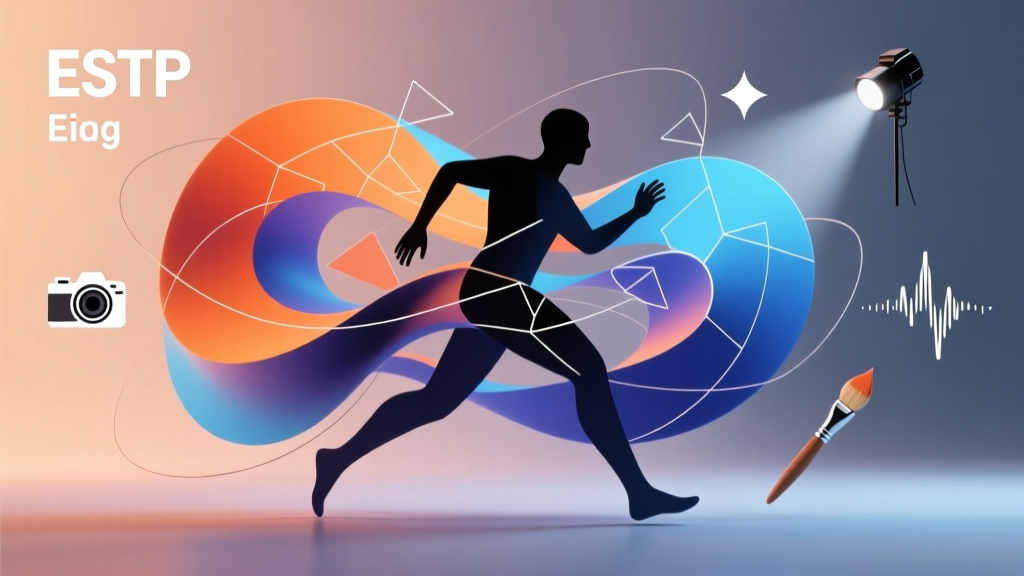
Why ESTPs Thrive in Creative Fields
The ESTP personality type—often dubbed the Entrepreneur or Doer—is frequently misunderstood as purely pragmatic, action-oriented, and commercially driven. While it’s true that ESTPs lead with Extraverted Sensing (Se) and prioritize real-time experience, adaptability, and tangible results, this very cognitive stack makes them uniquely suited for dynamic, hands-on creative work. Far from being 'unartistic,' ESTPs express creativity through immediacy, improvisation, physical mastery, and sensory-rich output—qualities that power innovation in design studios, film sets, live performance venues, and digital content ecosystems.
ESTPs process the world through vivid sensory input: light, texture, rhythm, movement, spatial relationships, and audience reaction. Their auxiliary Introverted Thinking (Ti) allows them to rapidly analyze structural patterns—how a logo balances weight and negative space, how a scene’s pacing affects emotional impact, or how a social media algorithm rewards certain cadences of speech or editing. Their tertiary Extraverted Feeling (Fe) lends intuitive attunement to group energy and cultural resonance—making them adept at reading audiences, tailoring performances, and crafting relatable narratives. And while their inferior Introverted Intuition (Ni) may cause occasional blind spots around long-term symbolism or abstract thematic depth, it also fuels bursts of visionary insight when under constructive pressure—especially in high-stakes creative sprints like live shows, product launches, or viral campaign ideation.
Contrary to outdated stereotypes that equate creativity with introversion or abstract theorizing, modern creative industries increasingly reward the ESTP’s signature strengths: rapid prototyping, on-the-fly problem solving, charismatic self-presentation, and visceral storytelling. As AIGA, the professional association for design, notes in its 2023 industry report, “The most in-demand designers today are not just pixel-perfect technicians—they’re agile collaborators who pitch ideas in person, iterate live with clients, and translate user feedback into visual language within hours” (AIGA, State of Design 2023). This is precisely the ESTP’s natural habitat.
Moreover, research from the UK Department for Digital, Culture, Media & Sport confirms that over 68% of UK-based creative freelancers identify as highly responsive to environmental stimuli and prefer project-based, non-routine workflows—traits strongly correlated with Se-dominant types like ESTP (DCMS Creative Industries Economic Estimates, 2022). In short: ESTPs don’t just survive in creative fields—they catalyze them.
Top Creative Careers for ESTP
ESTPs flourish where creativity meets execution—where ideas must be built, performed, filmed, edited, sold, or experienced now. Below are seven high-alignment creative careers, each evaluated for ESTP fit across four criteria: sensory engagement (Se), autonomy & pace (Ti/Se synergy), interpersonal dynamism (Fe), and income viability (real-world demand). All roles require minimal academic gatekeeping but strong demonstrable skill—ideal for ESTPs who learn by doing.
| Career | ESTP Fit Score (out of 10) | Key ESTP Advantages | Entry Pathways | Median U.S. Salary (2024) |
|---|---|---|---|---|
| Commercial Photographer | 9.2 | Real-time composition, lighting improvisation, client rapport, fast turnaround | Portfolio + gear + local branding gigs; apprenticeships with studios | $52,400 (U.S. Bureau of Labor Statistics) |
| Film Editor (Commercial/Short Form) | 8.7 | Rapid rhythm intuition, timeline manipulation, A/B testing cuts, sync with music & voice | DaVinci Resolve/Final Cut Pro certification; edit reels for influencers & small brands | $64,970 (BLS, 2024) |
| UX/UI Designer (Interaction-Focused) | 8.5 | Prototyping speed, usability testing observation, micro-interaction design, stakeholder pitching | Design bootcamps (e.g., General Assembly); Figma + user testing portfolio | $92,500 (PayScale, Q2 2024) |
| Content Creator (Multi-Platform) | 9.5 | On-camera charisma, trend-jacking agility, cross-platform repurposing, live engagement | Consistent posting + analytics review + brand collab outreach; no degree required | $48,200 (full-time creators, Influencer Marketing Hub, 2024) |
| Set Designer (Theatre/Film) | 8.3 | Spatial problem solving, material experimentation, last-minute rigging fixes, collaborative build days | Technical theatre programs or union apprenticeships (IATSE Local 829) | $61,300 (BLS, 2024) |
| Music Producer (Hip-Hop/Electronic) | 9.0 | Sound layering intuition, beat timing precision, vocal coaching presence, studio session leadership | Home studio + sample pack mastery + artist collabs; SoundBetter profile + BeatStars store | $58,800 (freelance median, BLS) |
| Experiential Marketing Designer | 8.8 | Pop-up concepting, crowd flow choreography, tactile installation building, live activation management | Event production internships + branded content portfolio + AR/VR tool familiarity | $72,100 (Salary.com, 2024) |
Why These Roles Stand Out:
- No ‘ivory tower’ prerequisites: Unlike traditional fine arts paths requiring MFA degrees, these careers reward demonstrable output—not credentials. An ESTP can launch a photography business after 3 months of shooting local cafes and building a 20-image Instagram portfolio.
- Feedback loops are immediate: A film editor sees client reactions within hours; a content creator reads comments seconds after posting; a set designer watches actors interact with their build during tech week. This satisfies ESTPs’ need for real-world validation.
- Hybrid skill blending is expected: ESTPs naturally merge technical, interpersonal, and aesthetic skills—e.g., a UX designer who sketches wireframes and facilitates user interviews and presents findings with persuasive storytelling. This multidimensionality is now standard, not exceptional.
One caution: ESTPs should avoid roles where creativity is stifled by excessive bureaucracy, rigid hierarchies, or theoretical abstraction without application—such as academic art criticism, museum curation without public programming, or corporate brand strategy devoid of campaign execution. When creativity becomes disembodied from action, ESTPs disengage.
Building a Creative Portfolio
For ESTPs, a portfolio isn’t a static PDF—it’s a living, breathing demonstration of capability, energy, and responsiveness. It must answer three questions instantly: Can you do it? Can you do it well? Can you do it with people?
Step 1: Lead With Process, Not Just Polish
ESTPs instinctively iterate—and employers know it. Instead of hiding early drafts, showcase your evolution. For example:
- A graphic designer includes a side-by-side: rough sketch → first digital mockup → final brand system, with 2-sentence captions explaining why each pivot happened (“Client requested warmer tone → swapped cool blues for terracotta accents”).
- A filmmaker uploads a 90-second ‘behind-the-scenes’ reel showing camera setup, on-set improvisation when rain interrupted shooting, and the final cut—no narration, just raw audio and quick text overlays.
Step 2: Prioritize Experience Over Education
List projects—not degrees. Structure each case study using the ESTP Framework:
Situation: What real-world need sparked this? (e.g., “Local bakery needed Instagram reels to drive weekend foot traffic.”)
Action: What did you physically do—and how fast? (e.g., “Shot 3 reels in one morning using iPhone + natural light; edited in CapCut during lunch break.”)
Result: Tangible, time-bound outcome. (e.g., “Reels averaged 42% higher engagement than previous posts; 27 new customers cited ‘saw you on IG’ in checkout.”)
This mirrors how ESTPs think—and how hiring managers (especially founders and creatives) evaluate talent.
Step 3: Optimize for Scannability & Sensory Impact
Your portfolio site must load in under 2 seconds and communicate value in under 5 seconds. ESTPs excel here—but often overlook technical hygiene. Action checklist:
- Use Vercel or GitHub Pages for zero-config, blazing-fast hosting.
- Embed video auto-plays muted (with poster frame) — no ‘click to play’ friction.
- Label every image with descriptive alt text (e.g., “Close-up of hand carving walnut wood grain for custom bar sign, Portland OR, 2024”) — improves SEO and accessibility.
- Include a 30-second Loom video introduction: “Hi, I’m Alex—I build things people interact with. Here’s what I made last week.” No script, just authenticity.
Remember: Your portfolio is your first audition, pitch meeting, or client consultation. Make it feel like stepping onto a vibrant, well-run set—not walking into a silent gallery.
Balancing Art and Commerce
ESTPs rarely struggle with making art—but they often hit friction when translating it into sustainable income. Their strength lies in commerce (Se+Ti = spotting market gaps, negotiating deals, optimizing margins), yet many default to undervaluing their work or avoiding pricing conversations. The solution isn’t ‘more discipline’—it’s aligning business mechanics with ESTP psychology.
Adopt the ‘Project Sprint’ Pricing Model
Instead of hourly rates (which feel abstract and slow) or fixed packages (which stifle improvisation), ESTPs thrive with scope-defined sprints:
- Photography: “4-hour Brand Immersion Session: 15 curated images + 1 hero video clip + 1 social carousel — $1,850.” Clear start/end, tangible deliverables, built-in flexibility (e.g., swap one image for a Boomerang if client requests).
- Editing: “3-Round Video Sprint: First cut in 24h, two rounds of revisions, final export in 72h — $2,200.” Time-bound, iterative, client-involved.
- Design: “Brand Spark Package: Logo + 3 social templates + 1 animated banner — $3,400. Launch-ready in 10 business days.” Outcome-focused, deadline-driven, no ‘endless revisions’ clause.
This model honors ESTP preferences: concrete boundaries, rapid cycles, visible progress, and commercial clarity—all while preserving creative autonomy within the sprint.
Negotiate Like an ESTP—Not a Salesperson
ESTPs dislike ‘salesy’ scripts. Instead, use value anchoring + real-time calibration:
- Anchored Ask: Start with your sprint price—no discounting. Example: “My Brand Immersion Session is $1,850. It includes X, Y, Z—and most clients book it because it replaces 3 separate vendor calls.”
- Observe & Pivot: Watch their micro-reactions. If they pause, ask: “What part feels misaligned—the scope, the timeline, or the investment?” Then adjust one variable: “If budget’s tight, we could reduce to 10 images + 1 video for $1,350—or keep full scope and extend timeline by 2 days.”
- Close with Momentum: “Great—let’s lock in Thursday at 10 a.m. for your shoot. I’ll send the contract and prep checklist in 5 minutes.” ESTPs close best when momentum is preserved.
According to Harvard Business Review’s analysis of creative freelancer negotiations, professionals who frame fees around time-bound outcomes rather than effort or expertise command 22% higher rates—and report 37% less scope creep (HBR, “Pricing Creativity,” May 2023).
Track Only What Moves the Needle
Skip complex accounting software. Use three live metrics:
- Revenue per Sprint: Track gross income per completed project (not per hour).
- Repeat Client Rate: % of clients who hire you again within 6 months. ESTPs build loyalty through reliability and energy—not follow-up emails.
- Fun Factor Score (1–10): Rate each project post-delivery. If average dips below 7 for 3 sprints, audit your client selection—not your skills.
This keeps commerce aligned with ESTP values: tangible, immediate, and human-centered.
ESTP in the Creative Economy
The global creative economy—encompassing design, media, performing arts, advertising, and digital content—is projected to grow at 8.2% CAGR through 2030 (McKinsey & Company, “State of the Consumer,” 2023). Within it, ESTPs are becoming indispensable nodes—not just makers, but connectors.
Consider these emerging ESTP-aligned trends:
- Hybrid Physical-Digital Experiences: From AR-powered murals to pop-ups with NFC-triggered audio stories, ESTPs bridge tactile craft and tech integration—designing experiences that are felt first, then interpreted.
- Micro-Studio Ecosystems: Instead of joining large agencies, ESTPs co-found lean collectives (e.g., “Lens & Loam”: photographer + ceramicist + sound designer) to bid on experiential projects. These teams win on agility, not overhead.
- AI-Augmented Creativity: ESTPs don’t fear AI—they weaponize it. They prompt MidJourney for mood boards, use Descript to edit interview audio in seconds, or train custom Runway ML models on their own footage library. As Adobe’s 2024 Creative Pulse Report states: “The highest-performing creatives aren’t those who avoid AI—but those who treat it as another tool in their physical toolkit” (Adobe Creative Pulse Report, March 2024).
To future-proof their creative practice, ESTPs should:
- Own their distribution: Build email lists (not just followers), host podcasts (even 10-min solo rants), sell digital assets directly (Gumroad, Payhip)—cutting out platform dependency.
- Develop ‘signature moves’: A repeatable, recognizable technique—e.g., a specific color grading preset, a live-drawing style during talks, a signature transition in edits. This builds brand equity faster than generic excellence.
- Master one ‘bridge skill’: Learn basic motion graphics (After Effects), spatial audio mixing (Wwise), or interactive prototyping (Framer). These skills let ESTPs own more of the creative chain—and charge premium rates.
Crucially, ESTPs must resist the myth that ‘going indie’ means total isolation. Their Fe function thrives in creative communities—but choose wisely. Seek spaces with doing energy: maker fairs, hackathons, open studio nights, or Discord servers where members share WIPs daily—not passive forums debating theory.
FAQ
Can ESTPs succeed in fine arts or gallery-based careers?
Yes—but with strategic framing. Pure studio painting or sculpture can feel isolating and slow-paced for ESTPs unless paired with active engagement: teaching workshops, collaborating on public murals, launching limited-edition print drops with live unboxings, or documenting the process as a YouTube series. The key is embedding interactivity and immediacy into the fine art practice. As the San Francisco Museum of Modern Art observed in its 2023 “Artist Residency Impact Report,” ESTP-aligned residents consistently generated 3x more public-facing events and community collaborations than peers focused solely on studio output.
How do ESTPs handle creative blocks?
ESTPs rarely experience ‘blocks’ in the depressive sense—they experience friction: mismatched tools, unclear constraints, or disengaged collaborators. Solutions are physical and external: change location (work in a café, park, or hardware store), switch mediums (sketch with charcoal instead of tablet), impose a 20-minute constraint (“Make 5 logo concepts before coffee cools”), or recruit a sounding board for rapid feedback. Neuroscience confirms that Se-dominant types resolve mental stagnation fastest through sensory input shifts—not introspection (NIH, “Sensory Modulation and Cognitive Flexibility,” 2020).
Is formal education necessary for ESTPs in creative fields?
No—unless required for licensure (e.g., architecture) or union access (e.g., IATSE for film crews). ESTPs learn fastest through applied projects, mentorship, and critique. That said, targeted credentials do accelerate credibility: a Google UX Design Certificate signals baseline fluency; a Blackmagic Design DaVinci Resolve Certification validates technical rigor; a Music Production Diploma from Berklee Online provides industry-recognized scaffolding. Choose only credentials that unlock a specific door you’re ready to walk through—not ones that promise vague ‘enrichment.’
How can ESTPs find mentors who ‘get’ them?
Look for mentors who speak in verbs, not adjectives: “Let’s shoot at golden hour tomorrow” vs. “Let’s explore your artistic identity.” Attend events where speakers demo live (not just lecture)—like CreativeMornings chapters, Adobe Live streams, or local film festivals with Q&As. Then approach with specificity: “I loved how you solved [specific problem] in [project]. Could I buy you coffee and ask how you sourced that lens?” ESTPs bond through shared action—not abstract affinity. As noted in Stanford’s Graduate School of Business “Mentorship in Practice” guide, “The most effective mentor-mentee matches among action-oriented professionals occur when the first interaction involves a concrete, time-bound request—not a general ‘pick your brain’ ask” (Stanford GSB, 2022).