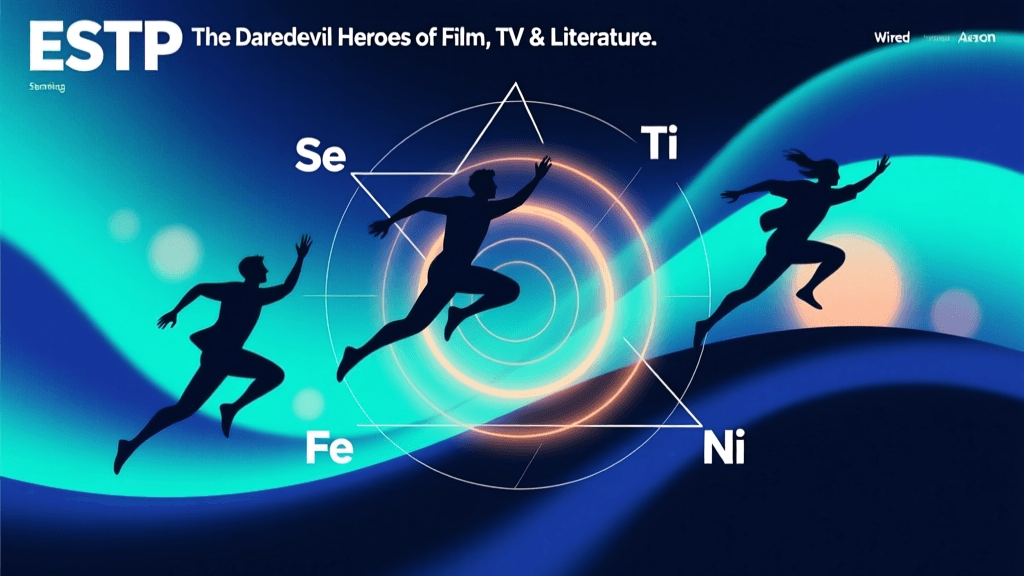
What Makes an ESTP Character
The ESTP personality type—often dubbed The Entrepreneur, The Dynamo, or The Doer—is defined by the cognitive function stack: Extraverted Sensing (Se) dominant, Introverted Thinking (Ti) auxiliary, Extraverted Feeling (Fe) tertiary, and Introverted Intuition (Ni) inferior. In fictional storytelling, this configuration manifests not as a checklist of traits, but as a distinct behavioral signature: rapid sensory engagement with the physical world, on-the-fly problem-solving grounded in real-time data, charismatic spontaneity, and a visceral aversion to abstract theorizing that lacks immediate utility.
Unlike INTJs who strategize three steps ahead or INFPs who wrestle with moral ambiguity in quiet introspection, ESTPs operate in the now. Their cognition is rooted in what can be seen, touched, heard, or reacted to within seconds. When Captain Jack Sparrow tilts his head mid-duel to assess wind direction, weapon weight, and a distracted guard’s blink—then pivots into a feint that disarms two opponents in under three seconds—that’s Se in full throttle. His Ti kicks in instantly afterward—not to reflect, but to re-calibrate: “That cutlass was 17% heavier than expected—next time, leverage the rust on the hinge.” This isn’t cold logic; it’s embodied, kinetic reasoning.
Crucially, ESTPs are often mislabeled as ‘shallow’ or ‘impulsive’ because their Fe is undeveloped early in life—and even in mature expressions, it serves social agility rather than deep emotional labor. They read rooms like radar: adjusting tone, humor, or posture to disarm tension or win over a skeptic—but rarely dwell in others’ inner worlds unless it directly impacts situational success. Their Ni inferior shows up under stress: sudden, catastrophic predictions (“This whole plan is going to collapse”), obsessive fixation on worst-case outcomes, or abrupt withdrawal when forced into long-term planning without tangible anchors.
For writers and analysts alike, identifying an ESTP character requires moving beyond surface tropes—“he’s reckless!” or “she’s charming!”—and asking: How does this character gather information? Where do they direct attention first? What kind of problems do they solve—and how do they solve them? As psychologist Dario Nardi explains in his neuroscientific study of MBTI types, ESTPs show heightened activity in brain regions associated with sensorimotor integration and rapid pattern-matching during live-action tasks—not during abstract hypothesis generation. This neural signature translates narratively into characters who thrive in dynamic environments: chase sequences, bar brawls, heist preparations, battlefield triage, or high-stakes negotiations where timing trumps theory.
Famous ESTP Fictional Characters
Below is a curated list of 9 iconic ESTP characters from film, television, and literature—each analyzed through the lens of their dominant Se, auxiliary Ti, tertiary Fe, and inferior Ni. We avoid vague generalizations and instead cite specific scenes, dialogue patterns, and behavioral consistencies that align with verified ESTP cognitive mechanics.
1. Han Solo (Star Wars Saga)
Han’s opening scene in A New Hope establishes his ESTP core: he enters the Mos Eisley cantina not to network or philosophize, but to scan—eyes flicking across patrons, hands resting near his blaster, assessing threat vectors and exit routes before uttering a single word. His famous line—“I know”—in response to Obi-Wan’s claim that the Force is “an energy field”—isn’t arrogance; it’s Ti rejecting unverifiable abstraction in favor of empirically validated physics (e.g., gravity, thrust, hull integrity). Later, his decision to return during the Death Star trench run isn’t sudden altruism—it’s Fe recalibration: he sees Leia’s expression, hears Luke’s voice crack over comms, and chooses loyalty because it serves both relational harmony and tactical advantage (a clear shot at Darth Vader’s TIE fighter). His inferior Ni emerges in The Empire Strikes Back when frozen in carbonite: isolated, time-bound, and unable to act, he spirals into fatalistic resignation—“I don’t know what’s going to happen to me…”—a hallmark Ni loop.
2. Arya Stark (Game of Thrones, HBO / A Song of Ice and Fire)
Arya’s evolution from traumatized child to lethal operative mirrors ESTP development. Her Faceless Men training doesn’t teach her to become “no one”—it sharpens her Se: learning to identify people by scent, gait, breath rhythm, and micro-expressions. Her Ti surfaces in her meticulous weapon selection (Needle’s balance, length, and flexibility optimized for her height and style) and her self-taught water dancing—adapting Syrio Forel’s principles to her own physiology, not doctrine. Her Fe matures from reactive vengeance (“Valar Morghulis” as threat) to calibrated influence (disguising herself as Walder Frey to orchestrate the Twins massacre—using charm, mimicry, and timing to manipulate perception). Her Ni stress appears post-Braavos: nightmares of endless hallways, voices whispering names she can’t place—a classic inferior function eruption.
3. James Bond (Dr. No through No Time to Die)
Bond is the archetypal cinematic ESTP: hyper-observant (Se), analytically precise in combat (Ti), socially fluent across cultures (Fe), yet emotionally detached until crisis forces depth (Ni). Consider his casino scene in Casino Royale: he monitors Vesper’s pupils, counts chip stacks, calculates odds in real time, adjusts his bluff based on Le Chiffre’s blink rate—all while delivering dry wit to diffuse tension. His Ti is evident in his gadget critiques: he doesn’t want flashy tech—he wants reliability, weight distribution, and fail-safes (“If it jams, I’m dead”). His Fe enables him to shift personas seamlessly—from MI6 diplomat to poker shark to seducer—without internal conflict, because each role serves mission parameters. His Ni breakdown in Spectre, where he fixates on SPECTRE’s legacy as an inescapable cycle, reveals inferior function strain: linear, deterministic dread replacing adaptive improvisation.
4. Ellen Ripley (Alien franchise)
Ripley subverts the ‘action hero’ stereotype by embodying ESTP competence without machismo. Her Se dominance is clinical: she notices coolant leaks before alarms sound, identifies xenomorph movement via floor vibrations, and uses spatial memory to navigate the Nostromo’s ducts blindfolded. Her Ti drives her protocol adherence—not out of rigidity, but empirical validation: “The quarantine procedure is standard. It’s not my call.” She only overrides it when sensory data contradicts policy (e.g., sensing the alien’s heat signature behind a wall). Her Fe evolves from enforcing rules to protecting Newt with fierce, pragmatic tenderness—teaching her to reload, checking her boots for debris, using calm tone to regulate fear. Her Ni stress peaks in Alien³: recurring dreams of the alien bursting from her chest, symbolizing suppressed trauma metastasizing into apocalyptic certainty.
5. Sherlock Holmes (BBC’s Sherlock, Benedict Cumberbatch version)
Contrary to popular belief, the BBC’s Holmes is not an ISTP or INTJ—he’s a high-functioning ESTP whose Se is so acute it mimics intuition. His ‘mind palace’ isn’t abstract visualization; it’s sensory indexing: associating facts with smells, textures, and sounds (e.g., recalling a suspect’s cologne, shoe scuff marks, and vocal fry simultaneously). His Ti generates rapid-fire deductions (“You’ve been in Afghanistan. Three months ago. You limp when tired, but your psychosomatic limp disappears when adrenaline spikes—so you were injured there, not here.”), always grounded in observable evidence. His Fe is performative but effective: he insults clients to provoke emotional tells, then switches to soothing tone when extracting critical data. His Ni inferior emerges in His Last Vow, where he fixates on Magnussen’s blackmail as an unsolvable, all-consuming threat—paralyzing his usual adaptability.
6. Katniss Everdeen (The Hunger Games)
Katniss’s ESTP nature is often obscured by her trauma, but her core cognition is Se-driven survival. She hunts daily not for sport, but to read wind shifts, animal tracks, and edible plant micro-variations—skills honed through relentless sensory immersion. Her Ti surfaces in bow calibration: adjusting draw weight, arrow fletching, and stance angles based on humidity and distance. Her Fe develops from stoic isolation to strategic symbolism: the mockingjay pin, the bread gesture to District 11, the final ‘double suicide’ gambit—all designed to manipulate public emotion and destabilize the Capitol’s narrative control. Her Ni stress appears in Catching Fire when she obsesses over Peeta’s potential betrayal, interpreting every glance as confirmation of inevitable doom.
7. Tony Stark / Iron Man (Iron Man through Avengers: Endgame)
Tony’s genius is Ti-based, but his method is ESTP: he prototypes in real time, scrapes data from live battle feeds, and iterates suits mid-fight. His Se is evident in his reflexive dodges, hand-to-hand improvisation (using repulsors as blunt force or grappling tools), and hyper-awareness of structural weaknesses (e.g., targeting Ultron’s central node by reading micro-fractures in his chassis). His Fe evolves from narcissistic charm to sacrificial leadership—using humor to defuse team conflict, tailoring pep talks to individual needs (e.g., grounding Bruce with tactile cues: “Feel that? That’s your pulse. You’re here.”). His Ni collapse occurs in Avengers: Infinity War, where he fixates on Thanos’s snap as an irreversible, preordained end—abandoning contingency plans for fatalistic resignation.
8. Zuko (Avatar: The Last Airbender)
Zuko’s redemption arc is a masterclass in ESTP growth. Early Zuko is Se-Ti-Fe-Ni in shadow: his Se fuels relentless pursuit (tracking Aang across continents), his Ti constructs rigid honor logic (“I must capture the Avatar to restore my honor”), his Fe manifests as performative anger to mask shame, and his Ni inferior spawns obsessive visions of his father’s approval. His turning point—joining Team Avatar—isn’t ideological; it’s sensory and tactical: he feels the warmth of Appa’s fur, tastes Iroh’s tea, sees Sokka’s genuine (if sarcastic) trust, and chooses alignment because it fits his lived reality better than Ozai’s dogma. His mature Fe shines in teaching Aang firebending not as destruction, but as life energy—translating abstract philosophy into embodied practice.
9. Jessica Jones (Jessica Jones, Netflix)
Jessica’s ESTP traits are grounded in trauma resilience. Her Se is hypervigilant: she notices door locks clicking, changes in streetlight hum, shifts in client posture before they speak. Her Ti drives her investigative process—cross-referencing alibis with traffic cam timestamps, analyzing toxin half-lives, reverse-engineering Kilgrave’s voice modulation. Her Fe is guarded but potent: she offers blunt honesty as care (“You’re not broken. You’re pissed off. That’s useful.”), and protects Trish with ferocious, no-nonsense loyalty. Her Ni stress surfaces in binge drinking episodes and intrusive thoughts about Kilgrave’s voice returning—a looping, catastrophic echo of past helplessness.
ESTP Archetype in Storytelling
The ESTP functions as a narrative engine—not a moral compass or philosophical anchor, but the force that propels plot forward through decisive action. Unlike INFJ ‘mentor’ archetypes who guide via insight, or ENTP ‘tricksters’ who disrupt via ideas, ESTPs resolve conflict through embodied intervention. They are the ones who:
- Disable the bomb while arguing with the villain;
- Win the duel by exploiting the opponent’s sweat-slicked grip;
- Broker peace by slipping a rival a drink and noticing their trembling hand.
This archetype serves three critical structural roles:
1. The Catalyst of Change
ESTPs rarely initiate stories—they enter already-unfolding crises and alter trajectories through intervention. Han doesn’t start the Rebellion; he joins it mid-crisis and changes its outcome. Zuko doesn’t create the Fire Nation conflict; he becomes the pivot that fractures it. Their presence shifts stakes from ‘will they survive?’ to ‘what will they do next?’
2. The Grounding Counterweight
In ensembles, ESTPs anchor abstract thinkers. When Spock debates Vulcan logic, Kirk physically grabs his arm and says, “He’s bleeding. Help him.” When Hermione lists twelve theoretical Horcrux protections, Ron smashes a cursed locket with a basilisk fang—“It’s not working. Try this.” This isn’t anti-intellectualism; it’s functional prioritization.
3. The Moral Pragmatist
ESTPs judge ethics by consequence, not doctrine. They’ll lie to protect a friend (“I told them you were dead”), steal to feed orphans (“The Crown’s hoarding grain while kids starve”), or kill a tyrant not for justice, but because “He’s holding a knife to the throat of someone who can’t fight back.” Their morality is situational, visceral, and fiercely protective—not universal, but deeply human.
How to Tell If a Character Is Really ESTP
Spotting ESTPs requires distinguishing them from similar types—especially ISTPs (Ti-Se, but introverted and less socially adaptive) and ESFPs (Se-Fe, but less analytically rigorous). Use this diagnostic framework:
| Diagnostic Criterion | ESTP Indicator | ISTP Counter-Indicator | ESFP Counter-Indicator |
|---|---|---|---|
| Information Gathering | Scans environment for actionable data first; asks “What’s happening right now?” | Observes silently, then withdraws to analyze; asks “How does this work?” | Notices mood shifts, fashion, energy flow; asks “Who’s having fun?” |
| Problem-Solving Style | Builds solutions from real-time inputs; modifies plans mid-execution | Designs systems or tools in advance; prefers controlled testing | Improvises socially—changes story, role, or tone to ease tension |
| Conflict Response | Confronts directly with tactical precision; uses humor to disarm, not deflect | Withdraws to assess; re-engages with targeted, logical counterpoints | Defuses with charm or distraction; avoids direct confrontation |
| Stress Behavior | Ni loop: catastrophizing, paranoia, obsessive worst-case rehearsal | Si loop: rumination on past failures, rigid adherence to routine | Fi loop: emotional withdrawal, identity questioning, hypersensitivity |
Apply this with scene-level scrutiny. For example, in Die Hard, John McClane’s ESTP status is confirmed not by his one-liners, but by his behavior: he uses a fire hose to swing across a lobby after testing its pressure and anchor point (Se + Ti); he negotiates with Hans Gruber by alternating threats and empathy based on Gruber’s micro-expressions (Fe); and his breakdown in the elevator shaft—whispering “It’s over… it’s all over…”—reveals Ni inferior collapse.
FAQ
Can ESTPs be introverted or shy?
Yes—but shyness in ESTPs is typically situational (e.g., unfamiliar social codes) or stress-induced (Ni loop), not inherent preference. Their energy flows outward through action and interaction, even if they conserve words. As the Myers & Briggs Foundation notes, extraversion refers to where one directs attention and draws energy, not sociability level. An ESTP may be quiet in a boardroom but electrifying in a crisis—because the latter engages their dominant Se.
Why do so many ESTP characters have military or law enforcement backgrounds?
These fields reward Se-Ti-Fe strengths: rapid threat assessment, real-time tactical adaptation, and authority negotiation. However, ESTPs thrive equally in entrepreneurship (Succession’s Logan Roy), sports (Friday Night Lights’ Tim Riggins), or medicine (Grey’s Anatomy’s Jackson Avery)—any domain demanding split-second decisions anchored in sensory reality. The military trope persists because it’s a visible, high-stakes laboratory for ESTP cognition.
Are ESTP characters always heroes?
No. ESTPs make compelling antagonists precisely because their competence is undeniable. Think of Breaking Bad’s Gustavo Fring: his Se allows him to detect lies by pupil dilation, his Ti designs flawless drug operations, his Fe maintains a benevolent public image, and his Ni inferior fuels his obsession with eliminating Walter White as an existential threat. His downfall isn’t moral failure—it’s Ni-driven overconfidence in controlling chaos.
How do ESTPs differ from ‘chaotic neutral’ alignment in D&D?
While both value freedom and action, ESTPs are not inherently anarchic. Their Ti seeks efficiency, their Fe values social cohesion, and their Se respects physical cause-and-effect. A chaotic neutral rogue might burn down a castle for fun; an ESTP would burn it down only if it blocked the only path to saving hostages—and would already be calculating the optimal ignition point and escape route. As personality researcher Dr. Linda V. Berens clarifies, type describes cognitive processes, not morality or alignment.
Understanding ESTP characters enriches both analysis and creation. For writers, it means building protagonists whose heroism lives in their hands, eyes, and timing—not just their hearts or minds. For readers, it transforms recognition into resonance: seeing not just what a character does, but how their mind moves through the world. And in doing so, we honor the truth that courage isn’t always spoken in manifestos—it’s whispered in the click of a safety switch, the flex of a wrist before a punch, the split-second choice to leap—not because it’s safe, but because it’s possible.
As the Center for Applications of Psychological Type affirms, MBTI insights are most powerful when applied with nuance and evidence. ESTPs aren’t caricatures of recklessness—they’re masters of the immediate, architects of action, and indispensable engines of narrative vitality.