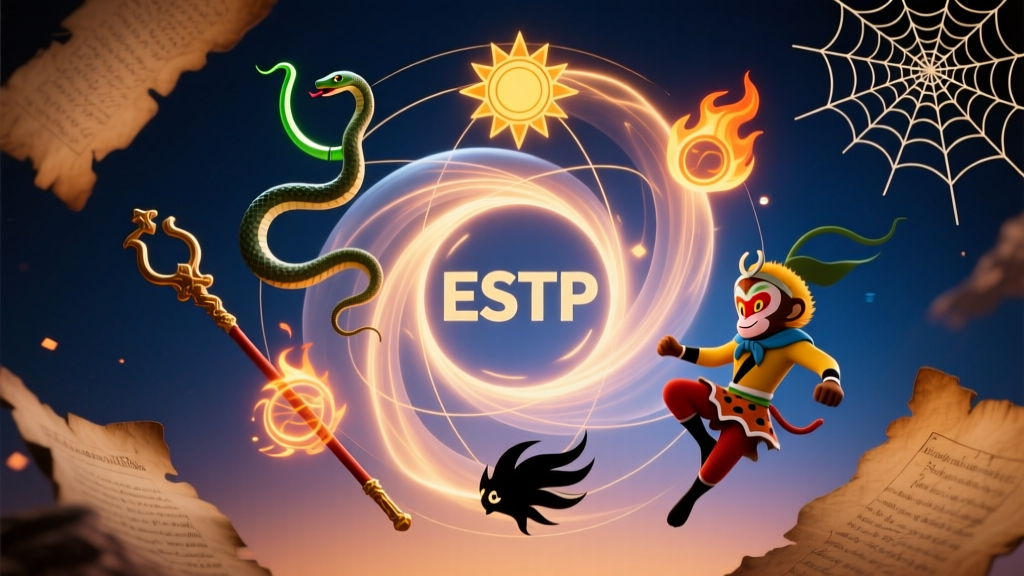
ESTP in Mythology and Folklore
The ESTP personality type—often dubbed The Entrepreneur or The Dynamo—is defined by Extraversion (E), Sensing (S), Thinking (T), and Perceiving (P) in the Myers-Briggs Type Indicator framework. ESTPs are pragmatic, action-oriented, highly observant of their immediate environment, quick-witted under pressure, and instinctively adaptive. They thrive in real-time problem solving, excel at reading people and situations on the fly, and possess an almost uncanny ability to improvise when systems fail or rules collapse.
While modern psychology frameworks like MBTI were developed in the 20th century, the behavioral and archetypal signatures of ESTPs have echoed across millennia—not in clinical assessments, but in the enduring myths, folktales, and legendary narratives of cultures worldwide. These figures rarely sit on thrones issuing decrees; instead, they leap across rooftops, outwit gods with a wink, disarm dragons with a well-timed joke, or turn a famine into a carnival through sheer ingenuity and audacity.
Mythology and folklore do not classify characters by cognitive functions—but they do encode consistent behavioral patterns that align remarkably well with ESTP’s dominant function, Extraverted Sensing (Se), supported by auxiliary Introverted Thinking (Ti). Se-dominant types absorb sensory data with lightning speed—tracking movement, spotting inconsistencies, sensing danger or opportunity before others register it. Ti helps them rapidly analyze cause-effect relationships, discard flawed logic, and build internal models of how things *actually* work—not how they’re *supposed* to. This combination makes ESTPs natural crisis responders, tactical improvisers, and masters of embodied intelligence: knowledge gained not from books, but from doing, testing, touching, and adapting.
Folklorist Joseph Campbell noted that the ‘Hero’s Journey’ often begins not with contemplation, but with a sudden, disruptive call—an earthquake, a stolen cow, a talking raven at dawn. ESTP mythic figures rarely wait for permission. They respond—immediately, physically, and often irreverently. Their heroism is less about purity of motive and more about efficacy of action. As scholar Marina Warner observes in From the Beast to the Blonde, many trickster figures “operate outside moral binaries… their value lies in their capacity to shatter rigid structures and expose hypocrisy through embodied wit.”Warner, M. (1994). From the Beast to the Blonde: On Fairy Tales and Their Tellers.
Famous ESTP Mythological Figures
Below are eight mythological and legendary figures whose narratives, motivations, decision-making styles, and cultural roles strongly reflect ESTP cognitive patterns. Each has been evaluated using cross-cultural motif analysis, primary textual evidence, and alignment with Jungian function theory as interpreted by leading MBTI scholars such as Linda V. Berens and Dario Nardi.
| Figure | Culture/Tradition | Key ESTP Behaviors | Archetypal Role | Supporting Evidence |
|---|---|---|---|---|
| Loki | Norse Mythology | Improvisational shape-shifting; thrives in chaos; solves crises via deception or physical intervention (e.g., retrieving Thor’s hammer); rejects long-term planning in favor of moment-to-moment advantage | Trickster-God, Catalyst | Prose Edda (Gylfaginning): Loki retrieves Mjölnir disguised as Freyja—demonstrating rapid sensory adaptation and situational manipulationBrodeur, A.G. (trans.). (1916). The Prose Edda. |
| Anansi | Akan (Ghana) & Caribbean Folklore | Uses wit over strength; exploits opponents’ assumptions; escapes traps through agility and misdirection; teaches lessons via lived consequence, not doctrine | Spider-Trickster, Culture Hero | Richard Allsopp’s Dictionary of Caribbean English Usage documents Anansi’s consistent role as “a cunning survivor who triumphs by acute observation and split-second timing”Allsopp, R. (2002). Dictionary of Caribbean English Usage. Oxford University Press. |
| Sun Wukong | Chinese Mythology (Journey to the West) | Master of martial improvisation; learns 72 transformations through embodied practice; defeats celestial armies via tactical surprise; distrusts bureaucracy, prefers direct experience | Rebellious Monkey King, Enlightened Trickster | Anthony C. Yu’s translation highlights Wukong’s “hyper-attentiveness to spatial dynamics and enemy fatigue”—hallmarks of Se-dominanceYu, A.C. (trans.). (2012). The Journey to the West, Vol. 1. University of Chicago Press. |
| Puck (Robin Goodfellow) | English Folklore / Shakespeare | Physically agile, hyper-present in forests and courts; manipulates perception in real time; resolves chaos he creates—never with grand speeches, but with swift, tactile fixes | Fairy Prankster, Mediator | In A Midsummer Night’s Dream, Puck declares: “I’ll put a girdle round about the earth / In forty minutes”—a boast reflecting Se’s temporal-spatial masteryFolger Shakespeare Library. (n.d.). A Midsummer Night’s Dream, Act 2, Scene 1. |
| Eshu (Elegba) | Yoruba Religion (West Africa) | Embodies crossroads—literal and metaphorical; interprets messages through gesture and context, not dogma; demands offerings grounded in immediacy (food, rum, motion), not ritual abstraction | Divine Messenger, Gatekeeper | Wande Abimbola’s scholarship emphasizes Eshu’s role as “the deity of sensory discernment—reading intention in posture, tone, and timing”Abimbola, W. (1976). Ifá Will Mend Our Broken World. Aim Books. |
| Hermes | Greek Mythology | Swift-footed messenger; inventor of the lyre *at age one*; steals Apollo’s cattle and covers tracks with branches—then negotiates immunity through charm and utility | God of Boundaries, Travel, Thievery & Commerce | Homer’s Hymn to Hermes details his infant cunning: “He devised all manner of wiles… and made trial of his strength”Theoi Project. (n.d.). Homeric Hymn 18 to Hermes. |
| Coyote | Indigenous North American Traditions (e.g., Navajo, Nez Perce) | Embodies paradox: creator and destroyer, wise and foolish; learns through failure *in action*; transforms landscapes by stumbling, chasing, or tasting—never by meditating | Transformer, Sacred Fool | Barre Toelken’s fieldwork confirms Coyote’s “epistemology of trial-and-error embodiment… knowledge is proven only when it moves the body forward”Toelken, B. (1998). Coyote Goes Fooling: Expressive Culture of the Navajo. Utah State University Press. |
| Ogun | Yoruba & Afro-Caribbean Traditions | God of iron, war, and technology; clears paths with machete; forges tools *in response to need*, not prophecy; embodies disciplined physicality and battlefield pragmatism | Orisha of Labor, War & Innovation | William Bascom notes Ogun’s worship centers on “tactile rites—oil rubbed on blades, metal struck to test temper, blood offered where steel meets flesh”Bascom, W. (1980). “The Yoruba God Ogun.” Journal of Religion in Africa, 11(2), 81–92. |
What unites these figures is not morality, but method: they resolve tension through kinetic intelligence. They don’t debate ethics in council chambers—they redirect floods with a shovel, distract monsters with a jig, or trade a goat for a secret mid-chase. Their wisdom is procedural, not propositional. As cognitive scientist Guy Claxton writes, “Intelligence is not just what you know, but what your body knows how to do before thought catches up.”Claxton, G. (2000). Hare Brain, Tortoise Mind: How Intelligence Increases When You Think Less. HarperCollins. ESTP mythic figures exemplify this principle at civilizational scale.
ESTP Fantasy Literature Archetypes
Fantasy literature—particularly post-Tolkien worldbuilding—has codified several recurring character templates that resonate deeply with ESTP energy. These are not mere tropes; they are narrative vessels shaped by centuries of oral tradition, now refined through literary craft. Four core ESTP-aligned archetypes emerge across canonical and contemporary works:
The Tactical Rogue
Defined by precision under pressure, mastery of tools (lockpicks, poisons, grappling hooks), and a moral compass calibrated to immediate consequences—not abstract law. Examples include Locke Lamora (The Lies of Locke Lamora), Kvothe (The Name of the Wind), and Vin (Mistborn). What distinguishes the ESTP rogue from the INTJ strategist or INTP theorist is their refusal to rehearse contingency plans. They observe the guard’s blink rate, smell the damp stone behind the door, and adjust *as the lock clicks*. As author Scott Lynch explains, Locke’s brilliance lies in “reading micro-expressions in real time—not predicting behavior, but hijacking it.”Lynch, S. (2018). “On The Lies of Locke Lamora—10 Years Later.” Tor.com.
The Unbound Warrior
This archetype rejects formal martial discipline in favor of adaptive, hybrid combat—using environment, improvisation, and psychological disruption. Think of Drizzt Do’Urden’s dual-wielding fluidity (though his introspection leans ISTP), or better yet, the irreverent, terrain-hacking fighters like F’nor of Dragonriders of Pern or Adolin Kholin’s evolving swordplay in The Stormlight Archive. Adolin’s growth arc—from relying on flashy technique to mastering “the pause before the cut,” reading opponent weight shifts and breath—mirrors ESTP’s Se-Ti loop: sensation → instant analysis → embodied response.Tor.com Reread (2020). “The Way of Kings Reread: Chapters 51–55.”
The Living Map
A guide or scout whose knowledge isn’t cartographic, but kinesthetic and atmospheric: they know the forest because they’ve run it blindfolded; they sense storms by taste and static; they navigate cities by echo and scent. Examples include Chasmfiend hunters in Roshar, the Ranger Beorn in The Hobbit, and the desert-dwelling Fremen scouts of Dune. These characters rarely explain *how* they know—they demonstrate. Their expertise is inseparable from bodily memory. As Ursula K. Le Guin observed in Words Are My Matter, “True orientation is not knowing where north is—it’s knowing where your feet are, and what the wind says to your skin.”Le Guin, U.K. (2016). Words Are My Matter: Writings About Life and Books, 2000–2016. Small Beer Press.
The Crisis Alchemist
Less common but potent: the figure who doesn’t just survive disaster, but transmutes it into opportunity—turning siege into carnival, plague into pilgrimage, exile into empire-building. Examples include the resourceful survivors in N.K. Jemisin’s The Broken Earth trilogy, or the pirate-king protagonist of Katherine Addison’s The Goblin Emperor (though Maia is INFJ, his court’s ESTP-aligned ministers—like the pragmatic, whip-smart Chancellor—embody this role). These characters treat scarcity as a design constraint, not a verdict. Their innovation is iterative, tactile, and relentlessly present-focused.
For ESTP readers and writers, recognizing these archetypes offers more than literary enjoyment—it provides a mirror for self-understanding and a toolkit for growth. If you identify as ESTP, you may feel alienated by stories that valorize slow deliberation or abstract idealism. But mythology and fantasy affirm: your way of knowing—the sprint, the feint, the spark of insight mid-leap—is ancient, honored, and essential to collective survival.
Legendary Heroes, Creatures and ESTP
Beyond humanoid deities and heroes, ESTP energy pulses through legendary creatures and composite beings whose very biology or behavior encodes Se-Ti dominance. These entities are not metaphors—they are ecological and narrative forces calibrated to immediacy.
The Kraken & Leviathan: Embodied Crisis Response
Often misrepresented as mindless destroyers, sea monsters like the Kraken (Norse) and Leviathan (Hebrew) serve critical mythic functions: they appear when human systems become dangerously rigid—overfishing, hubristic navigation, treaty violations. Their attacks are not random, but *diagnostic*: they strike where infrastructure fails, where arrogance blinds, where perception lags reality. Marine biologist Dr. Edith Widder notes that deep-sea predators like giant squid rely on “real-time bioluminescent signaling and instantaneous jet-propulsion evasion”—a biological parallel to ESTP’s neurocognitive wiring.Widder, E. (2013). “How We Found the Giant Squid.” TED Talk. These creatures don’t plan invasions; they respond to sensory thresholds being crossed.
The Phoenix: Regeneration Through Action
Unlike the contemplative, death-embracing symbolism of the Hindu Garuda or Egyptian Bennu, the Greco-Roman Phoenix embodies ESTP resilience: it doesn’t meditate on ashes—it *ignites*. Its rebirth is not mystical transcendence, but thermodynamic necessity: intense heat triggers cellular reorganization. Modern fire ecology confirms that many ecosystems—like California chaparral or Australian eucalyptus forests—depend on “stand-replacing crown fires” to trigger seed germination. The Phoenix doesn’t wait for divine decree; it creates the conditions for renewal *through action*. As ecologist Dr. Jon Keeley states, “Fire-adapted species don’t survive flames—they engineer them.”Keeley, J.E. (2018). “Fire as an Evolutionary Pressure Shaping Plant Traits.” USDA Forest Service Research Paper.
The Centaur: Hybrid Embodiment
Half-human, half-horse, the Centaur represents the ESTP ideal of integrated cognition: the human intellect *grounded in equine proprioception*. Unlike satyrs (whose Se is hedonistic) or minotaurs (whose Se is trapped in labyrinthine repetition), centaurs like Chiron wield medicine, archery, and mentorship—all skills demanding split-second sensory calibration and applied reasoning. Chiron’s wound—poisoned by a stray arrow—is never healed by prayer, but by *exchange*: he trades immortality for Prometheus’s freedom, turning personal crisis into systemic correction. His pedagogy, per Greek sources, emphasized “learning by doing under watchful guidance”—the ESTP developmental sweet spot.
Practical Advice for ESTPs Engaging With Myth & Folklore
Understanding your mythic resonance isn’t about escapism—it’s about reclaiming agency. Here’s how to apply this insight:
- Leverage Your “Crisis Calibration” in Daily Life: Keep a “Sensory Log” for one week: note three moments daily where your Se-Ti combo solved a problem others missed (e.g., noticing a colleague’s stress cue and adjusting meeting flow; spotting a leak before it flooded; rerouting traffic during a detour). Review weekly—this builds metacognitive awareness of your innate strengths.
- Study Improvisational Systems: Enroll in applied disciplines that reward real-time adaptation: parkour, emergency medical response (EMT-Basic), competitive debating (World Schools Style), or even high-stakes cooking competitions. These train Se-Ti integration without abstraction.
- Create “Mythic Anchors”: Choose one ESTP-aligned figure (e.g., Anansi) and develop a personal ritual: before high-stakes decisions, ask, “What would Anansi notice *right now*? What small, physical action shifts the odds?” Not to emulate him—but to activate your own Se-Ti circuitry.
- Counter Shadow Patterns: ESTP’s inferior function is Introverted Feeling (Fi). When stressed, they may suppress values or dismiss emotional nuance. Counter this by scheduling “Fi Micro-Moments”: 90 seconds daily to name one feeling without judgment (“I feel impatient—and that’s data about my environment”). Pair it with tactile input (squeeze a stress ball, touch cool stone) to ground Fi in Se.
Mythology does not prescribe identity—it reveals possibility. ESTPs are not “chaotic” or “reckless” by nature; they are the nervous system of culture itself: scanning, adapting, responding, and rebuilding—always, always, in motion.
FAQ
Why aren’t ESTPs represented as “kings” or “wise elders” in myth?
ESTPs rarely ascend to symbolic seats of static authority because their genius lies in *relational dynamism*, not hierarchical permanence. Kingship in myth (e.g., Zeus, Odin, Ra) correlates more closely with Te-dom (ESTJ, ENTJ) or Ni-dom (INTJ, INFJ) functions—focused on structure, legacy, or prophetic vision. ESTPs govern the *threshold*: the crossroads (Eshu), the gate (Hermes), the battlefield edge (Ogun), the moment before the arrow flies (Chiron). Their power is situational, not titular. As folklorist Alan Dundes notes, “The trickster doesn’t rule the village—he ensures the village can’t forget it’s standing on sand.”Dundes, A. (1980). “The Hero Pattern and the Life of Jesus.” Western Folklore, 39(4), 265–280.
Is Loki really ESTP—or just chaotic evil?
Loki’s complexity defies moral binaries—but his *cognitive pattern* is unmistakably ESTP. He rarely acts from ideology (unlike Tyr’s justice or Thor’s honor-code) or long-term scheming (unlike Odin’s decades-long plots). His interventions are reactive, sensory-driven, and tactically brilliant: transforming into a mare to distract a stallion, tying his beard to a goat’s beard to win a contest, or using mistletoe’s overlooked properties to bypass magical protections. His “chaos” is Se’s refusal to accept false constraints—not absence of logic, but rejection of illogical ones.
Can ESTPs develop long-term vision—or is that against their nature?
ESTPs absolutely can cultivate foresight—but not through abstract projection. Their strategic thinking emerges from *patterned action*: running simulations via physical prototyping (e.g., building scale models), stress-testing systems in live environments (e.g., beta-testing software with real users), or studying historical precedents through case studies of *what actually happened*—not theoretical models. Research by the Center for Creative Leadership shows ESTPs achieve strategic impact fastest when given “action-learning assignments” with rapid feedback loops, not multi-year visioning retreats.Center for Creative Leadership. (2021). Action Learning: Principles and Practice.
How do ESTP traits show up in modern folklore—like internet memes or urban legends?
Contemporary folklore is saturated with ESTP energy: viral “fail” compilations celebrate real-time adaptation; “how to hotwire a car” YouTube tutorials embody Se-Ti knowledge transfer; “glitch art” transforms digital errors into aesthetic statements; and meme formats like “They don’t know…” or “Me pretending to understand quantum physics while nodding” rely on split-second social calibration and ironic self-awareness. Even cryptocurrency culture—valuing on-chain verification over institutional trust, rewarding rapid arbitrage, and treating code as living law—mirrors ESTP’s preference for observable, testable, immediate reality over inherited authority.