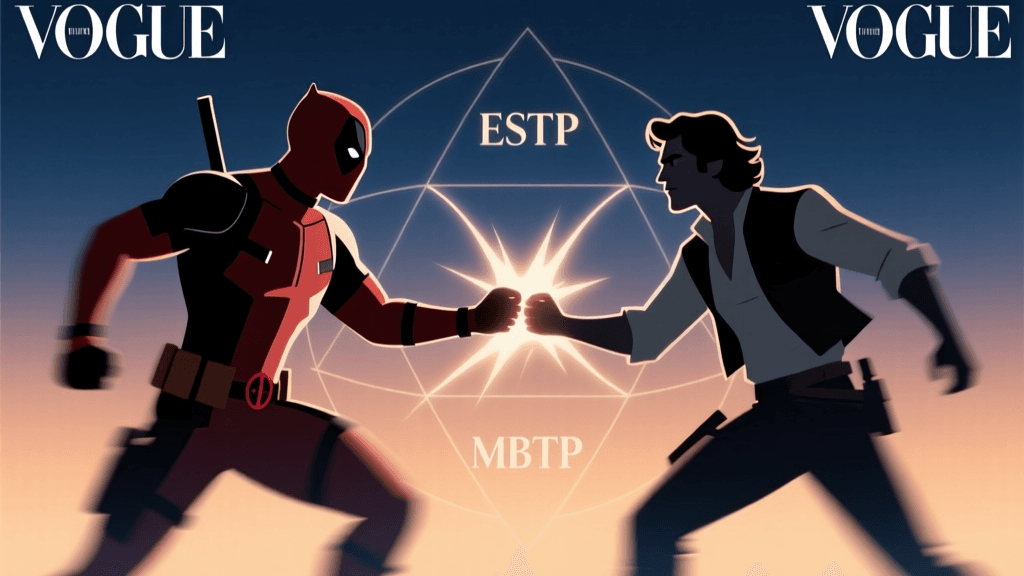
ESTP in Fictional Relationships
The ESTP—Extraverted, Sensing, Thinking, Perceiving—is often dubbed the Entrepreneur, Charmers, or Doers of the MBTI spectrum. In fictional storytelling, they rarely appear as brooding poets or meticulous planners. Instead, ESTPs leap into scenes with a cocky grin, a well-timed quip, and a tendency to solve relationship crises with action—not analysis. Their romantic dynamics are visceral, spontaneous, and grounded in tangible reality: touch, shared adrenaline, physical chemistry, and immediate emotional responsiveness.
Unlike INFJs who map emotional terrain before speaking, or INTJs who strategize long-term compatibility, ESTPs experience love as an embodied, moment-to-moment engagement. They don’t fall in love by reading between the lines—they fall when someone matches their pace, challenges their reflexes, and laughs *with* them—not *at* them—during a high-speed chase or bar brawl. This isn’t superficiality; it’s sensory fidelity. As psychologist David Keirsey observed in Please Understand Me II, ESTPs “live in the world of what is, not what might be”—a trait that makes them uniquely compelling (and sometimes frustrating) romantic leads in fiction.Keirsey.com
In narrative structure, ESTPs rarely initiate romance through grand declarations or symbolic gestures. Their first kiss happens mid-argument, after a near-death escape, or while fixing a broken engine under rain-soaked streetlights. Think of Han Solo brushing Leia’s hand while disabling the Death Star tractor beam—not because he’s rehearsed a line, but because the moment demanded proximity, urgency, and mutual competence. That’s ESTP romance: intimacy forged in real-time collaboration, not curated vulnerability.
What distinguishes ESTP-driven relationships from those led by other types is their low tolerance for emotional abstraction without behavioral proof. An ESTP character won’t believe ‘I love you’ unless it’s followed by action—showing up unannounced at a fight, sharing a last ration bar, or taking a bullet without hesitation. They distrust passive devotion. As clinical psychologist Dr. Dario Nardi notes in his neuroscientific MBTI research, ESTPs exhibit dominant extraverted Sensing (Se)—a cognitive function tied to heightened present-moment awareness, rapid pattern recognition in physical environments, and instinctive response to sensory stimuli—including facial microexpressions, body language shifts, and vocal tone fluctuations during conflict.Dario Nardi’s official site
This neurological wiring shapes how ESTPs navigate romantic tension. They read attraction like a combat scenario: assessing risk, timing, spatial proximity, and reciprocal energy. A slow-burn romance bores them—not because they lack depth, but because their cognitive architecture rewards immediacy. When writers force ESTPs into prolonged pining or internal monologues about ‘what if,’ the character rings false. Authentic ESTP romance thrives in scenes, not soliloquies.
Consider Katniss Everdeen (often typed as ESTP, though debated). Her bond with Peeta isn’t built on confessionals—it’s cemented in the arena: sharing bread, applying burn ointment, holding hands during the Victory Tour parade. Even her ambivalence toward both suitors stems from her Se-Ti axis: she observes behavior (‘Did he save me? Did he lie?’), weighs evidence (‘His hands trembled when he lied—but why?’), then acts decisively only when data converges. That’s not emotional avoidance—it’s evidence-based commitment.
ESTPs also bring refreshing honesty to fictional relationships. They rarely manipulate feelings to preserve harmony. If they’re bored, they’ll yawn mid-conversation. If they’re attracted, they’ll make eye contact and ask, ‘Wanna steal a speeder?’ Their bluntness isn’t cruelty—it’s efficiency. And when they commit, it’s with fierce protectiveness rooted in loyalty to the person *as they are*, not as they imagine them to be. They don’t seek to ‘fix’ partners; they seek partners who can keep up, adapt, and respond in kind.
Best Partner Types for ESTP Characters
While any MBTI type can form a meaningful bond with an ESTP, certain pairings generate richer narrative tension, thematic resonance, and psychological plausibility—especially in fiction where character arcs rely on complementary growth edges. The most narratively satisfying ESTP partnerships aren’t just ‘compatible’; they create dynamic friction that catalyzes development in both characters.
Below is a comparison of top partner types for ESTPs in fictional storytelling, ranked by narrative utility, psychological alignment, and documented relational patterns:
| Partner Type | Narrative Strengths | Growth Catalyst for ESTP | Potential Conflict Triggers | Iconic Example |
|---|---|---|---|---|
| ISFP | Shared Se-dom (present-moment intensity), mutual appreciation for aesthetics, spontaneity, and physical expression. High sensory chemistry. | Encourages emotional articulation through art, gesture, or shared silence—not just words. Softens ESTP’s blunt pragmatism with intuitive warmth. | ISFP’s need for inner peace vs. ESTP’s love of chaos; occasional misalignment on risk tolerance (e.g., ISFP avoids unnecessary danger). | Han Solo (ESTP) & Leia Organa (ISFP) — Star Wars |
| ISTJ | Stability anchor for ESTP’s impulsivity; ISTJ provides logistical scaffolding (plans, records, consistency) that lets ESTP shine in execution. | Teaches long-term consequence awareness; helps ESTP honor commitments beyond the ‘next exciting thing.’ | Clash over spontaneity vs. protocol; ESTP may perceive ISTJ as rigid; ISTJ may view ESTP as reckless or disrespectful of rules. | Jack Sparrow (ESTP) & Will Turner (ISTJ) — Pirates of the Caribbean (platonic, but structurally mirrors romantic dynamic) |
| ENFP | Electric synergy: both love novelty, adventure, and social charm. ENFP’s Ne inspires ESTP’s Se; ESTP’s realism grounds ENFP’s idealism. | Draws out ESTP’s values and deeper motivations; encourages reflection on ‘why’ behind actions—not just ‘how.’ | ENFP’s need for verbal affirmation vs. ESTP’s action-first love language; potential neglect of practical logistics (bills, safety, follow-through). | Tony Stark (ESTP) & Pepper Potts (ENFP) — Iron Man trilogy |
| INFJ | Profound contrast creates magnetic tension: ESTP’s realism vs. INFJ’s vision; Se vs. Ni; action vs. meaning. Often ‘opposites attract’ arcs. | Invites ESTP to consider long-term emotional impact, symbolic resonance, and ethical nuance beyond immediate outcomes. | Risk of mutual exhaustion: INFJ seeks depth, ESTP seeks motion; miscommunication around unspoken needs (INFJ expects intuitive understanding; ESTP expects direct asks). | James Bond (ESTP) & Vesper Lynd (INFJ) — Casino Royale |
Why do these pairings resonate so strongly in fiction? Because they reflect cognitive function complementarity. ESTP’s dominant Se pairs powerfully with ISFP’s auxiliary Fe (harmonizing values), ISTJ’s dominant Si (stabilizing memory), ENFP’s dominant Ne (expanding possibility), and INFJ’s dominant Ni (future-oriented insight). These couplings don’t just ‘work’—they create natural story engines: the ESTP drags the partner into action; the partner gives the action purpose.
Crucially, successful ESTP partnerships in fiction avoid two common tropes: (1) the ‘taming’ narrative (where the ESTP ‘settles down’ by abandoning core traits), and (2) the ‘chaos magnet’ trope (where the ESTP’s partner exists solely to absorb instability). Instead, the healthiest portrayals show mutual adaptation: Leia doesn’t stop Han from being reckless—she redefines recklessness as *protective*. Pepper doesn’t suppress Tony’s impulsivity—she builds fail-safes *around* it. That’s authentic romantic growth—not personality erasure.
ESTP Relationship Patterns in Stories
Fictional ESTPs follow distinct, recurring relational blueprints—not because writers lack imagination, but because these patterns reflect observable behavioral tendencies validated across decades of typological research and narrative analysis. Understanding these patterns helps creators write more believable chemistry and readers decode subtext in beloved romances.
Pattern 1: The ‘Competence Courtship’
ESTPs rarely fall for charisma alone. They fall for competence under pressure. Their romantic interest spikes when a potential partner demonstrates skill, calm, and resourcefulness in real-world stakes: disarming a bomb, negotiating a hostage situation, improvising a medical procedure, or winning a fistfight with minimal damage. This isn’t shallow admiration—it’s neurological attunement. Se-dominant types assess viability through observable performance. As noted in the Myers & Briggs Foundation’s official guide, ESTPs prioritize “what is real, actual, and immediately present” when forming judgments—including relational ones.
Practical writing tip: To signal ESTP attraction, show the character noticing *specific, physical details*—how the love interest’s hands move while reloading a weapon, the way they shift weight before dodging, the steadiness of their breath during crisis. Avoid inner monologues about ‘feeling safe’; instead, have the ESTP say, “You didn’t flinch when the ceiling collapsed. That’s rare.”
Pattern 2: The ‘Adrenaline Bond’
Shared danger accelerates ESTP attachment faster than months of coffee dates. This isn’t metaphorical—it’s biochemical. Co-experiencing acute stress triggers synchronized cortisol and oxytocin release, forging neural bonds. ESTPs intuitively engineer or gravitate toward these scenarios: escaping prisons, outrunning lava flows, surviving zombie hordes. Their proposal isn’t poetic—it’s tactical: “We’re stronger together. Let’s not split up again.”
Example: In Mad Max: Fury Road, Furiosa (ESTP) and Max Rockatansky (likely ESTP or ISTP) don’t exchange vows—they execute a flawless, high-risk maneuver to flip Immortan Joe’s war rig. Their partnership is sealed in grease, gunfire, and mutual survival. No dialogue needed.
Pattern 3: The ‘Blunt-but-Loyal’ Dynamic
ESTPs express devotion through unwavering presence and protective action—not grand speeches. Their love language is defensive readiness: standing between partner and threat, remembering minute preferences (“You take sugar *and* cream, right?”), or silently repairing something broken. But their honesty cuts both ways: they’ll call out hypocrisy, laziness, or self-deception—even mid-kiss—if it undermines authenticity.
Key nuance: This bluntness isn’t meant to wound. It’s diagnostic. Like a mechanic identifying a faulty transmission, the ESTP names problems to fix them—not shame. Writers who miss this confuse ESTP candor with cruelty. The fix? Pair criticism with immediate solution: “That plan’s flawed—here’s three ways to patch it.”
Pattern 4: The ‘Freedom-with-Fidelity’ Paradox
ESTPs fiercely resist possessiveness or emotional confinement—but demonstrate profound loyalty once committed. Their fidelity isn’t based on vows, but on earned trust and shared history. They’ll abandon a partner who lies or betrays confidence instantly—but stay through injury, exile, or disgrace if loyalty remains intact.
This creates rich dramatic irony: audiences fear the ESTP will leave, but the ESTP’s actions quietly prove otherwise. In Guardians of the Galaxy, Rocket Raccoon (ESTP) mocks Groot’s simplicity, abandons plans for personal gain, yet shields him from annihilation without hesitation. His love is non-verbal, non-transactional, and absolute—precisely because it’s unspoken.
Famous ESTP Fictional Couples
Let’s examine four iconic fictional couples where at least one partner is widely typed as ESTP—and how their dynamic exemplifies the principles above.
Han Solo (ESTP) & Princess Leia Organa (ISFP) — Star Wars
This pairing embodies the Competence Courtship and Adrenaline Bond in its purest form. Leia doesn’t win Han with titles or diplomacy—she wins him by outmaneuvering him in negotiation (“I don’t know who you are or where you came from, but you’re mine now”), then saving his life in the Death Star trench. Their banter isn’t flirtation—it’s sparring, testing reflexes and wit. When Han returns in Empire Strikes Back, it’s not with flowers, but with a blaster and a ship capable of evading Imperial destroyers. His love is calibrated to her capability.
Leia’s ISFP nature complements perfectly: she matches his physicality (lightsaber training, piloting), shares his disdain for bureaucracy, and expresses care through tactile presence (holding his hand before carbon freeze, cradling him post-rescue). Their final kiss isn’t romanticized—it’s urgent, desperate, and interrupted by stormtroopers. That’s ESTP-ISFP intimacy: love as shared survival.
Tony Stark (ESTP) & Pepper Potts (ENFP) — Iron Man Trilogy
A masterclass in Freedom-with-Fidelity and Blunt-but-Loyal dynamics. Tony’s ESTP impulsivity (building suits in caves, provoking aliens) constantly threatens Pepper’s stability. Yet Pepper doesn’t demand he change—she evolves alongside him: learning tech, managing PR fallout, even suiting up briefly in Iron Man 3. Her ENFP Ne reframes his chaos as innovation; his ESTP Se grounds her big ideas in executable steps.
Their turning point? When Tony, post-trauma, shuts down emotionally. Pepper doesn’t beg—he doesn’t need therapy talk. She sits beside him, recalibrates his arc reactor, and says, “Your chest-light’s flickering. Let me fix it.” Action as love language. Later, when he proposes, he doesn’t kneel—he builds her a tower. ESTP romance, decoded.
James Bond (ESTP) & Vesper Lynd (INFJ) — Casino Royale
The ultimate Opposites-Attract arc. Bond’s ESTP realism (“I’m a blunt instrument”) clashes with Vesper’s INFJ idealism (“We’re not supposed to feel anything”). Their attraction is intellectual friction: she sees through his armor; he sees past her deception. Their relationship forces Bond to confront consequences (Vesper’s death haunts him for years) and Vesper to question moral absolutes.
Crucially, their bond isn’t sustained by passion alone—it’s anchored in mutual sacrifice. Vesper chooses Bond over duty; Bond chooses vengeance over mission. The tragedy isn’t their incompatibility—it’s that their growth requires separation. This pairing proves ESTPs *can* engage deep emotional complexity—when the partner meets them in action *and* meaning.
Jack Sparrow (ESTP) & Angelica Teach (ESTP) — Pirates of the Caribbean: On Stranger Tides
Rarely discussed but profoundly instructive: an ESTP-ESTP pairing. Here, romance is pure kinetic energy—deception, swordplay, shared laughter mid-fall. They don’t ‘complete’ each other; they *compete* and *collude*. Their love language is mutual improvisation: lying seamlessly, stealing simultaneously, betraying then rescuing within seconds. It defies traditional ‘healthy relationship’ models—but reflects ESTP truth: love as exhilarating, unpredictable co-creation.
Why it works narratively: It avoids the ‘ESTP needs taming’ trope. Neither sacrifices core identity. Their ending isn’t marriage—it’s sailing separate ships, forever aware of each other’s wake. Freedom *is* the fidelity.
FAQ
Are ESTPs bad at long-term commitment in fiction?
No—ESTPs are often *exceptionally* loyal in fiction, but their commitment manifests differently. They don’t pledge ‘forever’ in abstract terms; they pledge action: “I’ll always have your six,” “I’ll rebuild your ship,” “I’ll die before I let them take you.” Long-term bonds emerge through accumulated deeds, not declarations. When writers reduce ESTPs to ‘players,’ they ignore their fierce, protective loyalty to chosen people—a trait consistently documented in Keirsey’s longitudinal studies of SP temperaments.
Why do ESTPs often pair with ISFPs in popular media?
Because ISFPs share ESTPs’ dominant perceiving function (Se) and value authenticity, aesthetics, and physical presence. Both types communicate best through gesture, environment, and shared experience—not exposition. As the Myers & Briggs Foundation explains, SP types (Sensing-Perceiving) “focus on immediate realities and adapt flexibly to changing circumstances”—making ISFP-ESTP duos naturally synergistic in high-stakes, sensory-rich narratives like heist films or wartime dramas.
Can ESTPs have healthy relationships with Feeling (F) types?
Absolutely—and some of fiction’s most resonant romances involve ESTP-F pairings (e.g., ESTP Han and ISFP Leia; ESTP Tony and ENFP Pepper). The key is functional balance: the F partner doesn’t demand constant emotional verbalization, and the ESTP doesn’t dismiss the F partner’s values as ‘illogical.’ Healthy ESTP-F dynamics thrive when Feeling types appreciate ESTP’s protective actions as love expressions, and ESTPs learn to translate feelings into tangible support (e.g., “You seem overwhelmed—I’ll handle the logistics so you can rest”).
What’s the biggest mistake writers make with ESTP romance?
Assuming ESTPs lack emotional depth. In reality, their emotions are intense, immediate, and somatically anchored—they just process them through action, not introspection. Writing an ESTP who suddenly delivers a 5-minute monologue about childhood trauma breaks character. Better: show them slamming a fist into a wall *then* handing their partner a cold beer and saying, “Tell me what you need. Now.” Depth isn’t absent—it’s embodied.
In conclusion, ESTP romance in fiction is neither shallow nor simplistic—it’s a high-resolution portrait of love as lived experience: urgent, sensory, courageous, and fiercely loyal. When writers honor their cognitive wiring—prioritizing action over abstraction, competence over credentials, and presence over poetry—they unlock some of storytelling’s most electrifying, enduring, and human relationships. Whether dodging blaster fire or rebuilding a shattered city, the ESTP doesn’t fall in love with ideals. They fall in love with the person who stands beside them—in the dirt, in the smoke, in the glorious, messy now.