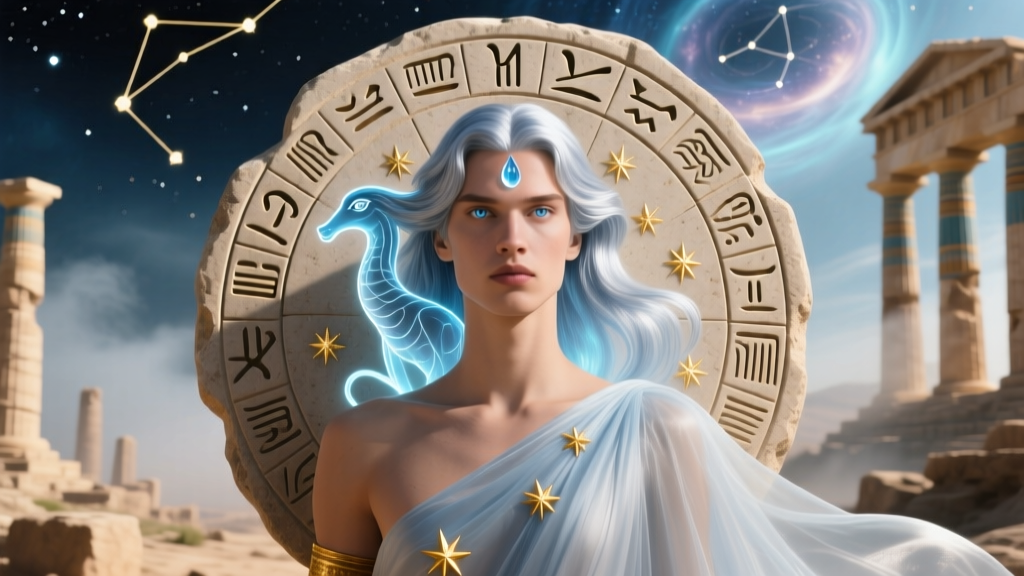
Individuals born on February 1 fall under the Aquarius sun sign. The feb 1 zodiac sign represents a fascinating intersection of ancient celestial observation and mythological evolution. Far from modern pop-astrology tropes, the origins of this fixed air sign trace back over 4,000 years to Mesopotamian star catalogs. Understanding the historical lineage of the Water Bearer provides profound context for the intellectual, diplomatic, and humanitarian traits associated with this specific birth date. By examining the astronomical texts and mythological shifts that defined this constellation, we can uncover the precise psychological blueprint of the February 1 archetype.
The Babylonian Roots: GU.LA and the Great One
The earliest recorded origins of the Aquarius constellation emerge from ancient Babylon. In the MUL.APIN, a comprehensive Babylonian star catalog compiled around 1000 BCE, the constellation was identified as GU.LA, meaning 'The Great One.' According to Ian Ridpath's Star Tales, this figure represented the god Ea (also known as Enki), the supreme ruler of the Apsu—the subterranean realm of fresh waters. Ea was the patron deity of wisdom, magic, incantations, and creation.
Unlike later interpretations that depicted a mere mortal pouring water, the Babylonian GU.LA was a supreme creator deity holding a vase from which the life-giving rivers Tigris and Euphrates flowed. The prominent stars in this constellation, Sadalmelik (Alpha Aquarii) and Sadalsuud (Beta Aquarii), later named by Arabic astronomers, translate to 'Luck of the King' and 'Luck of Lucks,' reflecting the deeply benevolent, life-sustaining nature of Ea's waters. This foundational myth establishes the core Aquarian archetype: the dispenser of intellectual and spiritual nourishment to humanity, operating from a position of profound systemic authority.
Egyptian Mythology: Hapi and the Nile's Inundation
As astronomical knowledge migrated to the Nile Valley, the Babylonian water-pouring deity syncretized with Egyptian cosmology. The Egyptians associated this region of the sky with Hapi, the god responsible for the annual inundation of the Nile. The flooding was not merely an agricultural event; it was a cosmic reset that deposited nutrient-rich silt across the delta, ensuring the survival and prosperity of the empire.
The Water Bearer's urn, therefore, symbolized the controlled release of vital, transformative resources. The timing of the sun's transit through this region of the sky correlated with the life cycles of the ancient world. For those born on February 1, this historical layer explains the innate drive to facilitate systemic renewal, dismantle obsolete structures, and distribute resources equitably within their communities. They are the architects of the 'inundation' that clears away dead wood to allow new growth.
Greek Antiquity: Ganymede and the Divine Cupbearer
The Hellenistic era drastically altered the mythological framework of the constellation. The Greeks stripped the figure of its divine, creator-god status, reimagining it as Ganymede, a handsome Trojan prince. According to myth, Zeus transformed into an eagle to abduct Ganymede, bringing him to Mount Olympus to serve as the cupbearer of the gods, replacing Hebe.
While this narrative shifted the archetype from a supreme deity to a servant, it introduced the concept of the 'divine intermediary.' Ganymede bridged the mortal and immortal realms, pouring the nectar of the gods and maintaining the harmony of the Olympian court. This transition is crucial for understanding the modern Aquarian paradox: they are deeply humanitarian and grounded in collective service, yet they often feel like outsiders observing humanity from an elevated, detached vantage point. They serve the collective, but they do not entirely belong to it.
The Elemental Paradox: Why the Water Bearer is an Air Sign
A common point of confusion in astrological studies is why a figure explicitly pouring water is classified as a fixed Air sign. The resolution to this paradox lies in Claudius Ptolemy’s foundational text, the Tetrabiblos, written in the 2nd century CE. Ptolemy categorized the signs based on seasonal, elemental, and atmospheric qualities rather than literal mythological imagery.
Aquarius falls in the late winter months in the Northern Hemisphere, a time when the air is cold and wet, but the intellectual current of the coming spring is beginning to stir beneath the surface. Furthermore, esoteric and Hellenistic traditions argue that the water poured from the Aquarian urn is not literal H2O, but the 'ether'—the fluid transmission of higher knowledge, ideas, and electrical impulses. The 'water' is the medium through which intellectual currents flow, making it an inherently mental and communicative sign, focused on the atmosphere of society rather than its emotional depths.
The Feb 1 Zodiac Sign: Second Decan and Mercurial Influence
To achieve absolute precision regarding the feb 1 zodiac sign, we must examine the decanic subdivisions of Aquarius. February 1 falls squarely within the second decan of Aquarius, spanning from 10° to 20° of the sign (roughly January 30 to February 8). While the primary ruler of Aquarius is Saturn (traditional) and Uranus (modern), the second decan is sub-ruled by Mercury, operating through the lens of Libra.
This Mercurial sub-rulership drastically modifies the baseline Aquarian personality. Where the first decan of Aquarius can be rigid, overly dogmatic, and fiercely independent (pure Saturnian influence), the February 1 born possesses a highly developed diplomatic apparatus. Mercury bestows exceptional communicative agility, while the Libra overlay demands harmony, aesthetic balance, and intellectual fairness. Individuals born on this date are the negotiators, translators, and synthesizers of the zodiac. They do not merely invent radical concepts in isolation; they possess the linguistic and social dexterity to translate those concepts into palatable, actionable frameworks for the masses.
Historical Timeline of Aquarius Symbolism
| Era | Culture | Designation / Figure | Core Symbolism & Function |
|---|---|---|---|
| c. 1000 BCE | Babylonian | GU.LA (Ea / Enki) | Supreme wisdom, creation, life-giving rivers, magic |
| c. 2000 BCE | Egyptian | Hapi | Nile inundation, agricultural renewal, cosmic reset |
| c. 800 BCE | Greek | Ganymede | Divine intermediary, service to the collective, harmony |
| 2nd Century CE | Hellenistic | Ptolemy's Air Sign | Intellectual currents, ether, systemic thought, fixed air |
Actionable Application: Leveraging Historical Aquarian Traits
Understanding the deep historical and astrological mechanics of your birth date provides a concrete framework for personal and professional development. Rather than relying on generic horoscopes, individuals born on February 1 can leverage their specific mythological and decanic heritage in the following ways:
- Channeling Ea (The Systemic Creator): When facing systemic problems in your workplace or community, adopt the GU.LA archetype. Do not merely critique the existing structure; focus on designing and distributing the 'fresh water'—the innovative, life-sustaining solutions, protocols, or technologies that allow the system to thrive independently.
- Leveraging the Mercurial Second Decan: Your superpower is translation and diplomacy. If you work in technology, engineering, data science, or avant-garde arts, your optimal role bridges the gap between complex data and end-user experience. Position yourself as the liaison between isolated visionaries and the general public, utilizing your Libra-ruled tact to negotiate buy-in for radical ideas.
- Embodying the Divine Intermediary: Ganymede’s role was to serve the collective by distributing divine nectar. In modern terms, this translates to curating high-value information. Build platforms, newsletters, or community forums where you filter signal from noise, providing your network with clear, elevated insights that promote collective harmony.
- Mastering the Ether (Air Sign Focus): Recognize that your 'water' is actually intellectual ether. When you feel emotionally detached or misunderstood, shift your focus to your intellectual output. Your primary mode of connecting with others is through the exchange of ideas, collaborative problem-solving, and shared visions for the future, rather than heavy emotional processing.
The Enduring Legacy of the February 1 Archetype
The trajectory of the Aquarius constellation—from a supreme Mesopotamian water god to a Greek cupbearer, and finally to a Ptolemaic fixed air sign—mirrors the psychological evolution of those born under its influence. The feb 1 zodiac sign is not merely a marker of eccentricity or rebellion, as modern media often suggests. It is a deeply historical archetype rooted in the distribution of wisdom, the facilitation of systemic renewal, and the intellectual bridging of disparate worlds. By anchoring your self-understanding in these ancient origins and acknowledging your Mercurial decan placement, you move beyond superficial personality traits and tap into a 4,000-year-old lineage of visionary service. For further reading on the classical elemental classifications, consult the historical translations of Ptolemaic astrology on Britannica, which detail how the ancients mapped the sky to human psychology and societal structures.