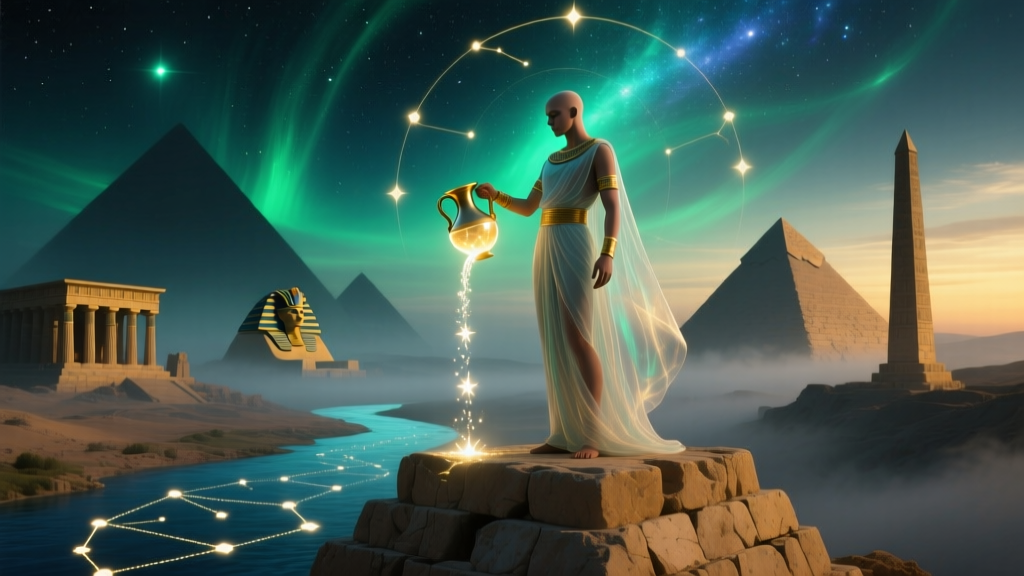
The Astronomical and Historical Roots of the Feb 15 Zodiac Sign
When examining the Feb 15 zodiac sign, we are looking at the 26th degree of tropical Aquarius. Unlike modern pop-astrology that reduces this date to generic horoscopes, the historical origin of this specific placement reveals a complex tapestry of ancient Mesopotamian astronomy, Hellenistic myth, and planetary evolution. The archetype of the Water Bearer was not invented by contemporary astrologers; it was codified over 3,000 years ago in the Babylonian star catalogs. To understand the true esoteric and historical weight of being born on February 15, we must trace the lineage of this sign from the banks of the Euphrates to the observatories of Alexandria.
Babylonian Origins: GU.LA and the God Ea
The earliest recorded iteration of the Aquarius constellation appears in the MUL.APIN, a comprehensive Babylonian astronomical text compiled around 1000 BCE. In this catalog, the constellation was not known as the Water Bearer, but as GU.LA, meaning 'The Great One.' This figure was directly associated with Ea (or Enki), the Mesopotamian god of water, wisdom, and creation.
Iconography from the Kassite period and later Neo-Babylonian boundary stones (kudurru) depict Ea holding a vase from which two streams of water flow, often with fish swimming within the currents. For the agrarian societies of ancient Mesopotamia, this imagery was not merely mythological; it was deeply tied to the seasonal flooding of the Tigris and Euphrates rivers. The sun's transit through this sector of the sky coincided with the life-giving, albeit destructive, winter rains and subsequent spring floods. Therefore, the foundational archetype of the Feb 15 zodiac sign is rooted in the dispensation of vital resources, intellectual wisdom, and the unpredictable forces of nature.
Hellenistic Astrology and the Myth of Ganymede
When Babylonian astronomy was synthesized with Greek philosophy during the Hellenistic period (circa 3rd century BCE), the archetype underwent a significant mythological shift. The Greek astronomer Ptolemy, in his foundational 2nd-century CE text Tetrabiblos, solidified the tropical zodiac that we use today. However, the Greeks replaced the god Ea with mortal or semi-divine figures.
The most prominent Hellenistic myth associated with this sector of the sky is that of Ganymede, the Trojan prince whose unparalleled beauty prompted Zeus to transform into an eagle, abduct him, and install him as the cupbearer to the Olympian gods. This narrative introduced themes of divine election, intellectual elevation, and service to a higher collective ideal—traits that deeply inform the psychological profile of late-degree Aquarius natives.
Alternative Greek Origins: The Flood of Deucalion
Earlier Greek sources, such as Eratosthenes in his Catasterismi, sometimes identified the figure as Deucalion, the Greek equivalent of Noah, who survived a cataclysmic global flood sent by Zeus. This origin story emphasizes survival, the preservation of human knowledge, and the rebuilding of society. For individuals born on February 15, the Deucalion myth underscores a historical imperative to act as an archivist of human progress and a catalyst for societal reconstruction following systemic collapse.
The Chaldean Decans: The Venusian Undertone of Late Aquarius
To achieve true astrological precision, we must look beyond the primary sign and examine the specific degree. February 15 typically falls at 26 degrees Aquarius. In the ancient Chaldean decan system, preserved by Hellenistic astrologers like Teucer of Babylon and later expanded by medieval Persian astrologers such as Abu Ma'shar, the zodiac is divided into 36 decans of 10 degrees each.
The third decan of Aquarius (20 to 30 degrees) is historically co-ruled by Venus, through its association with the sign of Libra. This is a critical piece of information gain for understanding the Feb 15 zodiac sign. While the primary sign is ruled by the austere, structural planet Saturn (and modernly, the disruptive Uranus), the decanic sub-ruler is Venus. This creates a unique historical synthesis: the radical, systemic reform of Aquarius is tempered and executed through the diplomatic, aesthetic, and relational strategies of Libra. Natives born on this date often possess a rare historical capability to implement avant-garde ideas without entirely alienating the social consensus.
Evolution of Planetary Rulership: Saturn to Uranus
For over two millennia, Saturn was the sole traditional ruler of Aquarius. Saturn provided the sign with its structural, philosophical, and institutional frameworks. The historical figures born under this sign prior to 1781 operated purely under this Saturnian paradigm, focusing on the codification of laws, the building of institutions, and the systematic categorization of knowledge.
The discovery of the planet Uranus by William Herschel in 1781 fundamentally fractured the historical paradigm. Modern astrologers assigned Uranus as the primary ruler of Aquarius, shifting the focus from structural preservation (Saturn) to sudden revolution, technological innovation, and systemic disruption (Uranus). Individuals born on February 15 today inherit a dual planetary heritage: the ancient Saturnian mandate to build enduring societal frameworks, combined with the modern Uranian imperative to shatter obsolete paradigms.
Historical Figures Born on February 15
Analyzing the historical impact of notable figures born on this date provides empirical evidence of how the 26th degree of Aquarius manifests in the real world. The following table outlines key historical personalities and their alignment with the Aquarian archetype.
| Historical Figure | Birth Year | Historical Impact | Astrological Signature |
|---|---|---|---|
| Galileo Galilei | 1564 | Championed heliocentrism, revolutionizing observational astronomy and the scientific method. | Uranian disruption of geocentric dogma; Saturnian rigor in mathematical proof. |
| Susan B. Anthony | 1820 | Pivotal leader in the women's suffrage movement, fundamentally altering civic rights. | Aquarian humanitarianism; utilization of the Venus-ruled decan for coalition building. |
| Ernest Shackleton | 1874 | Led the Imperial Trans-Antarctic Expedition, renowned for leadership in extreme survival. | Saturnian endurance; systemic preservation of his crew against environmental collapse. |
| Graham Greene | 1904 | Explored the ambiguous moral and political landscapes of the 20th century in literature. | Detached observation of societal decay; intellectual categorization of human morality. |
Tracing the Constellation vs. the Tropical Sign
A common point of confusion in historical astrology is the discrepancy between the tropical zodiac signs and the actual astronomical constellations. Due to the precession of the equinoxes—a slow wobble of the Earth's rotational axis first documented by Hipparchus in 127 BCE—the tropical zodiac has drifted approximately 24 degrees away from the sidereal constellations over the last two millennia.
Consequently, when the Sun occupies the Feb 15 zodiac sign (tropical Aquarius), it is astronomically positioned in front of the constellation of Capricorn. According to the International Astronomical Union (IAU), the physical boundaries of the constellations do not align with the 30-degree equal divisions of the tropical zodiac. Understanding this distinction is vital for historical accuracy: the psychological and seasonal archetype of the Water Bearer applies to the tropical sign, while the deep-space stellar influences apply to the sidereal constellation. For the tropical Aquarian born on February 15, the seasonal marker of late winter's impending thaw takes precedence over the physical starlight of the sea-goat.
The Egyptian Parallel: Hapi and the Nile Inundation
It is also necessary to acknowledge the Egyptian astronomical tradition. In ancient Egypt, the equivalent sector of the sky was associated with Hapi, the god of the annual flooding of the Nile. Hapi was depicted pouring water from two vessels, mirroring the Babylonian Ea. This cross-cultural synchronicity, documented extensively by historians of ancient astronomy, proves that the archetype of the 'Water Bearer' is not a localized myth, but a universal human response to the seasonal hydrological cycles that dictated early civilization's survival. For further reading on the syncretism of these ancient astrological systems, the traditional archives at Skyscript provide exhaustive translations of Hellenistic and medieval texts.
Actionable Guidance for Late-Degree Aquarius Natives
Understanding the historical and decanic origins of your birth date provides a concrete framework for personal and professional strategy. Rather than relying on vague horoscopes, apply these historically grounded principles:
- Leverage Decanic Diplomacy: Because the 26th degree falls in the Venus-ruled Libra decan, schedule high-stakes negotiations, collaborative design projects, and public relations campaigns during your solar return month. Use Libran tact to soften the abrasive edge of Uranian innovation.
- Channel the Deucalion Archetype: In times of industry or societal disruption, position yourself as an archivist and a builder. Do not merely disrupt for the sake of chaos; ensure you have a structural framework (Saturn) ready to rebuild what you have dismantled.
- Utilize the Ea Paradigm for Knowledge Dispensation: The original Babylonian god of this sector was the master of hidden wisdom. Focus your career or personal development on the democratization of complex information. Roles in educational technology, open-source development, or systemic reform align perfectly with this ancient mandate.
The history of the Feb 15 zodiac sign is a testament to humanity's enduring attempt to map the mechanics of progress, survival, and collective evolution. By anchoring your understanding in these ancient origins, you move beyond superficial personality traits and tap into a millennia-old lineage of systemic reform and intellectual dispensation.