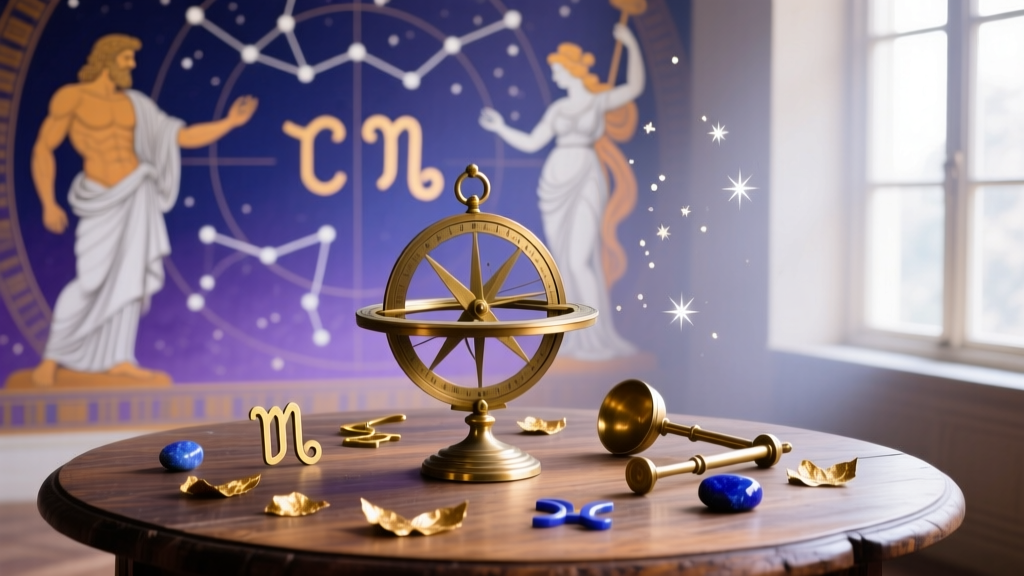
The february 19 zodiac sign designation represents one of the most historically complex boundaries in Western astrology: the threshold between Aquarius and Pisces. Unlike the fixed calendar dates found in pop-culture horoscopes, the exact solar ingress into Pisces fluctuates between February 18 and February 20 due to leap year cycles and the Earth's elliptical orbit. To understand the February 19 placement, we must examine the ancient Babylonian star catalogues, Hellenistic astronomical frameworks, and the mythological synthesis that created the 'Cusp of Sensitivity.' This historical analysis reveals how ancient sky-watchers mapped the transition from the Water-Bearer to the Fish.
The Astronomical Framework of the February 19 Zodiac Sign
The Western astrological system relies on the tropical zodiac, a framework formalized by the Greco-Roman astronomer Claudius Ptolemy in the 2nd century CE. As detailed in Ptolemy's Tetrabiblos, the tropical zodiac is anchored to the vernal equinox rather than the shifting background of the physical constellations. Ptolemy established that the sign of Aries begins exactly at the spring equinox, dividing the ecliptic into twelve equal 30-degree segments.
Because the Earth's orbit is elliptical and the calendar year (365 days) does not perfectly match the solar year (365.24219 days), the Sun's entry into the 330th degree of the ecliptic—the beginning of Pisces—drifts across a 48-hour window. Therefore, the February 19 zodiac sign is not a static historical artifact but a dynamic astronomical event. Depending on the leap year cycle, the Sun may ingress into Pisces on February 18 at 19:00 UTC, or remain in Aquarius until February 19 at 08:00 UTC. This mechanical reality necessitates the use of precise ephemeris data rather than generalized calendar dates for accurate historical and natal chart calculations.
Babylonian Antiquity: GU.LA and the Tails of the Fish
The origins of the Aquarius-Pisces boundary predate Greek astrology by over a millennium, rooted in the astronomical diaries of ancient Mesopotamia. The primary source for this early celestial mapping is the MUL.APIN, a Babylonian star catalogue compiled around 1000 BCE. According to historical analyses documented by Encyclopædia Britannica's overview of the zodiac, the Babylonians divided the ecliptic into specific constellations that heavily influenced later Hellenistic astrology.
In the MUL.APIN, the region of the sky we now call Aquarius was designated as GU.LA (The Great One). This figure was intrinsically linked to Enki (later known as Ea), the Sumerian god of water, knowledge, and creation. Enki was traditionally depicted with two streams of water flowing from his shoulders, representing the life-giving Tigris and Euphrates rivers. This specific iconography was directly inherited by the Greeks as the Water-Bearer.
Adjacent to GU.LA in the Babylonian sky were the KUN.MEŠ (The Tails), which later evolved into the Greek Piscis Austrinus (Southern Fish) and eventually the dual fish of Pisces. The historical transition from the Babylonian 'Tails' to the Hellenistic 'Two Fish' represents a fundamental shift in astrological symbolism, moving from a singular divine source of water to a dualistic representation of spirit and matter. The February 19 boundary, therefore, marks the ancient geographic transition in the sky from the domain of the creator god Enki to the vast, uncharted waters of the cosmic ocean.
Hellenistic Synthesis and Mythological Origins
When Alexandrian astrologers synthesized Babylonian observational data with Greek mythology between the 3rd and 1st centuries BCE, they assigned specific myths to the zodiacal signs to encode esoteric meaning. The transition from Aquarius to Pisces was framed through two distinct but interconnected mythological narratives:
- Ganymede and the Olympian Cup: Aquarius became identified with Ganymede, the Trojan prince abducted by Zeus to serve as the cupbearer to the gods. The water he pours represents divine intellect, inspiration, and the higher mind being distributed to humanity.
- Aphrodite, Eros, and the Tethered Fish: Pisces was linked to the myth of Aphrodite and her son Eros. Fleeing the monstrous Typhon, the deities transformed into fish and tied themselves together with a cord to avoid being separated in the Euphrates River. This tethering represents emotional bonds, empathy, and the duality of the mortal and divine soul.
The historical intersection of these myths on February 19 creates the 'Cusp of Sensitivity.' It bridges the detached, intellectual air of Ganymede serving the Olympian pantheon with the deeply emotional, bound water of the tethered fish navigating the subconscious depths. Individuals born on this historical cusp were traditionally viewed by Hellenistic astrologers as possessing the unique ability to translate divine, abstract intellect (Aquarius) into compassionate, tangible empathy (Pisces).
Ephemeris Data: The Fluctuation of the Solar Ingress
To demonstrate the historical and astronomical reality of the February 19 zodiac sign boundary, we must examine the exact solar ingress data. The International Astronomical Union (IAU) defines the physical constellations, but astrological signs are based on the tropical ecliptic. The following table illustrates how the Sun's entry into Pisces shifts across a nine-year leap cycle, proving that a February 19 birth does not guarantee a specific sun sign without the exact time of birth.
| Year | Sun Ingress Date (UTC) | Exact Time (UTC) | Zodiacal Status on Feb 19 (00:00 UTC) |
|---|---|---|---|
| 1996 (Leap) | February 19 | 07:30 | Aquarius |
| 1997 | February 18 | 13:15 | Pisces |
| 1998 | February 18 | 19:05 | Pisces |
| 1999 | February 19 | 00:45 | Pisces |
| 2000 (Leap) | February 19 | 06:30 | Aquarius |
| 2001 | February 18 | 12:10 | Pisces |
| 2002 | February 18 | 18:00 | Pisces |
| 2003 | February 18 | 23:50 | Pisces |
| 2004 (Leap) | February 19 | 05:40 | Aquarius |
This data highlights a critical rule in professional astrology: anyone born on February 19 must calculate their natal chart using their exact time and location of birth. In leap years and the years immediately following them, the Sun often remains in Aquarius well into the afternoon or evening of February 19. In standard years, the Sun typically crosses the boundary into Pisces late on February 18.
The Evolution of Planetary Rulership
The historical interpretation of the February 19 cusp has evolved dramatically alongside astronomical discoveries. In traditional Hellenistic and Medieval astrology, the cusp was governed by Saturn (the traditional ruler of Aquarius) and Jupiter (the traditional ruler of Pisces). Saturn's influence brought structure, discipline, and karmic boundaries, while Jupiter offered expansion, philosophy, and spiritual wisdom. Individuals born on this historical cusp were viewed as bridging the gap between rigid earthly structures and boundless spiritual truths.
However, the discovery of Uranus by William Herschel in 1781 and Neptune by Johann Galle in 1846 fundamentally altered the astrological paradigm. Modern psychological astrology reassigned Uranus to Aquarius and Neptune to Pisces. This shifted the February 19 interpretation from a Saturn-Jupiter dynamic to a Uranus-Neptune dynamic. The modern historical lens views this cusp as the intersection of revolutionary awakening (Uranus) and mystical dissolution (Neptune). This esoteric evolution transformed the 'Cusp of Sensitivity' into the 'Cusp of Vision,' emphasizing the historical shift from classical philosophical structures to modern psychological and spiritual integration.