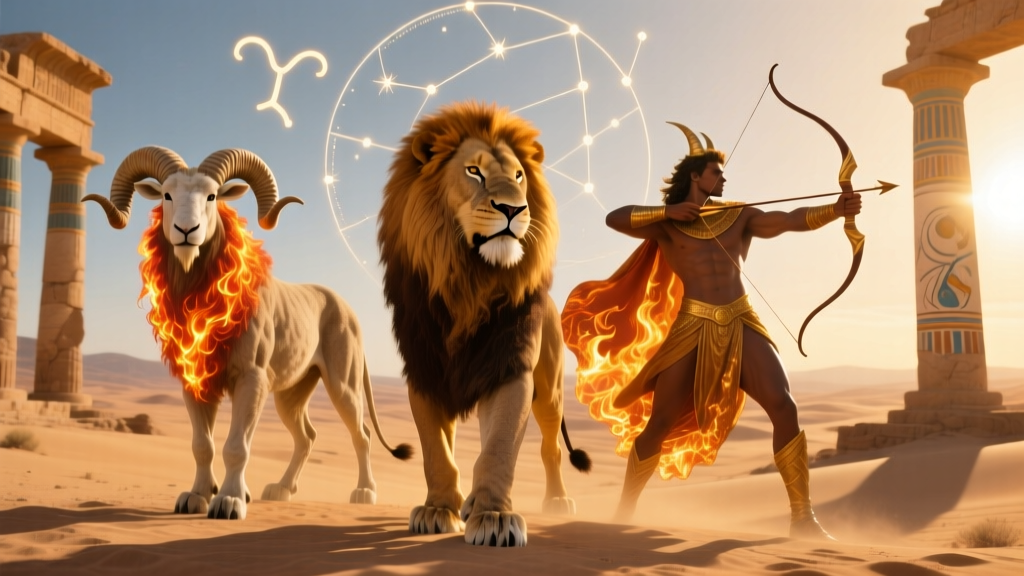
The categorization of the fire signs zodiac—Aries, Leo, and Sagittarius—is not a modern psychological invention, but the result of a millennia-long synthesis of Mesopotamian astronomy and Greek natural philosophy. To understand the fiery triplicity, one must look past contemporary pop-astrology tropes of impulsivity and anger. The true origin story of the fire signs zodiac begins in the agrarian calendars of ancient Babylon and culminates in the elemental physics of Hellenistic Alexandria. This historical excavation reveals how the Ram, the Lion, and the Archer were bound together by the classical element of fire, defined by the qualities of heat and dryness.
The Empedoclean Roots of the Fire Signs Zodiac
Before the zodiac was mapped to elements, the concept of the elements itself had to be formalized. The philosophical bedrock of the fire signs zodiac originates with Empedocles of Acragas (c. 494–434 BCE). As documented by the Stanford Encyclopedia of Philosophy, Empedocles proposed that all matter was composed of four eternal roots: fire, air, water, and earth. These were driven by the cosmic forces of Love (attraction) and Strife (separation).
Aristotle later expanded this framework by assigning two primary qualities to each element. Fire was designated as fundamentally 'hot' and 'dry'. In the context of ancient physics, 'heat' was the quality that caused matter to expand, rise, and animate, while 'dryness' was the quality that caused matter to separate, hold its distinct shape, and resist blending. Therefore, the original definition of fire was not merely 'passion' or 'combustion'; it was the physical principle of expansion and individuation. When Hellenistic astrologers later applied this physics to the zodiac, the fire signs became the archetypal expressions of boundary-setting, upward momentum, and distinct identity.
Babylonian Predecessors: MUL.APIN and the Constellations
The constellations that comprise the fire signs zodiac existed long before Greek elemental theory was applied to them. The earliest comprehensive catalog of these stars is found in the Babylonian MUL.APIN tablets, compiled around 1000 BCE. The Babylonians did not use a four-element system; instead, they organized the sky based on seasonal, agricultural, and mythological markers tied to the Tigris and Euphrates river cycles.
The Ram, The Lion, and The Archer
In the MUL.APIN, the stars we now call Aries were known as the 'Hired Man' (LÚ.ḪUN.GÁ), associated with the spring equinox, the god Tammuz, and the beginning of the agricultural labor season. Leo was simply 'The Lion' (UR.GU.LA), linked to the brutal heat of the summer solstice and the goddess Ishtar. Sagittarius was represented by Pabilsag, a centaur-like deity of the hunt, the underworld, and the autumnal harvest.
Crucially, the Babylonians recognized the intense solar and seasonal power of these specific constellations. The Hired Man marked the return of the sun's vitality; the Lion marked the peak of summer drought and heat; Pabilsag oversaw the burning of the fields after the harvest. When Greek astrologers later sought to map Empedoclean elements onto the zodiac, they looked at the seasonal realities of these constellations and logically assigned them the 'hot and dry' elemental signature.
Hellenistic Synthesis: Assigning the Elements
The formal integration of the fire signs zodiac into a cohesive elemental system occurred in Hellenistic Alexandria between the 2nd century BCE and the 2nd century CE. Astrologers like Vettius Valens and Dorotheus of Sidon merged Babylonian observational astronomy with Stoic and Aristotelian physics. They introduced the concept of 'triplicities' (or trigons), dividing the 360-degree zodiac wheel into four equilateral triangles.
The fire triplicity (Aries, Leo, Sagittarius) was assigned to the diurnal (daytime) sect, known in Greek as hairesis. Because fire produces light and rises toward the heavens, it was considered inherently aligned with the day, the sun, and outward, visible projection. The planetary rulers of this triplicity were assigned based on their affinity for heat and dryness: the Sun (ruler of Leo), Jupiter (ruler of Sagittarius), and Saturn (which, despite being cold, was considered dry and structurally necessary for the fire triplicity's nocturnal charts). This highly technical framework transformed the fire signs from mere star pictures into a sophisticated mathematical and philosophical model of time and temperament.
Ptolemy and the Tetrabiblos Framework
Claudius Ptolemy (2nd century CE) solidified this system in his seminal text, the Tetrabiblos. As translated in the LacusCurtius digital archive, Ptolemy stripped away much of the mythological baggage of earlier eras, grounding the zodiac strictly in seasonal physics. He argued that Aries initiates the spring equinox, where heat begins to increase and moisture begins to dry out. Leo represents the peak of summer, characterized by maximum heat and dryness. Sagittarius, marking the late autumn, retains the dry, fiery nature of the harvest fires and the preparation for winter. Ptolemy's rationalization, further analyzed by Encyclopædia Britannica, became the undisputed standard for Western astrology for the next eighteen centuries.
Evolutionary Table: Fire Signs from Antiquity to Modernity
| Era | Aries Archetype | Leo Archetype | Sagittarius Archetype | Elemental Status |
|---|---|---|---|---|
| Babylonian (c. 1000 BCE) | The Hired Man (Agrarian labor) | The Lion (Summer drought) | Pabilsag (Harvest & Hunt) | Seasonal/Agricultural |
| Hellenistic (c. 100 CE) | Cardinal Fire (Initiation) | Fixed Fire (Sustained Light) | Mutable Fire (Distribution) | Hot & Dry (Diurnal Sect) |
| Medieval (c. 1200 CE) | Martial Choleric | Solar Choleric | Jovial Choleric | Choleric Humor |
| Modern Psychological | Extroverted Intuition/Will | Ego/Creative Sovereignty | Teleological Meaning-Seeking | Spiritual Volition |
Translating Ancient Physics to Modern Psychological Fire
Understanding the historical origin of the fire signs zodiac provides a highly actionable framework for modern chart interpretation. Contemporary astrology often reduces fire placements to superficial traits: anger, loudness, or generic 'passion.' However, returning to the Aristotelian definition of fire as 'hot and dry' yields a much more precise psychological diagnostic tool.
Heat expands and seeks the future; dryness separates and defines boundaries. Therefore, the core psychological function of the fire signs is individuation and teleological drive. When analyzing a natal chart, apply this historical framework to decode complex placements:
- Boundary Setting (Dryness): A prominent Aries or Leo placement does not just indicate 'energy'; it indicates a psychological imperative to separate the self from the collective. The 'selfishness' often attributed to fire signs is historically rooted in the dry quality's need to maintain distinct structural integrity against the merging tendencies of water.
- Teleological Drive (Heat): Sagittarius and prominent Jupiter placements operate on the principle of heat rising. This manifests as a compulsion to seek overarching meaning, philosophy, or future horizons. The psychological distress of a 'blocked' fire sign is not just frustration; it is the suffocation of upward momentum and future-orientation.
- Sect and Visibility: Because the fire triplicity was historically assigned to the diurnal (daytime) sect, fire placements in a birth chart demand visibility. They are psychological functions that require external validation, objective realization, and conscious awareness to operate healthily. Repressing a fire placement forces it into the unconscious (the nocturnal realm), where it manifests as destructive, uncontrolled combustion.
By anchoring the fire signs zodiac in its rigorous historical and philosophical origins, astrologers and students can move beyond caricature. The Ram, the Lion, and the Archer are not merely symbols of temperament; they are the ancient, mathematically derived coordinates of human volition, sovereignty, and the relentless drive toward meaning.