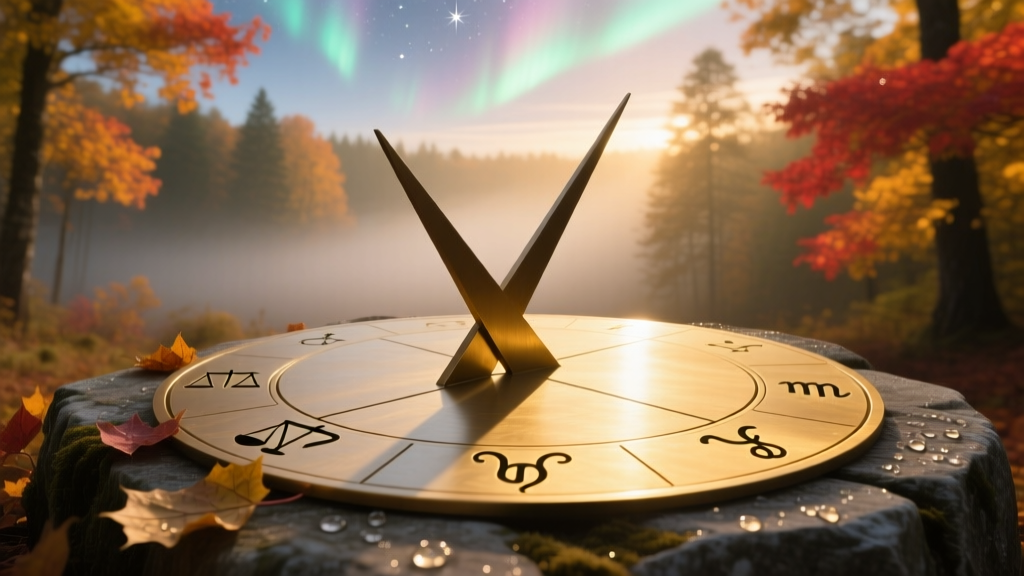
The first day of fall 2025 arrives on Monday, September 22, at exactly 18:19 UTC (2:19 PM EDT). This precise moment, known astronomically as the autumnal equinox, marks the instant the Sun's center crosses the celestial equator moving southward. Beyond the meteorological shift and the changing of leaves, this date represents the culmination of thousands of years of human observation, agricultural survival, and mythological storytelling. Ancient civilizations did not merely observe the equinox; they engineered monumental architecture and complex theological frameworks to predict and honor it.
Astronomical Precision: The First Day of Fall 2025
To understand the historical weight of the autumnal equinox, one must first understand its mechanical reality. Earth's axial tilt of 23.44 degrees dictates our seasons. During the September equinox, the subsolar point—the exact location where the Sun's rays hit the Earth at a 90-degree angle—crosses the equator from the Northern to the Southern Hemisphere. According to Time and Date, this celestial intersection results in nearly equal hours of daylight and darkness globally, a phenomenon derived from the Latin words aequus (equal) and nox (night).
While modern algorithms calculate the first day of fall 2025 down to the second, early agrarian societies relied on naked-eye archaeoastronomy. The survival of entire civilizations depended on accurately predicting this transition to initiate the final harvest before winter frost.
The Gregorian Correction: Anchoring the Equinox
The date of the autumnal equinox was not always stabilized around September 22. The historical struggle to pin down the exact day of the equinox led to one of the most significant calendar reforms in human history. The Julian calendar, introduced by Julius Caesar in 45 BCE, calculated the solar year at 365.25 days. However, the actual solar year is approximately 365.2422 days.
This 11-minute annual discrepancy caused the equinoxes to drift backward through the calendar. By the Council of Nicaea in 325 AD, the autumnal equinox was occurring around September 21. By the 16th century, the drift had accumulated to roughly 10 days, pushing the equinox into early September and disrupting the calculation of religious festivals and agricultural cycles. In 1582, Pope Gregory XIII introduced the Gregorian calendar, skipping 10 days in October to realign the calendar with the solar year. This reform successfully locked the autumnal equinox into its modern window between September 21 and September 24, ensuring that the astronomical markers of the seasons remained historically and agriculturally relevant.
Archaeoastronomy: Megalithic Equinox Trackers
Long before the Gregorian reform, prehistoric societies built sophisticated solar observatories. These structures prove that tracking the equinox was a paramount concern for early human settlements.
Cairn T at Loughcrew, Ireland
Dating back to approximately 3200 BCE, the Loughcrew complex in County Meath contains Cairn T, a passage tomb precisely aligned with the autumnal and vernal equinoxes. On the morning of the equinox, a distinct beam of sunlight penetrates the passage and illuminates a specific carved sunburst motif on the central backstone. As the sun rises, the beam of light moves across the stone, acting as a massive, highly accurate solar calendar that signaled the ancient Irish to begin their winter preparations.
Mnajdra Temple, Malta
The Mnajdra megalithic temple complex (c. 3600–3200 BCE) features an astronomical alignment that tracks both solstices and equinoxes. During the autumnal equinox sunrise, the light passes exactly through the main doorway, illuminating the central axis of the temple. This architectural precision required generations of continuous observation and an advanced understanding of geometry and solar mechanics.
Mythological Frameworks of the Descent
The abrupt shift in daylight and the dying of vegetation prompted early cultures to create mythological narratives explaining the sun's 'descent' and the earth's impending dormancy. Encyclopedia Britannica notes that these myths universally center on a deity descending into the underworld, symbolizing the seed buried in the earth.
The Sumerian Descent of Inanna
Predating Greek mythology by over a millennium, the Sumerian myth of Inanna (c. 1900–1600 BCE) details the Queen of Heaven's journey into the Underworld ruled by her sister, Ereshkigal. Inanna must strip away her garments and powers at each of the seven gates of the Underworld. When she dies and is hung on a hook, the earth above becomes barren and crops fail. Her eventual rescue requires a substitute, establishing the cyclical, seasonal exchange between the fertile upper world and the dormant underworld.
The Greek Abduction of Persephone
The more familiar Greek myth of Persephone (c. 800 BCE) mirrors the Sumerian narrative. Persephone's abduction by Hades and her consumption of pomegranate seeds bind her to the Underworld for a portion of the year. Her mother, Demeter (goddess of the harvest), grieves during this absence, causing the earth to freeze and crops to halt. The autumnal equinox historically marked the beginning of Persephone's descent, signaling the end of the growing season and the start of the 'dark half' of the year.
Historical Harvest Observances vs. Modern Practice
The historical observation of the equinox was inherently tied to caloric survival. Modern observances often strip away the life-or-death urgency of the harvest, focusing instead on aesthetic or generalized spiritual themes. The table below contrasts ancient equinox practices with modern adaptations.
| Civilization / Era | Primary Equinox Focus | Historical Action & Ritual | Modern Equivalent / Adaptation |
|---|---|---|---|
| Pre-Columbian Maya | Agricultural timing & deity manifestation | Observing the shadow-serpent descent at El Castillo; bloodletting rituals to ensure rain. | Tourism observation; modern meteorological tracking for regional farming. |
| Celtic / Insular Europe | Harvest completion & livestock culling | Second harvest (fruit/nuts); culling weak livestock to preserve winter fodder. | Mabon celebrations; autumn festivals; Thanksgiving harvest meals. |
| Ancient China | Celestial balance (Yin and Yang) | Mid-Autumn Festival; mooncakes; honoring the balance of light and dark. | Mid-Autumn Festival; family gatherings; moon gazing and lantern lighting. |
Actionable Equinox Alignment Practices
Reconnecting with the historical and astronomical reality of the autumnal equinox requires moving beyond passive observation. Utilize these historically grounded, actionable practices to align with the mechanics of the season:
- Construct a Gnomon Shadow Tracker: Replicate ancient archaeoastronomy by placing a straight stick (gnomon) vertically in a sunny, flat area of your yard. Mark the tip of the shadow at exactly solar noon every day for a month. You will physically document the sun's southern declination as the shadow lengthens daily after the September equinox.
- Circadian Rhythm Realignment: Historically, human sleep cycles were strictly tethered to solar light. As daylight hours decrease post-equinox, artificially extend your morning light exposure. Use a 10,000 lux light therapy lamp for 20 minutes immediately upon waking to counteract the biological impact of the shifting solar angle.
- The Second Harvest Audit: Ancient agrarian societies used the equinox to audit their winter stores. Translate this to modern life by conducting a physical audit of your pantry, freezer, and financial emergency reserves. Ensure you have adequate resources stored for the darker, more insulated months of winter.
- Equinoctial Shadow Mapping: Visit a local historical site, megalith, or even observe your own home's architecture. Note exactly where the sun rises and sets on the equinox. Many historical buildings and city grids are aligned to this specific solar axis, revealing hidden architectural intentions.
The transition into autumn is not merely a change in weather; it is a profound astronomical event that has dictated human survival, architecture, and theology for millennia. By understanding the deep history behind the shifting of the seasons, we can observe the celestial mechanics with the same reverence as our ancestors.