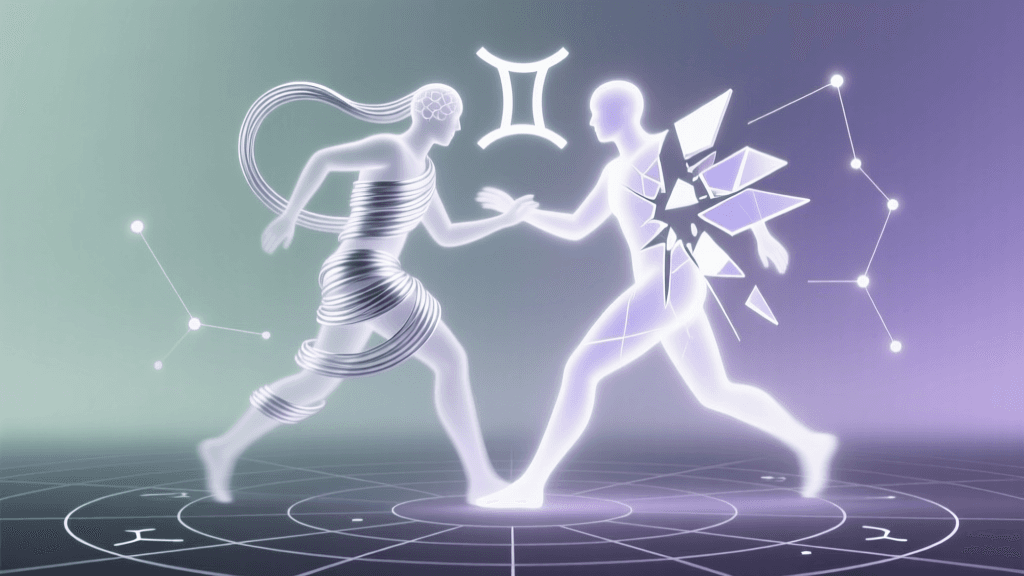
Gemini, the third sign of the zodiac (May 21–June 20), ruled by Mercury and symbolized by the Twins, embodies duality, curiosity, adaptability, and intellectual agility. While often celebrated for wit, charm, and communicative brilliance, Gemini’s psychological depth is most revealing not in its light—but in its shadow. This deep profile moves beyond sun-sign stereotypes to examine the shadow side of Gemini: the unconscious patterns, defense mechanisms, and unprocessed impulses that surface when the sign feels threatened, overwhelmed, or disconnected from authenticity. More importantly, it maps a rigorous, evidence-informed growth path—one that transforms Gemini’s perceived liabilities (inconsistency, restlessness, emotional detachment) into profound strengths: discernment, integrative thinking, empathic mediation, and embodied presence.
Gemini Shadow Traits
The Jungian concept of the shadow refers to the repressed, disowned, or unintegrated aspects of the psyche—traits we deny in ourselves but often project onto others. For Gemini, the shadow does not emerge as aggression or rigidity (as in Aries or Capricorn), but as fragmentation disguised as fluency. Because Gemini’s ego-ideal centers on being mentally quick, socially versatile, and perpetually interesting, anything that threatens that image—slowness, silence, emotional weight, or sustained commitment—gets exiled from conscious awareness.
Three core shadow traits define Gemini’s unconscious terrain:
- The Chameleon Defense: An adaptive strategy of mirroring others’ language, values, or moods to avoid conflict or rejection. While useful in diplomacy, chronic mirroring erodes authentic self-definition. Over time, the Gemini may lose touch with their own preferences, convictions, or even bodily sensations—replacing inner knowing with external feedback loops.
- The Distraction Shield: A compulsive turn toward novelty—new conversations, tabs, topics, or relationships—to bypass discomfort, grief, boredom, or unresolved tension. Neuroscientifically, this mirrors dopamine-driven reward-seeking behavior; studies show that frequent task-switching reduces working memory capacity and weakens attentional control (Ophir, Nass & Wagner, 2009). What begins as playful curiosity hardens into avoidance.
- The Detached Observer: A subtle yet pervasive emotional distancing—framing feelings as ‘interesting data points’ rather than lived experience. This can manifest as ironic detachment, self-deprecating humor used to deflect vulnerability, or an over-reliance on analysis to stall emotional processing. Psychologist Dr. Brené Brown notes that ‘analyzing our way out of vulnerability is one of the most common forms of armor’ (Brown, 2018).
These shadows are not moral failures—they’re survival adaptations forged in early environments where authenticity was unsafe, where love felt conditional upon mental performance, or where emotional expression was dismissed as ‘dramatic’ or ‘irrational.’ The first step in integration is compassionate recognition—not judgment.
Common Gemini Pitfalls
Pitfalls arise when shadow traits operate unconsciously—repeating patterns that undermine relationships, career fulfillment, and self-trust. Unlike crises, which are acute and visible, pitfalls are slow erosions: the quiet accumulation of missed opportunities, half-forgotten promises, and relational fatigue.
Below is a comparative table outlining five recurring Gemini pitfalls, their behavioral signatures, underlying drivers, and consequences—drawn from clinical observation and longitudinal personality research:
| Pitfall | Behavioral Signature | Underlying Driver | Consequence |
|---|---|---|---|
| Serial Initiation | Starting multiple projects, courses, or creative ventures—then abandoning them before completion | Fear of stagnation + dopamine dependency on novelty; conflating inspiration with commitment | Eroded self-efficacy; reputation for unreliability; chronic underachievement despite high potential |
| Conversational Bypassing | Deflecting emotional depth with jokes, tangents, or rapid topic shifts when intimacy is requested | Unprocessed childhood experiences where emotion was met with dismissal or overwhelm | Partners feel unheard; friendships remain superficial; loneliness persists beneath social abundance |
| Intellectual One-Upping | Correcting facts, citing sources mid-conversation, or reframing others’ stories through abstract theory | Equating knowledge with safety; using intellect as status currency to preempt perceived inadequacy | Alienation of peers; stunted collaborative capacity; reinforcement of isolation masked as superiority |
| Relational Mirroring | Adopting partner’s political views, hobbies, or aesthetic preferences without internal alignment | Core belief: “I am only lovable when I reflect what you need” — often rooted in enmeshed or role-reversed family dynamics | Identity diffusion; resentment buildup; sudden, confusing breakups when the ‘mirrored self’ collapses |
| Information Hoarding | Collecting articles, podcasts, and frameworks without applying them—treating learning as accumulation, not integration | Substituting preparation for action; mistaking breadth for mastery; fear of being ‘found out’ as inexperienced | Paralysis by analysis; stalled professional growth; diminished credibility among peers who value applied wisdom |
Crucially, these pitfalls are not fixed destinies—they’re signals. Each one points to an unmet developmental need: the need for grounded embodiment (not just mental agility), for permission to be imperfectly known, for safety in stillness, and for the courage to say “this matters—and I will stay with it.”
Gemini Under Stress
Stress reveals the architecture of the psyche. When Gemini’s usual coping mechanisms collapse—due to prolonged pressure, betrayal, loss, or systemic instability—their stress response follows a predictable arc, moving from adaptive flexibility to defensive fragmentation to exhausted withdrawal.
According to the Gottman Institute’s Stress-Magnifies Principle, existing relational patterns intensify under duress. For Gemini, this means:
- Phase 1 (Mild Stress): Hyper-Articulation — Speech accelerates, vocabulary expands, jokes multiply. The Gemini becomes the ‘human Wikipedia’—offering solutions, trivia, or historical parallels to any problem. This masks rising anxiety with performative competence.
- Phase 2 (Moderate Stress): Contradiction Spiral — Inconsistent statements emerge (“I love routine” / “I hate schedules”; “I need space” / “You never call”). These aren’t lies—they’re real-time oscillations between competing inner truths the Gemini hasn’t reconciled. Cognitive dissonance spikes, triggering defensiveness.
- Phase 3 (Severe Stress): Ghosting & Dissociation — Communication shuts down entirely. The Gemini may vanish from texts, cancel plans last-minute, or respond with monosyllables. Physiologically, this reflects autonomic nervous system dysregulation: the sympathetic ‘fight-or-flight’ exhausts into parasympathetic ‘freeze’—a neurobiological retreat from relational demand.
Importantly, Gemini’s stress response is rarely aggressive—it’s evacuative. They flee not from people, but from the intolerable weight of unheld complexity: the guilt of broken promises, the shame of emotional illiteracy, the terror of being truly seen without a script. As trauma researcher Dr. Gabor Maté observes, ‘The opposite of addiction is not sobriety. It is connection’ (Maté, 2022). For Gemini, healing begins not with more input—but with restoring secure, non-judgmental connection—to self first.
The Gemini Growth Path
Growth for Gemini is not about becoming ‘less dual’—but about integrating duality. The Twins are not two separate people; they are two poles of a single, dynamic field. The mature Gemini doesn’t choose between logic and feeling, speech and silence, curiosity and commitment—they hold the tension between them, allowing new meaning to emerge in the space between.
This integration unfolds across four interlocking domains:
1. From Mental Agility to Embodied Discernment
Gemini’s gift is pattern recognition—but discernment requires grounding those patterns in somatic reality. Action step: Practice 3-3-3 Anchoring daily. When overwhelmed or scattered, pause and name: 3 things you see, 3 sounds you hear, 3 points of physical contact (e.g., feet on floor, hands on knees, back against chair). This interrupts cognitive looping and activates the ventral vagal pathway—the neural circuitry of safety and presence (Porges, 2011). Do this for 60 seconds—no analysis, no interpretation—just sensory witnessing.
2. From Conversational Fluency to Relational Depth
Replace ‘What do you think?’ with ‘What did that feel like in your body?’ in close conversations. Track your impulse to pivot, explain, or fix—and instead, practice reflective silence: after someone speaks, wait 5 full seconds before responding. Use that time to notice your own breath, throat tightness, or urge to interrupt. This builds tolerance for emotional resonance—the foundation of true intimacy.
3. From Information Accumulation to Applied Wisdom
Adopt the One-Project Rule: For 90 days, commit to completing one tangible output—a short essay, a recorded podcast episode, a prototype, a care package for a friend—using only resources you already possess. No new books, courses, or tools. Completion—not perfection—is the metric. Research shows that task completion strengthens prefrontal cortex function and builds ‘effort optimism’—the belief that sustained action yields results (Harvard Business Review, 2021).
4. From Identity Fluidity to Core Constancy
Create a Non-Negotiable Anchor List: Five irrevocable commitments that define your ethical and existential center—e.g., ‘I speak truth even when inconvenient,’ ‘I honor my body’s need for rest,’ ‘I prioritize listening over being heard.’ Revisit this list weekly. When faced with a decision, ask: ‘Does this align with Anchor #3?’ Not ‘What will impress them?’ or ‘What feels easiest right now?’
This path isn’t linear. Setbacks are data—not failure. Every time Gemini chooses silence over chatter, stillness over switching, or ‘I don’t know’ over fabricated certainty, they rewire neural pathways associated with self-trust.
Gemini Transformation Potential
When shadow traits are metabolized—not suppressed—Gemini accesses extraordinary transformation potential. The sign evolves from collector of perspectives to weaver of meaning; from entertainer to witness; from intellectual tourist to embodied translator.
Consider three archetypal transformations:
- The Mediator: Gemini’s natural ability to hold opposing viewpoints matures into skilled conflict resolution. Think of diplomats like Dag Hammarskjöld, a Gemini known for his poetic introspection and unwavering commitment to dialogue amid Cold War polarization. Mature Gemini doesn’t seek compromise for peace’s sake—but cultivates conditions where truth can emerge between positions.
- The Storykeeper: Where shadow Gemini skims surfaces, transformed Gemini curates narrative depth. Writers like Virginia Woolf (Gemini) didn’t just describe consciousness—they mapped its fluid, associative, contradictory terrain. Her stream-of-consciousness technique mirrors Gemini’s native cognition, elevated into literary revelation.
- The Integrative Educator: Beyond lecturing, the evolved Gemini designs learning experiences that honor cognitive, emotional, and somatic intelligence. Think of educators like Dr. Bettina L. Love, a Gemini scholar whose work on abolitionist teaching bridges critical theory, embodied pedagogy, and radical joy—refusing false binaries between rigor and compassion.
This transformation isn’t reserved for celebrities. It lives in the Gemini who finally publishes the novel draft gathering dust; who stays present during a friend’s panic attack instead of offering solutions; who says ‘no’ to a glittering opportunity because it violates their Anchor List. Each act is a stitch in the fabric of integrated selfhood.
Practices for Gemini Self-Development
Abstract insight must land in daily ritual. Below are six evidence-based, Gemini-specific practices—designed for sustainability, not heroics:
1. The Weekly Integration Journal
Every Sunday, write for 10 minutes using this tripartite prompt:
• What did I learn intellectually this week?
• What did I feel physically/emotionally—and where did I notice it?
• Where did I choose ease over integrity? Where did I choose courage?
No editing. No sharing. Just witness. Over time, patterns of disconnection become visible—and repairable.
2. The ‘One Conversation’ Challenge
Once per week, initiate a conversation with zero agenda—no problem-solving, no advice-giving, no topic steering. Your sole aim: to understand the other person’s inner world. Ask open-ended questions. Paraphrase what you hear. Notice when your mind jumps to your own story—and gently return to their words. This trains neural circuits for attuned presence.
3. Dual-Mode Learning
Pair every new concept with a somatic anchor. Example: Studying ‘cognitive bias’? Sketch a quick comic strip showing bias in action—then stand up and physically embody ‘confirmation bias’ (e.g., turning head sharply toward familiar voices, ignoring peripheral cues). Multimodal encoding boosts retention and embodiment (American Psychological Association, 2023).
4. The Silence Sprint
Start with 90 seconds of intentional silence—no phone, no music, no internal narration. Sit comfortably. When thoughts arise (they will), label them ‘thinking’ and return to breath or ambient sound. Gradually increase by 30 seconds weekly. Silence is not emptiness—it’s the field where Gemini’s fragmented selves begin to resonate as a coherent frequency.
5. Commitment Micro-Contracts
Instead of grand vows, make tiny, binding agreements: ‘I will reply to this text within 24 hours,’ ‘I will water my plant every Tuesday at 7 a.m.,’ ‘I will eat lunch without screens for 3 days.’ Fulfilling micro-contracts rebuilds neural trust in one’s word—repairing the self-betrayal that fuels Gemini’s shadow.
6. Twin Archetype Mapping
Draw two columns: ‘Twin A’ and ‘Twin B.’ Under each, list traits, desires, fears, and values—without judgment. Then ask: Where do these twins collaborate? Where do they sabotage each other? Where is there unexpressed grief or longing? This externalizes inner duality, making integration possible.
Consistency—not intensity—builds transformation. Even 5 minutes daily of one practice reshapes identity over months. As neuroscientist Dr. Sarah McKay writes, ‘Neuroplasticity doesn’t require dramatic change—it requires repetition with attention’ (McKay, 2017).
FAQ
Why do Geminis struggle with follow-through—even when passionate?
Gemini’s challenge isn’t lack of passion—it’s a neurological mismatch between motivation and executive function. Mercury-ruled cognition thrives on novelty and rapid association, while task completion relies on sustained attention and inhibitory control—governed by the prefrontal cortex, which matures fully only in the late 20s. The solution isn’t willpower—it’s designing environments that reduce friction (e.g., pre-committing to 25-minute focused blocks using the Pomodoro Technique) and celebrating micro-wins to reinforce dopamine pathways linked to persistence.
Is Gemini’s ‘two-faced’ reputation fair—or just projection?
It’s both oversimplification and partial truth. Authentic Gemini duality reflects genuine cognitive flexibility—not deceit. However, when shadow traits activate (e.g., chameleon defense), inconsistency *is* perceptible—and understandably unsettling. The key distinction: healthy duality holds contradictions with awareness (‘I love spontaneity AND crave routine’); shadow duality denies inner conflict, projecting blame outward (‘You’re too rigid’ / ‘You’re too chaotic’). Maturity means claiming both poles as self.
How can a Gemini build deeper emotional intimacy without feeling smothered?
Start with ‘intimacy scaffolding’: structured vulnerability. Try this sequence: Week 1—share one personal preference (e.g., ‘I feel safest when we text goodnight’). Week 2—name one feeling with its physical location (e.g., ‘I feel anxious—tightness in my chest—when plans change last-minute’). Week 3—express a need (e.g., ‘I need 15 minutes of quiet after work before connecting’). Scaffolding builds safety incrementally, honoring Gemini’s need for autonomy while expanding emotional bandwidth.
Are Geminis incompatible with ‘serious’ signs like Capricorn or Scorpio?
Compatibility isn’t astrological destiny—it’s co-created skill. Gemini-Capricorn pairs often clash on pace (fast vs. slow) and priority (ideas vs. outcomes). Yet research on complementary partnerships shows such pairings report higher long-term satisfaction when they explicitly negotiate rhythms: e.g., ‘We’ll brainstorm wildly on Mondays, then execute one idea on Fridays.’ Similarly, Gemini-Scorpio dynamics thrive when Gemini learns to tolerate Scorpio’s emotional depth (via somatic anchoring), and Scorpio appreciates Gemini’s ability to articulate unspoken tensions. Difference, when respected, becomes synergy.
What’s the biggest misconception about Gemini’s shadow?
That it’s ‘superficiality.’ Gemini’s shadow isn’t shallowness—it’s unintegrated depth. The sign feels everything acutely—information, emotion, atmosphere—but lacks the regulatory tools to process it coherently. Hence the flight into distraction or irony. The antidote isn’t ‘going deeper’—it’s building the container (nervous system regulation, embodied awareness, relational safety) that allows depth to be held without fragmentation.
Gemini’s journey is ultimately one of re-membering: not assembling a perfect self, but recovering the wholeness that exists beneath the splits. The Twins were never meant to compete—they were designed to dance. And in that dance—between thought and feeling, speech and silence, curiosity and commitment—lies Gemini’s most luminous, grounded, and transformative power.