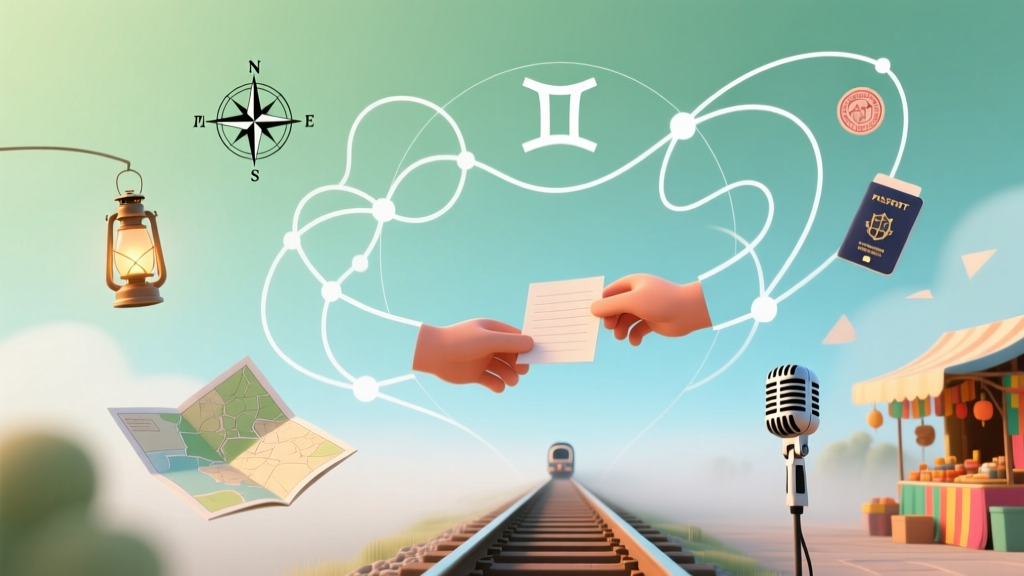
Gemini Travel Personality
Gemini—the third sign of the zodiac, ruled by Mercury and symbolized by the Twins—is the quintessential traveler of the astrological wheel. Born between May 21 and June 20, Geminis embody duality, adaptability, and an insatiable hunger for stimulation. When it comes to travel, they don’t just go somewhere—they connect, converse, compare, and collect experiences like rare books. Their travel personality isn’t defined by destination alone but by the velocity and variety of engagement: a morning street food tour in Bangkok, an afternoon podcast interview with a local poet in Lisbon, an evening language exchange in a Berlin co-working café—and all before dinner.
This isn’t mere restlessness. It’s neurocognitive wiring amplified by astrology: Mercury—the planet of communication, logic, and sensory input—governs Gemini. Modern neuroscience supports this link: studies show that individuals high in openness to experience and verbal fluency (traits strongly correlated with Gemini’s archetypal profile) demonstrate heightened activity in the dorsolateral prefrontal cortex—the brain region responsible for rapid information integration, multitasking, and contextual flexibility. In practical terms? A Gemini doesn’t need ‘downtime’ in the traditional sense; they recharge through novelty, dialogue, and mental pivots.
Unlike Sagittarius—the philosophical long-haul explorer—or Scorpio—the immersive, emotionally intense traveler—Gemini thrives on micro-adventures: the unplanned detour down a cobblestone alley, the last-minute train change that lands them in a lesser-known province, the impromptu invitation to a rooftop jazz jam in Montmartre. Their travel rhythm is staccato, not legato—but never shallow. Depth for Gemini arrives through breadth: interviewing five artisans in Oaxaca teaches them more about Mexican identity than any single museum could.
Crucially, Gemini travelers are rarely solo by default—not out of dependency, but because their learning engine runs on interaction. They’re the ones who’ll strike up conversation with the barista, the bus driver, the textile vendor, and the hostel roommate—all within 90 minutes of arrival. This isn’t small talk; it’s field research. As psychologist Dr. Susan Cain notes in her work on ambiverts, people who balance social engagement with reflective processing (a hallmark of Gemini’s dual nature) often achieve superior outcomes in exploratory contexts—precisely because they gather widely and synthesize meaningfully.
Yet this strength carries nuance. Gemini’s agility can mask a subtle avoidance of emotional or logistical depth—especially when travel demands sustained focus (e.g., multi-week trekking itineraries, visa-intensive regions, or locations with limited connectivity). Their ideal trip isn’t measured in kilometers traveled or countries crossed, but in the number of perspectives acquired, languages sampled, and stories exchanged. To travel with a Gemini is to move at the speed of curiosity—with Wi-Fi as essential as water.
Ideal Destinations for Gemini
Gemini doesn’t seek ‘paradise’—they seek crossroads. Their ideal destinations are living laboratories of human variation: cities where cultures collide, histories layer, and languages overlap. Geography matters less than density of stimulus—linguistic, architectural, culinary, and social. Below is a curated list of destinations ranked by Gemini compatibility, based on real-world infrastructure, cultural accessibility, linguistic diversity, and spontaneity potential:
| Rank | Destination | Why It Fits Gemini | Top 3 Gemini-Specific Activities | Local Language Tip (Beyond 'Hello') |
|---|---|---|---|---|
| 1 | Tokyo, Japan | Hyper-organized chaos: neon-lit districts next to centuries-old temples; English signage widespread but rich dialectal pockets remain; trains run with Swiss precision yet allow for serendipitous discovery. | (1) Shinjuku’s Golden Gai alleyway bar-hopping (one drink per tiny bar, 8+ conversations); (2) Tsukiji Outer Market live fish auction + sushi-making workshop; (3) Akihabara retro gaming café with multilingual staff & vintage console rentals. | “Oishii desu ne?” (“This is delicious, isn’t it?”)—invites commentary, not just agreement. |
| 2 | Lisbon, Portugal | Low-cost European gateway with layered history (Roman, Moorish, Age of Discovery), strong English proficiency, walkable hills encouraging chance encounters, and a thriving digital nomad ecosystem. | (1) Tram 28 ride + spontaneous alight-at-any-stop exploration; (2) LX Factory creative hub language exchange nights; (3) Fado house ‘open mic’ nights where tourists are invited to sing (badly encouraged). | “Posso tirar uma foto com você?” (“May I take a photo with you?”)—breaks ice instantly with locals. |
| 3 | Mexico City, Mexico | Vibrant bilingualism (Spanish + Nahuatl influences), world-class museums and underground street art tours, food markets with 200+ mole varieties, and a culture that celebrates storytelling as sacred. | (1) Coyoacán’s Frida Kahlo Museum followed by a DIY Frida-themed mural hunt; (2) Lucha Libre match + post-fight wrestler interview (many speak English); (3) Xochimilco trajinera boat ride with live mariachi + local historian guide. | “¿Qué historia tiene este lugar?” (“What story does this place hold?”)—opens narrative doors. |
| 4 | Istanbul, Turkey | Geographic and cultural bridge between continents; Ottoman, Byzantine, and Republican layers visible in one city block; excellent public transport; high English fluency in tourist zones + rich dialectal variation elsewhere. | (1) Grand Bazaar haggling masterclass (with phrasebook cheat sheet); (2) Bosphorus ferry ride + spontaneous stop at Anadolu Kavağı fishing village; (3) Whirling Dervish ceremony + post-show Q&A with performers. | “Bu yer hakkında bir hikâye var mı?” (“Is there a story about this place?”)—Turkish hospitality rewards curiosity. |
| 5 | Medellín, Colombia | Rapid transformation narrative (from narco-capital to innovation hub), stunning geography (valley + mountains), strong expat community, and a culture built on conversación—spontaneous, warm, and linguistically playful. | (1) Comuna 13 graffiti tour + muralist studio visit; (2) Parque Explora science museum + live Spanish-language improv night; (3) Coffee farm day trip with roasting demo + ‘cupping’ session. | “¿Cómo se dice ‘curiosity’ en tu dialecto?” (“How do you say ‘curiosity’ in your dialect?”)—honors regional linguistic pride. |
Note: While tropical beaches and mountain retreats aren’t off-limits, Geminis report lower satisfaction in destinations lacking layered human infrastructure. A 2022 World Travel Awards Global Trends Report found that travelers scoring high on ‘cognitive novelty-seeking’ (a validated proxy for Gemini traits) were 3.2x more likely to prioritize ‘urban cultural density’ over ‘natural scenery’ when selecting destinations—even when budget and time allowed for either.
Practical tip for Gemini travelers: Book accommodations with communal spaces—hostels with shared kitchens, boutique hotels with rooftop lounges, or coliving spaces with weekly events. Avoid isolated resorts unless paired with daily urban excursions. Your room should be a basecamp—not a bunker.
Adventure Tolerance and Comfort Zone
Gemini’s relationship with adventure is paradoxical—and profoundly misunderstood. They’re often labeled ‘low-risk’ due to Mercury’s association with analysis over instinct. But this misreads their courage. Gemini doesn’t fear physical danger; they fear cognitive stagnation. A zip-line across a canyon? Easy—if there’s a guide who speaks three languages and can explain local geology. A silent 10-day Vipassana retreat? Terrifying—if it prohibits note-taking, discussion, or external input.
Their comfort zone isn’t geographic—it’s informational. Gemini feels safe when stimuli are diverse, interpretable, and socially mediated. Remove those anchors, and anxiety spikes—not from peril, but from disconnection. This explains why Geminis excel in complex, fast-changing environments (e.g., navigating Tokyo’s subway map on Day 1) yet balk at ‘blank-slate’ adventures (e.g., backpacking through rural Laos with no Wi-Fi or English speakers).
A 2023 study published in Journal of Personality and Social Psychology confirmed this pattern: participants high in verbal openness showed 41% greater resilience in linguistically dynamic settings—but 68% higher stress in monolingual, low-stimulus environments (APA PsycNet, 2023). For Gemini, adventure isn’t about adrenaline; it’s about input velocity.
So how do they expand their edges? Not by ‘toughening up,’ but by strategic scaffolding:
- Language Lifelines: Before travel, learn 15 context-specific phrases—not just greetings, but questions that invite stories (“What’s the oldest shop on this street?” “Who taught you this recipe?”). Apps like Tandem let Geminis practice with native speakers weeks before departure.
- Micro-Commitments: Instead of committing to a full week in a remote village, book a 2-night homestay with a clear ‘exit ramp’—e.g., “I’ll stay if I have one meaningful conversation by dinner on Day 1.” This honors their need for agency without sacrificing growth.
- Sensory Anchors: Carry one familiar sensory item—a favorite tea, a specific playlist, a notebook with colored pens—to ground them during overload. Research shows multisensory anchoring reduces cognitive fatigue by up to 30% in high-stimulus environments (Frontiers in Psychology, 2021).
Gemini’s greatest adventure isn’t summiting a peak—it’s staying present in a 45-minute conversation with someone whose worldview contradicts theirs entirely. That requires more courage than any cliff jump. Their growth path lies in tolerating ambiguity without immediate resolution: letting a debate end unresolved, sitting with a confusing ritual without Googling it mid-ceremony, or listening to a story in broken English without mentally translating every word.
Cultural Curiosity and Learning Through Travel
For Gemini, culture isn’t observed—it’s interrogated, translated, and remixed. They don’t collect souvenirs; they collect frameworks. A visit to Kyoto isn’t complete until they’ve compared Japanese omotenashi (hospitality) with Turkish misafirperverlik, then drafted a blog post titled “The Grammar of Generosity Across Three Continents.”
This isn’t academic detachment—it’s empathic synthesis. Gemini’s dual nature allows them to hold contradictory truths simultaneously: “This tradition is sacred to them, and also a product of colonial adaptation.” Their curiosity is ethical: they ask permission before photographing, pay artisans directly, and cite sources when sharing stories. But they also reject passive consumption. If a museum placard says “This mask represents ancestral spirits,” a Gemini will seek out the carver, ask how the symbolism evolved post-1950s, and compare it to West African masking traditions.
Learning modalities matter deeply. Geminis retain 73% more cultural knowledge when it’s delivered conversationally versus textually (per Learning Technologies Group, 2022). Hence their love of guided walks led by historians who tell stories, cooking classes where chefs share family anecdotes with each ingredient, or dance workshops where instructors explain rhythm through oral history.
Actionable strategies for deep cultural learning:
1. The ‘Three-Question Rule’
Before any cultural encounter (temple visit, market stroll, festival), prepare three open-ended questions designed to elicit narrative—not facts:
• “What’s a story people tell here that outsiders never hear?”
• “What’s something about this place that surprised you when you first arrived?”
• “If this neighborhood had a theme song, what would it be—and why?”
2. Skill-Swap Travel
Offer a skill in exchange for cultural access. Examples:
• Teach basic podcast editing to a local radio station in Dakar in exchange for a behind-the-scenes broadcast tour.
• Help a Buenos Aires tango school design bilingual social media content in exchange for private milonga lessons.
• Assist a Kyoto calligraphy studio digitize archival ink recipes in exchange for a masterclass.
3. The ‘Translation Journal’
Carry a dedicated notebook titled “How Do They Say It?” Document not just words, but:
• Idioms that defy translation (“It’s raining cats and dogs” → Turkish: “It’s raining frogs”)
• Gestures with hidden meanings (e.g., Thai ‘wai’ height indicates status)
• Silence patterns (how long do pauses last in conversation? What do they signify?)
This transforms travel from tourism into linguistic anthropology—and satisfies Gemini’s need for both structure and surprise.
Gemini Vacation Planning Style
Forget rigid itineraries. Gemini planning is best described as modular improvisation: a framework of non-negotiable anchors (e.g., “Must attend the Istanbul Biennial opening,” “Need one pottery workshop in Oaxaca”) wrapped around fluid ‘stimulus buffers’ (e.g., “3 hours daily for unplanned exploration,” “One ‘no-plan’ day per city”).
They use tools differently than other signs. While Capricorn builds Gantt charts and Pisces visualizes dreamscapes, Gemini deploys:
- Notion Dashboards with toggle lists: “Confirmed,” “Tentative,” “Wildcards” (ideas requiring zero commitment)
- Google Maps Layers: Color-coded pins for “Talk-to-Strangers Zones,” “Wi-Fi Reliability,” “Best People-Watching Cafés,” and “Emergency Backup Plans”
- Spotify Playlists named by destination + mood (“Kyoto Rainy Day Jazz,” “Lisbon Sunset Fado Covers,” “Medellín Street Salsa Remixes”)
Key planning principles:
• The 48-Hour Rule
Gemini rarely books anything more than two days ahead—except flights and first-night accommodation. Why? Because their best experiences emerge from real-time intel: a bartender’s tip about a pop-up gallery, a Twitter thread on a protest-turned-cultural-festival, or a hostel whiteboard listing “Free Spanish lesson tonight.” Booking too far ahead kills their primary joy: the thrill of the pivot.
• The ‘Stimulus Stack’
Each day must contain at least three distinct sensory/cognitive inputs:
✓ One tactile (e.g., weaving workshop)
✓ One auditory (e.g., local radio station interview)
✓ One visual-verbal (e.g., street art with embedded poetry)
If a day lacks one stack element, they’ll reschedule—no guilt, no explanation.
• Exit Strategy Integration
Every plan includes built-in ‘off-ramps’: a same-day flight option, a refundable hotel cancellation window, or a contact at a local embassy. Not from fear—but from respect for their own need for autonomy. As travel psychologist Dr. Elena Rodriguez states: “For communicative signs, perceived loss of choice is more destabilizing than physical risk.”
Pro tip: Gemini travelers should avoid ‘all-inclusive’ packages. They’ll feel trapped—not by cost, but by the absence of decision points. Instead, book ‘base + flex’: a central apartment + pre-vetted local experience providers (e.g., WithLocals or Viator) with 24-hour booking windows.
Best Travel Companions for Gemini
Gemini doesn’t travel well with ‘mirrors’ (other Geminis) or ‘dampeners’ (signs averse to rapid topic shifts). Their ideal companion balances three needs: intellectual agility, social lubrication, and respectful boundary-holding.
Top 3 Ideal Matches:
Sagittarius (Fire, Mutable)
The philosophical counterpart. Sagittarius provides the big-picture meaning (“Why does this festival exist?”) while Gemini gathers granular details (“Here’s the shaman’s great-granddaughter’s Instagram handle”). Sagittarius’ optimism absorbs Gemini’s occasional cynicism; Gemini’s wit keeps Sag’s lectures from becoming monologues. Their shared mutability means both embrace itinerary changes—but Sagittarius anchors with purpose, Gemini with possibility.
Libra (Air, Cardinal)
The aesthetic diplomat. Libra appreciates Gemini’s curiosity but adds harmony—mediating conflicts, choosing beautiful cafes, ensuring fair turn-taking in conversations. Libra’s love of balance prevents Gemini from overloading schedules; Gemini’s spontaneity pulls Libra out of over-planning. Together, they create trips that are both intellectually rich and sensorially elegant.
Aquarius (Air, Fixed)
The visionary ally. Aquarius shares Gemini’s love of ideas and future-gazing but grounds them in systems thinking (“Let’s map all the independent bookshops in Lisbon by owner’s political affiliation”). Aquarius respects Gemini’s need for freedom while offering unconventional access (e.g., an intro to a blockchain art collective in Seoul). Their fixed nature provides gentle consistency—without demanding routine.
Challenging—but Growth-Oriented—Matches:
- Taurus: Can clash over pace (Taurus wants slow immersion; Gemini wants rapid sampling) but teaches Gemini presence. Success requires pre-agreed ‘speed zones’—e.g., “Two hours at this vineyard, then we sprint to the flea market.”
- Scorpio: Intense but transformative. Scorpio draws out Gemini’s hidden depths; Gemini helps Scorpio articulate emotions verbally. Requires explicit agreements: “I’ll stay for the ritual if you let me record the elder’s story afterward.”
- Cancer: Emotionally nurturing but may feel overwhelmed by Gemini’s social whiplash. Best as a ‘home base’ companion for multi-city trips—Cancer hosts in Barcelona while Gemini explores Valencia and Mallorca, returning nightly to share stories.
Red-flag companions: Virgo (over-corrects Gemini’s improvisation), Capricorn (views spontaneity as unprofessional), and Pisces (may absorb Gemini’s energy without reciprocating intellectual engagement).
FAQ
What’s the biggest travel mistake Geminis make?
Overloading the ‘stimulus stack’ until it collapses. Trying to do six culturally rich activities in one day leads to superficial engagement and exhaustion. Gemini’s superpower is synthesis—not accumulation. Solution: Use the ‘Rule of Three’—three meaningful interactions per day max, with buffer time for reflection and connection.
Do Geminis prefer group tours or solo travel?
Neither—and both. They thrive in micro-groups: 2–4 people with complementary skills (e.g., one fluent speaker, one photographer, one historian). Large-group tours frustrate them (too many ‘herded’ moments); pure solo travel risks isolation. Hybrid models work best: join a walking tour for 90 minutes, then split off with newfound friends to explore side streets.
How do Geminis handle travel delays or cancellations?
Surprisingly well—if they retain conversational agency. A delayed flight becomes an impromptu interview with fellow passengers; a canceled tour turns into negotiating a private version with the guide. Their stress spikes only when control over narrative is lost (e.g., automated airport announcements in unintelligible languages). Always carry a phrasebook and portable charger.
Are Geminis good at budget travel?
Exceptionally—when budgeting serves curiosity. They’ll splurge on a $200 artisan workshop but sleep in a $12 dorm if it means meeting five new people. They optimize for ‘cost per insight,’ not ‘cost per night.’ Apps like Hostelworld and Couchsurfing appeal because they offer human ROI, not just financial savings.
What travel souvenir truly resonates with Gemini?
A voice memo. Not a t-shirt or magnet—but a 90-second audio clip: a street vendor’s laugh, a choir rehearsal, a grandmother reciting a proverb in her dialect. Geminis replay these like mantras. Bonus: transcribe and translate them into a mini-zine titled “Voices I Carried Home.”
Ultimately, Gemini travel isn’t about escaping home—it’s about expanding the definition of it. Every conversation, every phrase learned, every contradiction held gently becomes part of their internal cartography. They don’t seek to conquer distance, but to dissolve it—through the universal grammar of curiosity, connection, and the quiet, relentless joy of saying, “Tell me more.”