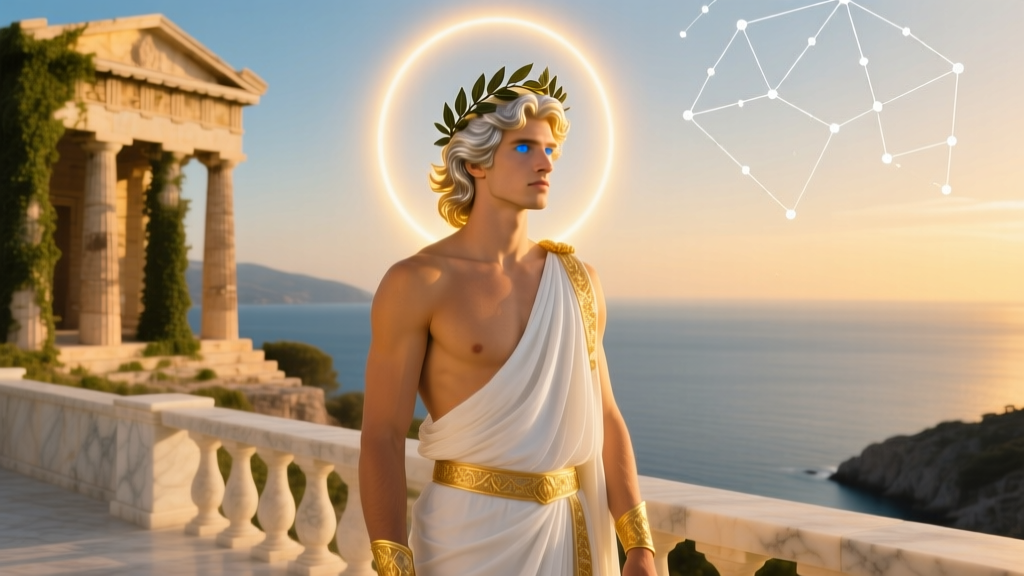
The Greek god Phoebus Apollo represents one of the most complex paradoxes in classical antiquity and modern archetypal psychology. Far from a one-dimensional solar deity, Apollo governs the terrifying intersection of divine retribution, prophetic truth, and aesthetic perfection. In Book 1 of Homer’s Iliad, he is not a benevolent healer but a bringer of plague, raining silver arrows upon the Achaean camp to punish Agamemnon's hubris. This duality—holding the power to inflict disease and the wisdom to cure it—forms the bedrock of Apollonian spirituality. Understanding the Greek god Phoebus Apollo requires dissecting his multifaceted domains, his psychological shadow, and his enduring influence on astrological and esoteric traditions.
The Dual Nature of the Greek God Phoebus Apollo
In ancient Hellenic religion, Apollo was the ultimate arbiter of miasma (spiritual pollution) and katharsis (purification). He did not merely represent the sun; he represented the piercing, uncompromising light of truth that exposes flaws and demands order. When mortals transgressed divine boundaries—such as Niobe boasting about her children or Marsyas challenging the gods to a musical contest—Apollo's retribution was swift and absolute. Yet, as the father of Asclepius, he was also the foundational source of medicinal healing. This paradox teaches a core spiritual lesson: the very force that breaks down the ego and inflicts suffering is the exact same force required to catalyze profound healing and integration. To work with the Apollonian archetype is to accept that clarity often arrives through the destruction of comfortable illusions.
Epithets and Domains: Mapping the Apollonian Psyche
The ancient Greeks utilized epithets to isolate and invoke specific frequencies of a deity's power. Analyzing these epithets provides a precise framework for understanding the different facets of the Apollonian archetype in psychological and astrological chart interpretation.
Phoebus (The Radiant) and the Solar Connection
While later antiquity conflated Apollo with Helios (the literal personification of the sun), the epithet Phoebus translates to 'The Radiant' or 'The Bright One.' In esoteric traditions, Phoebus does not govern the physical celestial body, but rather the Logos—the divine intellect, the illumination of the mind, and the conscious ego's drive toward perfection. In a natal chart, strong Apollonian signatures (such as a prominent Sun, Leo placements, or 5th house emphasis) indicate a soul path dedicated to achieving conscious mastery, artistic excellence, and intellectual brilliance, often at the cost of emotional vulnerability.
Loxias (The Oblique) and the Mechanics of Prophecy
As Loxias, Apollo is the god of the slanting, ambiguous truth. The prophecies delivered at Delphi were notoriously riddling, forcing the seeker to engage in deep cognitive and spiritual labor to decipher the divine will. This epithet highlights the psychological reality that ultimate truths are rarely direct; they must be approached obliquely through symbols, dreams, and synchronicities. According to the Theoi Greek Mythology Project, Apollo's domain over prophecy was not about predicting a fixed future, but revealing the hidden structural dynamics of the present moment.
Musagetes (Leader of the Muses) and Aesthetic Order
Apollo Musagetes wields the lyre, an instrument of mathematical precision and harmonic resonance. Unlike the chaotic, breath-driven aulos (flute) associated with Dionysus and Marsyas, the lyre represents the imposition of divine order onto raw creative energy. This aspect of the deity governs the architectural principles of music, poetry, and sacred geometry. In personality psychology, the Musagetes archetype manifests as the drive to organize chaotic emotions into structured, beautiful, and communicable art forms.
Astrological Correspondences and Archetypal Data
Translating mythological domains into astrological and esoteric correspondences allows modern practitioners to identify and work with Apollonian energies in their own charts and spiritual practices. The table below outlines the primary structural associations of this archetype.
| Domain | Primary Epithet | Astrological Link | Tarot Correspondence | Shadow Expression |
|---|---|---|---|---|
| Intellect & Light | Phoebus | The Sun / Leo | The Sun (XIX) | Arrogance, blinding dogmatism |
| Prophecy & Truth | Loxias | Mercury / Virgo | The High Priestess (II) | Obsession with certainty, fatalism |
| Healing & Purification | Akesios | Chiron / 6th House | Temperance (XIV) | Clinical detachment, spiritual bypassing |
| Art & Harmonics | Musagetes | Venus / Libra | The Magician (I) | Perfectionism, aesthetic elitism |
| Boundaries & Law | Archegetes | Saturn / Capricorn | The Emperor (IV) | Rigidity, ruthless punishment of hubris |
The Oracle of Delphi: Pneuma and Prophetic Trance
No deep dive into this deity is complete without examining the Oracle of Delphi, the spiritual epicenter of the ancient Mediterranean. Apollo did not speak directly to the masses; he channeled his will through the Pythia, the high priestess who sat upon a tripod over a chasm in the earth. According to the Perseus Digital Library's archives on the Homeric Hymns, Apollo claimed the site after slaying the Python, a chthonic serpent representing primordial earth forces. By integrating the earth's raw, subconscious power with his celestial intellect, Apollo created a bridge between the underworld and the heavens.
Modern geological studies suggest that the chasm at Delphi released pneuma—specifically ethylene and methane gases—which induced a mild trance state in the Pythia. This intersection of geology, neurochemistry, and divine invocation demonstrates the Apollonian principle of harnessing chaotic, subconscious forces (the earth gases) and filtering them through a structured, conscious vessel (the priestess and the interpreting priests) to produce actionable wisdom.
Apollonian vs. Dionysian: A Framework for Shadow Work
Friedrich Nietzsche famously delineated the Apollonian and Dionysian forces in The Birth of Tragedy. The Apollonian represents individuation, boundaries, logic, and the illusion of the separate self. The Dionysian represents dissolution, ecstasy, chaos, and the return to the primal collective. In spiritual and shadow work, an over-identification with the Greek god Phoebus Apollo leads to severe psychological rigidity. The 'Apollonian Shadow' manifests as emotional sterility, a relentless demand for perfection, and the cruel rejection of the messy, irrational aspects of human nature.
The myth of Daphne perfectly illustrates this shadow. Apollo's obsessive, unyielding pursuit of the nymph Daphne—who ultimately transforms into a laurel tree to escape him—symbolizes the danger of the hyper-rational mind attempting to possess and control the elusive, intuitive soul. True spiritual mastery requires the laurel wreath (wisdom) without the violent pursuit (control).
Integrating the Apollonian Archetype in Modern Spirituality
Working with the Apollonian archetype is highly effective for individuals struggling with brain fog, boundary violations, or creative disorganization. By invoking the energy of Loxias and Musagetes, practitioners can cultivate mental acuity and structural harmony in their daily lives.
Practical Rituals for Clarity and Healing
- The Lyre Harmonization: Before engaging in deep intellectual or creative work, spend five minutes listening to mathematically structured music (such as Bach or Pythagorean tuning frequencies). This aligns the nervous system with the Apollonian principle of cosmic order, reducing anxiety and enhancing focus.
- Shadow Journaling for Perfectionism: To counteract the ruthless Apollonian inner critic, practice 'flaw-mapping.' Identify three areas where your demand for perfection is causing stagnation, and consciously perform a 'C-grade' task in that area to break the paralysis of the ego.
- Solar Purification Rite: At solar noon, when the sun casts the shortest shadow, stand in direct sunlight and visualize the piercing light of Phoebus burning away miasma (mental clutter, guilt, or energetic attachments). This is particularly potent during the Sun's transit through Leo or Aries.
By understanding the profound depth, terrifying power, and exquisite beauty of this deity, modern seekers can harness the light of prophecy and reason without being burned by its uncompromising fire.