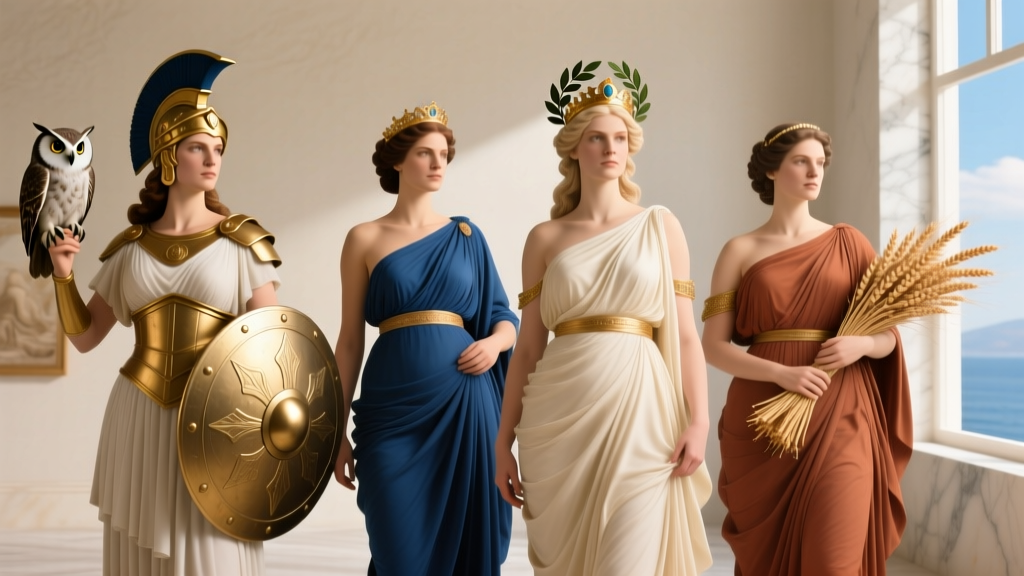
Pop culture often reduces the Greek goddesses to one-dimensional caricatures. Aphrodite is framed as a vain beauty, Hera as a jealous shrew, and Athena as a stoic warrior. However, classical antiquity reveals a vastly different pantheon. The original Greek goddesses commanded complex spheres of influence encompassing cosmic law, sovereignty, and existential transitions. This guide addresses the most pervasive misconceptions and answers frequent questions regarding the true nature, historical worship, and psychological archetypes of these ancient deities.
The Most Common Misconceptions About Greek Goddesses
Misconception 1: Aphrodite Was Merely a Goddess of Romance
Modern media portrays Aphrodite exclusively as the deity of romantic love and physical beauty. In historical Greek religion, her domain was far more expansive and politically potent. Philosophers like Plato later divided her into Aphrodite Ourania (heavenly, spiritual love) and Aphrodite Pandemos (common, civic love). More importantly, she was a goddess of civic unity and political alliances. In Sparta and on the island of Cythera, she was worshipped as Aphrodite Areia (the warlike), often depicted in full armor. She also governed maritime navigation, protecting sailors and merchants. Reducing her to a symbol of mere vanity ignores her role as a foundational force of cosmic binding and civic cohesion.
Misconception 2: Hera Was Defined by Her Jealousy
Hera is frequently dismissed as the bitter, jealous wife of Zeus, punishing his mortal lovers. This interpretation projects modern domestic morality onto ancient cosmic theology. Hera is the Queen of Heaven and the ultimate sovereign of the Olympian order. Her wrath is not petty jealousy; it is the fierce enforcement of themis (divine law, order, and the sanctity of oaths). When Zeus broke the marital oath, he threatened the foundational stability of the cosmos. Furthermore, archaeological evidence suggests Hera was a pre-Hellenic, possibly Minoan, mother goddess who was later subsumed into the patriarchal Olympian narrative. In major cult centers like Argos and Samos, she was worshipped as an independent, supreme deity of sovereignty and the changing seasons, entirely separate from her marital status.
Misconception 3: The 'Virgin' Goddesses Were Strictly Celibate
The translation of the Greek word parthenos (applied to Athena, Artemis, and Hestia) as 'virgin' carries heavy modern, often Christianized, connotations of strict sexual abstinence. In classical antiquity, parthenos more accurately translated to 'unmarried' or 'one-unto-herself.' It denoted autonomy, independence, and a refusal to be subjugated to a husband's authority. Artemis, for example, was deeply associated with childbirth (Artemis Eileithyia) and was the Kourotrophos (nurturer of the young). Her 'virginity' was a symbol of her inviolable boundaries and self-contained power, not a puritanical rejection of the physical world.
Greek Goddesses FAQ: Clearing Up the Confusion
Are Greek Goddesses the Same as Roman Goddesses?
No. The Romans utilized a practice called Interpretatio graeca, mapping their indigenous deities onto the Greek pantheon for literary and diplomatic convenience. However, the core functions and theological nuances differed significantly. For instance, Demeter was deeply tied to the Eleusinian Mysteries, agricultural law, and the cycle of life and death. Her Roman equivalent, Ceres, was primarily a state goddess of grain growth and plebeian rights. Similarly, Artemis governed liminality, wilderness, and childbirth, while Diana was more closely associated with the moon, crossroads, and the protection of the lower classes. Conflating the two erases the unique cultural contexts that shaped their worship.
Who Was the Most Powerful Goddess in the Pantheon?
Power in the Greek pantheon is domain-specific rather than hierarchical. Hera holds executive sovereignty and the power to bind the cosmos. Athena holds strategic, civic, and intellectual dominion. However, if we look at cosmic authority independent of Zeus, Hecate and Styx hold unique positions. According to Hesiod's Theogony, Hecate is a Titan who retained her shares in the earth, sea, and sky after Zeus's victory, making her a goddess of universal scope. Styx, the river of the underworld, was the binding oath of the gods; even Zeus was paralyzed if he broke an oath sworn upon her waters. For comprehensive genealogical and textual data on these power dynamics, researchers frequently consult the Perseus Digital Library at Tufts University.
How Were These Goddesses Actually Worshipped in Antiquity?
Worship was highly localized and ritualistic, moving far beyond simple temple prayers. The Thesmophoria, a women-only festival for Demeter and Persephone, involved the sacrifice of piglets and the retrieval of decayed offerings to mix with seed corn, directly tying female biological cycles to agricultural fertility. At Delphi, the famous Oracle (the Pythia) spoke for Apollo, but the site originally belonged to Gaia (Earth) and Themis (Divine Law), and the oracle's power was intrinsically linked to chthonic (underworld) feminine forces. Detailed records of these localized cult practices and epithets are extensively cataloged in the Theoi Greek Mythology project.
Comparative Table: Greek vs. Roman Domains and Nuances
| Greek Deity | Roman Equivalent | Core Greek Domain | Often Overlooked Nuance |
|---|---|---|---|
| Hera | Juno | Sovereignty, Marriage | Protector of the state and cosmic order (themis) |
| Athena | Minerva | Strategic War, Wisdom | Goddess of artisans, navigation, and civic justice |
| Artemis | Diana | Wilderness, Childbirth | Guardian of liminal spaces and sudden transitions |
| Demeter | Ceres | Harvest, Sacred Law | Central figure in mystery cults regarding the afterlife |
| Hecate | Trivia | Magic, Crossroads | Titan with universal shares in earth, sea, and sky |
Integrating Mythological Archetypes into Self-Analysis
Understanding the historical depth of these deities provides a robust framework for personality psychology and spiritual development. Jungian analysts and archetypal psychologists, such as Jean Shinoda Bolen, utilize these figures not as literal beings, but as profound psychological patterns. When we strip away the patriarchal overlays and Victorian moralizing, the Greek goddesses emerge as powerful tools for self-analysis.
For example, identifying with the Artemis archetype is not about rejecting society to live in the woods; it is about recognizing an egalitarian drive, a focus on personal autonomy, and a protective instinct over the vulnerable. The Athena archetype represents strategic foresight, the ability to navigate patriarchal or corporate structures without losing one's center, and the integration of intellect with practical action. The Aphrodite archetype is the alchemical catalyst—the drive to create, transform, and find profound meaning through connection and aesthetic experience.
By studying the original texts and historical contexts provided by authoritative sources like Encyclopedia Britannica's archives on Greek Religion, we can reclaim these figures from pop-culture reductionism. Recognizing the true complexity of the Greek goddesses allows us to map the multifaceted nature of the human psyche with far greater accuracy and depth.