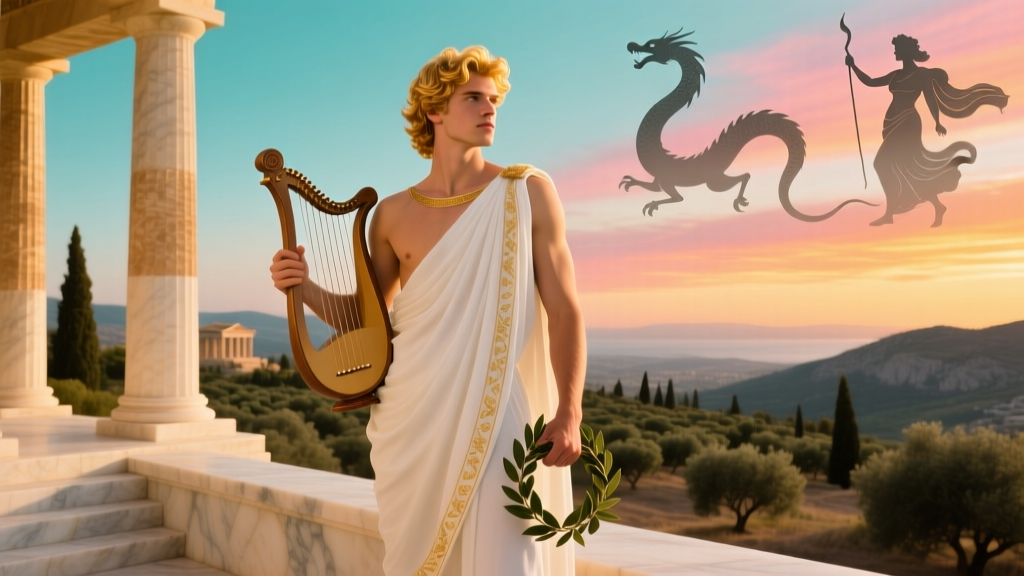
Apollo stands as one of the most complex and widely venerated deities in the Olympian pantheon. When readers search for a foundational greek myth about apollo, they often encounter fragmented stories or later Roman conflations. This guide synthesizes his lore, breaking down his origins, domains, and most significant legends into an accessible framework for mythology beginners.
Unlike modern pop-culture depictions that reduce him to a mere sun god, the classical Apollo governed a vast array of civic, spiritual, and artistic domains. Understanding his dual nature—the bringer of both healing and plague, the patron of reason and distant death—is crucial for grasping the ancient Hellenic worldview. According to primary texts preserved in the Perseus Digital Library, Apollo's influence permeated every level of Greek society, from the political decrees of city-states to the personal devotion of rural farmers.
The Birth on Delos: A Masterclass in Divine Politics
The origin story of Apollo is rooted in divine jealousy and survival. His mother, the Titaness Leto, conceived twins with Zeus. Enraged, Hera forbade Leto from giving birth on any land connected to the earth. Leto wandered the Mediterranean until she found the barren, floating island of Asteria (later renamed Delos). Because Delos was not tethered to the earth's roots, it bypassed Hera's curse.
Leto first gave birth to Artemis, who immediately acted as a midwife to help deliver her twin brother, Apollo. Born on the seventh day of the month Thargelion, Apollo was fed nectar and ambrosia by the goddess Themis, instantly maturing into a powerful deity. He immediately demanded a lyre and a bow, establishing his primary domains of music and archery within hours of his birth.
Mapping the God of Many Names: Domains and Epithets
Beginners often struggle with Apollo's vast portfolio. The Greeks used specific epithets (descriptive titles) to invoke different aspects of his power. The Theoi Project catalogs dozens of these titles, but four are essential for understanding his societal role.
| Epithet | Domain | Function in Antiquity |
|---|---|---|
| Phoebus | Light / Purity | Represented spiritual and physical cleanliness; invoked in purification rituals and civic oaths. |
| Loxias | Prophecy | The 'Oblique' One; referenced his cryptic, multi-layered oracles delivered via the Pythia at Delphi. |
| Mousagetes | Arts / Music | Leader of the Muses; patron of civic harmony, poetry, and choral singing at public festivals. |
| Alexikakos | Healing | The 'Averter of Evil'; worshipped specifically to ward off plagues, miasma, and sudden diseases. |
Note that Apollo was not originally the sun god; that was the domain of the Titan Helios. The conflation of Apollo and Helios into a singular 'sun god' occurred much later, primarily during the Hellenistic and Roman periods.
Analyzing a Classic Greek Myth About Apollo
To understand Apollo's temperament, one must examine his interactions with mortals and lesser deities. His myths consistently enforce the boundaries between divine authority and mortal limitations.
The Slaying of Python and the Miasma of Delphi
Just four days after his birth, Apollo traveled to Pytho (later Delphi) to establish his oracle. The site was guarded by Python, a massive serpentine dragon born from the mud of the great flood. Python had previously harassed Leto on Hera's orders. Apollo slew the beast with his silver arrows, claiming the sacred chasm for his prophetic shrine.
However, killing a child of Gaia (Earth) incurred miasma—a severe ritual pollution. To cleanse himself, Apollo was forced to serve King Admetus as a mortal shepherd for eight years and institute the Pythian Games in honor of the fallen serpent. This myth established a core tenet of Greek religion: even the gods are subject to the cosmic laws of purification and blood guilt.
Apollo and Daphne: The Mechanics of Divine Pursuit
Detailed in Ovid's Metamorphoses, this myth highlights the dangers of divine arrogance. After Apollo mocked Eros (Cupid) for playing with a warrior's weapon (the bow), Eros exacted revenge. He shot Apollo with a gold-tipped arrow, inducing obsessive love, and shot the naiad Daphne with a lead-tipped arrow, inducing absolute repulsion.
Apollo pursued Daphne relentlessly. Exhausted and cornered, Daphne prayed to her father, the river god Peneus, to destroy her beauty. She was instantly transformed into a laurel tree (daphne in Greek). Heartbroken, Apollo declared the laurel his sacred plant. He wove its leaves into a wreath, which subsequently became the ultimate symbol of victory, poetic achievement, and imperial power in the Greco-Roman world.
The Flaying of Marsyas: Hubris and the Aulos
This brutal legend serves as a stark warning against hubris (mortal arrogance). The satyr Marsyas found an aulos (a double-reed flute) discarded by Athena and mastered it. Drunk on his own skill, Marsyas challenged Apollo to a musical contest. The Muses judged the event, which ended in a tie until Apollo challenged Marsyas to play his instrument upside down while singing. Marsyas could not do this with a flute, and Apollo won.
As punishment for his hubris, Apollo flayed Marsyas alive. While jarring to modern sensibilities, this myth reinforced the ancient Greek hierarchy of music: the lyre (stringed, rational, Apollonian) was superior to the aulos (wind, emotional, Dionysian). It also reiterated that mortals must never presume equality with the divine.
The Apollonian Ideal in Art and Philosophy
Apollo's cultural footprint extends far beyond ancient religion. In the 19th century, philosopher Friedrich Nietzsche utilized Apollo to frame his aesthetic theory in The Birth of Tragedy. Nietzsche contrasted the 'Apollonian' (order, reason, sculpture, individuation, and logic) with the 'Dionysian' (chaos, intoxication, music, and the dissolution of boundaries). According to Nietzsche, the greatest achievements of Greek culture, particularly Attic tragedy, arose from the synthesis of these two opposing forces.
This philosophical framework remains highly actionable for students of literature and art today. When analyzing classical architecture, neoclassical literature, or even modern cinematic narratives, identifying the tension between Apollonian structure and Dionysian chaos provides a reliable lens for critical analysis.
Practical Guide: Identifying Apollo in Classical Antiquities
When visiting institutions like the British Museum or the Louvre, beginners can reliably identify Apollo by looking for specific iconographic markers. Use this checklist when examining classical statues, frescoes, or pottery:
- The Kouros Form: Look for a statuesque, athletic, beardless youth. Unlike Zeus or Poseidon, who are depicted as mature, bearded patriarchs, Apollo represents eternal youth (ephebeia) and physical perfection.
- The Laurel Wreath: A crown of bay leaves resting on his head, signifying victory, poetic inspiration, and his connection to Daphne.
- The Lyre or Kithara: A stringed instrument held in his hands or resting at his side, denoting his role as Mousagetes.
- The Bow and Quiver: A silver bow slung over his shoulder, representing his capacity to deliver distant, painless death (often via plague).
- Animal Companions: Look for a raven, a wolf, a dolphin, or a python coiled at the base of a statue. The raven specifically links to his mythological role as a messenger of prophetic truths.
By recognizing these visual cues, you can decode the specific narrative or civic function the artwork was meant to convey, transforming a simple museum visit into an exercise in classical literacy.