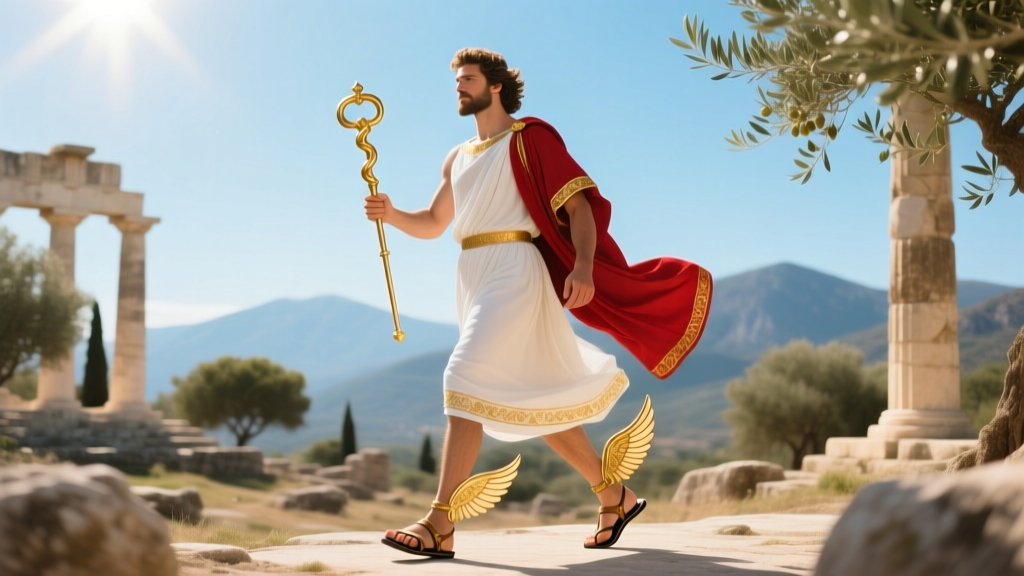
When studying ancient pantheons, the Greek mythology Hermes god stands out as the most dynamic and multifaceted Olympian deity. Unlike gods confined to a single domain like war or harvest, Hermes operates across boundaries. He is the messenger of the gods, the patron of thieves, the guide of souls, and the protector of travelers. For beginners exploring ancient Hellenic religion, understanding this deity requires looking past the modern image of a simple delivery mascot and examining his complex role as the ultimate liminal figure—a being who exists on the thresholds between worlds.
Understanding the Greek Mythology Hermes God
Hermes was born in a secluded cave on Mount Cyllene in Arcadia. His mother was Maia, one of the Pleiades (the seven daughters of the Titan Atlas), and his father was Zeus, the king of the Olympian gods. According to the Homeric Hymn to Hermes, the infant god exhibited extraordinary precocity. Mere hours after his birth, he slipped out of his cradle, invented the lyre from a tortoise shell, and embarked on a legendary cattle raid. This rapid maturation symbolizes his domain over intellect, cunning, and the swift transition from innocence to experience.
As the herald of Zeus, Hermes was the only Olympian with the unrestricted authority to travel between Mount Olympus (the divine realm), the mortal earth, and the Underworld (Hades). This unique mobility made him the divine mediator, translating the will of the gods into human language and guiding the deceased into the afterlife.
Core Domains and Ancient Epithets
The ancient Greeks rarely referred to their deities by a single name, relying instead on epithets that highlighted specific functions or localized worship. Hermes possessed more epithets than almost any other god, reflecting his vast portfolio of responsibilities.
- Hermes Psychopompos (Guide of Souls): Perhaps his most sacred duty. Hermes escorted the shades of the newly deceased to the banks of the River Acheron, ensuring they safely crossed the threshold into the Underworld.
- Hermes Argeiphontes (Slayer of Argus): A title commemorating his loyalty to Zeus when he defeated the hundred-eyed giant Argus Panoptes to free the mortal Io.
- Hermes Empolaios (God of Commerce): Invoked by merchants, traders, and hucksters. He governed the concept of profit, market exchange, and the cunning required in business negotiations.
- Hermes Hodios (Patron of Travelers): Ancient Greeks erected stone pillars called "herms" at crossroads and property boundaries to invoke his protection during journeys.
- Hermes Strophaios (God of Thieves): Recognized as the patron of burglars and tricksters, honoring his own first act of stealing Apollo's sacred cattle.
Iconography and Sacred Symbols
Visual representations of Hermes evolved over the centuries. In Archaic Greek art, he was depicted as a mature, bearded man wearing a traveler's cloak. By the Classical and Hellenistic periods, he was reimagined as a youthful, athletic, and beardless figure. His iconography is rich with specific tools and garments that signify his domains.
| Symbol | Greek Name | Meaning & Function |
|---|---|---|
| Winged Staff | Kerykeion (Caduceus) | Represents commerce, negotiation, and the ability to cross borders safely. It features two intertwined serpents and is frequently, though incorrectly, used as a modern medical symbol. |
| Winged Sandals | Talaria | Grants the speed of the wind, allowing instantaneous travel between Mount Olympus, Earth, and the Underworld. They symbolize his role as the divine messenger. |
| Traveler's Hat | Petasos | A broad-brimmed hat, often adorned with small wings. It symbolizes protection from the elements during long journeys and his status as a patron of wayfarers. |
| Tortoise Shell Lyre | Chelys | Invented by Hermes on his first day of life. Represents diplomacy, music, and the bridging of divine and mortal realms through art and negotiation. |
Defining Myths from the Homeric Hymns
To truly grasp the character of Hermes, one must examine the foundational myths that established his relationships with the other Olympians. According to Theoi Project, a comprehensive database of classical mythology, these narratives highlight his cunning, charm, and diplomatic brilliance.
The Theft of Apollo's Cattle
On the very day he was born, Hermes grew bored in his cradle and wandered out of his mother's cave. He encountered a tortoise, hollowed out its shell, and stretched cow-gut strings across it, creating the first lyre. Later that night, he stole fifty of his half-brother Apollo's sacred cattle. To cover his tracks, the infant god made the cattle walk backward and wrapped their hooves in woven twigs. When confronted by an enraged Apollo, Hermes played the innocent infant, hiding his face in swaddling clothes. Zeus found the deception amusing rather than punishable. To appease Apollo, Hermes offered him the lyre. Enchanted by the music, Apollo traded the stolen cattle back to Hermes and gifted him the caduceus, cementing Hermes as the god of trade and barter.
The Slaying of Argus Panoptes
When Zeus transformed his mortal lover Io into a white heifer to hide her from his wife Hera, the jealous goddess assigned Argus Panoptes—a giant with a hundred eyes across his body—to guard the cow. Because Argus could close some eyes while keeping others open, he never truly slept. Zeus tasked Hermes with freeing Io. Relying on intellect rather than brute force, Hermes disguised himself as a mortal shepherd. He sat beside Argus and played soothing melodies on his pan flute while telling long, monotonous stories. Eventually, all one hundred eyes succumbed to sleep, allowing Hermes to strike the giant down with a stone. This myth underscores his mastery over hypnosis, persuasion, and psychological manipulation.
The Hermes Archetype in Modern Spirituality
In modern esoteric practices and Jungian psychology, the Greek mythology Hermes god serves as a powerful archetype. Carl Jung identified Hermes as the ultimate Trickster and the Psychopomp. The Trickster archetype disrupts rigid structures, exposes hypocrisy, and forces necessary change through chaos and humor. The Psychopomp guides the conscious ego through the terrifying landscapes of the unconscious mind during shadow work or deep meditation.
For spiritual practitioners, working with the Hermes archetype is highly actionable when navigating life transitions. If you are starting a new career, moving to a new city, or attempting to break through creative blocks, invoking Hermetic energy involves embracing adaptability. Practical applications include:
- Liminal Rituals: Perform meditations or set intentions specifically at thresholds—doorways, bridges, or during twilight (the threshold between day and night).
- Shadow Work Journaling: Use the Trickster archetype to identify where you are lying to yourself. Ask: "Where is my cunning being used to avoid necessary growth?"
- Communication Magic: Write petitions regarding legal matters, public speaking, or negotiations on a Wednesday (the day of Mercury, his Roman equivalent) using yellow or orange ink to align with his mercurial frequency.
As noted by Encyclopedia Britannica, the syncretism of Hermes with the Egyptian god Thoth created Hermes Trismegistus, the foundational figure of Hermeticism. This later esoteric tradition heavily influenced Renaissance alchemy and modern occultism, proving that his domain over hidden knowledge extends far beyond ancient Greek borders.
Quick Reference Profile
Use this structured cheat sheet to quickly recall the core associations of Hermes for study, trivia, or spiritual correspondence.
- Roman Equivalent: Mercury
- Planetary Ruler: Mercury (governing intellect, communication, and short-distance travel)
- Day of the Week: Wednesday (Mercredi in French, Miércoles in Spanish, both derived from Mercury)
- Sacred Animals: Tortoise, hare, rooster, hawk
- Sacred Plants: Olive tree, strawberry tree, crocus
- Elemental Association: Air (representing intellect, speed, and the breath of communication)
- Primary Chakra Correspondence: Throat Chakra (Vishuddha) due to his governance over speech, language, and truth-telling.