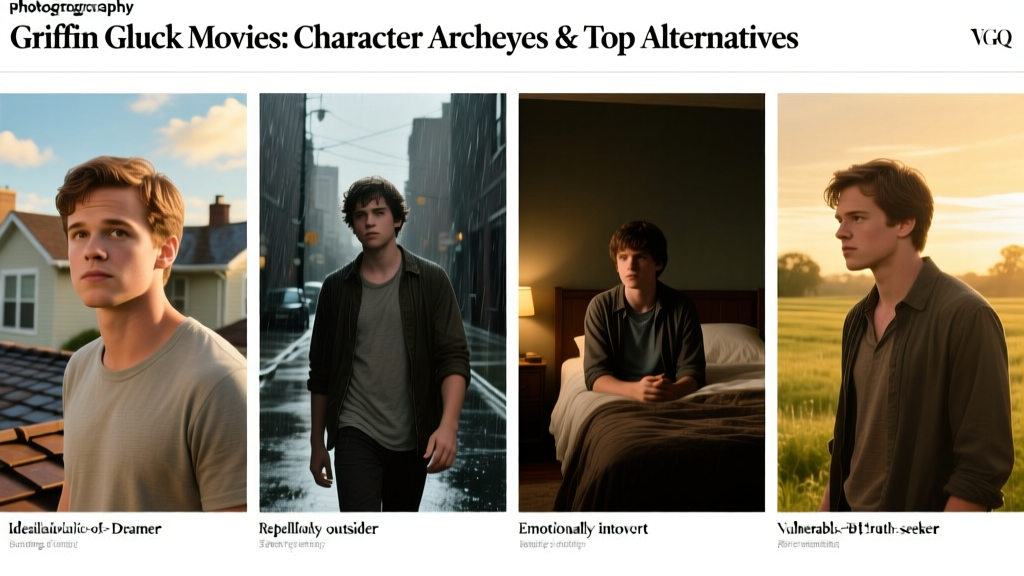
Evaluating the cinematic trajectory of young actors requires moving beyond surface-level genre classifications to examine the psychological frameworks of their characters. When analyzing griffin gluck movies, audiences and critics alike are drawn to the specific coming-of-age archetypes he consistently embodies. From the socially anxious outcast navigating high school hierarchies to the time-looping existentialist confronting mortality, his roles offer a distinct lens into adolescent psychological development. This comparison and alternatives analysis breaks down the Jungian archetypes, Myers-Briggs personality alignments, and thematic resonance of his primary filmography, providing curated alternative films for viewers seeking identical psychological depth and narrative structures. By mapping the individuation process of these characters, we can identify precise cinematic substitutes that mirror these exact emotional frequencies.
The Puer Aeternus and Existential Stagnation
In The Map of Tiny Perfect Things, Gluck portrays Mark, a teenager trapped in a temporal loop. From a mythological and psychological perspective, Mark is the quintessential Puer Aeternus—the eternal youth who resists the transition into the responsibilities of the Senex (adult) world. The time loop is not merely a sci-fi gimmick; it is a manifestation of psychological stagnation and a defense mechanism against grief, specifically regarding his mother’s hidden illness. Mark’s journey requires Shadow integration—acknowledging the painful realities he has been avoiding. Viewers who resonate with Mark’s INFP (Introverted, Intuitive, Feeling, Perceiving) personality type and his Enneagram 4w5 ('The Bohemian') tendencies are drawn to narratives where internal emotional landscapes dictate external reality. The film leverages the mythological concept of Chronos (linear, destructive time) versus Kairos (the opportune, meaningful moment), forcing the protagonist to shift from passive observation to active participation in his own life.
The Trickster Archetype and Institutional Rebellion
Transitioning from existential indie drama to institutional comedy, Middle School: The Worst Years of My Life casts Gluck as Rafe Khatchadorian. Rafe operates firmly within the Trickster archetype. In Jungian psychology, the Trickster disrupts rigid systems and exposes the hypocrisy of authority figures through chaos, humor, and rule-breaking. Rafe’s creation of a clandestine rulebook to dismantle the oppressive structure of his middle school mirrors the mythological exploits of Hermes or Loki, albeit on a suburban scale. His MBTI alignment leans heavily toward ENTP (Extraverted, Intuitive, Thinking, Perceiving), characterized by a disdain for arbitrary rules and a high capacity for divergent thinking. The core psychological conflict here is the tension between individual authenticity and systemic conformity. Rafe’s ultimate growth requires him to realize that the Trickster’s destruction must eventually pave the way for the Creator’s reconstruction, moving from mere rebellion to purposeful self-expression.
The Lover, Social Hierarchies, and Anima Projection
In the Netflix feature Tall Girl, Gluck plays Jack Dunkleman, a character who initially appears as the comedic relief but functions narratively as the Lover archetype. Jack’s persistent, unwavering support for the protagonist, Jodi, represents a healthy integration of the Anima—the feminine inner personality in the male psyche, focusing on empathy, connection, and emotional validation. Unlike the toxic manifestations of the Lover archetype that result in codependency, Jack maintains his own boundaries and pursuits (his theater ambitions) while offering a secure attachment base for Jodi. His personality profile aligns with the ESFJ (Extraverted, Sensing, Feeling, Judging) or ENFJ (Extraverted, Intuitive, Feeling, Judging) types, prioritizing social harmony and the emotional well-being of his peer group. The film explores the sociology of adolescent hierarchies, positioning Jack as the emotional anchor who subverts the traditional 'alpha male' high school trope in favor of emotional intelligence and vulnerability.
Archetype and Personality Comparison Matrix
| Film Title | Character | Jungian Archetype | MBTI Alignment | Core Psychological Conflict |
|---|---|---|---|---|
| The Map of Tiny Perfect Things | Mark | Puer Aeternus / Innocent | INFP | Overcoming grief and temporal stagnation |
| Middle School: The Worst Years | Rafe Khatchadorian | Trickster / Creator | ENTP | Individual authenticity vs. systemic conformity |
| Tall Girl | Jack Dunkleman | Lover / Everyman | ENFJ | Subverting social hierarchies via emotional intelligence |
| The Starling Girl | Paul | Explorer / Rebel | ISFP | Navigating dogma and personal freedom |
Targeted Alternatives Based on Psychological Profiles
For viewers seeking the specific emotional and psychological frequencies found in these performances, the following alternatives offer parallel character studies and thematic explorations.
Alternatives for the INFP Dreamer (The Map of Tiny Perfect Things)
- The Fundamentals of Caring (2016): Explores the ENFP-INFP dynamic through a road trip narrative that forces the protagonists to confront physical and emotional limitations. It mirrors the existential roadblocks seen in Mark’s time loop, replacing temporal stagnation with physical immobility as the metaphor for grief.
- Paper Towns (2015): Dives deep into the concept of projection and the Idealized Anima. The protagonist’s obsessive search for a manic pixie dream girl deconstructs the very mythological ideals that Mark initially projects onto Margaret before learning to see her as a flawed, autonomous individual.
Alternatives for the ENTP Rebel (Middle School)
- Eighth Grade (2018): While the protagonist (Elsie Fisher) aligns more with an INTP or ISFJ profile, the film’s unflinching look at the anxiety of institutional social structures provides a grounded, realistic counterweight to Rafe’s fantastical Trickster rebellion. It is a masterclass in the shadow-work required to survive early adolescence.
- Captain Fantastic (2016): Features a systemic rebellion against societal norms, though from the perspective of the patriarch. It explores the ENTP/ENTJ drive to build an alternative utopian structure, only to realize that complete isolation from the collective shadow is psychologically damaging.
Alternatives for the ENFJ Supporter (Tall Girl)
- The Half of It (2020): A sophisticated deconstruction of the Cyrano de Bergerac myth. It examines the Lover archetype through the lens of unrequited love, intellectual intimacy, and the painful but necessary process of letting go of the Anima projection to achieve true self-actualization.
- Edge of Seventeen (2016): Offers a darker, more cynical exploration of the high school social hierarchy. The mentor figure (Woody Harrelson) provides the grounded, boundary-setting energy that Jack attempts to offer Jodi, but within a narrative that heavily features Enneagram Type 4 ('The Individualist') angst and shadow integration.
Thematic Substitutes: Beyond the Teen Rom-Com
When analyzing the broader scope of coming-of-age cinema, the specific narrative devices utilized in Gluck’s filmography serve as modern mythological frameworks. The time loop in The Map of Tiny Perfect Things is a direct descendant of the Sisyphean myth and the Buddhist concept of Samsara—the cycle of aimless drifting and suffering that can only be broken through profound spiritual awakening and the acceptance of impermanence (Anicca).
Similarly, the institutional rebellion seen in his earlier work parallels the Promethean theft of fire; the protagonist steals agency from the gods (school administrators) to empower the mortals (the student body), inevitably facing punishment but ultimately catalyzing a shift in collective consciousness. Audiences who appreciate these underlying mythological structures will find immense value in indie cinema that treats adolescent struggles not as mere melodrama, but as vital rites of passage. Films like The Edge of Seventeen, Lady Bird, and Call Me By Your Name operate on this exact frequency, elevating the teenage experience into a profound exploration of the human condition, ego death, and the eventual integration of the fractured self.