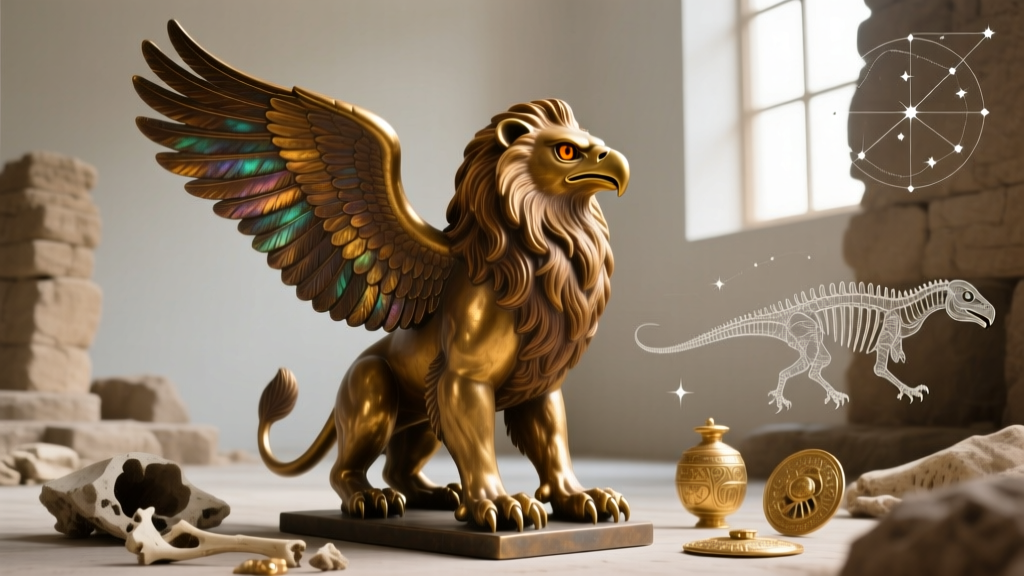
The Anatomical Blueprint of the Griffin
The griffin—a composite chimera possessing the hindquarters, tail, and hind legs of a lion, paired with the head, forelegs, and wings of an eagle—dominates ancient mythology and modern institutional heraldry. Far from being a mere fantasy trope, the griffin serves as a verifiable cultural artifact. By examining the griffin through real-world case studies, ranging from paleontological misidentifications to medieval Islamic metallurgy, we uncover how ancient civilizations processed their natural environments into enduring symbolic frameworks. This analysis moves beyond basic mythological summaries to evaluate the physical, architectural, and institutional footprints the creature has left on human history.
The Paleontological Case Study: Fossils That Birthed the Myth
One of the most compelling real-world explanations for the griffin’s origin lies in the field of paleontology and ancient trade routes. Classical folklorist Adrienne Mayor, in her seminal work The First Fossil Hunters, presents a robust case study linking the griffin myth to the discovery of dinosaur fossils in Central Asia.
The Protoceratops Connection
Scythian nomads and ancient Greek gold miners traversing the Altai Mountains and the Gobi Desert frequently encountered exposed fossils of Protoceratops andrewsi and Psittacosaurus. These dinosaurs possessed distinct anatomical features that map directly onto the griffin’s morphology:
- The Beak: Protoceratops had a pronounced, parrot-like rostral bone that fossilized into a sharp, hooked beak.
- The Wings and Frill: The massive bony neck frill of the Protoceratops, when broken or weathered, resembles the shoulder blades and wings of a large bird.
- The Claws and Posture: Fossilized remains often protruded from red sandstone cliffs, featuring prominent claws and a quadrupedal stance that aligned with the lion-like hindquarters described by the Greek physician Ctesias in the 4th century BCE.
This case study demonstrates that the griffin was not merely an invention of imagination, but an early, pre-scientific attempt to reconstruct megafauna based on observable, real-world fossil evidence. The myth functioned as an ancient warning system, guarding the rich gold deposits of the Scythian steppes from rival miners.
Architectural Case Study: The Pisa Griffin and Apotropaic Magic
In the realm of physical artifacts, the Pisa Griffin stands as the most significant surviving case study of the creature in three-dimensional form. Cast in the 11th century, this massive bronze statue measures over 42 inches in height and is the largest bronze animal sculpture from the medieval Islamic world.
Metallurgy and Acoustic Engineering
Currently housed in the Museo dell'Opera del Duomo, the griffin was originally placed atop the Pisa Cathedral in Italy after being seized as war booty during the Pisan-Moorish conflicts. However, its functional design reveals a sophisticated understanding of acoustic engineering. The statue is hollow, featuring an opening in its beak and a complex internal chamber. Metallurgical analyses suggest it was originally designed in Islamic Spain or Egypt to function as an acoustic resonator or wind instrument. When wind passed through the structure, or when it was fitted with a bellows system, the griffin would emit a low, resonant roar.
This dual function—serving as both a visual apotropaic (evil-warding) guardian and an auditory intimidation device—highlights how medieval engineers utilized the griffin's mythological attributes to project temporal and spiritual power over civic spaces.
Institutional Heraldry: Modern Case Studies in Brand Identity
While dragons and lions saturate modern corporate branding, the griffin occupies a highly specific niche in institutional heraldry. According to Encyclopedia Britannica, the griffin represents the mastery of both earth (lion) and sky (eagle), symbolizing unparalleled vigilance and authority. Modern institutions leverage this duality for specific psychological branding.
| Institution / Brand | Heraldic Posture | Symbolic Function | Real-World Application |
|---|---|---|---|
| University of Pennsylvania | Segreant (Rampant) | Guardianship of Knowledge | Cast iron statues on College Hall, representing the fusion of classical intellect and grounded research. |
| Vauxhall Motors | Segreant | Speed and Noble Heritage | Adapted from the 13th-century flag of Sir Falkes de Breauté, projecting automotive agility and aristocratic engineering. |
| The Griffin Hospital | Passant (Walking) | Vigilance and Healing | Utilized in healthcare branding to symbolize tireless watchfulness over patient well-being and protection against disease. |
| City of London (Ward Markers) | Statant (Standing) | Financial Guardianship | Often confused with dragons, the griffin statues mark the boundaries of the financial district, symbolizing the hoarding and protection of wealth. |
The Scythian Pazyryk Case Study: Tattoos and Gold Plaques
To understand the griffin’s role in ancient esoteric and spiritual practices, we must examine the Pazyryk burials in the Siberian permafrost. The mummified remains of Scythian chieftains, dating back to the 5th century BCE, feature elaborate, preserved tattoos of griffins in combat with herbivores.
Spiritual and Shamanic Utility
In the Pazyryk context, the griffin was not merely decorative; it was a psychopomp—a spiritual guide designed to transport the soul of the deceased through the treacherous altitudes of the afterlife. The tattoos were placed strategically on the shoulders and chest, acting as spiritual armor. Furthermore, the gold belt plaques found in these tombs depict griffins tearing apart horses and stags. This violent imagery served a specific sympathetic magic function: by wearing the image of the ultimate apex predator, the chieftain absorbed the creature's martial invincibility and secured divine protection over the tribe's livestock and territorial borders.
Actionable Framework: Integrating Griffin Symbolism Today
For modern practitioners of esoteric arts, personality psychology, and symbolic design, the griffin offers a highly structured framework for personal and organizational development. Applying the griffin’s mythological attributes requires moving beyond superficial aesthetics and adopting its core dualities.
- Cognitive Duality (The Eagle's Vision): Apply the eagle’s macro-perspective to strategic planning. In decision-making frameworks, this translates to prioritizing long-term forecasting, aerial data analysis, and objective detachment from immediate emotional variables.
- Grounded Execution (The Lion's Strength): Counterbalance aerial strategy with the lion’s terrestrial dominance. This requires executing plans with territorial authority, resource hoarding (capital preservation), and physical endurance.
- Boundary Enforcement: Just as the Scythians and the Pisans used the griffin to enforce physical and spiritual boundaries, modern applications involve establishing strict psychological and operational perimeters. In organizational psychology, this means creating uncompromising quality-control gates and protecting proprietary intellectual property with aggressive vigilance.
By analyzing the griffin through these historical, paleontological, and institutional case studies, the creature transcends its status as a mythological chimera. It emerges as a sophisticated, real-world tool used by humanity to process natural anomalies, project institutional authority, and enforce the boundaries of both physical wealth and spiritual realms.