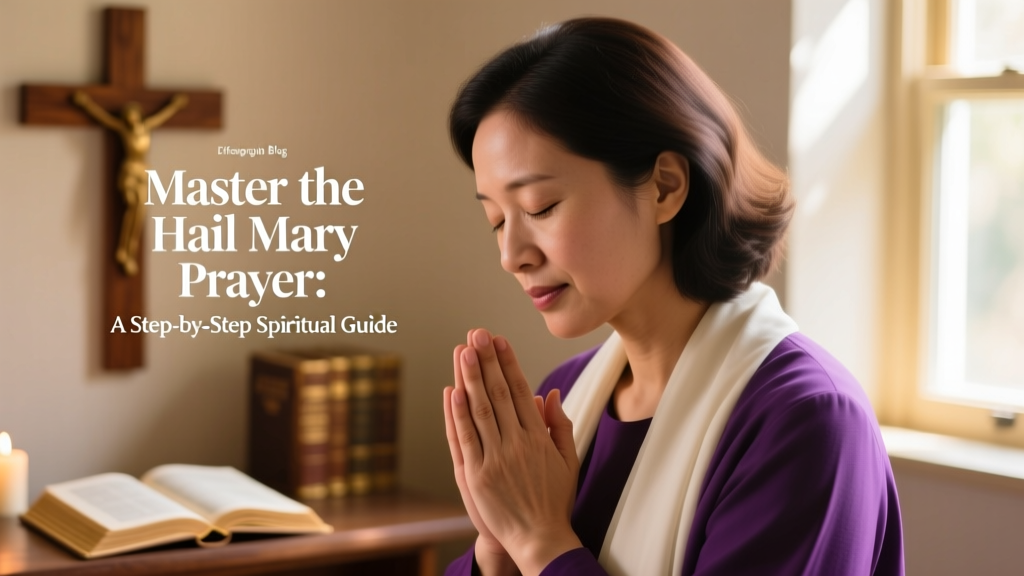
The hail mary prayer (traditionally known as the Ave Maria) is one of the most widely recognized spiritual invocations in Western esoteric and Christian traditions. Far from being a mere rote recitation, it functions as a structured meditative tool designed to align the practitioner’s mind, body, and spirit. For those studying spiritual technologies, repetitive prayers act as mantras, engaging the parasympathetic nervous system and inducing states of deep contemplative focus. This guide provides a rigorous, step-by-step methodology for reciting the prayer, breaking down its theological anatomy, historical development, and practical application in daily spiritual routines.
The Theological Anatomy of the Hail Mary Prayer
To recite this invocation with genuine intent, one must understand its tripartite structure. The prayer is not a single monolithic text but a composite of biblical scripture and later ecclesiastical petition. According to the New Advent Catholic Encyclopedia, the prayer evolved over centuries, combining the Angelic Salutation with the Church’s later intercessory requests.
1. The Angelic Salutation (Biblical)
The first segment originates directly from the Gospel of Luke (1:28), where the Archangel Gabriel greets Mary. In the original Greek text, Gabriel uses the phrase chaire kecharitomene. The word kecharitomene is a perfect passive participle of charis (grace), indicating a permanent, completed state of being filled with divine grace. Understanding this linguistic nuance transforms the opening words from a simple greeting into a profound acknowledgment of spiritual perfection.
2. The Visitation (Biblical)
The second segment is drawn from Luke 1:42, spoken by Elizabeth during the Visitation: "Blessed art thou among women, and blessed is the fruit of thy womb, Jesus." This section grounds the ethereal nature of the angelic greeting in physical, historical reality, acknowledging the incarnation of the divine.
3. The Petition (Ecclesiastical)
The final segment ("Holy Mary, Mother of God, pray for us sinners, now and at the hour of our death") was not present in the early medieval versions of the prayer. It was gradually formulated in the 15th century and officially standardized by Pope Pius V in the Roman Breviary of 1568. This section shifts the prayer from pure adoration to active intercession, requesting spiritual protection in the present moment and at the critical threshold of mortality.
Step-by-Step Guide to Reciting the Hail Mary Prayer
Approaching this prayer as a meditative discipline requires deliberate pacing, breath control, and cognitive focus. Follow these steps to establish a grounded recitation practice.
Step 1: Somatic Preparation and Grounding
Before speaking, regulate your nervous system. Sit with your spine erect to allow for unrestricted diaphragmatic breathing. Close your eyes and take three slow breaths, inhaling for a count of four, holding for two, and exhaling for six. This signals the vagus nerve to shift your body out of sympathetic (fight-or-flight) dominance and into a receptive, parasympathetic state.
Step 2: The Salutation (Inhale and Project)
Speak the first half slowly: "Hail Mary, full of grace, the Lord is with thee." As you say "full of grace," visualize a descending column of light or spiritual energy. Align your internal intention with the concept of kecharitomene—opening yourself to be a vessel for divine favor.
Step 3: The Visitation (Center and Acknowledge)
Continue with: "Blessed art thou among women, and blessed is the fruit of thy womb, Jesus." On the name of Jesus, pause for one full second. In contemplative traditions, the holy name acts as an anchor. Use this micro-pause to center your wandering mind, bringing your awareness back to the present moment.
Step 4: The Petition (Exhale and Release)
Conclude with: "Holy Mary, Mother of God, pray for us sinners, now and at the hour of our death. Amen." As you say "now," focus on your immediate earthly anxieties and release them. As you say "at the hour of our death," confront the reality of impermanence (memento mori), surrendering the ultimate outcome of your life to divine providence.
Comparative Analysis of Repetitive Spiritual Technologies
To understand where the hail mary prayer fits within the broader spectrum of global spiritual practices, it is helpful to compare it with other repetitive contemplative techniques. Neurotheological studies, such as those conducted by Dr. Andrew Newberg, demonstrate that all rhythmic, repetitive prayers decrease activity in the parietal lobes, fostering a psychological sense of unity and transcendence.
| Practice | Tradition | Primary Mechanism | Spiritual Objective |
|---|---|---|---|
| Hail Mary (Rosary) | Catholic Christianity | Vocalized rhythmic meditation combined with tactile counting (beads). | Intercession, Marian contemplation, and grounding the mind in the mysteries of Christ. |
| The Jesus Prayer | Eastern Orthodox | Continuous internal repetition synchronized with the heartbeat and breath. | Hesychasm (inner stillness) and the unceasing remembrance of God. |
| Om Mani Padme Hum | Tibetan Buddhism | Chanting or spinning prayer wheels to generate vibrational focus. | Cultivation of universal compassion and purification of negative karmic imprints. |
| Transcendental Mantra | Vedic/Hindu | Silent, effortless repetition of a personalized Sanskrit sound. | Transcending thought to access the baseline state of pure consciousness. |
Integrating the Prayer into Daily Rituals
While a single recitation offers a moment of centering, the true esoteric power of the hail mary prayer is unlocked through structured repetition, most notably via the Rosary. The United States Conference of Catholic Bishops (USCCB) outlines the Rosary as a profound scriptural meditation tool, utilizing the Hail Mary as a rhythmic backdrop to contemplate specific biblical events (the Mysteries).
- Morning Anchoring: Recite three Hail Marys immediately upon waking. This establishes a protective spiritual boundary before engaging with the demands of the day.
- Transitional Pacing: Use the prayer as a transitional tool between work and rest. Reciting it while commuting or walking helps metabolize the stress of the workday, utilizing the rhythmic syllables to lower cortisol levels.
- The Angelus Tradition: Historically, practitioners recited three Hail Marys at 6:00 AM, 12:00 PM, and 6:00 PM. Adopting this framework punctuates the day with deliberate pauses for spiritual realignment.
Common Mistakes to Avoid During Recitation
Even experienced practitioners can fall into habits that dilute the efficacy of the prayer. Avoid these common pitfalls to maintain the integrity of your practice:
- Velocity Over Intent: The most frequent error is rushing. Reciting the prayer in under ten seconds reduces it to a meaningless phonetic exercise. Aim for a pace of 20 to 25 seconds per recitation, allowing the meaning of the words to register in your conscious mind.
- Ignoring the Biblical Roots: Treating the prayer merely as a magical incantation strips it of its historical and scriptural weight. Always remember that the first half is a direct quotation from the Gospel of Luke.
- Monotone Delivery: While the prayer is repetitive, it should not be emotionally flat. Inflect your voice slightly to reflect the joy of the Angelic Salutation and the solemnity of the final petition regarding mortality.
Establishing Your Contemplative Baseline
Mastering the hail mary prayer requires shifting your perspective from viewing it as an obligation to recognizing it as a sophisticated spiritual technology. By combining precise breathwork, an understanding of its Greek and historical origins, and a disciplined approach to pacing, you transform a simple vocalization into a profound mechanism for inner stillness. Begin with a single, meticulously paced recitation today, focusing entirely on the transition from the angelic greeting to the final petition, and observe the immediate shift in your cognitive and spiritual baseline.